
CELPIP Blog
CLB 9 explained: what it means for your job market chances
CLB 9 explained: what it means for your job market chances

A CLB 9 score means you can operate at an advanced professional level in English, and it puts you at the top of the language points scale for Express Entry. When all four abilities (listening, speaking, reading, writing) hit CLB 9, you’re eligible for maximum CRS language points, and depending on your education and work history, you can pick up as many as 50 extra skill-transferability points on top of that.
Here’s what that unlocks right away:
- Hireability for professional roles where reports, presentations, and client communication happen daily
- A stronger resume signal that tells employers you can handle nuance, not just basic instructions
- A meaningful CRS bump that can be the difference between an invitation to apply and another few months of waiting
If you don’t know exactly where you stand yet, the smartest first move is a proper diagnostic test, not a guess based on how confident you feel in conversation.
Key Takeaways
Reaching CLB 9 across all four language abilities maximizes CRS points and signals advanced, independent professional communication to employers.
| Point | Details |
|---|---|
| CLB 9 unlocks top CRS points | All four abilities at CLB 9 secures maximum language points, plus up to 50 more transferability points. |
| Balance beats a high average | CRS and employers both reward even proficiency across all four skills, not one strong skill masking a weak one. |
| Wage growth follows language gains | A one-point CLB improvement within two years is linked to stronger wage growth over five years. |
| Proof requires an official test | Convert scores using government mapping tables; attach the report directly to job applications. |
| Celpipguide targets your weak skill | Diagnostic testing and AI feedback on speaking and writing help close gaps faster than self-study alone. |
Where to verify these details
- IRCC’s CRS criteria for exact Express Entry point breakdowns
- Language for official CLB descriptors and benchmark details
- CLB 9 at a glance PDF for task-level examples
- Celpipguide’s score calculator to estimate your CRS points from a test score
Table of Contents
- What does CLB 9 mean for the job market, exactly?
- What does CLB 9 look like at work?
- How does CLB 9 affect employability and Express Entry?
- How do employers evaluate CLB 9 on a job application?
- Which tests map to CLB 9, and how do you prepare?
- How long does it take to reach CLB 9?
- Sources
- FAQ
What does CLB 9 mean for the job market, exactly?
CLB stands for Canadian Language Benchmarks, the national standard used to describe English ability in real, functional terms rather than academic grades. CLB 9 sits near the top of that scale, one step below the highest benchmark, and it’s the level most professional and semi-regulated jobs expect from candidates who need to communicate independently and persuasively.
The Centre for Canadian Language Benchmarks describes CLB 9 as the ability to handle complex professional tasks: reading policy manuals, pulling data out of several workplace charts at once, and presenting a proposal to colleagues without stumbling over structure or vocabulary. That’s a different animal than being “conversational.”
What does CLB 9 look like at work?
Numbers on a score report don’t mean much until you picture them in a meeting room or on a shift floor. Here’s what CLB 9 actually looks like, skill by skill.
Listening. You follow a manager explaining a restructuring plan, including the reasoning behind it, without needing it repeated. You catch tone shifts in a tense client call and adjust your response accordingly.
Speaking. You present a proposal to a room of people who don’t already agree with you, and you defend it when someone pushes back. You can explain a technical process to a non-technical colleague clearly.

Reading. You work through a benefits document or a compliance manual and extract exactly what applies to your situation. The CLB 9 descriptors specifically mention reading editorial pieces and identifying the writer’s attitude, which is a subtler skill than most test-takers expect.
Writing. You draft a formal report or a project proposal that a manager could send upward without heavy editing.
- Follow a manager’s explanation of company changes without asking for a repeat
- Read and interpret an employment benefits package accurately
- Summarize data pulled from multiple workplace charts
- Write a report clear enough to submit without a rewrite
Regulated professions (nursing, engineering, teaching) often set CLB 9 or higher as a floor precisely because miscommunication in those fields carries real consequences.
Pro Tip: If you’re not sure whether your current level clears CLB 9, don’t rely on how a conversation “feels.” Test yourself against the actual task types above, particularly the writing and speaking ones, since those are where most candidates overestimate themselves.
How does CLB 9 affect employability and Express Entry?
This is where CLB 9 stops being an abstract score and starts changing real outcomes. On the immigration side, IRCC’s CRS criteria award the maximum language points once all four abilities reach CLB 9 or higher, and that number compounds. Pair CLB 9 with a post-secondary credential or a year or more of skilled Canadian work experience, and you can add up to 50 more points through the skill-transferability factors, which is often the gap between sitting in the pool and getting an invitation.
By the numbers: Reaching CLB 9 across all four abilities can unlock the maximum CRS language points on its own, and stacking that with education or Canadian work experience adds up to 50 additional skill-transferability points. For some profiles, that swing is often what separates an invitation to apply from another draw cycle of waiting.
On the wage side, employment research tracking newcomers found that raising your CLB level by even one point within the first two years tends to correspond with higher wage growth over the following years. Language improvement isn’t a soft skill on a resume. It’s one of the few levers a job seeker can pull directly, without waiting on employer goodwill or market timing.
- Maximum CRS language points require all four skills at CLB 9, not just an average
- Skill-transferability points can add up to 50 more when combined with education or experience
- Wage growth research links even a single CLB point gain to better five-year earnings outcomes
Balance matters more than most candidates assume. Two people can average the same overall score, but the one with all four skills evenly at CLB 9 will out-score the one who’s strong in reading and weak in speaking, both for CRS purposes and in a hiring manager’s eyes.
How do employers evaluate CLB 9 on a job application?
Hiring managers rarely say “CLB 9” out loud, but they’re evaluating for it constantly. What they’re actually checking is whether you can walk into a client meeting, write an internal memo, or troubleshoot a problem over the phone without a translator in your head. Benchmarks give employers, and settlement and training programs, a shared language to describe that expectation instead of relying on vague terms like “fluent.”
To prove CLB 9 on paper, you generally need one of the following:
- An official test score that maps to CLB 9 on the government’s conversion tables
- Verifiable Canadian work or study experience in an English-heavy environment
- Concrete workplace examples in your resume (“led client presentations,” “authored quarterly reports”) that imply the skill level rather than just stating it
Pro Tip: Skip the resume line that says “fluent in English.” Replace it with a specific task, like “presented findings to cross-functional teams,” because that phrase does the CLB 9 signalling for you without sounding like a checkbox.
Attach your test score report to applications where language proficiency is explicitly part of the job posting, especially for regulated or client-facing roles. It removes any doubt before the interview even starts.
Which tests map to CLB 9, and how do you prepare?
You can’t submit a CLB number directly. You submit a test score, and that score gets converted using official government mapping tables. Here’s roughly where CLB 9 lands across the major English tests:
| Test | Approximate CLB 9 range | Notes |
|---|---|---|
| CELPIP General | Around 7 to 8 per skill | Scored on a scale designed specifically around CLB levels |
| IELTS General Training | High band scores per skill | Bands vary slightly by skill (listening vs. writing) |
| Other IRCC-approved tests | Varies by provider | Always confirm against the current official table |
Treat these as approximate. The official conversion table is the only source that matters for an actual application.
A workable prep sequence looks like this:
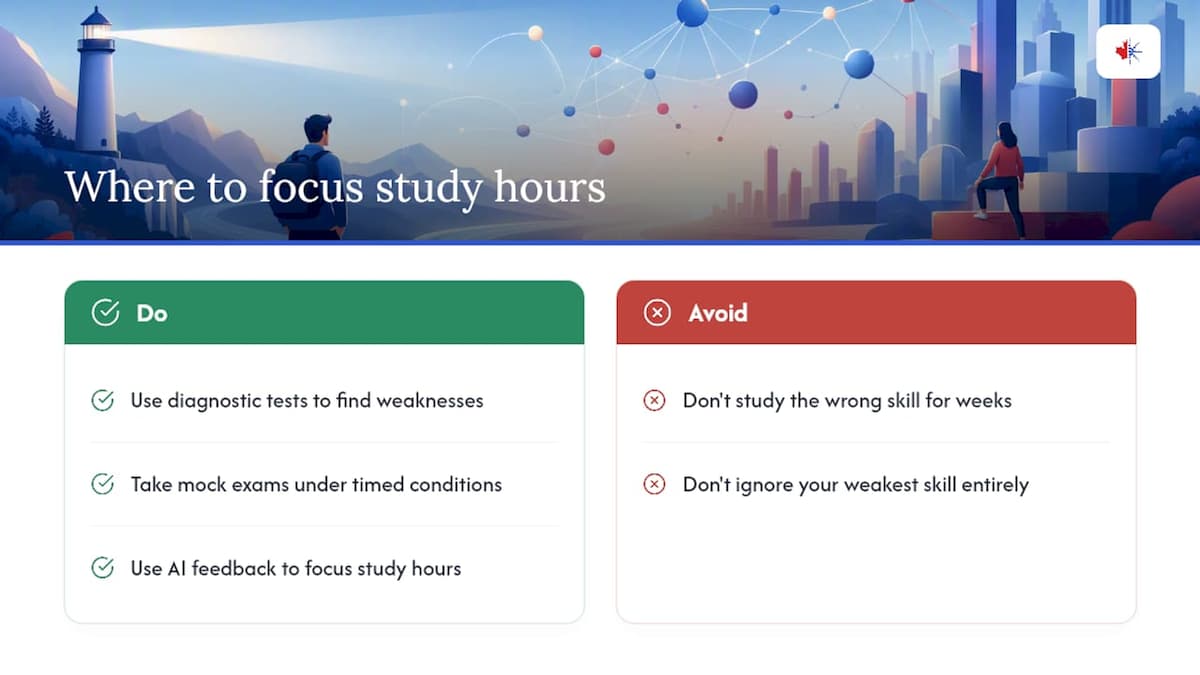
- Take a diagnostic test to find out which of the four skills is actually holding you back.
- Run full-length mock exams under timed conditions so test-day pressure isn’t a surprise.
- Target speaking and writing specifically, since these are graded on structure and precision, not just vocabulary, and they’re where most candidates plateau.
- Get feedback on every attempt, not just a score, because a number alone doesn’t tell you what to fix.
This is exactly the gap Celpipguide was built to close. Diagnostic testing, over 5,000 practice questions, and an AI-driven study plan mean you’re not guessing which skill needs the next hour of your time. Instant rubric feedback on speaking and writing tasks, the two areas where self-assessment is least reliable, is often what separates plateaued study from actual score movement.
How long does it take to reach CLB 9?
Timelines depend entirely on where you’re starting and how many hours a week you can commit.
- Fast-track: possible if you’re already close to CLB 9 (around CLB 7 to 8) and can study intensively.
- Steady pace: more typical if you’re starting lower or have time constraints.
Three steps, in order:
- Diagnose your current level honestly, skill by skill.
- Build a focused study plan around your weakest skill first, not your strongest.
- Sit a mock test, then adjust based on what the feedback actually shows, not what you assumed going in.
Pro Tip: Speaking is the skill most people neglect because it’s uncomfortable to practise alone. Book structured speaking feedback early, since it’s the hardest skill to self-correct without an outside ear.
A note from the Celpipguide team
I’ve worked through enough CELPIP prep material to know that most candidates don’t fail from lack of effort. They fail from studying the wrong skill for weeks while their weakest one goes untouched. Every tip in this guide comes from watching that pattern repeat, and it’s exactly why Celpipguide’s diagnostic tests, mock exams, and AI feedback exist: to point your hours at what actually moves your score.
Reach CLB 9 without wasting study hours on the wrong skill
Celpipguide gives you what a textbook can’t: instant, rubric-based feedback on your actual speaking and writing responses, not just a final band score. That means you find out why a response scored what it did, and what to fix before your next attempt, instead of repeating the same mistake for another three weeks.
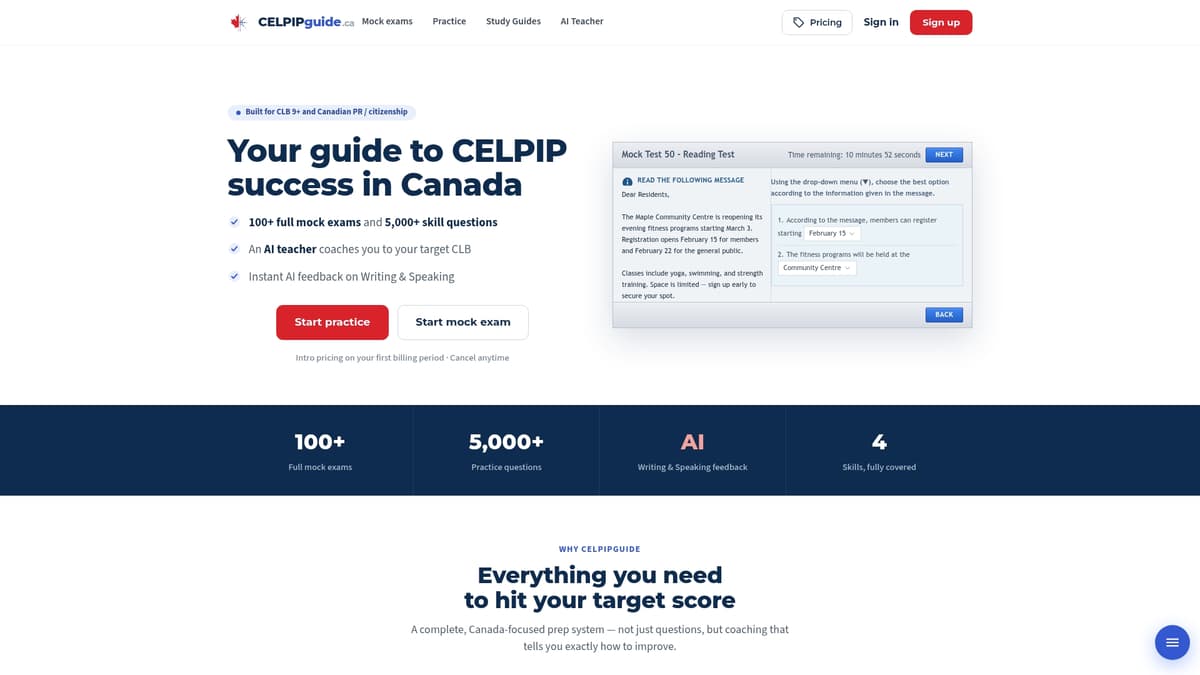
The platform includes a diagnostic test, over 5,000 practice questions, full-length mock exams, and an AI study plan that adjusts as your scores change. If you’re ready to see exactly where you stand, start with the CELPIP readiness check and get a personalized plan built around your real gaps, not a generic one.
Sources
- Canada
- Language
- CLB 9 at a glance (pdf) - CLB OSA
- How language skills predict earnings in Canada - CIC News
FAQ
What does CLB 9 mean for job prospects specifically?
CLB 9 signals you can handle complex professional communication, reports, presentations, client interaction, which qualifies you for roles that require independent, advanced English use.
Is CLB 9 the same across CELPIP and IELTS?
No. Each test has its own score range that maps to CLB 9 through official conversion tables, so always check the current table rather than assuming scores are interchangeable.
Does CLB 9 guarantee a job in my field?
No. CLB 9 strengthens your application and meets language thresholds for many regulated professions, but it doesn’t replace licensing or credential requirements specific to your field.
How is CLB 9 different from NCLC 9?
NCLC is the French-language equivalent benchmark system. CLB 9 measures English ability; NCLC 9 measures the same skill level in French, and immigration programs can award points for either or both.
Can Celpipguide help me prepare specifically for CLB 9?
Yes. Celpipguide’s diagnostic test identifies your weakest skill, and its mock exams plus AI feedback target speaking and writing, the two areas most test-takers struggle to improve without outside input.