
CELPIP Blog
Repetition and vocabulary retention: what actually works
Repetition and vocabulary retention: what actually works

Spaced repetition combined with active retrieval reliably beats massed rereading for long-term vocabulary retention. In a controlled web-application trial, learners who got spaced sessions, corrective feedback, and frequent testing recalled about 29 percentage points more vocabulary than learners who studied in a less optimal pattern. That gap is the difference between forgetting half your new words by next week and actually owning them.
Here is the one-line rule I want you to walk away with before reading another paragraph: do short daily retrieval sessions, and aim for three to four spaced recalls of each new word before you consider it learned.
- Cram sessions feel productive but decay fast; spaced retrieval sticks.
- Recognizing a word (“oh yeah, I’ve seen that”) is not the same as recalling it cold.
- Ten minutes a day, spread across a week, outperforms one hour once a week.
Key Takeaways
Spaced, retrieval-based repetition, paired with corrective feedback, produces measurably stronger long-term vocabulary retention than rereading or passive review.
| Point | Details |
|---|---|
| Spacing beats cramming | Spreading retrievals across days, not hours, produced roughly a 29 percentage-point recall gain in controlled testing. |
| Retrieval beats recognition | Producing a word from memory strengthens it far more than simply recognizing it on a flashcard. |
| Combine written and oral practice | Written plus oral repetition held up better at six weeks than oral-only repetition in classroom trials. |
| Repetition alone isn’t enough | Receptive gains from flashcards don’t automatically transfer to fluent, productive speaking or writing. |
| Celpipguide structures the schedule | Its diagnostic test, AI study plan, and vocabulary builder apply spacing and retrieval automatically for CELPIP prep. |
Table of Contents
- The role of repetition in vocabulary retention: what the evidence shows
- Why does repetition help memory? The mechanisms behind it
- How should you schedule repetitions for maximum retention?
- How can teachers build repetition into lessons without losing communicative practice?
- What should you look for in an SRS or flashcard tool?
- Where does repetition alone fall short?
- How Celpipguide applies the research to CELPIP prep
- Repetition works, but not the way most learners assume
- Get started with a study plan built around this evidence
- Sources
- FAQ
The role of repetition in vocabulary retention: what the evidence shows
The role of repetition in vocabulary retention isn’t really about how many times you see a word. It’s about the pattern of exposure and what your brain has to do each time. Simple rereading barely moves the needle. Repetition that forces you to retrieve a word from memory, spaced out over days, produces durable learning that survives weeks and months.
The clearest demonstration comes from a web-based vocabulary trial published in Frontiers in Psychology. Researchers tested how spacing, corrective feedback, and testing frequency interacted, and found that the combination of all three produced roughly a 29 percentage-point improvement in recall compared with a weaker, non-optimal setup. That’s not a marginal tweak. That’s the difference between a study method that mostly wastes your time and one that actually works.
A broader review in Nature Reviews Psychology backs this up from a different angle. Looking across decades of memory research, it concludes that spacing and retrieval practice produce some of the most consistent, replicable effects in the entire learning science literature, and that “successive relearning,” retrieving an item repeatedly across spaced sessions until it sticks, is one of the highest-leverage techniques available for factual knowledge like vocabulary.
Classroom research tells a similar story with an added wrinkle about format. A 2018 controlled study comparing oral, written, and combined repetition found that written repetition and combined oral-plus-written repetition produced significantly higher delayed recall than oral repetition alone, measured at one week and again at six weeks out. Oral-only practice faded fastest. The combined group, which took a bit more time and effort per session, held onto meaning and form the longest.
Separately, a trial using an adaptive spaced-repetition tool found close to a threefold improvement in long-term recall for learners using the system compared with controls, with median exposure of just over a minute per item. Small daily doses, correctly spaced, beat long occasional sessions by a wide margin.
Three things matter when you read studies like these:
- Delayed post-tests are the real measure. A quiz taken five minutes after study tells you almost nothing about retention. Researchers test at 24 hours, one week, and six weeks because that’s where massed rereading collapses and spacing holds up.
- “Retention” usually means recall, not recognition. Multiple-choice comprehension is a weaker bar than producing the word unaided, and most of the strongest studies measure the harder version.
- Effect sizes vary by design, but the direction never flips. Every major review points the same way: spaced retrieval beats massed exposure, and testing beats passive review.
Does repetition improve vocabulary on its own, without spacing or retrieval? Only modestly. A synthesis of vocabulary-learning principles published in MDPI Languages makes the point directly: repetition quantity correlates with learning, but quality, meaning elaboration, spacing, and varied context, is what turns exposure into durable knowledge. Repetition is necessary. It is not sufficient by itself.
Why does repetition help memory? The mechanisms behind it
Three cognitive mechanisms explain why spaced, retrieval-based repetition outperforms rereading, and understanding them changes how you build practice sessions.
The spacing effect. When you space out exposures to a word instead of bunching them together, your brain has to work slightly harder to reactivate the memory each time. That extra effort is exactly why it works. Cramming feels efficient because everything stays “hot” in working memory, but that heat fades fast once you stop studying.

The testing effect (retrieval practice). Pulling a word out of memory strengthens it more than looking at it again does, even when the looking happens more often. A retrieval-based review of the literature notes that repeated retrieval, especially practised to the point of consistent correct recall, can nearly eliminate forgetting across long delays. Recognizing a flashcard’s answer is a much weaker version of this than producing it yourself.
Desirable difficulty. Struggle, within limits, is the engine here. A well-known review of desirable difficulties confirms that effortful retrieval, when it eventually succeeds, builds stronger long-term memory than easy, low-effort review. The catch: the retrieval has to actually succeed often enough to feel like progress, not constant failure. That’s the success-effort tradeoff, and it’s why over-hinted flashcards quietly sabotage your own progress.
Elaboration adds a fourth layer. Attaching a new word to a sentence, an image, a sound, or a personal association creates more paths back to that word later. A single retrieval route is fragile; five overlapping routes are not.
- Spacing: forces reactivation after partial forgetting, which is when strengthening happens.
- Retrieval: production beats recognition, every single time it’s been tested.
- Desirable difficulty: some struggle is good; constant failure is not.
- Elaboration: more sensory and contextual hooks mean more ways back to the word.
Pro Tip: If a flashcard app shows you a picture alongside the word during the retrieval prompt, it’s often doing your remembering for you. Save the image for the answer screen, after you’ve already tried to recall the word cold.
How should you schedule repetitions for maximum retention?
Ten to fifteen minutes a day, done consistently, beats an hour once a week almost every time. Here’s a schedule that reflects what the research actually supports, not a made-up study hack.
- First exposure, then retrieve within 24 to 48 hours. Waiting longer risks losing the word before your brain gets a second chance at it; waiting less doesn’t give forgetting enough time to make the second retrieval meaningful.
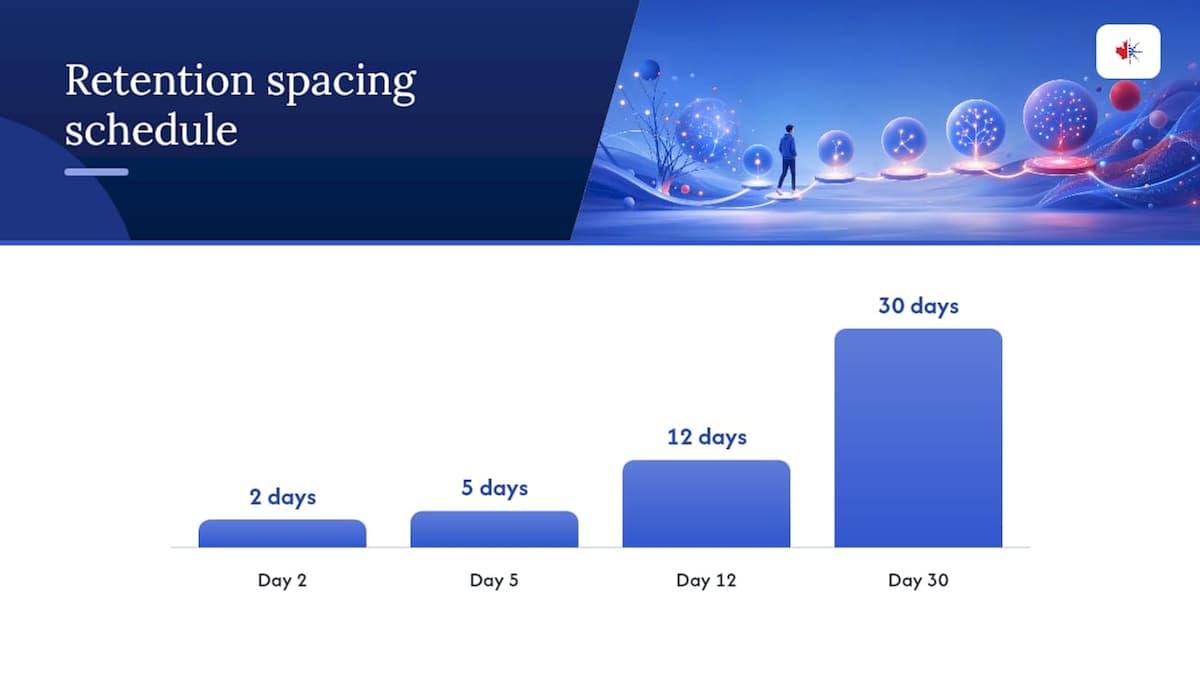
- Expand the interval each time you succeed. Day 2, then day 5, then day 12, then day 30 is a reasonable rough progression. Miss a recall, and the interval resets shorter, not longer.
- Use cued recall, not recognition. Fill-in-the-blank, translation prompts, and sentence completion force actual retrieval. Multiple choice lets you guess your way to a false sense of mastery.
- Combine written and oral production. Write the word, say it out loud, then use it in your own sentence. The 2018 repetition study found this combined approach outlasted oral-only practice by a wide margin at the six-week mark, though it does take a little more time per session.
- Design cards that don’t cheat for you. Use your own example sentences, not generic ones. Keep audio and images on the answer side of the card, as feedback, never as a hint shown during the attempt.
- Learn to criterion, not to “I think I remember.” Keep retrieving a word until you get it right without help, ideally more than once, before you trust that it’s actually learned. Early, verified success on a word strongly predicts whether it survives long term.
For anyone building academic vocabulary for a specific test target, this schedule works the same way, just applied to exam-relevant word lists instead of general vocabulary.
Pro Tip: Keep a small notebook or app column for “words I got wrong twice.” Those are the ones desirable difficulty hasn’t finished working on yet, and they deserve extra retrieval attempts before test day.
How can teachers build repetition into lessons without losing communicative practice?
Repetition and communication aren’t competitors. The trick is scheduling short, low-stakes retrieval moments around the communicative work you’re already doing, not replacing it.
- Run two-minute retrieval checks at the start or end of class, covering words introduced three to ten days earlier, with quick corrective feedback on the spot.
- Pair a receptive task (reading or listening) with an immediate productive task (a short spoken or written response) using the same target words, then revisit those same words in a later lesson.
- Curate a shared class card set for spaced review rather than leaving vocabulary entirely to individual apps; it keeps pacing consistent and lets you measure delayed retention across the group.
- In large classes, rotate retrieval stations or use quick peer-testing pairs so students still get individual retrieval practice without a one-on-one quiz from you.
- Track which words keep failing group retrieval checks; that list tells you where to spend the next lesson’s review time.
None of this requires new curriculum. It requires five minutes of deliberate retrieval, spaced across the weeks you already teach.
What should you look for in an SRS or flashcard tool?
Not all spaced-repetition tools reflect the research equally well, and the differences show up in your results within weeks.
Look for an adjustable spacing algorithm that lengthens intervals after correct recall and shortens them after a miss, rather than a fixed schedule applied to every word regardless of how well you know it. Learn-to-criterion settings, where a word doesn’t graduate to “known” until you’ve nailed it more than once, matter more than most people realize.
User-generated cards consistently outperform generic premade decks. A systematic review of digital flashcard tools found that cards built from your own sentences and context produce deeper processing than someone else’s pre-written deck, largely because writing the card is itself a retrieval and elaboration exercise. Multimodal feedback, hearing the word pronounced or seeing it used after you attempt recall, adds another retrieval path without weakening the attempt itself.
Watch for warning signs. Premade decks optimized for speed over context tend to strip out the sentence-level meaning that makes a word stick. Cards where an image sits next to the word during the prompt, rather than after, let you guess visually instead of actually retrieving. And tools with no export options or classroom controls make it hard for educators to curate or track group progress.
A vocabulary tracker built for spaced, exam-relevant practice should tick these boxes: adjustable spacing, retrieval-first prompts, and feedback that reinforces without hinting.
| Feature | Why it matters |
|---|---|
| Adaptive spacing | Expands intervals after success, shortens after a miss, matching the actual forgetting curve. |
| Learn-to-criterion | Prevents premature “mastered” tags on words you’ve only half-learned. |
| User-generated cards | Forces elaboration during card creation, which strengthens the memory before review even starts. |
| Feedback placement | Audio or images belong after the attempt, not during it, so retrieval stays effortful. |
Where does repetition alone fall short?
Repetition, even done well, has real limits. SRS and flashcard drills build receptive knowledge fast, recognizing and recalling a word in isolation, but productive fluency, using that word naturally in a sentence under time pressure, needs more than a flashcard can offer.
- Collocations and natural phrasing rarely transfer from isolated word cards; they need contextualized, communicative tasks.
- Researchers still don’t agree on the ideal spacing schedule for every word type, age group, or proficiency level; current intervals are reasonable estimates, not fixed laws.
- Overreliance on premade decks or image-heavy cards quietly reduces the retrieval effort that makes spacing work in the first place.
- A word “known” on a flashcard app is not the same as a word you can produce fluently in speech.
Pair repetition with meaningful use, real sentences, real conversations, and check occasionally whether the word actually transfers, not just whether the card says “learned.”
How Celpipguide applies the research to CELPIP prep
A diagnostic test identifies which vocabulary gaps actually cost you CLB points, so your first repetitions target words that matter rather than a generic list. From there, an AI-driven study plan schedules review sessions the way the spacing research recommends, expanding intervals as you succeed and pulling missed words back sooner.
- Diagnostic test: pinpoints weak vocabulary areas before you waste time reviewing words you already know.
- Vocabulary builder: structures spaced, retrieval-first review instead of passive list-reading.
- AI feedback on writing and speaking: delivers the corrective feedback loop that research ties directly to stronger retention.
- Full mock exams: give you high-volume retrieval practice under realistic time pressure, the productive-skill piece flashcards alone can’t provide.
Pro Tip: Run a short diagnostic before building a vocabulary list from scratch. It saves you from spacing out repetitions for words you didn’t actually need.
Repetition works, but not the way most learners assume
Most learners think repetition means “see the word enough times and it sticks.” That belief is exactly what the evidence pushes back against. Seeing a word repeatedly without retrieving it barely helps; the Nature Reviews synthesis on spacing and retrieval is blunt about this, and it’s one of the more consistent findings in memory research generally.
The bigger gap I see in how people talk about this topic is overconfidence in SRS apps as a complete solution. They’re outstanding for receptive vocabulary, matching a word to its meaning under time pressure. They do far less for the kind of fluent, spontaneous production a speaking test or a real conversation demands. Paul Nation has pointed out for years that learners confuse short-term recall with durable retention, and I think that confusion is the single biggest reason study time gets wasted.
If you take one thing from the research, take this: prioritize retrieval effort over exposure volume, and pair every spaced review with at least occasional real use, a sentence, a spoken answer, a written response. Repetition sets the foundation. Use is what makes it permanent.
Get started with a study plan built around this evidence
You’ve seen what actually moves vocabulary retention: spacing, retrieval, corrective feedback. Celpipguide builds all three into one platform instead of leaving you to cobble together flashcard apps, mock tests, and feedback tools separately. That’s the practical advantage here, one connected system instead of three disconnected ones, tracking your progress across all of them.
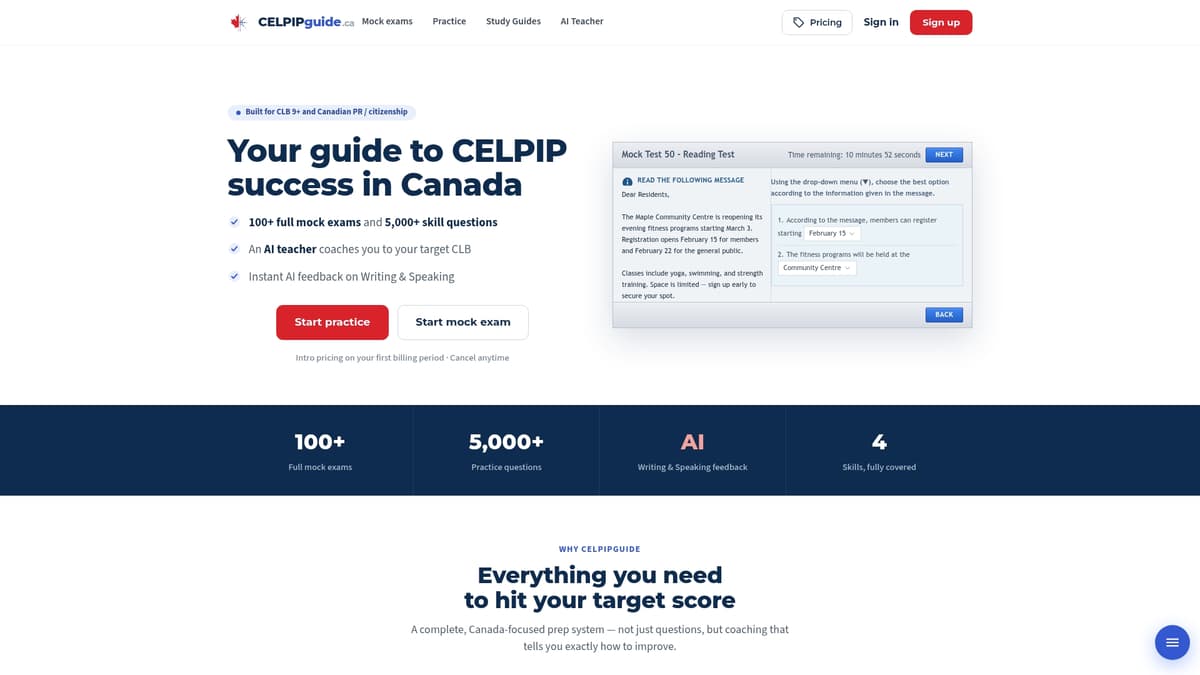
Start with the CELPIP readiness check to see exactly where your vocabulary and skill gaps sit before you build a study schedule around guesswork. From there, the study plan generator turns those results into a week-by-week spaced review schedule, and the full-length mock exams give you the high-volume retrieval practice under real test conditions that flashcards alone can’t replicate. Take the readiness check today and build your first spaced-review schedule this week.
Sources
FAQ
What are some effective strategies for retaining vocabulary?
Space out short retrieval sessions instead of rereading lists, use cued recall (fill-in-the-blank or translation) rather than multiple choice, and combine written and spoken practice for each word.
How can you retain most of what you study?
No method guarantees a fixed percentage, but studies using spacing, retrieval, and corrective feedback together have shown recall gains of roughly 29 percentage points over weaker study methods, which is the strongest evidence-backed combination available.
What is the role of repetition in learning generally?
Repetition strengthens memory mainly when it involves spaced retrieval rather than passive review; simply seeing information more often produces far smaller and less durable gains.
Does repetition alone improve vocabulary?
Only modestly. Repetition quantity correlates with learning, but quality factors like spacing and elaboration determine whether that exposure turns into lasting knowledge.
How does Celpipguide apply repetition research to CELPIP prep?
Its diagnostic test, AI-generated study plan, and vocabulary builder schedule spaced, retrieval-first review automatically, while AI feedback on writing and speaking supplies the corrective feedback loop the research identifies as essential.