
CELPIP Blog
Role of AI teacher in language learning: a practical guide
Role of AI teacher in language learning: a practical guide

AI works best in language education not as a replacement for teachers, but as a co-teacher: one that delivers adaptive feedback, generates practice at scale, and scaffolds learners around the clock while you retain control over pedagogy, ethics, and high-stakes decisions. That single principle, formalised in a 2026 human-AI co-agency framework published in Frontiers in Education, is the most useful lens for any Canadian educator or CELPIP learner evaluating AI tools right now.
The role of AI teacher in language learning covers four concrete functions:
- Evaluative feedback: automated scoring of writing and speaking against rubrics
- Adaptive scaffolding: personalised pathways that adjust to your current CLB level
- Generative support: model answers, task creation, and vocabulary modelling
- Conversational practice: chatbot role plays and dialogue simulations
Platforms like Celpipguide apply all four functions to CELPIP preparation, while Canadian privacy law (PIPEDA) sets the compliance floor every tool must clear before entering a classroom.
Table of Contents
- What an AI teacher actually does in language learning
- What the research says about AI’s impact on language learning
- A practical human-AI co-agency model for your classroom
- Concrete strategies by skill for classrooms and self-study
- Using AI for assessment and CELPIP preparation: calibration and cautions
- How to choose an AI tool for Canadian language classrooms
- Key takeaways
- The gap between what AI promises and what actually matters
- Celpipguide puts the co-agency model to work for CELPIP learners
- Useful sources
- FAQ
What an AI teacher actually does in language learning
Think of AI as handling the repetitive, high-volume instructional jobs that eat teacher time, so you can focus on the work only a human can do.
Evaluative feedback is where transformer-based scoring earns its keep. A learner submits a writing response; the AI scores it against a rubric, flags weak cohesion, and returns a comment in seconds. Research from Springer confirms that transformer-based automated scoring significantly reduces teacher grading time and supports rapid feedback cycles. That time goes back to you for conferencing and nuanced coaching.
Adaptive scaffolding means the system tracks which grammar patterns or vocabulary sets a learner keeps missing and serves more practice on exactly those items, not a generic review sheet. A teacher using a well-designed platform can see that dashboard and redirect instruction accordingly.
Generative support lets AI draft model paragraphs, create gap-fill tasks from authentic texts, or produce sample speaking prompts at different difficulty levels. The teacher’s job is to review those outputs before learners see them.
Conversational practice gives shy or low-confidence learners a low-stakes space to speak or write repeatedly without fear of judgement. The boundary is clear: AI cannot read the room, notice a learner’s distress, or make a culturally sensitive call. That stays with you.
Pro Tip: Before assigning any AI-generated task, read it yourself against the official CELPIP rubric. One two-minute check prevents a week of learners practising the wrong thing.
A systematic review published in BERA/Wiley confirms these four functions and stresses that teacher mediation is what makes AI effective, not the tool alone.
What the research says about AI’s impact on language learning
The evidence is genuinely encouraging, with important caveats.
A 2026 meta-analysis in Springer reports large positive effects of generative AI interventions on both language proficiency and affective-cognitive outcomes, measured by Hedges’ g, though heterogeneity across contexts is high. In plain terms: AI works well on average, but results vary significantly by task type, learner level, and how much teacher guidance surrounds the tool.
| Outcome area | Direction of effect | Key caveat |
|---|---|---|
| Language proficiency | Large positive (Hedges’ g) | High variability by context |
| Affective outcomes (anxiety, pleasure) | Positive after adaptation period | Initial friction is normal |
| Teacher grading efficiency | Significant time reduction | Requires calibration against human raters |
| Assessment variety | Broadened by AI tools | Accuracy depends on tool quality |
On the affective side, a Frontiers in Public Health study found that AI-personalised learning reduces anxiety, increases pleasure, and raises self-efficacy after an initial adaptation period. Learners need a few weeks to trust the system before the emotional benefits show up.
Survey evidence from 2025 shows most educators report AI improves exam-preparation efficiency and broadens the range of assessment item types available to them.
A practical human-AI co-agency model for your classroom
The co-agency model assigns distinct roles. AI scaffolds, practises, and provides an initial assessment. The teacher designs the pedagogy, sets the ethical guardrails, and validates what AI produces before it reaches learners.
Classroom workflow:
- Teacher designs the task and sets the rubric criteria
- Learner completes the task with AI support (practice partner or generative scaffold)
- AI returns initial feedback
- Teacher moderates a sample of AI outputs for accuracy and cultural fit
- Learner receives validated feedback and revises
Prompt literacy is the practical skill that makes this work. Teachers who know how to write a precise prompt get far better AI outputs than those who type a vague request. A few examples:
- “Generate three CELPIP Writing Task 1 prompts at CLB 7, each requiring a formal email with a complaint and a request.”
- “Score this speaking response against the CELPIP fluency and coherence criteria and list two specific improvements.”
- “Create a gap-fill vocabulary exercise using the word set [list] at a B2 reading level.”
Teaching learners to write their own prompts moves them from passive consumers of AI feedback to active metacognitive agents. IELTS research on communicative AI integration identifies prompting as a critical emergent literacy and warns that surface-level prompts produce surface-level feedback.
Pro Tip: Run a five-minute “prompt audit” once a week: ask three learners to show you the prompts they used that week. You will quickly spot who is getting deep feedback and who is getting generic responses.
Concrete strategies by skill for classrooms and self-study
Speaking
- Use AI chatbots for low-stakes role plays (job interview, community meeting) before the real speaking task
- Prompt: “Act as a CELPIP examiner. Ask me Task 5 questions and give me feedback on my vocabulary range and pronunciation clarity.”
- Teacher checkpoint: listen to two recordings per learner per week and note patterns the AI missed
Writing
- Run two-stage revision cycles: learner drafts, AI scores against the rubric, learner revises, teacher reviews the final version
- Cross-check AI suggestions against the CELPIP writing guide before accepting them
- For mixed-proficiency groups, ask AI to generate parallel tasks at CLB 5, 7, and 9 simultaneously
Reading
- Ask AI to generate comprehension questions at different cognitive levels (recall, inference, evaluation) from the same passage
- Prompt: “Create five inference questions from this passage for a B2 learner preparing for a Canadian citizenship reading task.”
Listening
- Use AI-generated dialogues with transcripts; learners listen first, then check the transcript for missed details
- The CELPIP listening guide pairs well with AI-generated practice for note-taking drills
Student fieldwork on generative AI for test prep shows learners value personalised practice but consciously limit AI use to avoid overreliance, a pattern researchers call Artificially Intelligent Mediated Counterbalance (AIMC). Build that self-monitoring habit deliberately into your classroom culture.
Using AI for assessment and CELPIP preparation: calibration and cautions
Automated scoring is a powerful formative tool, not a substitute for human judgement on high-stakes decisions.
Calibration checklist:
- Score the same 10 learner responses with both the AI tool and a trained human rater
- Acceptable variance: no more than one band level on any single response
- Run calibration at the start of each term and after any model update
- Flag responses where AI and human scores diverge by two or more bands for manual review
- Assign one staff member as calibration officer; document results
Known limitations to watch: some automated systems show leniency bias (scoring higher than a human rater would) and inconsistency across response types, particularly with non-standard accents or unconventional text structures. The IELTS research report on communicative AI explicitly flags leniency and inconsistency as risks in automated assessment.
For CELPIP and citizenship preparation, treat AI scores as a draft grade that informs practice, not a final result. Celpipguide’s instant feedback for writing is designed with rubric alignment in mind, but learners should still cross-verify against official CELPIP scoring criteria.
How to choose an AI tool for Canadian language classrooms
| Selection criterion | What to look for | Vendor question to ask |
|---|---|---|
| Scoring accuracy | Validated against human raters | “What is your inter-rater reliability data?” |
| Transparency | Explainable feedback, not just a score | “Can learners see why they received a score?” |
| Privacy compliance | PIPEDA-aligned, clear data retention policy | “Where is student data stored and for how long?” |
| Curriculum alignment | Maps to CLB/CEFR levels | “Does your rubric align with CELPIP or CLB standards?” |
| Teacher controls | Dashboard, override capability | “Can teachers adjust or override AI scores?” |
| Professional development | Onboarding and ongoing training | “What training do you provide for teachers?” |
| Cost model | Transparent, no hidden per-student fees | “What is the per-learner cost at our enrolment size?” |
Pilot before you commit. Run a four-week trial with one class, track calibration scores weekly, and survey learners on usability. A diagnostic test at the start of the pilot gives you a baseline to measure against at the end.
Budget consideration: most SaaS AI tools for education charge per learner per month. Factor in teacher training time (typically two to four hours for onboarding) and IT support for device compatibility checks.
Key takeaways
AI is most effective in language education when teachers retain pedagogical control and use AI as a co-teacher for feedback, practice, and scaffolding, not as a replacement for human judgement.
| Point | Details |
|---|---|
| Co-agency is the model | Assign AI to scaffold and practise; keep rubric design, ethics, and final assessment with the teacher. |
| Calibrate automated scoring | Compare AI and human scores on 10 responses each term; flag divergence of two or more bands. |
| Teach prompt literacy | Learners who write precise prompts get deeper, more useful feedback from AI tools. |
| Check privacy before adopting | Confirm PIPEDA alignment, data residency, and consent processes before any student data enters an AI system. |
| Celpipguide applies co-agency | Celpipguide combines AI feedback on speaking and writing with a personalised study plan and diagnostic baseline for CELPIP preparation. |
The gap between what AI promises and what actually matters
The loudest claims about AI in language education focus on automation: grade faster, practise more, scale infinitely. Those benefits are real. But the research keeps pointing to something quieter: the quality of teacher mediation determines whether AI helps or misleads a learner.
A tool that scores writing in two seconds is only as good as the rubric it was trained on and the teacher who checks whether that rubric still matches what the exam actually rewards. For CELPIP candidates specifically, the stakes are high enough that a miscalibrated AI score can send someone into the wrong study direction for weeks. The co-agency model is not a compromise between human and machine. It is the only arrangement that makes AI genuinely useful in high-stakes preparation.
What one classroom task will you pilot with AI this week?
Celpipguide puts the co-agency model to work for CELPIP learners
Celpipguide gives you the sharpest advantage a CELPIP candidate can have: instant, rubric-aligned AI feedback on your speaking and writing tasks, paired with a diagnostic test that maps exactly where you are losing marks. Most learners waste weeks practising skills they already have. Celpipguide’s AI teacher identifies your actual weak points from day one and builds a personalised weekly study plan around them.
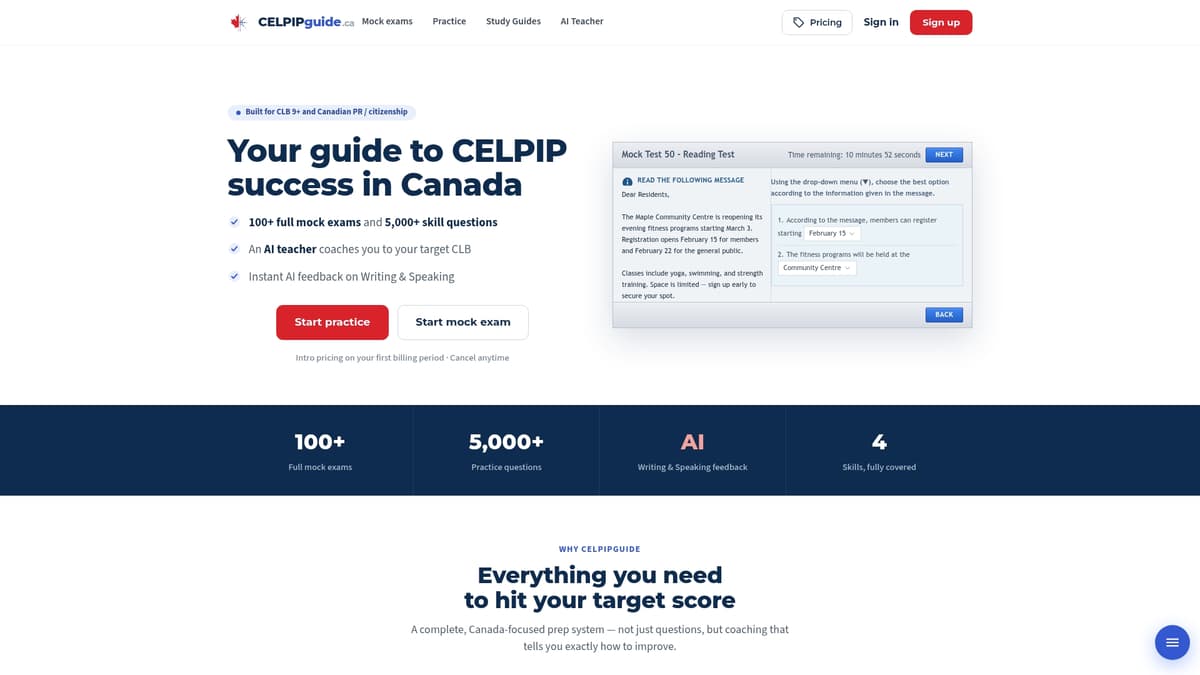
The platform covers all four skills with over 5,000 practice questions and more than 100 full mock exams, all calibrated to CLB and CEFR standards. That is the co-agency model in practice: AI handles the volume and the instant feedback; you stay in control of how you use that information.
Use coupon BLG30 for 30% off on top of all other discounts. Start with a personalised study plan today and know exactly what to practise before your next session.
Useful sources
| Source | Why it matters |
|---|---|
| Human-AI synergy framework, Frontiers in Education (2026) | Foundational co-agency model; defines teacher and AI roles in classroom adoption |
| Meta-analysis of GenAI in language learning, Springer (2026) | Effect sizes for proficiency and affective outcomes; primary evidence for efficacy claims |
| AI-driven personalised learning and mental experiences, Frontiers in Public Health (2025) | Affective outcomes and the adaptation-period finding; informs emotional design guidance |
| Communicative AI in IELTS preparation, IELTS Research Report (2025) | Prompting literacy and automated scoring cautions; directly applicable to CELPIP prep |
| Systematic review on AI in English language teaching, BERA/Wiley | Synthesises four AI functions and teacher mediation evidence across multiple studies |
| AI tools for EFL exam preparation, Taylor & Francis (2025) | Educator survey data on efficiency and assessment variety gains |
| Generative AI for IELTS preparation: student perspectives, MDPI (2025) | AIMC framework; learner strategies for avoiding overreliance |
| AI in personalised foreign language teaching, Springer Nature (2025) | Transformer scoring and teacher time savings; supports assessment calibration guidance |
FAQ
What is the role of an AI teacher in language learning?
An AI teacher functions as a co-teacher: it delivers adaptive feedback, generates practice tasks, and scaffolds learners, while the human teacher retains control over pedagogy, rubric design, and high-stakes assessment decisions.
Can AI replace a human language teacher?
No. AI handles volume and speed; human teachers manage cultural nuance, ethical decisions, and the kind of responsive coaching that changes when a learner is struggling. The co-agency framework treats substitution as the wrong goal.
How does AI help with CELPIP preparation specifically?
AI tools like Celpipguide provide instant rubric-aligned feedback on writing and speaking tasks, identify weak CLB areas through diagnostic testing, and generate personalised practice at scale, all calibrated to CELPIP scoring standards.
What privacy rules apply to AI tools in Canadian classrooms?
PIPEDA governs how personal data is collected and stored. Before adopting any AI tool, confirm data residency, obtain informed consent, and verify the vendor’s data retention and deletion policies with your school board.
How do I know if an AI tool’s scoring is accurate enough to trust?
Run a calibration check: score the same 10 learner responses with both the AI and a trained human rater. If scores diverge by more than one band level, the tool needs adjustment before you use it for formative assessment.