
CELPIP Blog
CELPIP Complaint Letter: A CLB 9+ Sample, Explained Line by Line
CELPIP Complaint Letter: A CLB 9+ Sample, Explained Line by Line

A high-scoring CELPIP complaint email follows a tight four-part structure: a formal opener that states your purpose, a factual middle section covering every prompt bullet, a clear statement of impact paired with a specific request, and a polite close. Keep it between 150 and 200 words, stay formal throughout, and you are already ahead of most test-takers.
TL;DR:
- Missing even one prompt bullet caps task fulfilment, regardless of polished language, so map each requirement to a sentence and include an explicit remedy.
- Put dates, order numbers, and what went wrong in the first body paragraph; use the second to explain the impact and request a named remedy.
- Spend 2 to 3 minutes planning, 18 to 20 drafting, and 3 to 5 proofreading; check every prompt bullet, tone, request, greeting, and closing.
- Practice with 10 to 12 minute structural drafts, compare them line by line with model answers, and schedule one full timed mock each week.
Table of Contents
- What raters actually look for in your complaint email
- The 4-part structure to write in the test
- Ready-to-use CELPIP complaint templates and a CLB 9+ sample
- Line-by-line explanation of the CLB 9+ sample
- A practical 27-minute exam plan and self-edit checklist
- How to practise effectively and where to get reliable feedback
- Why task fulfilment beats fancy vocabulary
- How Celpipguide helps you turn practice into a higher score
- FAQ
- Sources
What raters actually look for in your complaint email
We have spent enough time around CELPIP rubrics to know that raters are not hunting for fancy vocabulary. They are checking whether you did the job the prompt asked for, and whether you did it in a tone that fits a formal complaint.
Here is what tends to move your score the most:
- Task fulfilment: every bullet in the prompt needs an answer, plus a clear, explicit request.
- Tone: formal, measured language outperforms emotional venting every time.
- Organisation: short paragraphs with simple linking phrases (“as a result,” “therefore”) keep your ideas easy to follow.
- Language accuracy: clean grammar and precise word choice matter more than rare vocabulary.
- Time management: you only get 27 minutes for this task, so pacing is part of the test.
Miss one prompt bullet and you cap your task fulfilment score no matter how polished your sentences are. That single fact changes how you should plan before you start typing.
The 4-part structure to write in the test
Memorize this shape and you can produce a solid complaint email under pressure, even on a prompt you have never seen before.
- Opening paragraph: a formal greeting (“Dear Sir or Madam” or a named contact) followed by one sentence stating exactly why you are writing.
- Body paragraph one: the facts. Dates, order numbers, what went wrong, and anything tied directly to the prompt bullets.
- Body paragraph two: the impact on you (lost time, extra cost, inconvenience) and a specific, named remedy: a refund, replacement, or written apology.
- Closing paragraph: a brief, polite sign-off that confirms your availability for follow-up and thanks the reader for their attention.
Short, well-structured emails that explicitly mirror the prompt bullets and close with a clear remedy request consistently outscore longer, less focused letters. Length is not the goal. Coverage is.
Pro Tip: Write your remedy request as a single, direct sentence: “I would appreciate a full refund within 10 business days.” Vague requests cost you marks even when every fact is correct.
Ready-to-use CELPIP complaint templates and a CLB 9+ sample
A flexible template saves you from building sentences from scratch during the real test. Keep the skeleton the same and swap in the specifics of whatever scenario you draw.
- A 150 to 200 word core template that answers common complaint prompts: faulty product, poor service, or a billing error.
- One annotated CLB 9+ sample with brief notes tying sentences back to the rubric.
- Two short variants built on the same four paragraphs: one for a retail or online purchase, one for a service failure like a delayed repair or a missed appointment.
A typical opener reads: “I am writing to express my concern regarding an order I placed on your website on [date].” Keep that pattern and rebuild the body paragraphs around whatever details the prompt gives you. A strong template is less about memorized sentences and more about a reliable sequence you can trust when the clock is running.
Line-by-line explanation of the CLB 9+ sample
Breaking down a strong sample sentence by sentence shows why it works, not just that it works.
- The opening line names the product and date immediately, which signals task fulfilment before the rater reads further.
- Each body sentence maps to one prompt bullet, so nothing gets missed and nothing feels repeated.
- Formal phrasing (“I would like to request” instead of “I want”) keeps tone consistent from the first line to the last.
- Short sentences compress detail without losing clarity: a date, an order number, and one consequence per sentence is usually enough.
Rater training materials consistently show that annotated model answers paired with rubric commentary help writers see exactly which sentences earn marks and which ones just add words. That is the real value of studying a sample closely instead of skimming it once.
A practical 27-minute exam plan and self-edit checklist
Treat your 27 minutes like three short sprints instead of one long write.
- 2 to 3 minutes: read the prompt twice, list every bullet, pick your remedy, and sketch your four paragraphs in point form.
- 18 to 20 minutes: write using the four-paragraph template, one paragraph at a time, without stopping to polish.
- 3 to 5 minutes: proofread against a short checklist before time runs out.
Your checklist should cover:
- Formal greeting present
- Every prompt bullet answered
- A specific, explicit request included
- Tone stays polite and formal throughout
- No slang or overly casual phrasing
- Closing line and sign-off included
Our self-edit checklist for CELPIP writing walks through this same process in more detail if you want extra repetitions before test day.
How to practise effectively and where to get reliable feedback
Reading about structure only gets you so far. The real gains come from writing under timed conditions and then checking your work against something more precise than a gut feeling.
- Write timed mini-drafts (10 to 12 minutes) focused only on structure, then compare against a model answer.
- Look for feedback that maps directly to the rubric: task fulfilment, tone, organisation, and vocabulary, not just a generic score.
- Use a large question bank so you see different complaint scenarios: product, service, billing, and scheduling issues.
- Alternate focused mini-writes with a full timed mock once a week to build stamina alongside accuracy.
Pro Tip: Compare your draft against a model answer line by line rather than just reading your score. Spotting the specific sentence that cost you marks teaches you more than the number itself.
CELPIP practice apps are also available through Google Play and the Apple App Store, which makes short practice sessions easy to fit into a commute or a lunch break.

Why task fulfilment beats fancy vocabulary
The biggest shift I have seen in students is simple: they stop trying to sound impressive and start answering the prompt completely. A learner who writes plain, accurate sentences that cover every bullet almost always outscores one chasing complex vocabulary while skipping a request or a detail. Practise with a timer, check your work against a rubric, and the marks follow.
— Reza
How Celpipguide helps you turn practice into a higher score
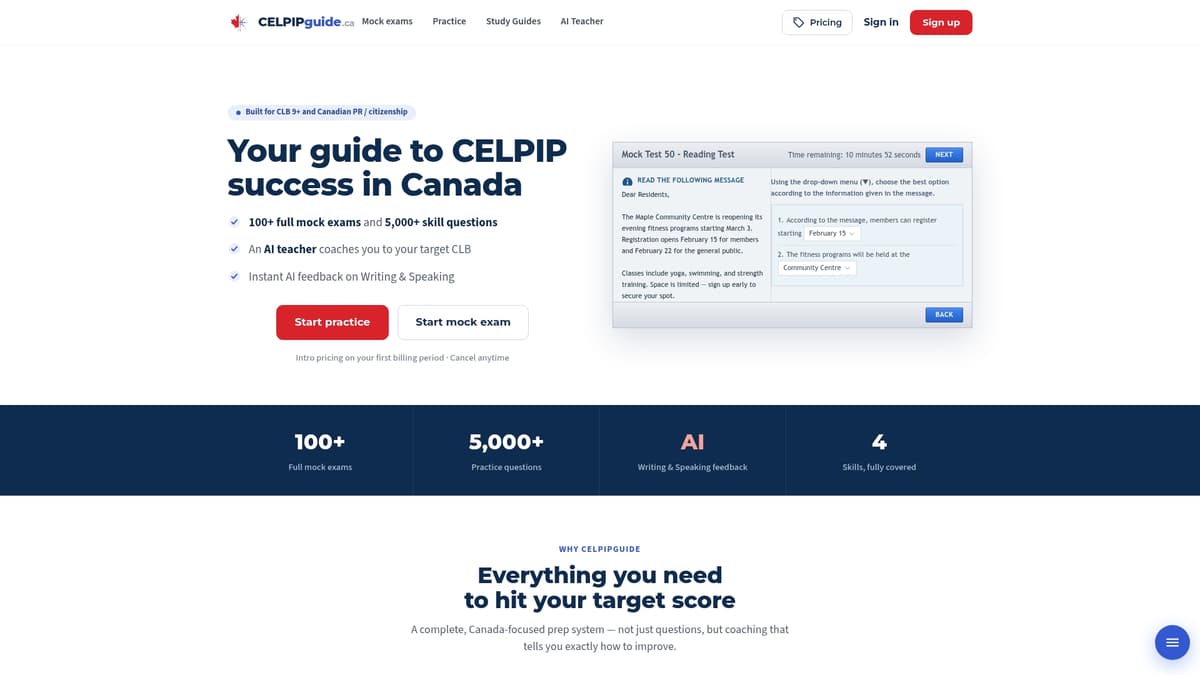
We built our Plus plan around focused practice: timed mock exams, AI-based instant writing review, and rubric-style feedback that highlights task fulfilment, tone, and vocabulary. A practical workflow looks like this:
- Draft a complaint email under timed conditions using the four-paragraph structure.
- Submit it for instant AI feedback mapped to the rubric categories raters actually use.
- Revise based on what the feedback flags, then repeat with a new scenario.
Our Plus plan is $29.99, one-time, and use code BLG30 for 30% off.
FAQ
How do I write a complaint letter?
Start with a formal greeting and a one-sentence statement of purpose, then cover the facts, the impact, and a specific request across two short body paragraphs. Close politely and confirm you are available for follow-up.
How do I write a formal letter of complaint?
Use formal language throughout, avoid contractions and casual phrasing, and keep your tone measured even when describing frustration. A greeting like “Dear Sir or Madam,” factual middle paragraphs, and a direct closing line form the backbone of strong formal complaint examples.
How to write a complaint letter email?
An email complaint follows the same four-part structure as a printed letter: opener, facts, impact and request, then a polite close. Keep it to 150 to 200 words for CELPIP Task 1 and stay within the 27 minute time limit.
How do you write a strongly worded letter of complaint?
Being firm does not mean being emotional. State the facts precisely, name a specific remedy, and let the clarity of your request carry the weight instead of strong adjectives or frustrated language.
What should I avoid in a CELPIP complaint email?
Avoid vague requests, informal language, and skipping any bullet from the prompt, since missing even one detail caps your task fulfilment score. Also avoid padding the email with extra sentences that do not add new information.
Sources
- How to Write a High-Scoring CELPIP Task 1 Email in 15 …
- Lesson 3.1 – Business letters: complaint and bad news letters – English 301 99A Technical Writing