
CELPIP Blog
Reach CLB 9 Faster: AI Feedback for CELPIP Speaking, 5 Step Loop
Reach CLB 9 Faster: AI Feedback for CELPIP Speaking, 5 Step Loop

AI CELPIP speaking feedback gives you instant, rubric-linked notes on task fulfilment, coherence, vocabulary, grammar and pronunciation so you can practise targeted fixes and raise your CLB band. It works as a practice tool, not a substitute for your official result. Think of it as a coach who flags exactly what’s holding your score back, so every practice session has a clear job to do.
TL;DR:
- The AI feedback highlights whether you are adding enough specific details to demonstrate task fulfillment and how well your ideas flow logically.
- Feedback points like frequent hesitations or repetitive vocabulary directly relate to the CLB levels, especially CLB 9, which many immigration pathways require.
- Focusing on fixing one language fault at a time through repeated, targeted practice significantly improves scores faster than unfocused talking.
- Instant AI feedback allows you to identify and address weaknesses immediately, supporting more effective study sessions under timed exam conditions.
Table of Contents
- How AI speaking feedback works and what it evaluates
- Translating AI notes into CLB bands and what CLB 9 demands
- The attempt, review, retry routine that turns feedback into gains
- A sample walkthrough: reading feedback and acting on it
- Why Celpipguide’s AI teacher fits this practice routine
- Instructor perspective: three mistakes that slow your progress
- Get started with Celpipguide Plus
- FAQ
- Sources
How AI speaking feedback works and what it evaluates
We built our feedback engine to mirror how CELPIP examiners actually listen. Instead of a single pass or fail stamp, you get notes across the dimensions that matter most for a speaking score:
- Task fulfilment: did you answer the actual prompt with enough relevant detail?
- Coherence and cohesion: does your response flow logically, with clear transitions between ideas?
- Vocabulary range: are you reaching for varied, precise words instead of repeating the same three?
- Grammar accuracy: are your sentence structures correct and controlled under time pressure?
- Pronunciation and listenability: can a listener follow you easily, without straining for meaning?
The AI pulls this from several layers of evidence: a transcript of what you said, timing data that shows hesitations and pacing, prosody patterns like stress and intonation, and lexical measures that track word variety and complexity. That combination is what separates a useful practice tool from a simple speech-to-text check.
One caveat worth repeating: this is a practice estimate built to mirror official criteria, not your actual CELPIP result. Treat every session as a diagnostic, not a verdict.
Translating AI notes into CLB bands and what CLB 9 demands
Feedback only helps when you know what it’s aiming at. CELPIP speaking scores map directly to Canadian Language Benchmark levels, and a CELPIP score of 9 corresponds to CLB 9, the level many economic immigration pathways require. Official guidance also confirms that CELPIP-G results map across abilities using published CLB tables, so a note like “add more detail” isn’t vague criticism. It’s a direct pointer to task fulfilment, one of the specific descriptors examiners weigh.
Official CLB tables define exactly how speaking abilities map to each benchmark level, which is why Canada’s citizenship language proof guidance lists CELPIP-G results against those same levels. Knowing the mapping turns scattered feedback into a checklist.
Common AI comments line up with CLB indicators fairly predictably. “More detail” points to task fulfilment. “Frequent hesitations” points to fluency and delivery. “Repetitive vocabulary” points to lexical range. Once you see the pattern, you stop guessing what each comment means and start treating it as a coordinate on the CLB map.

The attempt, review, retry routine that turns feedback into gains
Feedback sitting unread changes nothing. We recommend a short, repeatable loop after every practice response:
- Attempt the task under real timed conditions, no pausing to rethink your answer.
- Review the AI notes in full before judging your own performance.
- Choose one or two faults to fix, never the whole list at once.
- Drill those faults specifically: shadowing audio for pronunciation, sentence expansion exercises for cohesion, or swapping repeated words for stronger alternatives to build vocabulary range.
- Retry the same or a similar prompt and compare the new notes against the old ones.
Shadowing works well for pronunciation because you’re matching rhythm and stress in real time rather than reading rules about them. For fluent delivery practice, a tool like the AI teleprompter from ProNoto can help you rehearse pacing without losing your place.
Pro Tip: Fix one fault category per session. Chasing five issues at once usually means you fix none of them well.
A sample walkthrough: reading feedback and acting on it
Picture a response to a CELPIP speaking prompt about describing a memorable trip. The paraphrased AI feedback might read like this:
- Task fulfilment: answer stayed general, missing specific details about the location or timeline.
- Coherence: ideas jumped between two unrelated events without a clear transition.
- Vocabulary: relied on “nice” and “good” five times each.
- Grammar: past tense slipped into present twice mid-response.
- Pronunciation: word stress on multi-syllable words was inconsistent, lowering listenability.
The fix for each bullet is concrete. Add one named detail early. Insert a transition phrase like “after that” before switching events. Replace “nice” with “memorable” or “unexpected” in at least two spots. Lock the verb tense before speaking by rehearsing the timeline mentally first. Practise stress patterns on the three longest words in the response using shadowing.
After two or three focused retries, listen for fewer filler pauses and a steadier tense throughout, both signs the fix is sticking.
Why Celpipguide’s AI teacher fits this practice routine
Our platform builds the attempt-review-retry loop directly into how we structure practice. With many full mock exams and numerous practice questions, you’re never stuck repeating the same few prompts until feedback goes stale. Our AI teacher personalizes your study plan after each attempt and delivers instant feedback on speaking and writing tasks, so the review step happens the moment you finish talking, not days later.
That immediacy matters for the loop described above. The faster you see which fault to target, the faster you can drill it and retry while the prompt is still fresh in your mind. Diagnostic-driven practice, paired with real exam-style simulation, is built to support the kind of targeted, repeatable sessions that move a CLB band rather than just racking up attempts.
Instructor perspective: three mistakes that slow your progress
Most learners chase a target score number before fixing the habits that produce it. That’s backwards. Score chasing without targeted drills wastes attempts; unfocused practice spreads effort across too many faults at once; and neglecting listenability, how easy you are to follow, undercuts scores even when grammar and vocabulary look strong.
Spend thirty focused minutes on one fault category, retry twice, and compare notes before moving to the next. That single habit shift usually matters more than another hour of unstructured talking.
— Reza
Get started with Celpipguide Plus
Our Plus plan unlocks the full practice loop in one place, so you’re not piecing together tools from five different sites.
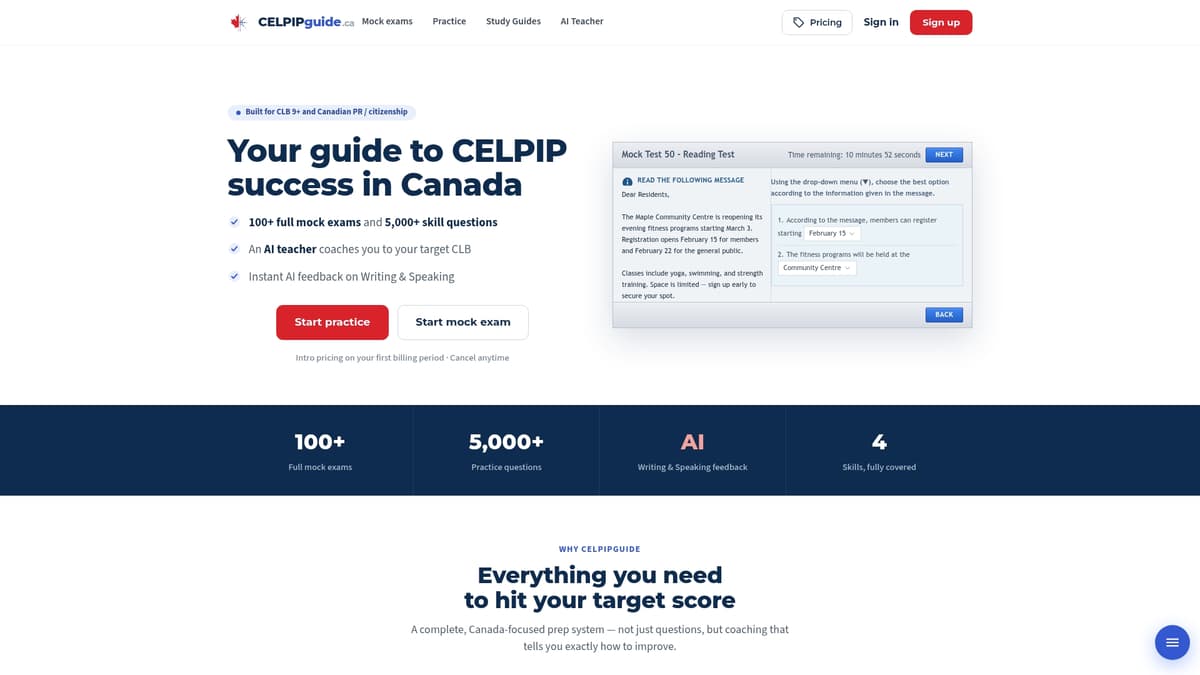
- Full access to over 100 mock exams across all four skills.
- Instant AI feedback on every speaking and writing attempt.
- A personalized study plan that adjusts as your weak spots shift.
Plus is available for $29.99 one-off.
FAQ
Is CELPIP speaking marked by AI?
Official CELPIP speaking results are marked by trained human raters, not AI. AI tools like ours are built for practice sessions beforehand, giving you rubric-style feedback so you know what to work on before your real exam.
How do I improve my CELPIP speaking score?
Focus on one weak dimension at a time, whether that’s task fulfilment, coherence, vocabulary, grammar, or pronunciation, and drill it with targeted exercises like shadowing or sentence expansion. Repeating the attempt-review-retry loop consistently tends to produce steadier gains than unfocused repetition.
What does CLB 9 require for CELPIP speaking?
A CELPIP speaking score of 9 maps to CLB 9, the benchmark many economic immigration pathways require. Reaching it generally means clear task fulfilment, logical flow, varied vocabulary, and consistent grammar under timed conditions.
How can I reach CLB 9 in CELPIP speaking?
Target the specific CLB 9 descriptors rather than practising generally: detailed, well-organized responses with minimal hesitation and strong listenability. Our AI teacher on Celpipguide maps feedback directly to these descriptors so each practice attempt has a clear, measurable goal.