
CELPIP Blog
Rubric First CELPIP Scoring Criteria: Turn Descriptors Into Actions
Rubric First CELPIP Scoring Criteria: Turn Descriptors Into Actions

CELPIP reports four separate skill scores, each on a scale of M and 3 to 12, and every one of those numbers comes from raters applying explicit level descriptors, not a gut feeling. Speaking and Writing get scored by trained raters against published rubrics covering content, vocabulary, coherence, and task fulfillment. Listening and Reading are scored against precise accuracy thresholds. Every level ties directly to a Canadian Language Benchmark (CLB) equivalent, which is exactly what Immigration, Refugees and Citizenship Canada (IRCC) uses to check eligibility.
TL;DR:
- CELPIP scores for each skill range from level 3 to 12, with levels 10 to 12 consolidating into CLB 10, meaning little benefit in aiming for the highest levels once CLB 10 is achieved.
- Responses are scored against explicit, published descriptors by trained raters, focusing on specific criteria like task fulfillment, coherence, vocabulary, and listenability, not general language fluency.
- Listening and Reading scores depend on correct answer counts and gauge inference, detail retention, and speed under pressure, rather than coherence or vocabulary.
- Reviewing official score charts and descriptors helps identify exact gaps, enabling targeted practice that aligns with observable, rubric-based behaviors.
- Using rubric-aligned practice tools and full mock exams accelerates progress because they focus on concrete performance standards raters actually evaluate.
Table of Contents
- What the CELPIP score scale is and how it maps to CLB
- How each skill is scored: the criteria behind every level
- How CELPIP scores are calculated and reported
- Sample descriptors and how to interpret them
- Where to find the official score comparison chart and descriptors
- How to practise against the official scoring criteria
- What candidates get wrong about CELPIP scoring
- Get rubric-aligned practice with an online CELPIP preparation platform
- Sources
- FAQ
What the CELPIP score scale is and how it maps to CLB
CELPIP scores run from M (a score too low to place on the main scale) through levels 3 to 12, with 12 being the highest attainable level on the test. Each of the four skills, Listening, Reading, Writing, and Speaking, gets its own level. There’s no combined “overall score” the way some other tests report one, and that trips people up constantly. Your Writing level says nothing about your Speaking level, and IRCC treats them as four distinct data points.
The reason this matters so much comes down to one word: equivalence. CELPIP levels aren’t just abstract numbers picked to sound official. Each level corresponds directly to a Canadian Language Benchmark, and the Government of Canada uses CLB as the common yardstick across every accepted language test, immigration stream, and credential check in the country. If you’re applying under Express Entry, filing for citizenship, or getting a professional credential assessed, whoever is reviewing your file isn’t thinking in CELPIP numbers. They’re thinking in CLB.
Here’s the basic shape of that mapping, though you should always confirm your exact target against the official tables before you build a study plan around it:
- CELPIP level 10, 11, or 12 generally aligns with CLB 10
- CELPIP level 9 aligns with CLB 9
- CELPIP level 8 aligns with CLB 8
- CELPIP level 7 aligns with CLB 7
- CELPIP level 6 aligns with CLB 6
- CELPIP level 5 or below drops into CLB 5 and lower
Notice the pattern break at the top. Levels 10 through 12 all collapse into a single CLB 10, which means grinding from an 11 to a 12 does nothing for your CRS points if you’re already sitting at CLB 10 on that skill. That’s worth knowing before you spend another three months chasing a number that won’t move your immigration outcome at all.
The safest way to confirm where you stand is to check your target skill by skill against the official CELPIP tables and cross reference them with the government’s own CLB guidance, since minor updates do happen. Our breakdown of how CELPIP’s four skills feed into immigration scoring walks through how this plays out for actual Express Entry files, skill by skill.
How each skill is scored: the criteria behind every level
This is where most candidates get lost, and honestly, it’s where most study plans fall apart too. People prep for CELPIP the way they’d prep for a general English test: broad vocabulary, general fluency, hope for the best. But CELPIP raters aren’t grading “how good is your English.” They’re grading against specific, published criteria for each skill, and those criteria differ meaningfully between Speaking and Writing, and again between Listening and Reading.
Speaking: what raters are actually listening for
Speaking gets scored on four main dimensions, and the official score comparison chart spells out sample responses for each level so you can hear the difference for yourself rather than guess at it.
- Content and coherence: does your response actually answer the task, and does it flow logically from point to point, or does it wander?
- Vocabulary: is your word choice precise and varied, or do you lean on the same three adjectives for every task?
- Listenability: this covers pronunciation, stress, intonation, and pacing, essentially, can a rater follow you without straining?
- Task fulfillment: did you actually do what the prompt asked, in the format it asked for, within the time given?
A candidate sitting around CELPIP level 6 to 7 on Speaking typically produces responses that are understandable and reasonably organized but rely on simpler sentence structures and occasional hesitation. Push into level 9 or 10 territory and you’re hearing natural pacing, idiomatic phrasing used correctly, and responses that address every part of a multi-part prompt without the speaker visibly searching for words. Industry breakdowns of the CELPIP scoring chart describe this same shift: it’s not that higher-level speakers use fancier words, it’s that their language use stops drawing attention to itself.
Pro Tip: Record yourself answering a Speaking task, then listen back and count your filler words and false starts. Raters notice hesitation patterns more than most candidates realize, and this single habit tracking exercise reveals more than another round of vocabulary flashcards.
Writing: the four pillars raters check line by line
Writing shares some DNA with Speaking’s rubric but shifts the emphasis toward structure and grammatical control, since a reader has time to scrutinize your sentences in a way a listener can’t.
- Task fulfillment: did you cover every bullet point in the prompt, at the right length, in the right format (email versus survey response, for example)?
- Organization: does your response have a clear structure, paragraphs that build logically, and transitions that guide the reader?
- Vocabulary and grammar: how varied and accurate is your language, and how well do you avoid repetitive sentence patterns?
- Tone and register: does your writing match the situation, formal for a complaint letter to a company, conversational for a message to a friend?
A response sitting at level 7 usually fulfills the task adequately with generally clear organization, but grammar slips show up under pressure, and vocabulary stays functional rather than precise. A level 9 or 10 response demonstrates control: complex sentences used correctly, a tone that matches the audience without being told to, and almost no grammatical noise for a rater to trip over. You can check your own Writing responses against this exact rubric using the CELPIP writing checker, which flags where your response is losing points on each of these four dimensions rather than giving you a single vague score.
Listening and Reading: comprehension with accuracy thresholds
Listening and Reading work differently from the two productive skills. There’s no rater judging your “coherence” here. Instead, your level is determined by how many questions you answer correctly across a set of passages and audio clips designed to increase in difficulty. The skill being tested isn’t just literal comprehension either. Higher-level items test inference (can you figure out what’s implied but not stated), detail retention across longer passages, and your ability to distinguish between similar-sounding answer choices designed to catch surface-level skimming.
A candidate answering a high number of Reading questions correctly typically lands in the upper CELPIP levels, though exact cutoffs shift slightly between test forms. What separates a level 7 reader from a level 10 reader usually isn’t vocabulary size. It’s speed under pressure, and the ability to spot which detail in a passage actually answers the question versus which one just looks related.
That last point deserves attention because it explains a pattern a lot of candidates notice and get frustrated by: they “know” all the words in a passage and still miss the question. Reading and Listening at the higher levels test judgment under time pressure, not raw comprehension in isolation.
A note on how many raters actually see your response
Speaking and Writing responses go through a rating process designed to reduce the noise of any single rater’s subjective read. Multiple trained raters assess your responses, and CELPIP’s process averages those independent judgments rather than relying on one person’s call, which matters if you’ve ever wondered why a friend with seemingly similar English got a different level than you did on the same task. Industry explainers of the CELPIP score chart note that this rater averaging process is specifically designed to smooth out individual rater bias, and it’s a big part of why the scoring feels more consistent test to test than a single human grading everything alone would be.
How CELPIP scores are calculated and reported
Every task you complete gets an individual mark first. For Speaking, that means each of the eight tasks gets scored separately against the rubric criteria above. For Writing, both tasks (the email and the survey response) get scored independently. Those task-level marks then get combined and converted into your single reported level per skill, the number that shows up on your official Score Report.
Here’s the sequence, simplified:
- Raters score each Speaking or Writing task against the published descriptors, task by task.
- Multiple raters typically review your responses, and their scores get averaged to reduce single-rater variance.
- Listening and Reading scores come from raw correct-answer counts, converted through a scaling process into the same 3 to 12 level system used for the productive skills.
- Your final report shows four separate levels, one per skill, never a combined average across all four.
Results generally take a couple of weeks to process from your test date, though exact turnaround varies by testing centre and format (computer-delivered tests tend to report faster than paper-based ones). Your official report lists your level for each skill individually, alongside the raw score band that produced it, which is the piece most candidates skip past too quickly. That raw band matters because it tells you how close you are to the next level up, information a bare “level 8” on its own doesn’t give you.
Once you have that report, converting it into an immigration estimate is a separate step. This is where a lot of candidates guess wrong, because CLB and Comprehensive Ranking System (CRS) points don’t move in a straight line with your CELPIP level. Working backward from your target CLB to figure out exactly which CELPIP level you need on each skill, rather than assuming “higher is always better across the board,” saves a lot of wasted study time. Our CELPIP score calculator does that conversion directly, showing you the CLB and estimated CRS impact for whatever levels you’re currently hitting or targeting.
Sample descriptors and how to interpret them
Reading an official level descriptor for the first time can feel like reading a job posting written by committee. Phrases like “generally coherent” or “adequate range of vocabulary” sound vague until you learn to translate them into things you can actually hear or see in a real response. That translation is the entire skill of using the rubric well.
Here’s how to do it, step by step:
- Find your current level’s descriptor on the official chart and read it alongside the descriptor one level above yours. Don’t just read your own level in isolation; the contrast between adjacent levels is where the useful information lives.
- Underline every concrete, observable word. Not adjectives like “good” or “clear,” but specific behaviours: “uses a range of cohesive devices,” “responds to all parts of the prompt,” “minor errors that don’t interfere with meaning.”
- Turn each underlined phrase into a checklist item you can score yourself against on your next practice response. “Uses a range of cohesive devices” becomes “did I use more than ‘and’ and ‘but’ to connect ideas in this paragraph?”
- Compare your own recorded or written response against that checklist, one item at a time, rather than asking “was that good?”
A quick paraphrased comparison across levels makes the pattern clearer. A mid-range Speaking response (roughly level 6 to 7) might answer the question, use basic connecting words, and include one or two grammar slips that don’t block understanding. A high-range response (level 8 to 9) answers the question fully, uses varied sentence openings, and self corrects an error mid-sentence without losing flow. An expert-range response (level 10 to 12) does all of that while also adjusting tone naturally to the scenario and handling a follow-up twist in the prompt without visibly pausing to reorganize.
Pro Tip: Keep a running log of which specific descriptor phrases show up as “not yet” on your checklist across three or four practice sessions. If the same phrase, say, “adequate range of vocabulary”, keeps failing, you’ve found your actual bottleneck, and it’s almost never the bottleneck you assumed going in.
The practical takeaway here is simple: after reading any descriptor, don’t ask “am I at this level?” Ask “which specific line item on this descriptor is my response missing right now?” That’s a study task. “Am I good enough?” isn’t.
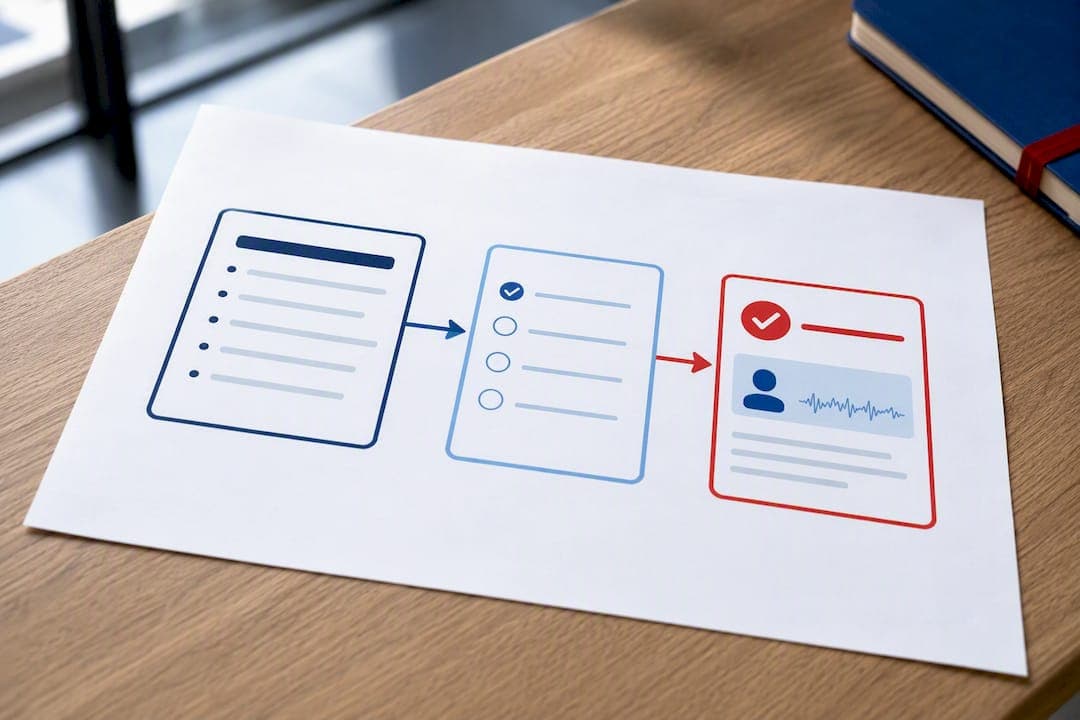
Where to find the official score comparison chart and descriptors
The single most reliable source for interpreting your results is CELPIP’s own score comparison chart, hosted directly on the official CELPIP site. It lists sample responses for each level across all four skills, side by side, so you can see the actual language that separates a level 7 from a level 9 rather than relying on someone’s paraphrase of it (including this one).
Use it in a specific way rather than just skimming it once. Pick your current estimated level in each skill, read the sample response at that level, then read the sample one level above it. Note the concrete differences, not the overall impression. Do this for Speaking and Writing especially, since those samples show full annotated responses rather than just a score.
For immigration files specifically, save a copy of the chart page and the date you accessed it alongside your application documents. Official pages do get updated periodically, and having a timestamped reference protects you if a reviewer asks how you interpreted your score against the published standard at the time you applied. It’s a small step that takes two minutes and avoids a headache six months later if anything about the chart’s presentation shifts.
Cross-check your target level against the government’s own CLB reference pages too, since the descriptor chart tells you what a level looks like, but the CLB equivalence tables tell you what that level is worth for your specific application stream.
How to practise against the official scoring criteria
Once you know which descriptor lines you’re missing, practice stops being vague and starts being targeted. That shift alone is usually what separates candidates who plateau from candidates who move up a full level in a few weeks.
Start with a diagnostic test rather than jumping straight into random practice questions. A proper diagnostic tells you exactly where you sit on each rubric dimension right now, not just an overall guess, so you’re not wasting time drilling vocabulary when your real gap is task fulfillment on Speaking task 4.
From there, build drills that isolate one rubric dimension at a time instead of practising “everything” every session:
- Listenability drills: record a 60 second response, then re-record it focusing only on pacing and pausing, nothing else, to isolate that one variable.
- Coherence drills: write or speak a response, then go back and add explicit transition phrases (“this leads to,” “as a result”) where you skipped them the first time.
- Vocabulary precision drills: take a response you’ve already written and swap five generic words (“good,” “big,” “nice”) for more precise alternatives.
- Task fulfillment checks: reread the prompt after finishing your response and tick off every sub question it asked, since missing one part quietly caps your score regardless of how polished the rest is.
A structured approach that works well is isolating one dimension per week, vocabulary range in week one, organization and coherence in week two, then retesting with a full mock exam to see if that isolated practice actually moved your reported level. Our study plan generator builds exactly this kind of week-by-week structure automatically once it knows your diagnostic results.
It’s also worth practising your comprehension skills more broadly outside CELPIP-specific material. Verbal reasoning exercises, like those on TESTUNO, sharpen the inference and detail-tracking skills that Reading and Listening lean on heavily.
Pro Tip: Get feedback from more than one source on the same Writing or Speaking response before you decide it’s “done.” Since CELPIP itself uses multiple raters and averages their scores, relying on a single reviewer’s opinion during practice, even a good one, gives you a noisier signal than the real test will.
- Full mock exams that mirror real test timing and task types give a far more accurate read on your likely reported level than piecemeal practice questions, and Celpipguide’s mock exam hub is built specifically to mirror those conditions.
What candidates get wrong about CELPIP scoring
The biggest misread I see is candidates treating their CELPIP level as a reflection of how “fluent” they feel, rather than how closely their response matches observable, published behaviours. Confidence and rubric performance often don’t correlate the way people expect. A confident, chatty response can still lose points on task fulfillment if it skips half the prompt, and a hesitant, quieter response can score well if it hits every rubric point cleanly.
The second mistake is studying skills in isolation from the descriptors themselves, memorizing vocabulary lists without ever checking whether that vocabulary shows up in a way raters are actually scoring. Rubric-aligned practice, where every drill maps back to a specific descriptor line, consistently shortens the distance between where candidates start and where they need to land, simply because nothing gets practised without a clear reason tied to the score.
— Reza
Get rubric-aligned practice with an online CELPIP preparation platform
Reading the official descriptors tells you what raters want. Closing that gap between your current responses and those descriptors is the harder part, and some online preparation platforms offer AI scoring for Writing and Speaking responses against criteria like content, coherence, vocabulary, listenability, and task fulfillment, highlighting specific line items missing.
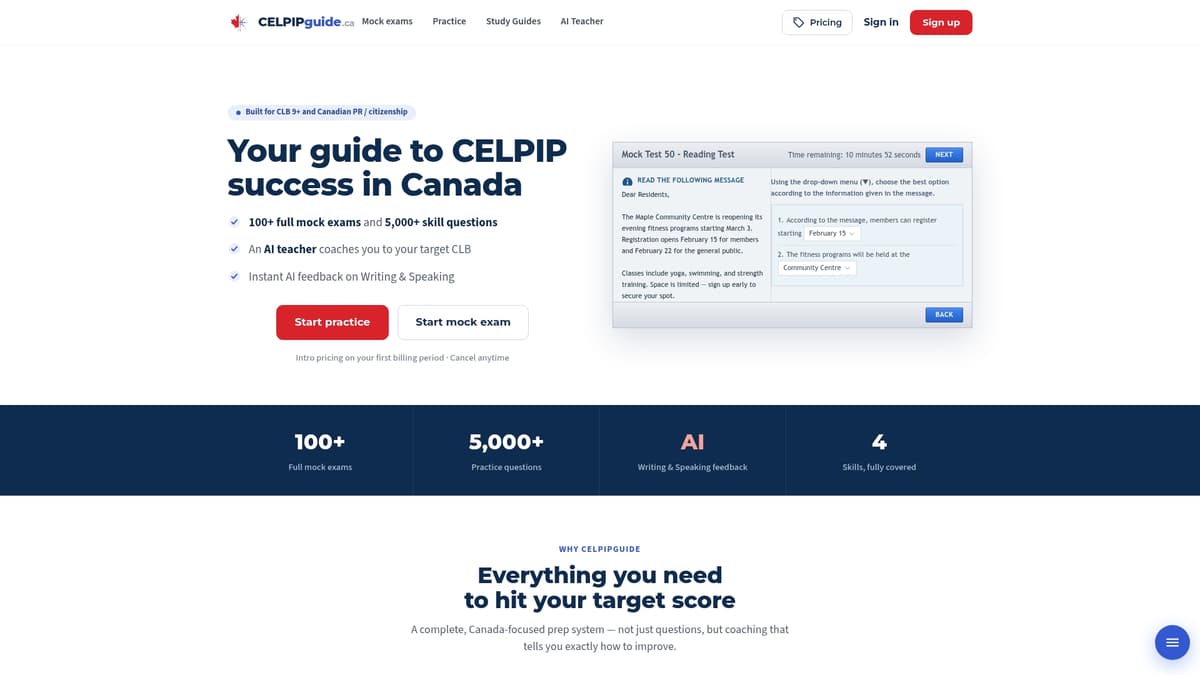
Some preparation plans include full-length mock exams, thousands of practice questions, diagnostic tests to identify starting levels on each skill, and study-plan generators to target weak spots with scheduled practice. If you want to start with a specific skill, the Speaking practice test gives instant feedback on your first response so you can see exactly how the rubric applies to your own English before committing to anything further.
Ready to see where you actually stand? Check out the Plus plan and use coupon code BLG30 for 30% off your subscription. It’s a fixed one-time fee of $29.99 for full access to the diagnostic, mock exams, and AI feedback tools covered above.
Sources
FAQ
How is the CELPIP score calculated?
Raters score each Speaking and Writing task against published descriptors, multiple raters average their scores to reduce individual bias, and Listening and Reading scores come from correct-answer counts converted into the same 3 to 12 level scale.
What is 34 out of 38 in CELPIP reading?
A high number of correct Reading answers typically places a candidate in the upper CELPIP levels, though exact cutoffs shift slightly between test forms.
Is 7 a good CELPIP score?
A CELPIP level 7 on a skill maps to CLB 7, which meets or exceeds the minimum requirement for several immigration and citizenship pathways, making it a solid, functional score for many applicants rather than a top-tier one.
What is the minimum score to pass the CELPIP test?
CELPIP doesn’t have a universal pass or fail score since there’s no combined total; instead, each of the four skill levels is measured against whatever CLB minimum your specific immigration program, credential body, or citizenship application requires.
How can I check exactly what CELPIP raters are looking for at my target level?
Review the official score comparison chart for sample responses at your target level, then use rubric-aligned practice tools, like the diagnostic and AI feedback available through Celpipguide, to compare your own responses against those same descriptor lines.