
CELPIP Blog
Speaking task 2 CELPIP: the 3-stage story method
Speaking task 2 CELPIP: the 3-stage story method

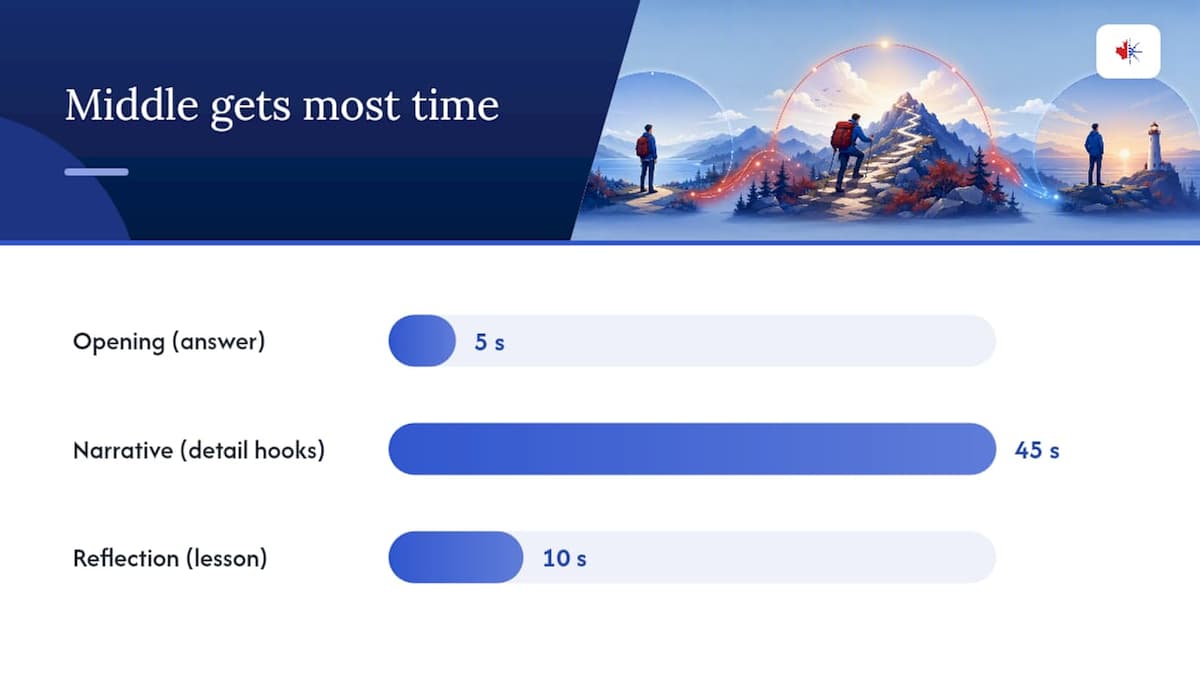
The fastest way to nail Speaking Task 2 is a 3-stage story: a fast opening that answers the prompt, a narrative built on three or four detail hooks, and a reflection line that ties back to what you learned. Split your 30 seconds of prep and 60 seconds of speaking roughly 5, 45, and 10 seconds across those stages, and always cover every guiding question the prompt gives you.
TL;DR:
- Success requires sticking to a three-stage story structure: immediate answer, three to four detail beats, and a clear reflection, all timed precisely within 60 seconds.
- Effective preparation involves concise outline building in 30 seconds, focusing on key triggers and avoiding full sentence scripting to stay on topic and save time.
- Using simple past tense consistently and linking ideas with basic connectors enhances clarity, listenability, and overall raters’ scoring, more than complex vocabulary.
- Practicing with timed mock exams that replicate real test conditions fosters automatic use of the structure and improves pacing under pressure.
- Avoid common mistakes like off-topic drifts, neglecting reflection, or rushing the ending, by rehearsing the outline and reflection line repeatedly before testing.
Table of Contents
- What Task 2 asks you to do and how raters judge it
- A one-minute template: the 3-stage story with timing and phrasing
- How to use the 30 seconds of preparation
- Language and delivery that raise your score
- Model answers and timed practice prompts
- Common mistakes, quick fixes, and a pre-test checklist
- How Celpipguide helps you practise Task 2
- A coaching note from the classroom
- Practise Task 2 under real exam timing with Celpipguide
- Sources
- FAQ
What Task 2 asks you to do and how raters judge it
CELPIP Speaking Task 2 asks you to recall a real (or realistic) personal experience and describe it out loud, on the spot, with no do-overs. The prompt usually arrives in three layers: a topic (say, “describe a time you learned something new”), a couple of examples to jog your memory, and two or three guiding questions you’re expected to touch on before your time runs out. Skip one of those guiding questions and you’ve handed the rater a reason to mark you down, even if your grammar was flawless.
The clock is unforgiving and deliberately so. You get 30 seconds to prepare and 60 seconds to speak, full stop. There’s no pausing the recording to gather your thoughts. That structure rewards candidates who plan in shorthand rather than trying to script full sentences in their head, because 30 seconds evaporates the moment you start second-guessing your English.
Task 2 also tends to land early in the speaking section. It’s the second task out of eight, which means you’re fresh but possibly not yet warmed up to speaking English under a strict countdown. That’s worth knowing going in: your first real speaking task, Task 1, is your warm-up lap whether you planned it that way or not.
Raters score you across a few overlapping dimensions: content and coherence (does your story actually make sense and answer the prompt), vocabulary range (are you reaching for varied, precise words or recycling the same five), and listenability, which covers pacing, pronunciation, and how much effort it takes a listener to follow you. Grammar isn’t scored in isolation. It’s woven through all three, because sloppy tense-switching or fragment sentences drag down both coherence and listenability at once. The candidates who land a higher CLB aren’t the ones with the fanciest vocabulary. They’re the ones who answer the actual question, stay on topic for all 60 seconds, and sound like a person telling a story rather than reciting a memorized paragraph.
A one-minute template: the 3-stage story with timing and phrasing
Every strong Task 2 answer follows the same skeleton: orientation, then a complication or turning point, then resolution, then reflection. That four-beat structure fits naturally into 60 seconds once you compress it into three speaking stages, because resolution and reflection blend together at the end anyway. Think of it as opening, narrative, reflection. Three moves, one minute, no wasted breath.
1. Opening (5 to 8 seconds). Answer the prompt in your very first sentence. Don’t build up to it. Try starters like:
- “One experience that really stands out for me happened when I was starting a new job.”
- “A stressful moment I remember clearly was moving to a new city with no plan.”
- “I’ll talk about the time I learned to drive standard, which was harder than I expected.”
2. Narrative (35 to 45 seconds). This is where three or four detail hooks carry the whole story. A detail hook is a small, concrete beat: what happened first, what went wrong, what you did about it, how it ended. Don’t narrate every minute of the memory. Pick the three or four beats that actually move the story forward and let the rest go. A candidate who says “I was nervous, then I talked to my manager, then things got easier, and by the end I felt confident” has covered four beats in fifteen words. That’s the density you’re aiming for.
3. Reflection (8 to 12 seconds). Close by naming what you learned or how the experience changed you. This isn’t optional decoration. It’s a specific requirement in most guiding questions, and skipping it is one of the most common reasons candidates lose content points. A line like “That experience taught me to ask for help sooner instead of struggling alone” does the job in one breath.
Pro Tip: Practise your reflection line first, before you build the story. If you know how the story needs to end, you’ll naturally shape the narrative to get there instead of rambling and running out of time.
Total runtime: roughly 5, 45, 10. That split isn’t arbitrary. It protects the two moments raters weight most, your opening answer and your closing reflection, from getting crowded out by an overlong middle.
How to use the 30 seconds of preparation
Thirty seconds sounds tight because it is. The candidates who use it well aren’t writing sentences. They’re building a scaffold they can climb during the recording.
Here’s a routine worth drilling until it’s automatic:
- Read the prompt once, fully, before you write anything.
- Circle the command verbs and guiding questions. If the prompt asks “what happened” and “how did you feel,” those two phrases are your checklist.
- Pick one specific incident immediately. Don’t brainstorm three options. The first plausible memory is almost always good enough.
- Write a 3 word opening cue, something like “new job, nervous.”
- Jot three plot point triggers as single words or short phrases: “first day,” “made mistake,” “manager helped.”
- Add one reflection bullet: the lesson or feeling in three or four words, like “learned to ask sooner.”
That’s five or six shorthand fragments, numbered in order, sitting on your scratch paper. When the recording starts, you’re not composing from scratch. You’re reading your own outline and turning it into sentences, which is a much easier cognitive task under pressure.
Pro Tip: In the last three to five seconds of prep, don’t add a new idea. Instead, glance back at the guiding questions and confirm every one of them has a matching trigger on your outline. A missing trigger means a missing point, and you’ll only catch it now.
Community study resources consistently point to this kind of concise, shorthand planning over trying to mentally script full sentences, and it’s the single biggest habit shift that separates a rushed, disorganized answer from a controlled one.
Language and delivery that raise your score
Consistency beats complexity here. Stick to simple past tense for the body of your story since you’re narrating something that already happened, and reserve present perfect for framing, as in “I’ve never forgotten how nervous I felt that morning.” Switching tenses mid-story without reason confuses listeners and costs you on listenability.
Linking language does more work than people expect in a one-minute answer. A few connectors carry your entire narrative arc:
- “At first…” to open the complication
- “But then…” or “Unexpectedly…” to signal the turning point
- “So I decided to…” to move into your response
- “Eventually…” or “In the end…” to signal resolution
- “Looking back…” or “That experience taught me…” to open your reflection
Vocabulary range matters more than vocabulary difficulty. Raters notice when you reach beyond “good” and “bad.” Build small phrase banks by theme so you’re not hunting for words mid-recording:
- Work: “took on more responsibility,” “felt out of my depth,” “gained confidence”
- Study: “struggled to keep up,” “finally clicked,” “put in extra hours”
- Travel: “got completely lost,” “adjusted to the pace,” “felt like an outsider”
- Feelings: “overwhelmed,” “relieved,” “proud of myself”
- Problem/solution: “figured out a workaround,” “asked for advice,” “changed my approach”
On delivery, three habits move the needle fastest: keep a steady pace instead of racing to fit everything in, use a deliberate half second pause instead of “um” or “uh” when you need a beat to think, and finish your reflection cleanly rather than trailing off. One overlooked structural detail: annotated model answers that map onto this orientation, complication, resolution, reflection structure tend to be far more useful for self-study than long grammar explanations, because they show you exactly how much detail fits in each stage.
Model answers and timed practice prompts
Reading about structure only gets you so far. What actually builds fluency is running the clock, over and over, against prompts that mirror the real exam. Community-compiled prompt lists tend to cluster around a handful of recurring themes: a memorable place, a stressful moment, a challenge you solved, and a new skill you picked up. Practising all four gives you flexible triggers for almost anything the real test throws at you.
Here’s how to build your own drill session around six exam-style prompts:
- Describe a memorable place you visited. Prep sketch: orientation (“beach town, family trip”), plot points (“got lost,” “found small café,” “spent hours there”), reflection (“appreciate slowing down”).
- Talk about a stressful experience. Prep sketch: orientation (“exam week, sick”), plot points (“fell behind,” “asked professor for extension,” “caught up”), reflection (“learned to communicate early”).
- Describe a time you solved a difficult problem. Prep sketch: orientation (“broken laptop, deadline”), plot points (“tried fixing myself,” “failed,” “borrowed a friend’s”), reflection (“backup plans matter”).
- Talk about learning a new skill. Prep sketch: orientation (“learning to cook”), plot points (“burned first dish,” “watched videos,” “made a full meal”), reflection (“patience pays off”).
- Describe a time you helped someone. Prep sketch: orientation (“neighbour moving”), plot points (“offered help,” “took longer than planned,” “finished together”), reflection (“small effort meant a lot to them”).
- Talk about an important decision you made. Prep sketch: orientation (“choosing a program”), plot points (“weighed options,” “asked for advice,” “committed”), reflection (“trusted my research”).
A full model answer for prompt two, annotated by stage, looks like this:
[Opening] A stressful experience I remember clearly was during exam week when I got sick two days before a major test. [Narrative] At first I tried to push through and study anyway, but I couldn’t focus and fell further behind. So I emailed my professor and explained the situation, which felt uncomfortable, but she agreed to a short extension. I spent the next two days resting and reviewing in smaller sessions instead of cramming. [Reflection] Looking back, that experience taught me that asking for help early is far less stressful than struggling silently until it’s too late.
Notice the annotation isn’t decoration. It shows exactly how little narrative detail is needed once your structure is solid, roughly three sentences carrying the whole complication and resolution.
Build a daily drill: pick one prompt, give yourself the real 30 and 60 second split using a phone timer, record yourself, and play it back. Score your own attempt against three questions: did you answer every guiding question, did your story have a clear turning point, and did you close with a genuine reflection. Do this for ten minutes a day and the structure stops feeling like a formula and starts feeling like how you naturally tell stories.
Common mistakes, quick fixes, and a pre-test checklist
Four mistakes account for most of the lost points on this task, and all four are fixable in under a week of focused practice.
- Off-topic drift. Candidates start telling one story, then wander into an unrelated tangent halfway through. Fix: stick rigidly to your numbered triggers from prep. If it’s not on your outline, don’t say it.
- Too much background. Spending 20 seconds setting the scene before anything happens. Fix: get to the complication within your first two sentences after the opening.
- No reflection. Ending on the resolution and forgetting to say what it meant. Fix: rehearse your reflection line before you build the rest of the story, so it’s never an afterthought.
- A rushed, abrupt ending. Running out of time mid-sentence. Fix: if you’re running short on time, cut a narrative detail, not the reflection. A two-word summary tied to your reflection, like “taught patience,” beats an unfinished sentence every time.
Before you sit down for the actual test, run this checklist once:
- Confirm you understand exactly how the 30/60 timing displays on screen.
- Have your scratch paper and pen ready and positioned before the task loads.
- Rehearse one flexible opening sentence you can adapt to almost any prompt.
- Remind yourself: answer first, story second, reflection always.
Pro Tip: If your mind goes blank during prep, default to the most recent believable memory instead of hunting for your “best” story. A slightly ordinary story delivered with clear structure will always outscore a dramatic story told in a panic.
How Celpipguide helps you practise Task 2
Reading about timing splits is one thing. Feeling them under pressure is another, which is why timed repetition matters more than theory here. Celpipguide’s free speaking practice test runs the same 30 second prep and 60 second recording window as the real exam, so you can drill the opening, narrative, reflection structure until it’s reflexive rather than something you’re calculating mid-sentence.
Once the free practice feels comfortable, the AI teacher on Celpipguide gives instant feedback on your recorded response, flagging exactly where your pacing dragged, where vocabulary repeated, and where a reflection line went missing. Paired with a diagnostic mock exam, it maps directly onto the three scoring dimensions raters actually use: content, vocabulary range, and listenability. That’s a faster feedback loop than practising alone and guessing where you lost points.
A coaching note from the classroom
The biggest thing candidates misjudge under time pressure isn’t their English. It’s their instinct to make the story impressive. I’ve watched students burn ten precious seconds trying to think of their “best” memory instead of just picking the first honest one and telling it clearly. Clarity beats ambition every time in a 60 second window.
Here’s the counterintuitive tip: simple vocabulary delivered fluently scores higher than advanced vocabulary delivered haltingly. Raters are listening for control, not vocabulary showing off. Chase a clean, complete structure before you chase impressive words. Once the structure is automatic, the vocabulary upgrades come naturally, because you’ll have spare mental bandwidth to reach for a better word instead of just surviving the timer.
— Reza
Practise Task 2 under real exam timing with Celpipguide
Templates only pay off once you’ve run them against the clock enough times that the structure feels like instinct instead of memorization. Celpipguide is built around exactly that gap: full-length mock exams replicate the same 30 second prep and 60 second recording window covered above, so every practice attempt matches what you’ll actually face on test day, not a simplified version of it.
Start with the free speaking practice to get comfortable with the opening, narrative, reflection template, then move into a full timed mock exam once your structure feels solid. Head to the CELPIP practice hub to book your first mock exam and see exactly where your Task 2 score stands right now.
Sources
- CELPIP Tips: Speaking Task 2 – Talking about a Personal Experience — MOSAIC engage
- A Complete Guide to CELPIP Speaking Task 2 - Speaking for CELPIP
- Speaking - Task 2 - Talking about a Personal Experience … — Quizlet
FAQ
How do you write a strong answer for CELPIP Task 2?
Structure your answer as three stages: an opening that immediately answers the prompt, a narrative built on three or four detail hooks, and a closing reflection that states what you learned. Keep to the 30 second prep, 60 second speaking format and make sure every guiding question in the prompt gets addressed.
How do you pass CELPIP speaking overall?
Passing comes down to consistent, timed practice across all eight speaking tasks, not just memorizing templates. Focus on content and coherence, vocabulary range, and listenability, since these are the dimensions CELPIP raters score most heavily, and drill your responses under the exact timing conditions of the real test.
What does a score of 33 out of 38 mean on CELPIP reading?
Raw scores on the reading section get converted to a CLB (Canadian Language Benchmark) level using CELPIP’s official conversion tables, which vary slightly by test version. Check your official score report for the exact CLB equivalent rather than estimating from the raw number alone.
Is CELPIP speaking harder than IELTS speaking?
Neither test is inherently harder, but they test different skills: CELPIP speaking is computer based with strict timed responses and no examiner interaction, while IELTS speaking involves a live conversation with an examiner. Candidates who struggle with speaking to a screen under a hard countdown, like the format used in CELPIP speaking task 2, often find CELPIP’s format more demanding despite covering similar language skills.
How many tasks are in the CELPIP speaking section?
The CELPIP speaking section has eight tasks in total, with Task 2 (personal experience) appearing second, right after the giving advice task. Because it comes early, warming up with Task 1 helps you settle into the timed format before Task 2’s stricter storytelling demands begin.