
CELPIP Blog
Map CEFR to CLB for Canada in 4 Skills Using IRCC Tables
Map CEFR to CLB for Canada in 4 Skills Using IRCC Tables

IRCC does not accept CEFR certificates as proof of language ability. Only approved tests count, so if you already have CELPIP, IELTS General Training, or PTE Core results, use IRCC’s official conversion tables to find your CLB per skill. If all you have is a CEFR level from a school or app, treat any CEFR to CLB chart as a rough guide only, then book an approved test for the real number.
TL;DR:
- IRCC only accepts official approved tests like CELPIP, IELTS, or PTE Core, and maps each skill separately using official conversion tables.
- CEFR certificates from schools or apps are only rough guides and cannot substitute for approved test results in immigration applications.
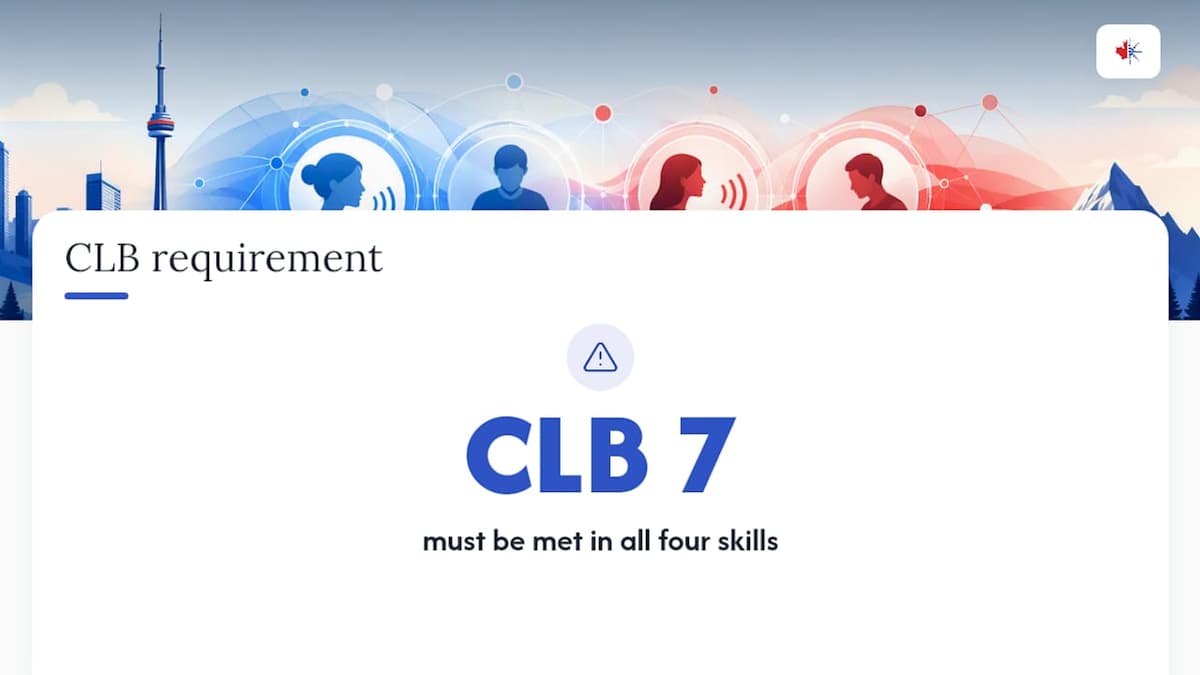
- The minimum CLB level needed varies by program but is often CLB 7 across all skills, with weaknesses in any area potentially disqualifying an application.
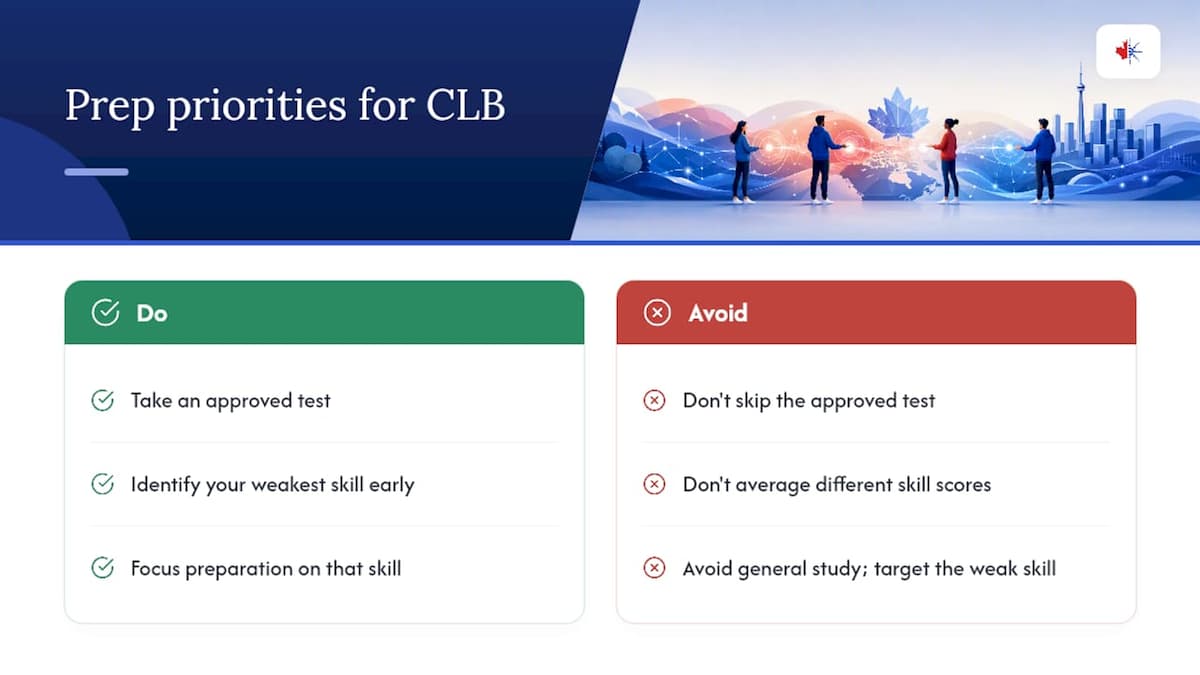
- To improve your CLB score, focus specifically on practice that targets your weakest skill and avoid averaging scores across different skills.
- Always check the latest IRCC tables for your test, and keep a screenshot of your conversion to avoid confusion during application processing.
Table of Contents
- Cefr to CLB: the official IRCC conversion tables
- Why CEFR is not the same as CLB
- How to check your CLB from your test results
- What CLB level you need for common immigration programs
- Practical next steps: how to reach your CLB target
- The gap between CEFR familiarity and CLB readiness
- Celpipguide: prepare for CELPIP and hit your CLB target
- Sources
- FAQ
Cefr to CLB: the official IRCC conversion tables
IRCC does not care what your CEFR certificate says. It cares what your CELPIP, IELTS General Training, or PTE Core report says, because those are the only tests it accepts for English proficiency in most immigration streams. French speakers go through TEF Canada or TCF Canada, which map to the NCLC (the French-language equivalent of CLB).
Here’s the part people miss: CLB is not one number. It’s four numbers, one per skill, and each test has its own conversion grid. A CELPIP score of 7 in a skill lines up with CLB 7 in that same skill, because CELPIP was actually built around the CLB scale from the start. IELTS General Training and PTE Core weren’t, so their score bands get mapped separately by IRCC, and the numbers don’t always feel intuitive at first glance.
Here’s how the most commonly referenced benchmarks line up for CLB 7 and CLB 9, based on IRCC’s published tables:
| CLB level | CELPIP (per skill) | IELTS General Training | PTE Core |
|---|---|---|---|
| CLB 7 | 7 | Scores around 6.0 in each IELTS skill | PTE Core scores mapping to CLB 7 vary by skill |
| CLB 9 | 9 | Higher IELTS band scores correspond to CLB 9 but vary by skill | PTE Core higher band scores correspond to CLB 9 but vary by skill |
A few things to keep in mind before you go hunting for your number:
- Each skill is converted on its own. Your reading score doesn’t blend with your speaking score.
- IELTS and PTE Core bands shift slightly by skill, so don’t assume a flat 6.0 equals CLB 7 across the board without checking the specific table row.
- French-track applicants need the TEF Canada or TCF Canada grids, which convert to NCLC, not CLB directly.
Always check the current IRCC page for your exact test, since these grids get refined over time.
Why CEFR is not the same as CLB
CEFR and CLB share a philosophy. Both describe what a person “can do” with a language rather than just testing grammar rules in isolation. But research aligning the two frameworks found they were built for different jobs. CEFR was designed as a general European reference for language education. CLB was designed specifically around Canadian settlement, workplace tasks, and daily life scenarios, like reading a rental agreement or making a doctor’s appointment.
That difference in purpose creates real gaps. Government research into the CLB’s theoretical framework notes that the top range of the CLB scale overlaps with CEFR’s C levels in some descriptors, but the overlap isn’t clean or consistent across every skill.
Three mistakes trip up applicants over and over:
- Averaging skill scores instead of mapping each one separately.
- Trusting an informal CEFR to CLB chart found online instead of an official IRCC table.
- Assuming a CEFR-based school certificate satisfies IRCC’s language requirement.
Both frameworks share a can-do approach to describing proficiency, but CLB was developed independently, with its own settlement and workplace focus, and the two are not directly interchangeable.
That last point is the one that costs people the most time. A CEFR-based report from a language school will not get accepted in your application, no matter how strong your actual English or French is.
How to check your CLB from your test results
Once you have an approved test report in hand, the process is mechanical. Follow it in order and you’ll avoid the most common mix-ups.
- Find your per-skill scores. Your test report lists four separate numbers: listening, reading, writing, speaking. Don’t average them.
- Open the matching IRCC table for your test. CELPIP, IELTS General Training, and PTE Core each have their own conversion grid, and French tests convert to NCLC instead of CLB.
- Map each skill individually. Write down the CLB level for each of the four skills. This is your real profile, not a single overall score.
- Check the program’s per-skill minimums. Most programs set a floor for every skill, not just an average, so one weak skill can disqualify an otherwise strong application.
If all you have right now is a CEFR level from a course or an old certificate, use it only as a rough directional guide. Book an approved test before you rely on that number for anything official.
Pro Tip: Keep a screenshot of the IRCC table row that matches your exact scores. If your application gets questioned later, you’ll have the source ready instead of scrambling to find it again.
What CLB level you need for common immigration programs
CLB 7 shows up constantly in Express Entry discussions, and for good reason. It’s a common minimum threshold for principal applicants in several federal programs, while some trade or lower-TEER occupation streams accept CLB 5. The exact number depends entirely on the specific program, so always confirm on the program’s own eligibility page rather than assuming.
Here’s where people get caught off guard: eligibility runs on your weakest skill, not your best one. If your speaking sits at CLB 9 but your writing sits at CLB 6, and the program needs CLB 7 across all four skills, you don’t qualify yet. Boosting your strongest skill further won’t fix that gap.
CLB also drives Comprehensive Ranking System points directly, and the jump from CLB 7 to CLB 9 or higher can add a meaningful chunk of points to your Express Entry profile. Our breakdown of CLB scores and Express Entry points walks through exactly how those point bands work if you want the fuller picture, and our CLB score and PR application guide covers program-specific detail.
Language proficiency also feeds into how Canadian employers assess your resume, which our partners at Professional Resume Writing Services cover in more detail if you’re job hunting alongside your application.
Practical next steps: how to reach your CLB target
Once you know which skill is holding your CLB back, the fix is targeted practice, not generic studying. If your speaking score needs to reach CLB 7 or higher, focus specifically on extended responses to workplace scenarios, the kind IRCC’s own descriptors emphasize for that level.
An effective diagnostic and mock exam system helps pinpoint which skill needs work before you waste weeks on the wrong one.
- Run a diagnostic first to see your current standing per skill before picking a study plan.
- Practise timed reading comprehension if your reading skill sits below target, since pacing is usually the real issue, not vocabulary.
- Work through information-gap speaking tasks if your speaking score needs a lift, since that task type mirrors what CLB 7 and up actually demand.
- Use full-length mock exams to build stamina, since fatigue in the final section is a common score killer.
Pro Tip: Practise the specific task types your target CLB level demands, not just “English in general.” A CLB 9 writing task and a CLB 6 writing task ask for genuinely different things.
If you want a deeper look at pushing higher CLB levels specifically, our guide on getting CLB 9+ in CELPIP speaking and writing breaks down what changes between the mid and upper bands.
The gap between CEFR familiarity and CLB readiness
Most applicants arrive already comfortable with CEFR, because it’s the framework their schools, apps, and certificates used for years. That familiarity creates a false sense of security. The conventional advice out there treats CEFR to CLB conversion as a quick lookup, a chart you glance at once and move on. That undersells how much the two frameworks diverge once you get into workplace and settlement specific tasks, which is exactly where CLB lives and CEFR doesn’t.
What the research actually supports is narrower and more useful: don’t skip an approved test, and don’t average your skills. Those two habits cause more rejected applications than any actual gap in language ability. I’d go further than most guides and say the real priority isn’t studying harder in general, it’s identifying your weakest skill early and building your entire prep plan around fixing that one thing. A CLB 9 speaker with CLB 6 writing doesn’t need more speaking practice. They need writing practice, specifically, and soon.
— Reza
Celpipguide: prepare for CELPIP and hit your CLB target
Once you know which skill is holding your CLB score back, the fastest path forward is targeted practice, not another full course you don’t need. Celpipguide’s CELPIP readiness check maps your current level against your target CLB benchmark for free, so you know exactly where to spend your study time before you spend a dollar.
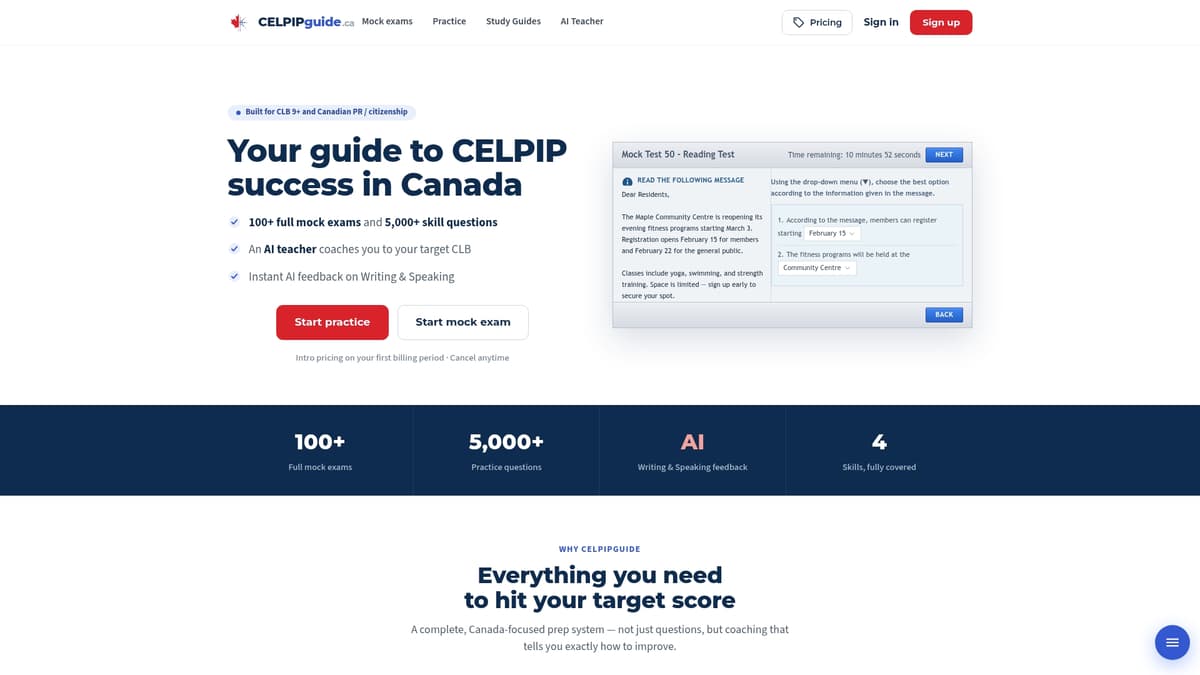
AI feedback can score your speaking and writing against rubric structures used by examiners, catching gaps a self-study guide might miss. Full-length mock exams simulate real test conditions, and the practice hub breaks tasks down by skill so you’re not guessing which section needs the most attention. Run your free readiness check, see your skill-by-skill standing, and build a study plan around your actual weak points.
Sources
- Language test results — Express Entry (Government of Canada)
- Aligning the Canadian Language Benchmarks (CLB) to the Common European Framework of Reference (CEFR)
FAQ
What is CEFR level C1 in CLB?
CEFR C1 roughly overlaps with the upper range of the CLB scale, but the alignment research shows the overlap varies by skill and descriptor, so there’s no single clean CLB number for C1. Book an approved test for an official CLB result rather than relying on this comparison.
Is CLB 7 equivalent to B2?
CLB 7 is often discussed alongside CEFR B2 in informal comparisons, but IRCC does not publish an official CEFR equivalency for CLB. Your actual CLB 7 status comes only from an approved test result mapped through IRCC’s conversion tables.
What is A1, A2, B1, B2, C1, C2 language proficiency?
These are the six CEFR levels, running from A1 (basic beginner) through C2 (near-native mastery), each describing what a learner can do in reading, writing, listening, and speaking. CEFR is widely used in Europe for language education but isn’t accepted by IRCC as proof of proficiency for Canadian immigration.
How do I calculate my CLB level?
Take your approved test report (CELPIP, IELTS General Training, or PTE Core), find your score for each of the four skills, and match each one against IRCC’s per-test conversion table. Never average your skills; each one gets its own CLB level, and our CELPIP score calculator can help you estimate CLB and CRS impact from a CELPIP result.