
CELPIP Blog
CELPIP-General: your guide to meeting CLB targets for immigration
CELPIP-General: your guide to meeting CLB targets for immigration

IRCC accepts CELPIP-General as proof of English for immigration and citizenship applications. If you are applying through Express Entry, a provincial nominee program, or a temporary-resident-to-PR pathway, CELPIP-General is the test you need. Not CELPIP-LS, not another variant — specifically CELPIP-General.
Here is what to do right now:
- Check your CLB target. Every immigration stream sets a minimum Canadian Language Benchmark (CLB) level. Find yours before you book anything.
- Book a CELPIP-General slot at an approved test centre or online, leaving enough buffer for results to arrive before your application deadline.
- Run a diagnostic test to see where you stand against your CLB target before you start studying.
- Include your results with your application. IRCC requires that your test results be less than two years old at the date you apply. Keep a copy for your records.
Key takeaways
CELPIP-General is the accepted English proficiency test for Canadian immigration, and your CLB target, test validity window, and preparation method all determine whether your application succeeds.
| Point | Details |
|---|---|
| CELPIP-General is IRCC-accepted | Only CELPIP-General (not other variants) satisfies IRCC’s English language requirement. |
| CLB minimums vary by stream | Federal Skilled Worker requires CLB 7 per skill; other programs set lower minimums by NOC TEER. |
| Two-year validity rule | Test results must be less than two years old when you submit your application to IRCC. |
| Diagnostic before booking | A diagnostic test identifies your weakest skills so your study time targets the right CLB gaps. |
| Celpipguide for preparation | Celpipguide offers 100+ mock exams, 5,000+ practice questions, and AI feedback to raise per-skill CLB scores. |
Table of Contents
- What CLB score does your immigration stream require?
- How do CELPIP scores convert to CLB levels?
- What you need to know about booking, fees, and test validity
- How to build a study plan that actually reaches your CLB target
- How Celpipguide helps you reach your CLB goals
- What actually separates candidates who improve from those who plateau
- Celpipguide subscription options and a special offer
- Sources
- FAQ
What CLB score does your immigration stream require?
Your CLB target depends on which program you are applying through and, in some cases, your job offer’s NOC TEER category. The table below maps the most common streams to their minimum CLB requirements.
| Immigration stream | Minimum CLB | Notes |
|---|---|---|
| Express Entry: Federal Skilled Worker | CLB 7 (all four skills) | Higher CLB = more CRS points |
| Express Entry: Canadian Experience Class | CLB 7 (NOC TEER 0–1) / CLB 5 (TEER 2–3) | Per-ability minimum applies |
| Express Entry: Federal Skilled Trades | CLB 5 (listening, reading) / CLB 4 (speaking, writing) | Trade-specific minimums |
| Atlantic Immigration Program | CLB 5 (TEER 0–3) / CLB 4 (TEER 4) | Tied to NOC TEER of job offer |
| Rural and Northern Immigration Pilot | CLB 6 (TEER 0–1) / CLB 5 (TEER 2–3) / CLB 4 (TEER 4–5) | Varies by community |
| TR-to-PR pathways | Varies by stream | Must include results with application |
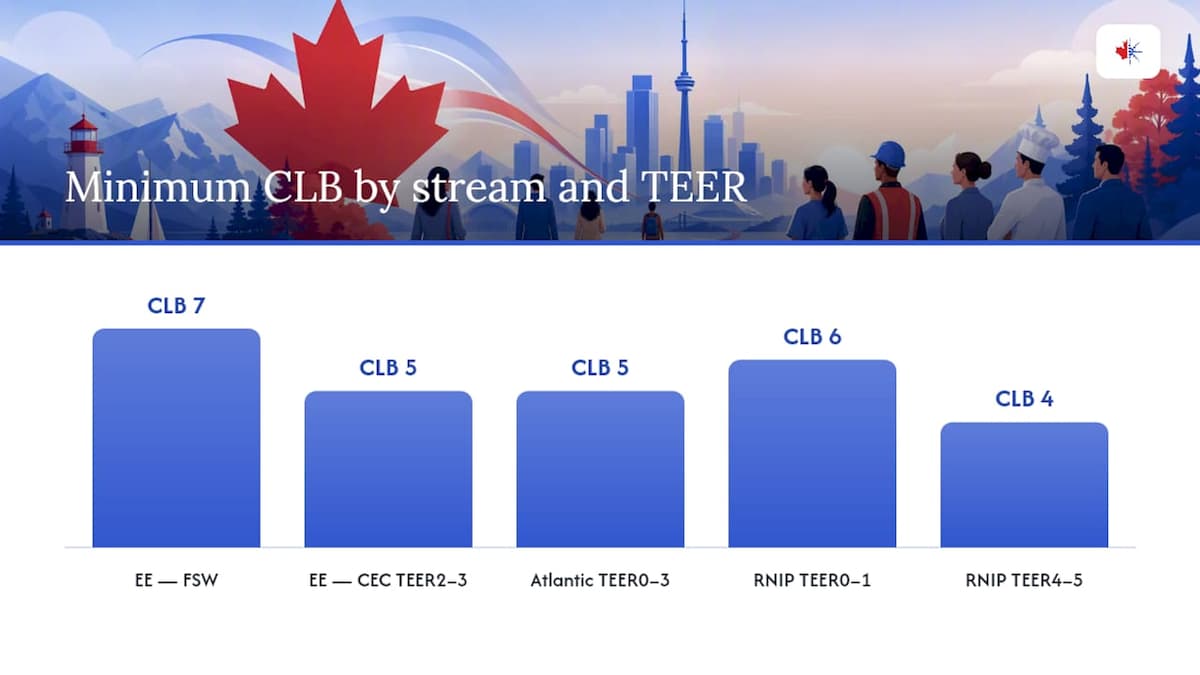
For the Federal Skilled Worker Program, CLB level directly affects your Comprehensive Ranking System (CRS) score. Each ability (listening, speaking, reading, writing) earns points separately: CLB 7 earns 4 points per ability, CLB 8 earns 5, and CLB 9 or 10+ earns 6. That is a maximum of 24 points for your first official language alone.
Pro Tip: Aim at least one CLB level above the stream minimum. That extra level can add 4–8 CRS points per ability, which sometimes makes the difference between receiving an Invitation to Apply and waiting another draw cycle.
How do CELPIP scores convert to CLB levels?
IRCC publishes official CLB conversion tables for CELPIP-General, mapping raw scores to CLB levels for each of the four skills. Here is the core mapping:
| CELPIP score | CLB equivalent |
|---|---|
| 4 | CLB 4 |
| 5 | CLB 5 |
| 6 | CLB 6 |
| 7 | CLB 7 |
| 8 | CLB 8 |
| 9 | CLB 9 |
| 10 | CLB 10 |
| 11 | CLB 11 |
| 12 | CLB 12 |
The mapping is one-to-one: a CELPIP score of 7 equals CLB 7, a score of 9 equals CLB 9. IRCC evaluates each ability independently, so a strong listening score does not compensate for a weak writing score. Every skill must clear the stream’s minimum on its own.
Worked example: Suppose you score Listening 8, Speaking 7, Reading 8, Writing 7 on CELPIP-General and you are applying through the Federal Skilled Worker Program. Your CLB equivalents are L8, S7, R8, W7. In Express Entry points, that translates to 5 + 4 + 5 + 4 = 18 CRS points for language. Raising Speaking and Writing to 8 would add 2 more points, bringing you to 20. Use the CELPIP score calculator to model your own scenario.
For a deeper breakdown of how per-skill CLB affects your immigration scoring, the CELPIP four-skills immigration scoring guide walks through each ability in detail.
What you need to know about booking, fees, and test validity
Planning your test date carefully is one of the most practical things you can do for your application timeline. Here is a step-by-step checklist:
- Find an approved test centre or online option. IRCC requires you to use an approved testing agency. CELPIP-General is administered by Paragon Testing Enterprises; check their official site for centre locations and online availability.
- Register and pay your fee. Fees are set by Paragon and are not publicly listed here, so confirm the current amount directly on the CELPIP registration page.
- Bring required identification on test day. Typically a valid passport. Confirm the exact ID requirements when you register.
- Plan for results turnaround. CELPIP-General results are typically available within four to five business days of your test date.
- Build in a buffer. Allow at least three to four weeks between your test date and your application submission deadline to account for any delays.
The critical rule: IRCC requires your test results to be less than two years old at the date you submit your application. If your results expire before you apply, you will need to retake the test. That resets your timeline and can delay a PR application by several months, so build that two-year window into your planning from the start.
If you are applying for accommodations on test day, review the documentation process early. Resources like LSAT Accommodations explain how accommodation evidence is gathered and submitted for standardised tests, which can inform your approach when requesting CELPIP accommodations through Paragon.
How to build a study plan that actually reaches your CLB target
Start with a diagnostic test before you book your test date. A diagnostic tells you exactly which skills are below your target CLB, so you study what matters instead of reviewing what you already know.
Study timelines by target CLB
Targeting CLB 4–5: Four to six weeks of focused daily practice is usually enough if you are starting close to the target. Prioritise basic vocabulary, sentence structure for writing, and listening for main ideas.
Targeting CLB 6–7: Eight to twelve weeks. At this level, accuracy and fluency both matter. Add timed reading practice, structured speaking responses, and writing templates with correction cycles.
Targeting CLB 8 and above: Twelve or more weeks. The gap between CLB 7 and CLB 9 is significant. You need consistent mock exam practice, detailed feedback on writing and speaking, and active work on vocabulary tied to CLB descriptors.
Skill-specific drills that move the needle
For speaking, record yourself answering CELPIP task prompts for five minutes daily. Play it back and listen for hesitation, filler words, and sentence variety. For reading, practise under timed conditions from day one — the test does not give you extra time, and pacing is where most candidates lose marks. For listening, take notes while you listen rather than trying to hold everything in memory. For writing, use a template structure for each task type, then run your draft through rubric-based feedback to catch errors before they become habits.
After four to six weeks of targeted practice, run a full mock exam under real test conditions. Your mock results will show which skills are still below target and where to focus your final weeks.
Pro Tip: Download the official CLB descriptors from the Centre for Canadian Language Benchmarks and use them as weekly micro-goals. If your writing is at CLB 6, read the CLB 7 descriptor and write one response that specifically demonstrates those features. That gap-closing method is faster than generic practice.
How Celpipguide helps you reach your CLB goals
Celpipguide is built specifically for the diagnostic-to-mock-exam preparation cycle described above. Here is what the platform gives you:
- Diagnostic assessment to identify your starting CLB level per skill before you commit to a study plan.
- AI-personalised study plans that adjust weekly based on your progress and target CLB.
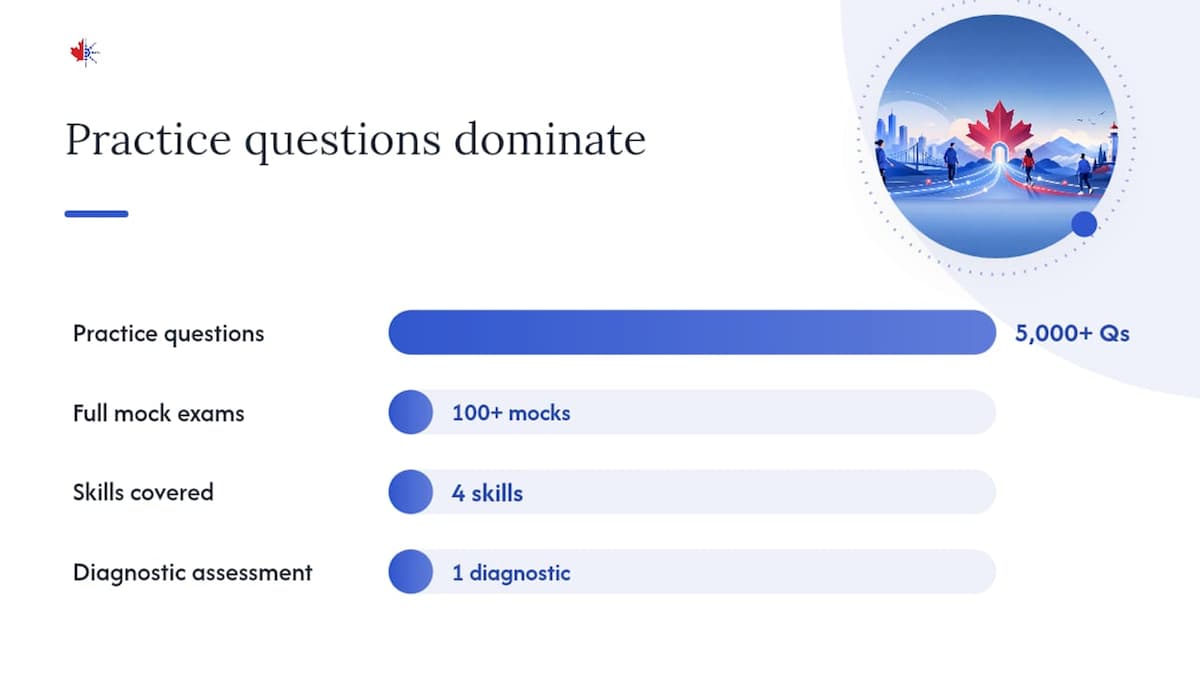
- 100+ full mock exams simulating real CELPIP-General conditions, including timing.
- 5,000+ practice questions covering all four skills at every CLB level.
- Instant rubric-based feedback on writing and speaking tasks, so you know exactly why a response scores at CLB 7 versus CLB 8.
- Progress tracking across all four skills so you can see improvement week over week.
A typical subscriber workflow looks like this: take the diagnostic on day one, review the personalised study plan, complete targeted skill drills for two to four weeks, then run a full mock exam. Repeat the mock-exam cycle every two weeks until all four skills consistently hit your target CLB. The CELPIP study plan generator builds this schedule for you automatically based on your test date and target score.
Pro Tip: Use the free AI writing checker on your first practice response before you subscribe. It gives you rubric-level feedback immediately, which shows you exactly what the scoring system is looking for.
What actually separates candidates who improve from those who plateau
Most candidates who stall before their target CLB share the same three habits: they study passively (reading about the test instead of doing timed tasks), they skip the diagnostic and guess at their weak skills, and they treat mock exams as a final check rather than a training tool to use throughout preparation.
The quick wins are simpler than most people expect. A five-minute speaking sprint every morning, where you respond to a prompt out loud and then listen back critically, builds fluency faster than an hour of silent vocabulary review. Back-timing your writing tasks — starting from the end of the time limit and working backward — forces you to prioritise the highest-value sentences first. Active listening with a notepad, where you jot the main idea and two supporting details for every audio clip, trains the exact skill the test measures.
The candidates who reach CLB 8 or above consistently are the ones who treat each mock exam as diagnostic data, not just a score. They look at which question types cost them marks, then drill those specifically before the next mock.
Celpipguide subscription options and a special offer
Reaching your CLB target is a concrete, achievable goal when you practice with the right material under real test conditions. Celpipguide gives you exactly that: over 100 full mock exams, AI-driven writing and speaking feedback, and a personalised week-by-week plan built around your test date.
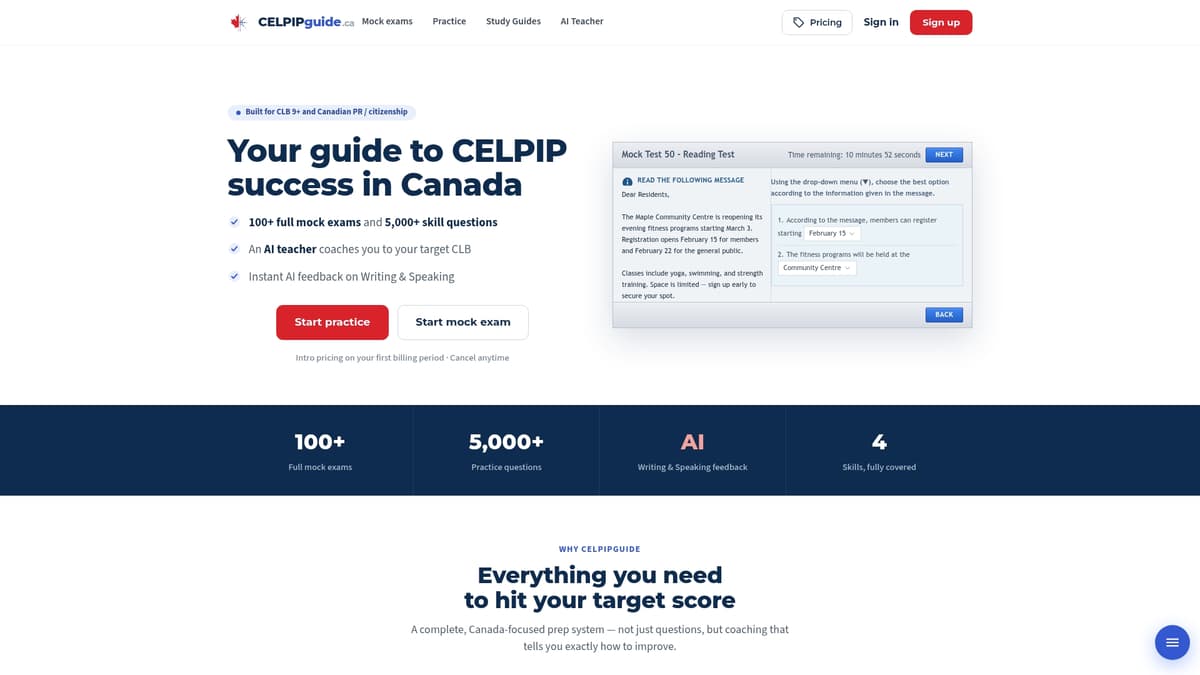
Subscriptions are available weekly, monthly, and quarterly, with each tier unlocking the full mock exam library, AI feedback, and expanded practice features.
Start with the CELPIP practice hub to run your first diagnostic and see your starting CLB level across all four skills. From there, the platform builds your study plan and tracks your progress to test day.
Sources
IRCC official pages:
Celpipguide resources:
FAQ
Is CELPIP-General accepted for all Canadian immigration programs?
IRCC accepts CELPIP-General for Express Entry programs, the Atlantic Immigration Program, the Rural and Northern Immigration Pilot, and TR-to-PR pathways, among others. Always confirm the accepted tests for your specific stream on the IRCC program page before booking.
What CELPIP score do I need for CLB 7?
A CELPIP score of 7 in any skill equals CLB 7. For the Federal Skilled Worker Program, you need a score of at least 7 in all four skills: listening, speaking, reading, and writing.
How long are CELPIP-General results valid for immigration applications?
IRCC requires test results to be less than two years old at the date you submit your application. Plan your test date with that window in mind to avoid having to retake the exam.
Can I retake CELPIP-General if my scores are too low?
Yes. There is no mandatory waiting period between attempts. If your scores fall short of your CLB target, you can rebook and retake the test. Factor the retake timeline into your application planning, since results typically take four to five business days to arrive.
How does Celpipguide help me reach my target CLB faster?
Celpipguide starts with a diagnostic test to identify your weakest skills, then generates a personalised study plan and tracks your progress through 100+ mock exams and 5,000+ practice questions. AI feedback on writing and speaking tasks shows you exactly what to fix before test day.