
CELPIP Blog
CELPIP test guide: which version to take and how to pass
CELPIP test guide: which version to take and how to pass

The CELPIP test (Canadian English Language Proficiency Index Program) is a computer-delivered English exam accepted by Immigration, Refugees and Citizenship Canada (IRCC) for permanent residency, citizenship, and many professional designations. Your first move: decide whether you need CELPIP General (four skills) or CELPIP General LS (listening and speaking only), then book through the official registration portal.
Three quick facts before you go further:
- The test is developed and administered by Paragon Testing Enterprises, a subsidiary of UBC.
- Scores map directly to Canadian Language Benchmarks (CLB), the scale IRCC uses to assess language ability.
- Results are typically available within 4–8 calendar days of your test date and remain valid for two years.
Key takeaways
The single most important thing to know: choose the right CELPIP version for your immigration goal, book through the official Paragon portal, and practise with full-length timed mocks that include rubric-based feedback on writing and speaking.
| Point | Details |
|---|---|
| Choose the right test version | CELPIP General for PR and professional designations; General LS for citizenship only. |
| CLB target for Express Entry | CLB 7 qualifies; CLB 9 earns maximum language points in the CRS. |
| Results and validity | Scores arrive within 4–8 calendar days and remain valid for two years. |
| Study plan starting point | Take a diagnostic test first to identify weak skills before committing to a schedule. |
| Celpipguide for structured prep | 100+ full mocks and AI rubric feedback help you target CLB gaps faster than unguided practice. |
Table of Contents
- What is the CELPIP test and who accepts it?
- Which CELPIP test should you take: General or General LS?
- What does each section of the CELPIP test look like?
- How is CELPIP scored and what CLB level do you need?
- How to register, book a test date, and what to expect at the centre
- Official free practice versus paid mock exams: what to prioritise
- Test-day rules and how to handle common problems
- A prescriptive 4–8 week study plan to raise your CELPIP score
- What actually moves the needle fastest
- Celpipguide gives you the mock exams and AI feedback to score higher, faster
- Sources
- FAQ
What is the CELPIP test and who accepts it?
CELPIP is a fully computer-based English proficiency exam designed specifically for Canadian contexts. Every task, every audio clip, and every writing prompt reflects real Canadian situations — a job email, a neighbourhood notice, a phone conversation. That Canadian framing is one reason it tends to feel more natural to people already living in Canada than other international exams.
National Bank’s newcomer resource confirms CELPIP’s broad acceptance across immigration pathways, and the list of accepting bodies is long:
- IRCC accepts CELPIP General for Express Entry (Federal Skilled Worker, Canadian Experience Class, Federal Skilled Trades) and for permanent residency applications generally.
- IRCC also accepts CELPIP General LS for adult citizenship applications.
- Professional regulators including some nursing, engineering, and pharmacy bodies accept CELPIP General for licensure.
- Provincial Nominee Programs (PNPs) across most provinces accept CELPIP General scores.
Fast facts at a glance:
| Detail | CELPIP General | CELPIP General LS |
|---|---|---|
| Skills tested | Listening, Reading, Writing, Speaking | Listening, Speaking |
| Approximate duration | About three hours | About one hour |
| Fee (approximate) | Approximately CAD $280 | Approximately CAD $200 |
| Results timeline | 4–8 calendar days | 4–8 calendar days |
| Score scale | 1–12 per skill | 1–12 per skill |
Note: Fees are set by Paragon Testing Enterprises and may vary slightly by test centre. Always confirm the current fee on the official registration site before booking.
Which CELPIP test should you take: General or General LS?
The answer comes down to one question: what are you applying for?
CELPIP General tests all four language skills — Listening, Reading, Writing, and Speaking — and takes roughly three hours. You need this version for Express Entry, most Provincial Nominee Programs, and professional designation applications. It is also the version accepted for citizenship if you prefer a single test that covers both use cases.
CELPIP General LS tests only Listening and Speaking, runs about 90 minutes, and is accepted exclusively for adult Canadian citizenship applications. It is shorter and, for many test takers, less stressful because it removes the reading and writing components entirely. If citizenship is your only goal right now, LS is a legitimate and practical choice.
| Goal | Correct test | Why |
|---|---|---|
| Express Entry / PR | CELPIP General | IRCC requires all four skills for PR applications |
| Canadian citizenship (adult) | CELPIP General or General LS | Both accepted; LS is shorter |
| Professional designation (nursing, pharmacy, etc.) | CELPIP General | Regulators require all four skills |
| Provincial Nominee Program | CELPIP General | Most PNPs require four-skill results |
One practical note: if you are applying for PR now and citizenship later, taking CELPIP General once covers both milestones, provided your scores remain valid (two years). That saves you a second registration fee and another test day.
What does each section of the CELPIP test look like?
The test runs in a fixed order: Listening, Reading, Writing, then Speaking. Here is what you will face in each section.
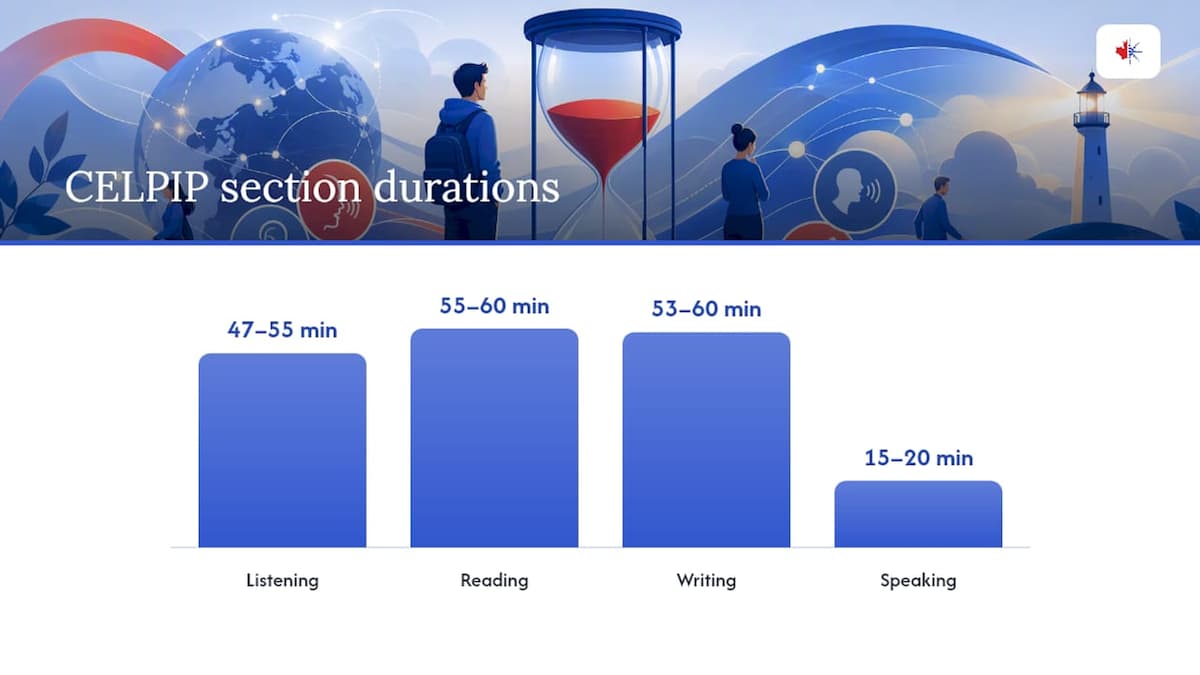
Listening (approximately 47–55 minutes)
Eight parts covering everyday Canadian situations — a conversation between neighbours, a news report, a workplace discussion. Tasks include multiple-choice questions, fill-in-the-blank responses, and matching exercises. Raters assess how accurately you identify main ideas, specific details, and speaker intent.

Pro tip for listening: Take notes on paper during each audio clip. You cannot replay recordings, so jotting down names, numbers, and key actions gives you something to reference when answering.
Reading (approximately 55–60 minutes)
Four parts with passages drawn from emails, advertisements, workplace notices, and longer articles. Tasks include multiple choice, sentence insertion, and reading-to-respond (reading a document and then writing a short reply). Speed matters here — many test takers run out of time on Part 4.
Writing (approximately 53–60 minutes)
Two tasks: a short email (150–200 words, 27 minutes) and a survey response or opinion piece (150–200 words, 26 minutes). Raters score on content/coherence, vocabulary range, readability, and task fulfilment.

Sample task (Writing Task 1): “Your neighbour has been playing loud music late at night. Write an email to your building manager describing the problem and requesting action.”
Pro tip for writing: Spend the first three minutes planning your email structure (greeting, problem, request, closing). Test takers who plan first consistently produce more coherent responses than those who type immediately.
Speaking (approximately 15–20 minutes)
Eight tasks recorded directly on your computer. Tasks include describing a scene, giving advice, expressing an opinion, and retelling a story. Raters assess vocabulary range, clarity, coherence, and pronunciation.
Sample task (Speaking Task 6): “A friend asks whether they should move to a new city for a job. Give your opinion and explain your reasons.”
For structured speaking templates and sample CELPIP speaking answers, reviewing scored examples before test day makes a real difference.
Compact timing overview:
| Section | Approximate time | Key task types |
|---|---|---|
| Listening | 47–55 min | Multiple choice, fill-in, matching |
| Reading | 55–60 min | Multiple choice, sentence insertion, read-to-respond |
| Writing | 53–60 min | Email, survey/opinion response |
| Speaking | 15–20 min | Description, advice, opinion, story retell |
How is CELPIP scored and what CLB level do you need?
Each of the four skills is scored on a scale of 1–12. Those scores convert directly to CLB levels, which is the number IRCC actually uses when assessing your application. Understanding this conversion is where preparation gets practical.
Example conversion:
| CELPIP score | CLB level |
|---|---|
| 4 | CLB 4 |
| 7 | CLB 7 |
| 9 | CLB 9 |
| 10 | CLB 10 |
For a deeper breakdown of how CLB scores affect Express Entry points, the relationship between your language score and your Comprehensive Ranking System (CRS) total is significant.
Common CLB targets:
- Express Entry (Federal Skilled Worker): minimum CLB 7 in all four skills to qualify; CLB 9 or higher earns maximum language points in the CRS.
- Canadian citizenship (adult): CLB 4 in speaking and listening (CELPIP General LS meets this requirement).
- Professional designations: requirements vary by regulator; many nursing bodies require CLB 7 or higher.
Important: Always verify current CLB requirements directly with IRCC or your professional regulator before booking. Programme-specific thresholds can change, and this article provides general guidance only.
Results arrive within 4–8 calendar days and are valid for two years from the test date.
How to register, book a test date, and what to expect at the centre
Registration happens entirely through the official Paragon booking portal. Here is the process step by step:
- Create a Paragon account at the registration portal using a valid email address.
- Choose your test type — CELPIP General or CELPIP General LS.
- Select a test format — in-person at a test centre or at-home (ProctorU-supervised).
- Pick a date and location — the portal shows available dates by city and centre.
- Complete payment — the fee is approximately CAD $280; accepted methods include major credit cards.
- Receive confirmation — a booking confirmation email arrives immediately; save it.
At-home testing is available for CELPIP General and requires a compatible computer (Windows or Mac), a working webcam, a stable internet connection, and a quiet, private room. You will be supervised by a live proctor via ProctorU throughout the test.
What to bring to a test centre:
- One piece of government-issued photo ID (passport strongly recommended).
- Your booking confirmation (printed or on your phone).
- No personal items are permitted at your workstation — no phones, notes, or food.
Common booking mistakes to avoid:
- Booking the wrong test type (General vs. LS) — double-check your application requirement before paying.
- Choosing a test date too close to your application deadline — allow at least two weeks for results plus processing time.
- Using a name on your account that does not exactly match your ID — this can cause check-in problems on test day.
Official free practice versus paid mock exams: what to prioritise
Start with the official free materials. Paragon offers free CELPIP-General practice tests that include full-test samples, answer keys, and performance standards showing exactly what raters look for. These are your baseline — use them to get familiar with task formats and timing before anything else.
Once you know the format, free practice alone has a ceiling. It does not give you personalised feedback on why your writing scored a 6 instead of an 8, or which speaking habits are pulling your score down. That is where paid mock exams earn their place.
What makes a paid practice product worth it:
- Full-length timed mocks that replicate actual test conditions (all four sections, no breaks between).
- AI or rubric-based feedback on writing and speaking tasks, not just a score.
- A large question bank (ideally 5,000+ questions) so you are not repeating the same items.
- CLB-aligned scoring so your practice score translates directly to an immigration target.
- A diagnostic tool that identifies your weakest skill areas before you spend hours on the wrong drills.
Paragon also sells official paid practice products through its secure portal. These are authentic in format but do not include AI feedback on open-ended tasks.
Recommended daily practice mix:
- 30 minutes of timed section drills (rotate skills daily).
- 15 minutes reviewing AI or rubric feedback from the previous session’s writing or speaking task.
- 10 minutes of CLB vocabulary work focused on your weakest skill.
Pro Tip: Use the free CELPIP writing checker to get instant rubric-based feedback on your email and survey responses before committing to a full mock exam. Seeing your score broken down by coherence, vocabulary, and task fulfilment tells you exactly where to focus.
Test-day rules and how to handle common problems
Arriving prepared on test day is as much about logistics as it is about English ability. A technical glitch or a forgotten ID can derail an otherwise strong performance.
Test-day checklist:
- Bring your passport or government-issued photo ID — the name must match your booking exactly.
- Arrive at least 30 minutes early at a test centre; log in 15 minutes before your scheduled start for at-home testing.
- For at-home: run the ProctorU system check the day before, not the morning of.
- No scratch paper is provided at centres; you will have an on-screen notepad for the listening section.
- Wear layers — test centres vary in temperature and you cannot leave mid-test.
Common at-home technical issues and quick fixes:
- Webcam not detected: restart your browser and replug the USB connection before contacting ProctorU support.
- Audio cutting out: close all background applications and switch to a wired internet connection if possible.
- Proctor cannot hear you: check your system’s default microphone settings in your OS audio preferences.
If a serious technical failure occurs mid-test, do not close the browser. Contact ProctorU support immediately through the live chat window — they can pause and resume sessions for verified technical issues.
Pro Tip: For the speaking section, do not restart a response if you stumble. Raters assess your overall fluency and coherence, not a single hesitation. Keep going and finish the task — an incomplete response scores lower than an imperfect but complete one.
A prescriptive 4–8 week study plan to raise your CELPIP score
The fastest path to a higher score is not more practice — it is targeted practice. Start by knowing exactly where you stand.
- Week 1 — Diagnostic: Take a full diagnostic test and map your results to CLB levels. Identify your two weakest skills. Use Celpipguide’s study plan generator to build a week-by-week plan from your diagnostic results.
- Weeks 2–3 — Skill cycles: Spend two focused sessions per week on each weak skill. Use timed drills, not casual reading. For listening, practise with everyday-situation audio tasks that mirror real CELPIP parts.
- Weeks 4–5 — Full mock exams: Take one full-length timed mock per week under real conditions. Review AI feedback on every writing and speaking task before your next session.
- Weeks 6–7 — Targeted revision: Return to your two weakest skills with fresh drills based on mock feedback. Focus on professional vocabulary for CELPIP speaking tasks and email conventions for writing.
- Week 8 — Final polish: One final full mock, light review, and logistics confirmation (ID, booking, tech check for at-home).
Suggested weekly time investment:
- Beginner (CLB 4–5): 12–15 hours per week across all four skills.
- Intermediate (CLB 6–7): 8–10 hours per week with emphasis on speaking and writing feedback cycles.
- Advanced (CLB 8+): 5–6 hours per week focused on full mocks and score consistency.
Pro Tip: After each mock exam, do not just note your score — read every piece of AI feedback and write one corrected version of your lowest-scoring task. That single revision habit is what separates test takers who plateau from those who keep climbing.
What actually moves the needle fastest
Here is my honest take: most people preparing for this exam spend too much time on passive review and not enough time on feedback-driven revision. Reading grammar notes for two hours feels productive. Writing a timed email, getting rubric feedback, and rewriting it in 20 minutes actually is productive.
The types of English weaknesses CELPIP reveals — inconsistent vocabulary range, underdeveloped task coherence, speaking responses that trail off without a clear conclusion — are almost never fixed by more input. They are fixed by output with correction. The benefits of structured CELPIP prep for citizenship and PR applications go beyond the score itself: the discipline of timed, feedback-driven practice builds the kind of confident, organised English that serves you in interviews, workplaces, and community settings long after the test is done.
If you are comparing CELPIP vs. IELTS for immigration to Canada, CELPIP’s Canadian context and computer delivery tend to feel more familiar to people already living here. For students weighing CELPIP vs. IELTS, note that IELTS is more widely accepted internationally, while CELPIP is the stronger choice if your goal is specifically Canadian immigration or citizenship.
The CELPIP four-skills immigration scoring guide lays out exactly how each CLB level translates to CRS points — worth reading before you set your score target.
Celpipguide gives you the mock exams and AI feedback to score higher, faster
Scoring CLB 9 or higher on the CELPIP test is achievable — but only if your practice mirrors the real exam and gives you feedback that tells you why you lost points, not just that you did.
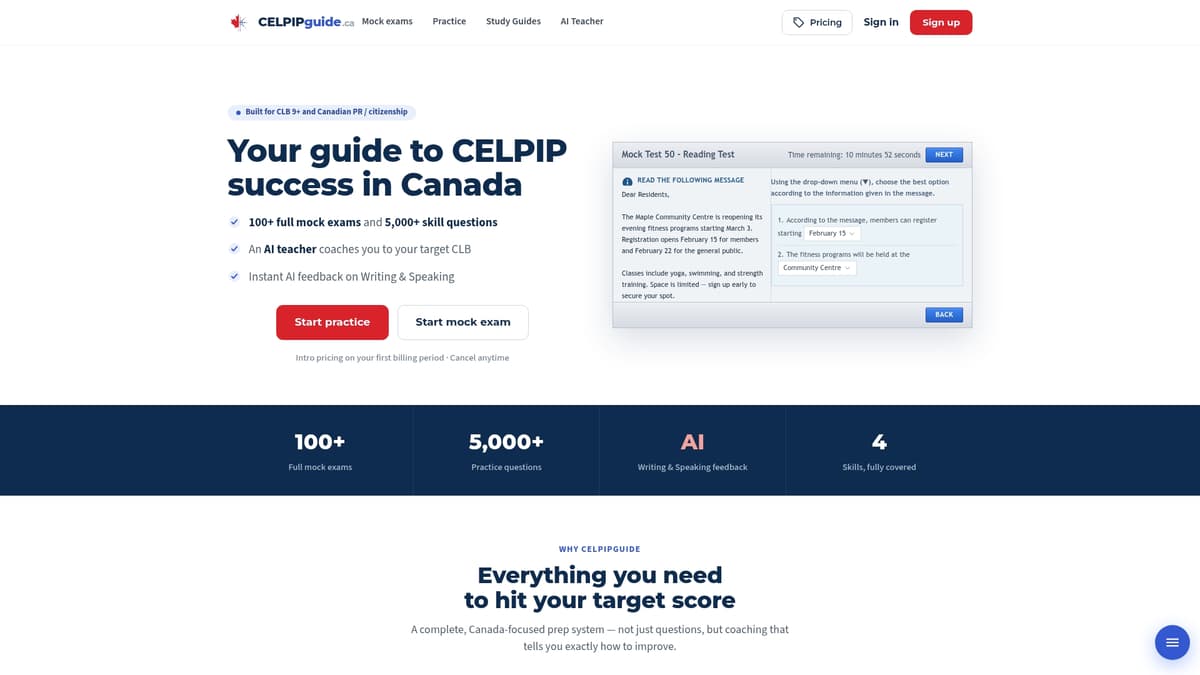
Celpipguide offers over 100 full-length mock exams and 5,000+ practice questions built to CEFR/CLB standards, plus an AI teacher that scores your writing and speaking tasks against the same rubrics raters use on test day. Start with a diagnostic test, get a personalised week-by-week study plan built around your CLB gaps, and work through timed mocks with instant feedback on every open-ended task. Use coupon BLG30 at checkout for 30% off on top of any current discounts. Head to the CELPIP practice hub to run your first mock exam today.
Sources
FAQ
Is CELPIP harder than IELTS?
Neither test is objectively harder, but they differ in format and context. CELPIP is fully computer-based with Canadian scenarios, while IELTS includes handwritten responses and more internationally varied content — test takers already living in Canada often find CELPIP’s context more familiar.
Is a score of 7 good on the CELPIP test?
A score of 7 maps to CLB 7, which meets the minimum language threshold for Express Entry’s Federal Skilled Worker Programme. To earn maximum CRS language points, you need CLB 9 (CELPIP score 9) or higher in all four skills.
Is the CELPIP test hard to pass?
“Passing” depends on your target CLB level. The citizenship requirement (CLB 4) is achievable for most intermediate English speakers with focused preparation; CLB 9 for Express Entry maximum points requires consistent, feedback-driven practice over several weeks.
Can I take the CELPIP test online at home?
Yes. Both CELPIP General and CELPIP General LS are available as at-home tests supervised by a live ProctorU proctor. You need a compatible computer, webcam, stable internet, and a quiet private room — full requirements are listed on the official registration portal.