
CELPIP Blog
Speaking fluency daily practice routine for CELPIP
Speaking fluency daily practice routine for CELPIP

TL;DR:
- Consistent daily output practice significantly improves speaking fluency, with 20 to 30-minute sessions being most effective.
- Structured strategies like shadowing, role-playing, and self-review, backed by research, produce large gains.
A focused daily routine of output-first practice is an effective way to improve speaking fluency. Pick your time budget, start today, and build from there:
- 5 minutes: Record a 2-minute non-stop talk on any topic, then listen back and note one thing to fix.
- 20–30 minutes: Warm up with shadowing, do structured output tasks (Describe Image, opinion response), then self-review one recording.
- 60 minutes: Full mock speaking session with timed tasks, shadowing, role-play, and a written note on three improvement points.
Research backs this up. A meta-analysis of language teaching practices spanning 1995–2019 found that structured, strategy-driven interventions produce a large positive effect on speaking proficiency, with an effect size of d = 0.90. That is not a modest gain. For CELPIP preparation specifically, Celpipguide’s AI teacher and CELPIP practice tasks map directly to this kind of structured daily output.
Table of Contents
- Why does structured daily practice actually improve your speaking?
- What do the 15, 30, and 60-minute daily routines look like?
- How should you rotate focus across the week to avoid plateaus?
- How do you do the high-impact activities correctly?
- How do you get useful feedback and track your progress?
- What prompts and phrases keep you speaking under pressure?
- How long before you notice real improvement?
- Key takeaways
- The part most learners get wrong about consistency
- Celpipguide gives your speaking routine instant, exam-aligned feedback
- Useful sources
- FAQ
Why does structured daily practice actually improve your speaking?
Output-focused practice reliably outperforms input-only study because production forces your brain to retrieve language under real-time pressure. Listening and reading build comprehension; speaking out loud builds the retrieval speed and motor memory you need when the clock is running. The meta-analysis effect size of d = 0.90 confirms that structured strategies move the needle significantly more than passive exposure alone.
Statistic callout: A meta-analysis covering 1995–2019 found structured speaking strategies produced an effect size of d = 0.90, placing them among the highest-impact interventions in language education.
Shadowing is one of the clearest examples of output driving gains. A controlled study of 40 EFL students showed the shadowing group made significant improvements in speech rate and pronunciation compared to the control group. The mechanism is simple: you are not just hearing the language, you are producing it simultaneously, which trains both accuracy and rhythm.
One common misconception is that fluency means speaking fast. It does not. Exam criteria reward steady pacing around 140–160 words per minute and natural rhythm. Rushing increases errors and makes responses harder to follow. Social interaction and risk-taking also drive oral development; tasks that mirror real communicative needs, like debates or problem-solving, build spontaneous retrieval better than rote memorisation.
What do the 15, 30, and 60-minute daily routines look like?
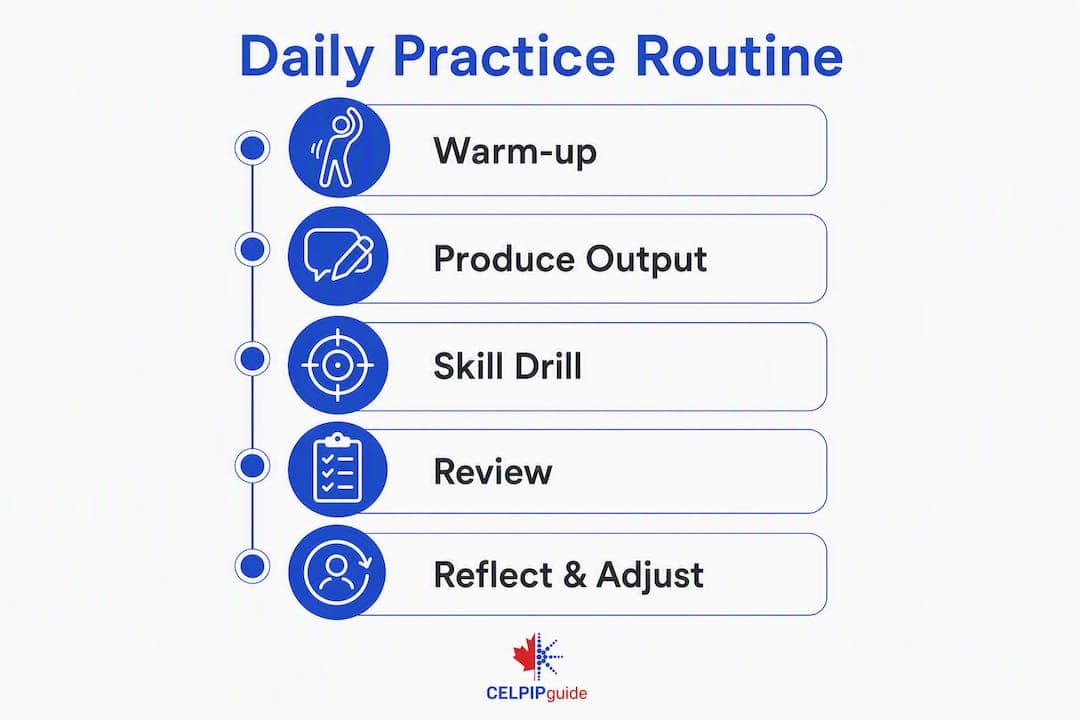
Every template below follows the same logic: warm up, produce output, drill a specific skill, then review. Pick the one that fits your schedule today.
| Time budget | Warm-up | Output block | Drill | Self-check |
|---|---|---|---|---|
| 5 min | — | 2-min non-stop talk | — | Note 1 issue |
| 5 min | 2-min shadowing | 5-min opinion response | — | Listen back once |
| 20–30 min | 3-min shadowing | structured output tasks | 5-min anchor-word drill | Review 1 recording |
| 60 min | 5-min shadowing | 20-min mock speaking tasks | 15-min role-play | Full review + notes |
Quick tips for each template:
- For the 15-minute version, use a single CELPIP-style prompt (e.g., “Describe a place you visit often”) and speak without stopping.
- For the 30-minute version, use the actual CELPIP preparation time (30–60 seconds) before each response to practise planning under exam conditions.
- For the 60-minute version, treat it as a timed exam simulation and do not pause or restart mid-response.
A daily target in the 20–30 minute range is the sweet spot for consistent gains. Shorter sessions build the habit; longer sessions build exam stamina.
How should you rotate focus across the week to avoid plateaus?
Practising the same skill every day leads to diminishing returns. A weekly rotation keeps your development broad and prevents the plateau that comes from over-drilling one area.
Sample weekly schedule:
- Monday: Fluency drills (2-minute non-stop talks, no pausing)
- Tuesday: Pronunciation and intonation (shadowing 30–60 second clips)
- Wednesday: Task-type rehearsal (Describe Image, Give Advice, Express Opinion)
- Thursday: Mock speaking session under timed conditions
- Friday: Role-play and register switching (formal vs. informal)
- Saturday: Self-review day: listen to the week’s recordings, note patterns
- Sunday: Free speaking on a topic you enjoy, no pressure
Each week, add one layer of complexity: a longer response, a more abstract topic, or a switch in register. Practice tests build exam confidence precisely because they replicate this kind of progressive pressure.
Low-friction reinforcement matters too. Narrate your morning routine out loud. Describe what you see on your commute. Think through decisions in English. These micro-moments compound over weeks without adding dedicated study time.
How do you do the high-impact activities correctly?
Shadowing
- Choose a 30–60 second clip of clear, natural English speech.
- Play one sentence, pause, and repeat it immediately, matching rhythm and intonation.
- Record yourself and compare to the original.
- Practise the same clip three times before moving on.
Recorded self-narration
- Set a 2-minute timer.
- Describe what you did today or narrate a simple task (making coffee, planning a trip).
- Listen back and count long pauses (over 2 seconds).
- Repeat the narration aiming to reduce those pauses by one or two.
Role-play
- Choose a scenario (job interview, giving directions, explaining a problem).
- Speak both sides of the conversation aloud.
- Focus on natural transitions and register, not perfect grammar.
Pro Tip: Use the four-anchor-word planning method for any timed speaking task. Before you speak, mentally note four key words that will structure your response. Develop each anchor into at least two sentences. This reduces filler use and keeps your response coherent under pressure, without scripting a full answer.
Inside a single session, sequence activities this way: shadowing first (warm-up), then structured output (main block), then a targeted drill (anchor-word or role-play), then a brief review.

How do you get useful feedback and track your progress?
| Feedback type | Immediacy | Cost | Best for |
|---|---|---|---|
| Self-review (record + checklist) | Immediate | Free | Identifying patterns over time |
| Peer exchange | Same day | Free | Practising natural interaction |
| Tutor correction | Scheduled | Paid | Targeted error correction |
| AI scoring | Instant | Low | Rubric-based, exam-aligned feedback |
For self-review, listen in this order: development first (did you fully answer?), then coherence (did ideas connect?), then vocabulary (did you use precise words?). This one-criterion-at-a-time approach prevents overwhelm and makes improvement measurable.
Weekly measurement routine:
- Record a 2-minute response to the same prompt every Sunday.
- Count pauses longer than 2 seconds and track the number week over week.
- Note sentence complexity: are you using subordinate clauses, or only simple sentences?
- Check full-response development: did you reach a conclusion, or trail off?
Celpipguide’s diagnostic test gives you a CLB-equivalent baseline on day one. From there, the AI teacher provides instant rubric-based speaking feedback after every task, and the progress dashboard shows week-over-week improvement across all four skills.
What prompts and phrases keep you speaking under pressure?
Prompt list by level:
- Beginner: Describe your daily routine. What do you usually eat for breakfast?
- Intermediate: Give your opinion on working from home. Retell a news story you heard this week.
- Advanced: Compare two approaches to solving a community problem. Argue both sides of a policy debate.
Filler replacement phrases (use these instead of “um” or “ah”):
- “That’s an interesting question — let me think about that for a moment.”
- “There are a couple of ways to look at this.”
- “What I mean is…”
- “To put it another way…”
“Natural fillers are acceptable occasionally, but they become a fluency problem when used as a habitual pause. Replacing them with strategic thinking phrases preserves flow and signals to the examiner that you are processing, not stalling.” — IELTSArena speaking fluency guidance
Quick editing rules: use vocabulary you already own confidently, prefer clear connectors (“however,” “for example,” “as a result”) over rare words you might mispronounce, and develop each anchor word with at least two specific sentences. For model responses and structure guidance, CELPIP speaking samples show exactly what a well-developed answer looks like.
How long before you notice real improvement?
Most learners notice fewer long pauses and smoother retrieval within a few weeks of consistent daily practice. Sustained complexity, meaning longer responses with connected ideas and varied vocabulary, typically develops over one to two months. The key variable is frequency, not session length.
Measurement checklist:
- Week 1: Record a 2-minute baseline. Count pauses and fillers.
- Week 2: Compare to baseline. Are pauses shorter or less frequent?
- Week 3: Check sentence complexity. Are you using “because,” “although,” and “which” naturally?
- Week 4: Assess full-response development. Do you reach a clear conclusion every time?
- Month 2: Target natural pacing consistent with exam criteria, focusing on steady rhythm rather than speed alone.
When you hit your pacing target consistently, increase session length or move to harder prompts, not both at once.
Key takeaways
A focused daily routine of output-first practice around 20–30 minutes, backed by structured strategies, is an evidence-supported path to measurable speaking improvement.
| Point | Details |
|---|---|
| Output beats input | Structured speaking practice (effect size d = 0.90) outperforms passive listening or reading for fluency gains. |
| 20–30 minutes is the target | Daily sessions of 20–30 minutes with shadowing, structured output, and self-review produce steady, measurable gains. |
| Rotate weekly focus | Cycling through fluency, pronunciation, task rehearsal, and mock sessions prevents plateaus and builds exam stamina. |
| Track one metric at a time | Review development first, then coherence, then vocabulary — weekly recordings make progress visible. |
| Celpipguide accelerates exam prep | Celpipguide’s diagnostic test, AI speaking feedback, and 100+ mock exams map directly to this daily routine. |
The part most learners get wrong about consistency
Here is what I keep seeing: learners spend weeks consuming content about speaking practice without actually speaking. They watch videos, read guides, and plan elaborate schedules. Then they sit down to record themselves and freeze. The discomfort of hearing your own voice, or of producing imperfect sentences, feels like a signal to stop. It is not. It is the signal that you are doing the hard part.
The research is clear that output, not input, drives fluency. But the habit only forms when you commit to a specific template for a specific number of days. Pick the 20-minute routine. Do it for seven consecutive days. Do not change the template mid-week. By day four, the warm-up will feel automatic. By day seven, you will have a baseline recording to measure against. That is the real starting point, not the planning stage.
Planning before you speak matters enormously too. The anchor-word method is not just an exam trick; it is a cognitive load reducer that makes every practice session more productive. Use it in daily narration, not only in timed tasks.
Celpipguide gives your speaking routine instant, exam-aligned feedback
Knowing what to practise is one thing. Knowing whether you are doing it well is another. Celpipguide closes that gap with a diagnostic test that sets your CLB baseline on day one, an AI teacher that delivers instant rubric-based feedback on every speaking task, and over 100 full mock exams that replicate CELPIP conditions exactly.
The CELPIP speaking guide covers task-specific strategies and vocabulary builders that slot directly into the daily templates above. The full mock exam hub lets you run timed simulations whenever you are ready to test your progress under real conditions. Use coupon BLG30 at checkout for 30% off on top of any existing discounts.
Start your diagnostic test today and find out exactly where your speaking score stands.
Useful sources
- Meta-analysis of language teaching practices (1995–2019) — supports the effect size d = 0.90 claim for structured speaking strategies.
- Daily language speaking practice routine — Heklin — source for time-tier templates and the controlled shadowing study.
- Anchor-word planning method — LU English — basis for the four-anchor-word pro tip and one-criterion review hierarchy.
- IELTS speaking fluency guidance — IELTSArena — source for filler replacement phrases and the 2-minute non-stop talk drill.
- TOEFL speaking pacing tips — Eduqia — basis for the 140–160 words per minute pacing guidance.
- Task-based language teaching systematic review — IJLTER — supports social interaction and risk-taking as drivers of oral development.
- Celpipguide practice hub — exam-aligned speaking tasks and mock materials referenced throughout.
FAQ
How many minutes a day should I practise speaking?
A 20–30 minute daily session with structured output and self-review produces consistent gains; five minutes is the minimum viable dose to maintain the habit on busy days.
Does shadowing actually improve speaking fluency?
Yes. A controlled study of 40 EFL students showed the shadowing group made significant gains in speech rate and pronunciation compared to those who did not shadow.
How do I stop using filler words like “um” and “ah”?
Replace them with strategic thinking phrases such as “That’s an interesting question” or “There are a couple of ways to look at this.” Fillers are acceptable occasionally but become a fluency problem when habitual.
How does Celpipguide help with daily speaking practice?
Celpipguide provides a diagnostic test, instant AI-scored speaking feedback, and over 100 full mock exams, giving you rubric-based results after every session so you know exactly what to fix next.
When will I notice measurable improvement in my speaking?
Most learners notice fewer long pauses within 2–3 weeks of daily practice, with sustained response complexity developing over 30–60 days, depending on session frequency and feedback quality.