
CELPIP Blog
Role of practice tests in confidence building
Role of practice tests in confidence building

TL;DR:
- Practice tests strengthen memory, reduce test anxiety, and build confidence through active retrieval and realistic practice.
- Using diagnostic cycles and error analysis transforms practice into targeted learning rather than mere score tracking.
Practice tests are the most effective tool for building authentic confidence in exam preparation. The role of practice tests in confidence building goes far beyond simple score tracking. Cognitive psychology research confirms that active retrieval through testing strengthens memory, reduces anxiety, and aligns your self-perception with your actual ability. For CELPIP test-takers working toward Canadian immigration, this distinction matters enormously. Celpipguide is built around this exact principle, offering over 100 full mock exams and 5,000 practice questions designed to turn preparation into measurable progress.
How do practice tests improve memory retention?
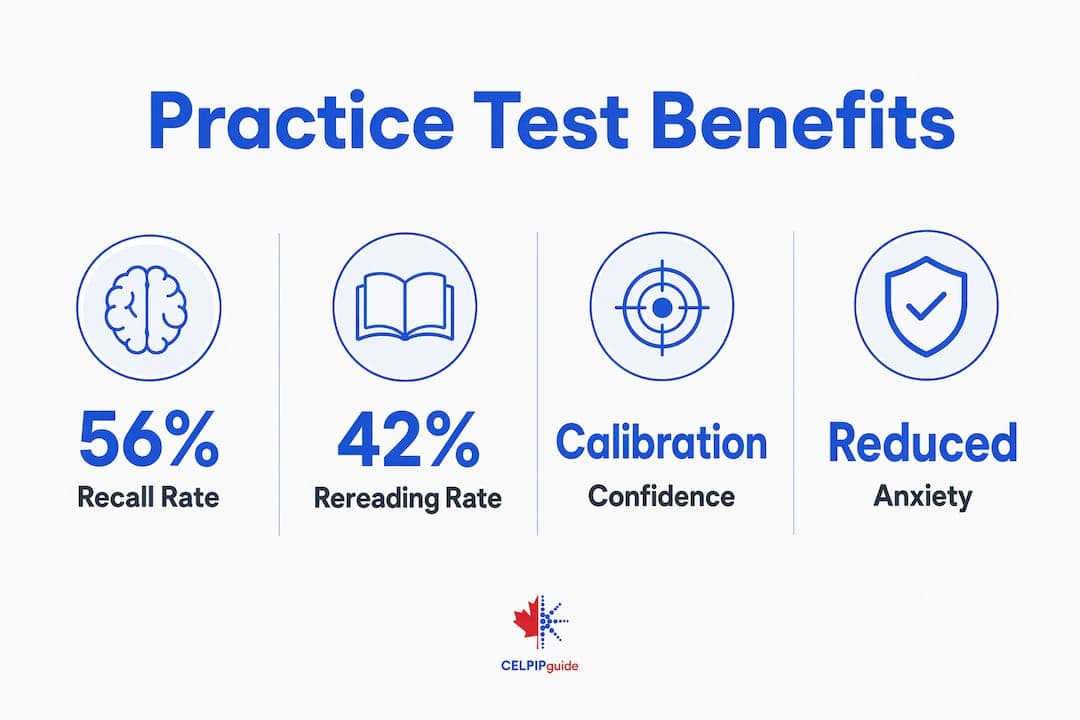
Practice tests outperform passive study methods like rereading by a significant margin. Research on the testing effect shows that tested learners recalled 56% of material after one week, compared to 42% for those who reread. The rereaders felt more confident but actually remembered less. That gap reveals a critical trap called the fluency illusion.
The fluency illusion occurs when material feels familiar after repeated reading, and you mistake that familiarity for genuine recall. You think you know it. Then the real exam arrives, and the knowledge isn’t there. Practice tests break this illusion by forcing you to retrieve information under pressure, which is exactly how memory gets strengthened.
The mechanism behind this is called “desirable difficulty.” Struggling to recall an answer during a practice test encodes that information more deeply than getting it right immediately. The effort itself is the learning. This is counterintuitive, but it is well supported by research in cognitive science.
| Study method | Recall after one week | Confidence level |
|---|---|---|
| Practice testing | 56% | Calibrated and realistic |
| Rereading | 42% | Inflated and unreliable |
Pro Tip: If a practice test feels hard, that is a good sign. Difficulty during retrieval means your brain is working. Easy practice sessions often signal low challenge and weaker long-term retention.
In what ways do practice tests reduce exam anxiety?

Taking practice tests early in your preparation cycle reduces test anxiety significantly more than cramming late. A study with 154 female undergraduates found that the group who practised early showed a more pronounced decrease in anxiety over the semester. Starting early normalises the test experience before the stakes feel real.
The psychological mechanism here is self-efficacy. Self-efficacy is your belief in your own ability to succeed at a specific task. Practice tests build self-efficacy by giving you tangible evidence of progress rather than abstract reassurance. You stop guessing whether you are ready. You start seeing the data.
Here is what practice tests do to reduce anxiety, step by step:
- Familiarise the format. Repeated exposure to question types removes the shock of the unknown on exam day.
- Expose gaps early. Finding a weakness in week two is far less stressful than finding it the night before.
- Create measurable progress. Watching your scores improve over time replaces worry with evidence.
- Simulate time pressure. Timed exam simulation trains you to manage pacing, which is one of the biggest anxiety triggers.
- Replace uncertainty with familiarity. The exam environment stops feeling threatening when you have been there dozens of times in practice.
“Practice tests reduce exam stress by making the environment familiar, exposing knowledge gaps early, and providing measurable progress evidence. The result is not just lower anxiety. It is a grounded, realistic confidence built on actual performance.”
What is the diagnostic approach to using practice tests?
Treating a practice test as a score tracker misses most of its value. The real power comes from using it as a diagnostic tool that converts subjective readiness into objective data. This approach turns every test into a study plan.
The structured sequence works like this:
- Study a topic area. Cover the material using your notes, vocabulary resources, or skill-specific guides.
- Take a practice test. Work under timed, realistic conditions without checking answers mid-test.
- Analyse your errors by type. Sort mistakes into three categories: knowledge gaps (you did not know the content), comprehension errors (you misread the question), and process errors (you knew it but made a procedural mistake).
- Target your weak areas. Spend focused study time only on the categories where you made errors.
- Retest within a short interval. Return to similar questions within a few days to confirm the gap is closed.
This cycle matters because attempting to retrieve unfamiliar material before you fully know it actually primes better retention when you study it afterward. Getting a question wrong on a practice test is not a failure. It is a setup for stronger learning.
Calibration is the final piece of this approach. Calibration means matching your confidence level to your actual knowledge level. Tracking your confidence and scores over time narrows the gap between what you think you know and what you can actually perform under pressure.
| Approach | What it measures | Outcome |
|---|---|---|
| Score tracking only | Overall performance | Surface-level progress |
| Diagnostic error analysis | Knowledge, comprehension, process gaps | Targeted improvement |
| Calibration tracking | Confidence vs. actual performance | Realistic self-assessment |
Pro Tip: After each practice test, rate your confidence on each topic from 1 to 5 before checking your score. Then compare. A big gap between confidence and score is your most valuable study signal.
What challenges do learners face when building confidence through practice tests?
The biggest challenge is confusing familiarity with genuine recall. You read a passage, recognise the vocabulary, and feel ready. That feeling is the fluency illusion at work. Practice tests expose it. Passive review reinforces it.
A second challenge is misreading high practice scores. If you consistently score well on the same question types, you are not building new knowledge. You are rehearsing what you already know. Avoiding error review reduces practice tests to confidence checks rather than learning tools. The learning happens in the review, not the test itself.
Here are the most common pitfalls and how to avoid them:
- Skipping error review. Always spend at least as much time reviewing mistakes as you did taking the test.
- Only practising strengths. Rotate through all skill areas, including the ones that feel uncomfortable.
- Treating discomfort as failure. Discomfort during retrieval signals active learning. Lean into it.
- Practising without time limits. Untimed practice builds a false sense of readiness. Always simulate real conditions.
- Ignoring CLB benchmarks. For CELPIP, knowing which CLB level each score corresponds to gives your results context and direction.
Pro Tip: When you get a question wrong, do not just read the correct answer. Write out why your answer was wrong and what you would do differently. That one step triples the retention value of the error.
Mindset is the underlying factor. Learners who treat failing on practice items as a desirable difficulty rather than a setback build more durable memory. The discomfort of not knowing is the exact moment learning happens. Reframe it, and practice tests become far more effective.
If test anxiety is making it hard to even start, that is worth addressing directly before you build a practice routine.
Key takeaways
Practice tests build genuine confidence by aligning your self-perception with real performance data, reducing anxiety through familiarity, and strengthening memory through active retrieval.
| Point | Details |
|---|---|
| Retrieval beats rereading | Tested learners recalled 56% after one week vs. 42% for rereaders, despite lower immediate confidence. |
| Start early to reduce anxiety | Early practice testing reduces exam anxiety more than late cramming, based on a study of 154 undergraduates. |
| Use the diagnostic cycle | Study, test, analyse errors by type, target gaps, and retest within days for maximum efficiency. |
| Discomfort signals learning | Struggling to recall during practice encodes information more deeply than easy review. |
| Calibrate confidence to performance | Track both your confidence ratings and your scores to close the gap between perceived and actual ability. |
What I have learned from building a practice test routine
I used to think confidence came from feeling ready. I would reread my notes until the material felt familiar, then walk into a practice test expecting a strong score. The results were humbling. My confidence was built on familiarity, not recall. That gap between what I thought I knew and what I could actually produce under timed conditions was the most useful thing I ever discovered about my own preparation.
The shift happened when I stopped treating practice tests as checkpoints and started treating them as the actual study method. I began taking a skill-specific practice test before I felt fully ready, which felt wrong at first. Getting questions wrong early in a study cycle is uncomfortable. But those early failures pointed me directly to the gaps I needed to close, and closing them felt like real progress rather than guesswork.
What I would tell any CELPIP test-taker is this: your confidence should be built on evidence, not optimism. Take a full-length mock exam early, review every error carefully, and track how your scores change over time. The data will tell you more about your readiness than any amount of rereading ever could. Embrace the hard sessions. They are the ones that actually move your CLB score.
— Reza
Celpipguide practice tests: build real confidence before exam day
Celpipguide gives you the practice infrastructure to apply everything covered in this article.
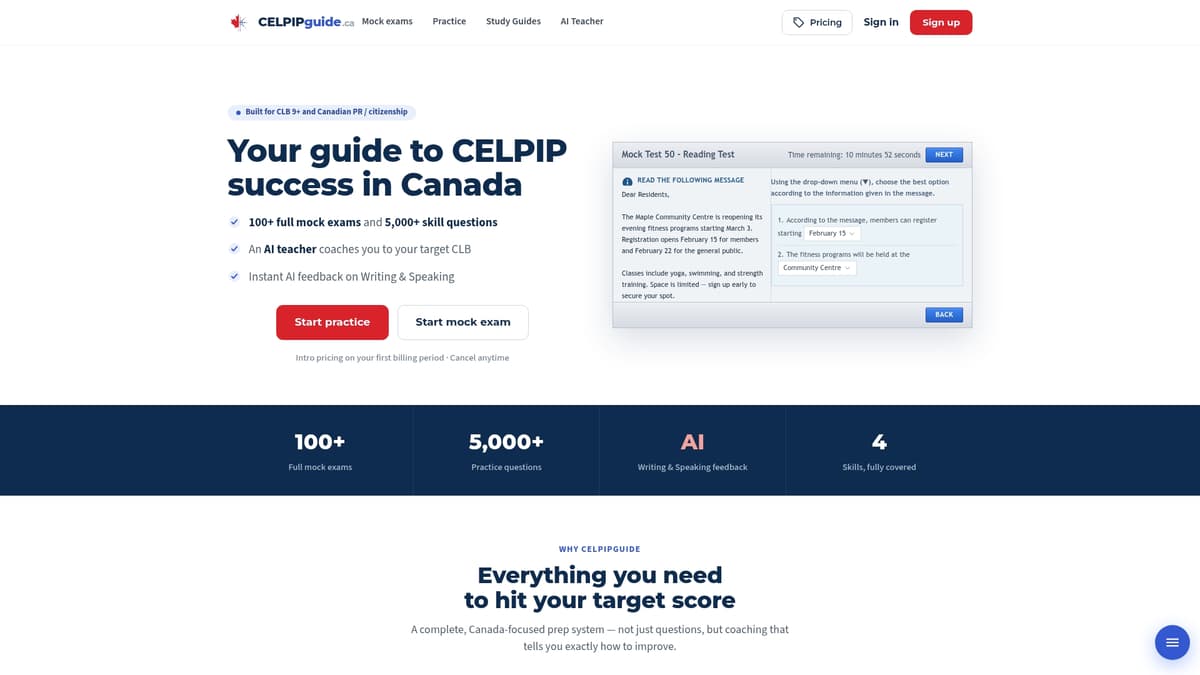
The CELPIP practice exam hub includes over 100 full mock exams and 5,000 practice questions aligned to CEFR language standards and CLB benchmarks. Each test comes with performance tracking so you can monitor your calibration over time, not just your scores. You can start with a free CELPIP practice test to run a diagnostic on your current level before committing to a full study plan. Celpipguide’s AI teacher delivers instant feedback on writing and speaking tasks, so error review becomes fast and specific rather than vague and discouraging.
FAQ
How do practice tests build confidence?
Practice tests build confidence by replacing abstract optimism with real performance data. Repeated testing shows measurable progress, familiarises the exam format, and aligns your self-belief with your actual ability.
When should I start taking practice tests?
Start as early as possible in your preparation cycle. Early practice testing reduces anxiety significantly more than late cramming, because it normalises the exam experience before pressure peaks.
Why do I feel confident after rereading but score poorly on tests?
That feeling is the fluency illusion. Material feels familiar after rereading, but familiarity is not the same as recall. Practice tests expose the gap between recognition and genuine retrieval.
How many practice tests should I take before the CELPIP exam?
There is no single number that works for everyone, but the diagnostic cycle matters more than volume. Take a test, analyse your errors by type, close the gaps, and retest. Repeat until your calibration score and your actual score align consistently.
What is the most important part of a practice test session?
The error review. Most learning happens during the analysis of mistakes, not during the test itself. Skipping the review turns practice tests into confidence checks rather than genuine learning tools.