
CELPIP Blog
Timed exam simulation: what it is and why it works
Timed exam simulation: what it is and why it works

TL;DR:
- Timed exam simulation helps students build active recall, manage time, and reduce exam anxiety under official conditions. Regular practice can improve final scores by up to 25% and prepares candidates for real test pressures. Authentic simulations follow strict timing, use official formats, and include post-test analysis for effective improvement.
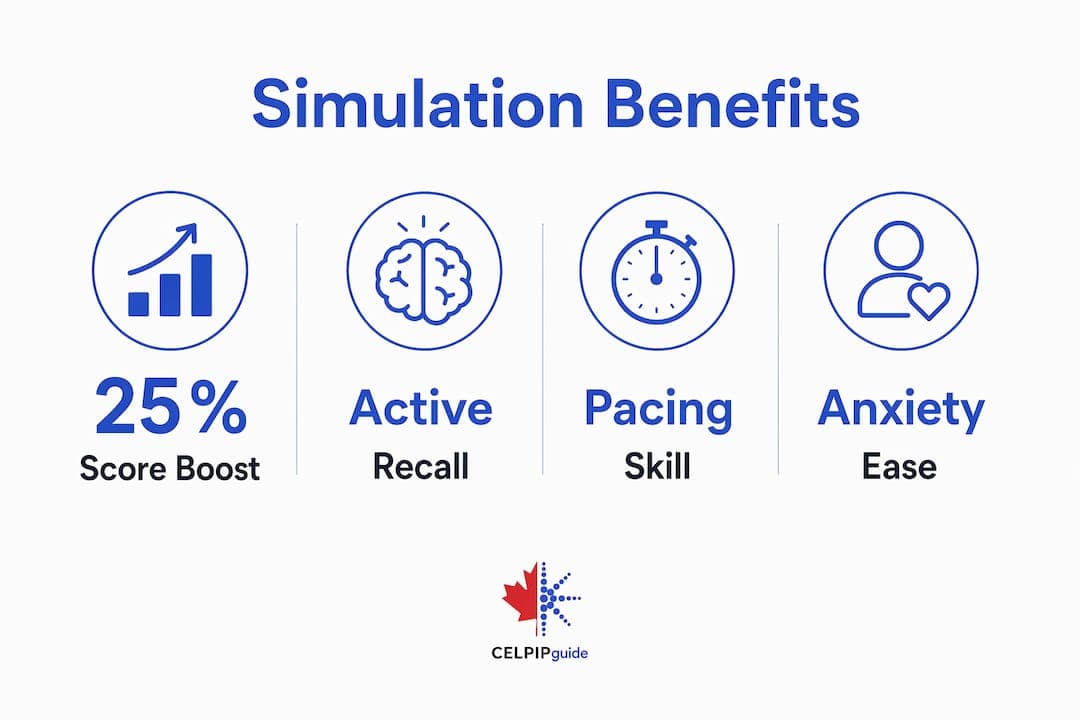
Timed exam simulation is defined as a practice method where you complete a full test under the exact same time limits, conditions, and structure as the real exam. It is the industry’s standard term for what many learners call “mock testing” or timed exam practice. Unlike casual review, simulation forces active retrieval under pressure, which is the cognitive mechanism that builds genuine recall strength. Research shows that students who practise this way improve their final exam scores by 10% to 25% compared to passive study. For CELPIP candidates aiming at specific CLB benchmarks for Canadian immigration, that gap is the difference between passing and repeating.
What is timed exam simulation and how does it improve performance?

Timed exam simulation works by replacing passive familiarity with active retrieval under real constraints. When you read notes or reread a textbook, your brain recognises information without actually producing it. Simulation forces production. That distinction matters enormously for exam performance.
The cognitive benefits fall into three clear categories:
- Active retrieval practice. Retrieving an answer under a countdown is harder than recognising it on a page. That difficulty is the point. Active recall builds retention strength that passive review cannot replicate.
- Stress inoculation. Repeated exposure to timed conditions trains your nervous system to stay calm. Repeat simulations build mental toughness by making exam-day pressure feel familiar rather than alarming.
- Metacognitive accuracy. Simulation exposes the gap between what you think you know and what you can actually produce. Metacognitive accuracy improves when learners see their real performance data instead of relying on how confident they feel after reviewing notes.
The score improvement range of 10% to 25% is not a small margin. For a CELPIP candidate who needs CLB 9 for a Canadian immigration application, even a single band improvement can change the outcome. Simulation is the preparation method most likely to deliver that improvement because it mirrors the conditions that produce the result.
Time management is another direct benefit. Pacing instincts develop through repetition, not theory. After several full-length timed sessions, you begin to sense when you are spending too long on a single question without needing to check the clock constantly. That instinct is built, not taught.
What features make a timed exam simulation authentic?
Authenticity is what separates a useful simulation from a casual practice session. A simulation that cuts corners on conditions produces misleading results. You end up feeling more prepared than you actually are.
The essential features of an authentic simulation are:
- Strict timing. Use the exact time limits from the official CELPIP test structure. Do not pause the timer for any reason.
- A distraction-free environment. Sit at a desk in a quiet room. Recreating environmental stressors from the test centre acclimates your nervous system and reduces panic on exam day.
- No unauthorised aids. No notes, no phone, no dictionary. The moment you allow a shortcut, the simulation stops measuring your real ability.
- Official question types and structure. Use full-length tests that follow the actual CELPIP format, including the correct section order and break timing.
- Post-test review. Complete the full test before reviewing anything. The review phase is where the learning happens.
Pro Tip: Set your phone to aeroplane mode and place it in another room before starting a simulation. Even the presence of a phone on your desk raises cortisol levels and reduces focus, according to attention research.
The post-test review deserves its own emphasis. Timed exam simulation replicates official conditions to identify knowledge gaps, but those gaps only become visible when you analyse your answers systematically after the test. Skipping the review wastes the most valuable part of the exercise.
How to run effective timed exam simulations for English proficiency exams
Setting up a simulation correctly takes about five minutes. Running it well takes discipline. Here is how to do both.
Start by scheduling your simulation at the same time of day as your actual CELPIP exam. Your cognitive performance varies across the day, and practising at the right time trains your brain for peak output when it counts.
During the simulation, track your timing per section, not just your total score. High-performing students use timing logs to adjust their test strategies precisely. A score tells you what went wrong. A timing log tells you why.
After the simulation, follow this review cycle:
- Categorise every error. Was it a vocabulary gap, a grammar error, a misread question, or a timing problem? Each category needs a different fix.
- Note which sections ran over time. If you consistently run out of time on the CELPIP Reading section, that is a pacing problem, not a comprehension problem.
- Build a targeted study block. Spend the next two to three study sessions on the specific weaknesses the simulation revealed. Reviewing your strong areas wastes time.
- Repeat the cycle. Diagnostic simulation cycles increase revision efficiency by focusing effort on specific weak points rather than broad re-study.
Pro Tip: Keep a simulation log in a simple spreadsheet. Record your score, your timing per section, and your top three error categories after every mock test. After four simulations, patterns become obvious and your study plan writes itself.
Celpipguide’s time management guide for CELPIP breaks down exactly how many minutes to allocate per question type in each section. Pair that guide with your simulation timing logs for a precise picture of where your pacing needs work.
How does timed exam simulation compare to other study methods?
The honest answer is that most other study methods feel productive without being effective. Rereading notes is the most common example. It feels like studying because the material looks familiar. That familiarity is an illusion. Rereading feels productive but does not build the retrieval strength you need under exam conditions.
| Study method | Builds active recall | Trains time management | Reduces test anxiety | Reveals real gaps |
|---|---|---|---|---|
| Rereading notes | No | No | No | No |
| Casual practice questions | Partially | No | Partially | Partially |
| Timed exam simulation | Yes | Yes | Yes | Yes |
| Vocabulary drills alone | Partially | No | No | Partially |
The table makes the pattern clear. Timed exam simulation is the only method that addresses all four dimensions of exam readiness simultaneously. Vocabulary drills and grammar exercises have their place, but they are inputs. Simulation is the test of whether those inputs have actually become usable skills.
A common misconception is that simulation is only useful close to the exam date. The opposite is true. Running simulations early in your preparation reveals your actual starting point, which makes every subsequent study session more targeted. Simulation trains candidates to transform exam day from an intimidating unknown into a manageable routine through repeated exposure. That transformation takes time, so starting early matters.
Casual practice questions without a timer are better than nothing, but they create a false sense of pacing. You might answer every question correctly with unlimited time and still fail the CELPIP exam because you cannot maintain that accuracy under a countdown. Simulation closes that gap.
Key takeaways
Timed exam simulation is the most effective preparation method for English proficiency exams because it builds active recall, time management, and stress resilience simultaneously.
| Point | Details |
|---|---|
| Definition | Timed exam simulation replicates real test conditions, including strict timing and no aids, to build genuine exam readiness. |
| Score impact | Students using regular simulation improve final exam scores by 10% to 25% compared to passive study methods. |
| Authenticity matters | Simulations must use official timing, question types, and a distraction-free environment to produce reliable results. |
| Review cycle | Analysing timing logs and error categories after each simulation is where the real learning and improvement happen. |
| Simulation beats passive study | Rereading and casual practice build familiarity but not retrieval strength; only timed simulation builds both. |
Why I think most candidates are wasting their practice tests
I have seen a consistent pattern among CELPIP candidates who plateau despite doing “lots of practice.” Almost always, the problem is the same. They are completing practice questions without simulating real conditions. They pause to look things up. They skip sections they find boring. They check their phones mid-test. Then they wonder why their score does not move.
The psychological edge from proper simulation is real and significant. When you have sat through a full-length timed CELPIP mock exam four or five times, the actual test day feels like repetition rather than a new experience. Your nervous system has already been there. That familiarity is not a small comfort. It is a genuine performance advantage.
The mistake I see most often is treating the score as the only output of a simulation. The score is the least useful part. The timing data, the error patterns, and the sections where you felt rushed are the actual information. Candidates who review that data carefully and then review common CELPIP mistakes tend to improve significantly faster than those who just count their correct answers and move on.
My honest advice is this: run your first full simulation this week, regardless of how prepared you feel. The discomfort of seeing your real starting point is far less costly than discovering it on exam day.
— Reza
How Celpipguide puts timed simulation into practice
Celpipguide is built specifically for CELPIP candidates who want to practise under real conditions, not approximate ones.
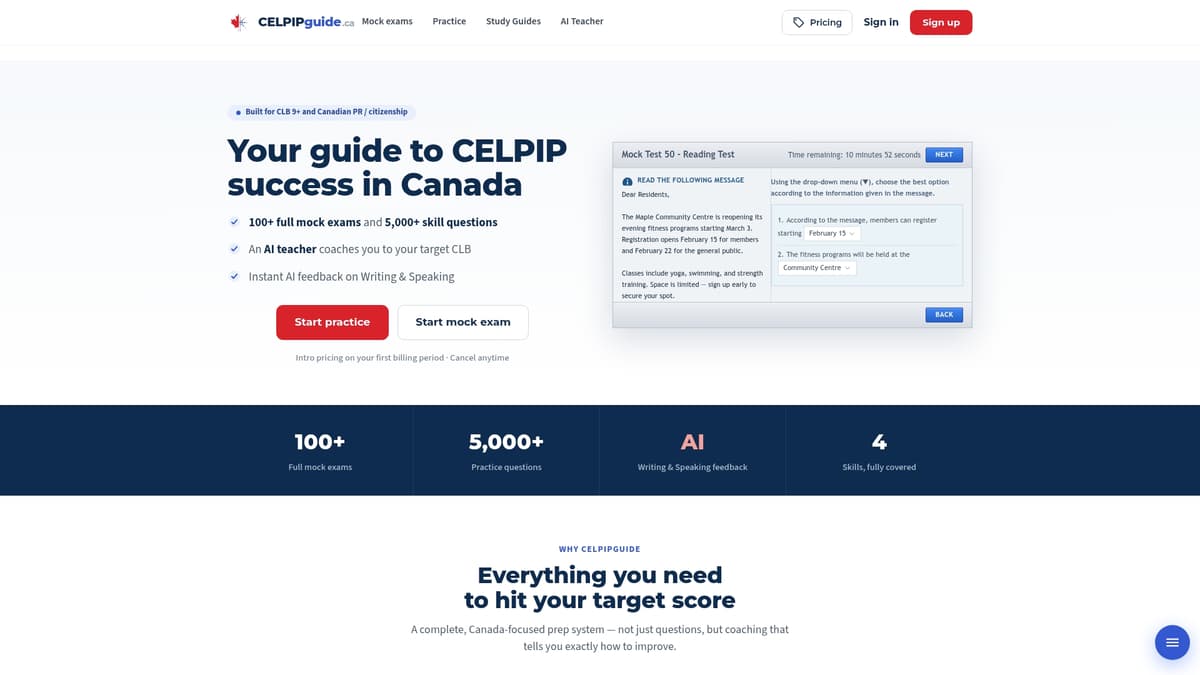
The platform offers over 100 full-length mock exams that replicate the exact CELPIP format, including official timing, question types, and section sequencing. Every simulation is followed by AI-generated feedback on writing and speaking tasks, so you get the post-test analysis that makes simulation actually useful. The CELPIP Exam Practice Hub gives you a single access point for timed practice tests, skill-specific drills, and a diagnostic test that identifies your weak areas before you begin. If you want to see what a session looks like before committing, a free practice test is available with no sign-up required.
FAQ
What is timed exam simulation?
Timed exam simulation is a preparation method where you complete a full practice test under the exact time limits and conditions of the real exam. It builds active recall, pacing instincts, and stress resilience simultaneously.
How does exam simulation improve my CELPIP score?
Students who use regular timed simulation improve exam scores by 10% to 25% compared to passive study. Simulation forces active retrieval under pressure, which builds the recall strength that passive review cannot.
How often should I run a timed mock exam?
Running one full-length simulation per week is effective for most candidates. Follow each session with a detailed review of your timing data and error categories before your next study block.
What makes an online timed test simulation authentic?
An authentic simulation uses official timing, real question formats, no notes or aids, and a quiet environment that mirrors the test centre. Skipping any of these conditions reduces the reliability of your results.
Is timed exam practice useful early in preparation?
Yes. Running simulations early reveals your actual starting point and makes every subsequent study session more targeted. Waiting until the final week means missing weeks of focused, data-driven improvement.