
CELPIP Blog
Phrasal Verbs for CELPIP: Drill Them, Don’t Just Memorize
Phrasal Verbs for CELPIP: Drill Them, Don’t Just Memorize

Yes, phrasal verbs are worth your study time: used correctly, they boost naturalness and lexical range across CELPIP Speaking and Writing, and raters notice the difference. The smartest way in isn’t a long memorized list. Start with a compact set of high-frequency, test-useful phrasal verbs and drill them through short retrieval exercises, fill-in-the-blank style, followed by sentence writing. That combination beats passive memorization for building usable vocabulary fast.
TL;DR:
- Prioritize the ten starred verbs, including look into, deal with, come up with, and run out of, before expanding your list.
- Use conversational verbs such as think over, hold off, and count on for advice, but choose milder or more formal alternatives in Writing.
- Repeated fill in the blank retrieval drills improved immediate and delayed retention more than composition tasks; follow recall practice with sentence writing and timed speaking.
- Place pronouns between the parts of separable verbs, as in turn it off, and check meanings carefully when choosing look up or look into.
Table of Contents
- Why phrasal verbs matter for CELPIP speaking and writing
- A curated list: high-utility phrasal verbs for CELPIP
- Matching phrasal verbs to speaking and writing tasks
- How to practise phrasal verbs so they actually stick
- Common mistakes and quick fixes
- Reza’s practical perspective: building phrasal verbs into your routine
- How CELPIPguide helps you practise phrasal verbs that score
- FAQ
- Sources
Why phrasal verbs matter for CELPIP speaking and writing
CELPIP raters score you on lexical range and naturalness, and phrasal verbs sit right at the centre of both. A response built entirely from single-word verbs (“investigate,” “continue,” “cancel”) sounds stiff next to one that naturally uses “look into,” “carry on,” or “call off.” That shift in register is exactly what separates a CLB 7 response from a CLB 9 one.
There’s also an immigration angle worth knowing. Canada’s Express Entry system maps CELPIP-G scores directly to Canadian Language Benchmark levels, and higher CLB bands demand language that sounds natural and accurate, not just grammatically correct. Phrasal-verb control feeds directly into that natural-sounding quality.
Here’s what this means for your study plan:
- Lexical range improves when you swap generic verbs for precise phrasal verbs in context.
- Naturalness improves when particles are used idiomatically, not just grammatically.
- CLB score bands reward accurate, varied vocabulary over simple, repetitive phrasing.
- Corpus-informed teaching recommends learning high-frequency verbs first, then sequencing practice around them.
Research backing this approach finds that corpus-based selection paired with sequenced retrieval and output tasks improves durable phrasal-verb use, according to a TESL Canada review of instructional methods. That’s the model this guide follows: high-frequency verbs first, then active practice.
A curated list: high-utility phrasal verbs for CELPIP

This list groups verbs by the kind of situation you’ll face in Speaking and Writing tasks, with a quick meaning and an exam-style example for each. The ones marked with an asterisk are worth memorizing first since they show up across multiple task types.
Describing problems and solutions
- Look into* (investigate): “I’d look into cheaper transit options before committing to a car.”
- Deal with* (handle): “We need to deal with the noise complaint before it escalates.”
- Come up with* (invent/produce): “My team came up with a backup plan within a day.”
- Put off (delay): “They put off the renovation until after the holidays.”
- Sort out (resolve): “I sorted out the billing error with one phone call.”
Describing experiences and opinions
- Look forward to* (anticipate positively): “I look forward to visiting my cousins every summer.”
- Get along with* (have a good relationship): “I’ve always gotten along with my coworkers.”
- Turn out (result): “The trip turned out better than we expected.”
- Point out (indicate/mention): “She pointed out a flaw in the original plan.”
- Bring up (introduce a topic): “He brought up the budget during the meeting.”
Giving advice and making requests
- Think over (consider carefully): “Take a few days to think over the offer.”
- Count on* (rely on): “You can count on public transit being on time here.”
- Give up (abandon): “Don’t give up on the application just because of one rejection.”
- Hold off (wait): “Hold off on signing until you’ve reviewed the contract.”
- Work out (resolve/exercise): “We worked out a schedule that suits everyone.”
Everyday and routine actions
- Run out of* (exhaust a supply): “We ran out of time during the last task.”
- Pick up (collect/learn casually): “I picked up a lot of vocabulary from watching the news.”
- Set up (arrange/establish): “They set up a meeting for next Tuesday.”
- Take over (assume control): “She took over the project when the manager left.”
- Go over (review): “Let’s go over the instructions one more time.”
The ten marked with asterisks are the highest-value starting point. Master those before expanding the list, since they appear across advice, opinion and narrative tasks.
Matching phrasal verbs to speaking and writing tasks
Not every phrasal verb fits every task, and register matters as much as meaning. Here’s how to match verbs to the task in front of you:
- For Speaking Task: Giving Advice, lean on “think over,” “hold off,” and “count on.” They sound natural in conversational advice and fit the informal register the task expects.
- For Speaking Task: Describing an Experience, use “turn out,” “look forward to,” and “get along with.” These carry narrative weight without sounding memorized. Our speaking structure and templates guide breaks down how to build a full response around phrases like these.
- For Speaking Task: Problem Solving, “deal with,” “sort out,” and “come up with” map directly onto the task’s cause-and-solution structure.
- For Writing Task: Email, mild phrasal verbs like “look into” and “set up” work fine, but save highly casual ones like “chill out” for Speaking only.
- For Writing Task: Survey or Opinion, prefer phrasal verbs with a slightly more formal feel, such as “point out” or “bring up,” and swap in single-word equivalents (“investigate,” “mention”) when the sentence feels too casual for a written argument.
- As a quick safety check, ask whether the verb would sound natural in a workplace email. If it wouldn’t, it probably belongs in Speaking, not Writing.
Our rater-aware writing strategies piece goes deeper on register choices like these if you want to fine-tune your Writing Task responses.
How to practise phrasal verbs so they actually stick
Memorizing a list rarely survives contact with a live Speaking task. What works better is retrieval: short, repeated exercises where you pull the right phrasal verb from memory under light pressure, rather than just reading it passively.
A quasi-experimental ESL study found that repeated fill-in-the-blank retrieval tasks produced higher immediate and delayed retention of phrasal verbs than longer composition tasks. In other words, five short drills beat one long essay for building the kind of quick recall you need on test day.
Here’s the sequence that follows from that finding:
- Retrieval drills first: short fill-in-the-blank exercises using the verbs from your list, done in multiple quick rounds.
- Sentence writing second: once recall feels solid, write two or three original sentences per verb.
- Spoken retrieval last: use the verbs out loud in a timed mock Speaking task to test transfer under exam conditions.
A simple two-week version: days 1 to 4, drill five verbs a day with fill-in-the-blanks; days 5 to 7, write sentences with those same verbs; days 8 to 11, add five new verbs using the same drill-then-write pattern; days 12 to 14, run full mock Speaking and Writing tasks using everything you’ve learned.
Pro Tip: Say your sentence out loud before you write it down. Hearing the phrasal verb in context catches awkward phrasing faster than reading it silently ever will.

Common mistakes and quick fixes
A few small errors cost real points, but they’re easy to catch once you know what to look for.
- Particle placement: with separable verbs like “turn off,” pronouns go between the verb and particle (“turn it off,” not “turn off it”).
- Meaning confusion: “look up” (research) and “look into” (investigate) get mixed up often; paraphrase the sentence mentally to check which one fits.
- Register traps: informal verbs like “chill out” or “hang out” don’t belong in formal Writing tasks; swap in “relax” or “socialize.”
- Overcorrecting: don’t replace every phrasal verb with a formal synonym in Speaking. That sounds stiffer, not better.
Reza’s practical perspective: building phrasal verbs into your routine
I treat phrasal verbs as a weekly habit, not a cram topic: five new verbs, drilled daily, tested in a timed mock response by week’s end. That rhythm shows whether your vocabulary actually transfers under pressure, which is the only measure that matters on test day.
— Reza
How CELPIPguide helps you practise phrasal verbs that score
Learning the right phrasal verbs matters less than proving you can use them under real exam conditions, and that’s where guided practice pays off. We built our Plus plan to include full mock exams, vocabulary builders tuned to CLB standards, and instant AI feedback on your Writing and Speaking responses, so you can see whether your phrasal-verb choices actually land with a rater.
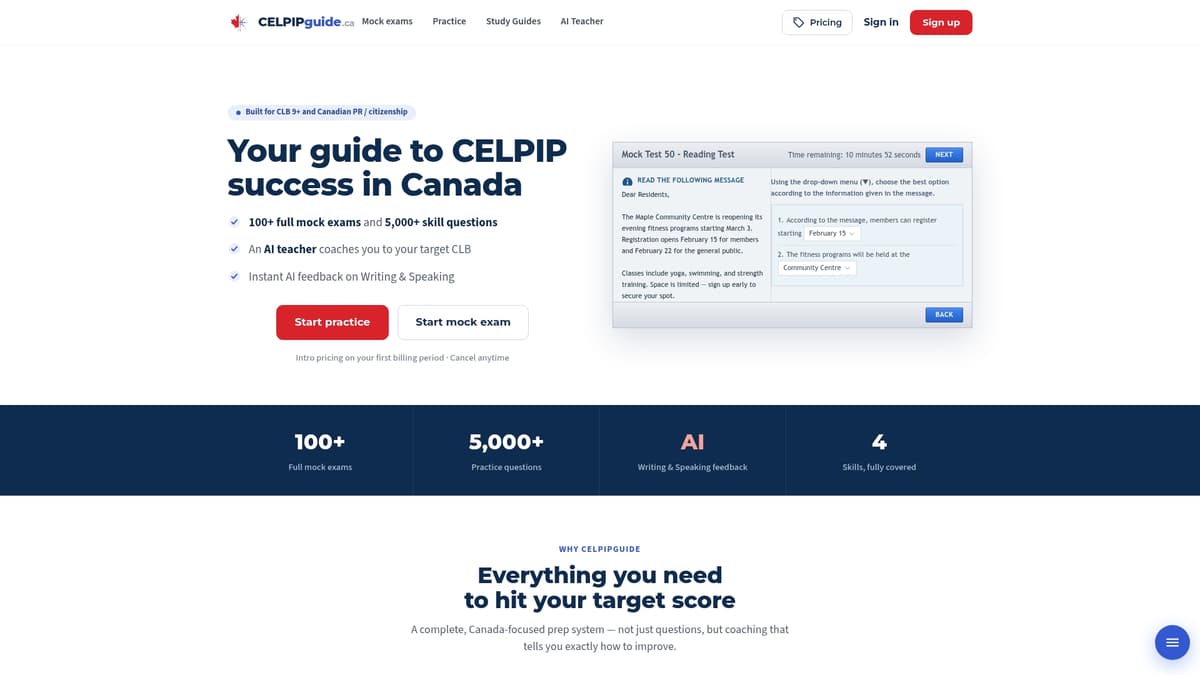
| What you get | Why it matters for phrasal verbs |
|---|---|
| Full mock exams | Test vocabulary choices under real timed conditions |
| AI feedback on Speaking and Writing | Instant, rubric-aware notes on naturalness and lexical range |
| Vocabulary builders | Practice targeted at CLB-relevant word and phrase choices |
If you’re ready to move past list memorization and into measurable practice, our Plus plan gives you the mock tests and feedback loop to test it properly, and you can find current pricing details on the website.
FAQ
Are phrasal verbs important for CELPIP Speaking?
Yes. Phrasal verbs improve naturalness and lexical range, two qualities CELPIP raters score directly in Speaking tasks. Using them accurately signals a more advanced command of conversational English than relying only on single-word verbs.
What’s the fastest way to learn phrasal verbs for CELPIP?
Short, repeated retrieval exercises like fill-in-the-blanks work faster than memorizing long lists, according to research on vocabulary retention. Follow drills with sentence writing, then spoken practice in a timed mock task.
Can I use phrasal verbs in CELPIP Writing tasks?
Yes, but choose carefully. Mild phrasal verbs like “look into” or “point out” work well in emails and opinion tasks, while highly casual ones are better saved for Speaking.
How many phrasal verbs should I know for CELPIP?
A focused set of high-frequency verbs covers most Speaking and Writing scenarios. Prioritize the ones usable across advice, opinion and problem-solving tasks before expanding further.
Do phrasal verbs affect my CLB score?
Indirectly, yes. Natural, varied vocabulary supports higher CLB bands under Canada’s language benchmark mapping, since accuracy and naturalness are both scored.
Sources
- Approaches to Teaching Phrasal Verbs: Insights from Corpus Research, Instructional Methods and Cognitive Linguistics | TESL Canada Journal
- The Effect of Four Vocabulary Tasks on the Initial Learning and Retention of Formulaic Language: The Case of Phrasal Verbs (UCF thesis)
- Canada