
CELPIP Blog
30 Day Sprint: Task Mapped CELPIP Speaking Vocabulary and Timed Drills
30 Day Sprint: Task Mapped CELPIP Speaking Vocabulary and Timed Drills

The vocabulary that raises your CELPIP speaking score isn’t rare or impressive. It’s communicative: transitions, opinion frames, topic-specific words, and safe idioms used accurately inside full timed answers, not memorized in isolation. We’d rather you nail “as a result” under pressure than fumble a thesaurus word. Target the CLB level your immigration or citizenship goal actually requires, and build from there.
TL;DR:
- Using simple, well-practiced phrases for transitions and opinion frames is more effective than attempting rare vocabulary under pressure.
- Focus on 10 to 15 target words or phrases weekly, practicing them in full timed responses rather than isolated memorization.
- Incorrect collocations and inappropriate register choices can quietly lower your score; stick to common, natural expressions.
- Prioritize accuracy and contextual use of vocabulary during practice to improve fluency and confidence in real test conditions.
- The CELPIPguide Plus platform offers targeted diagnostics, practice exams, and AI feedback to identify and improve your speaking vocabulary gaps.
Table of Contents
- 1. Your categorized CELPIP speaking vocabulary bank
- 2. Task-linked phrases you can use in CELPIP speaking tasks
- 3. How to build vocabulary into fluent, spoken use
- 4. Vocabulary mistakes that quietly cost you marks
- 5. Why this approach works, and how Celpipguide supports it
- 6. A 30-day final sprint plan for speaking vocabulary
- 7. Celpipguide Plus: practice this vocabulary with AI feedback
- FAQ
- Sources
1. Your categorized CELPIP speaking vocabulary bank
Before we get into drills and strategy, you need the raw material. We’ve organized this bank the way we’d organize our own study notes: by function, not by difficulty. A rare word you use correctly once is worth less than a simple phrase you can deploy on command in any of the eight CELPIP speaking tasks.
Why categories beat long lists: a 500-word glossary looks impressive, but if you can’t retrieve the right word at the right moment in a 60-second response, it’s dead weight. CELPIP’s own performance standards treat word choice, range, and precision as explicit scoring factors, not bonus points. That means accuracy and appropriateness carry more weight than obscurity.
Transitions and connectors for coherence
These are the glue words that make an answer sound organized rather than like a list of disconnected thoughts.
- Contrast: “on the other hand,” “that said,” “having said that”
- Cause and effect: “as a result,” “because of this,” “this means that”
- Examples: “for instance,” “to give you an idea,” “a good example of this is”
- Sequence: “to begin with,” “after that,” “in the end”
- Addition: “on top of that,” “not only that, but”
Test-style example: “I’d say the biggest challenge was the commute. As a result, I started leaving twenty minutes earlier every day.”
Opinion frames and hedges
CELPIP speaking tasks often ask you to state and defend a position. A flat “I think” repeated five times reads as thin. Rotate through these instead.
- “I would argue that remote work suits some roles better than others.”
- “It seems to me the bigger issue is scheduling, not location.”
- “I tend to think flexibility matters more than salary at this stage.”
- “From my perspective, the second option makes more practical sense.”
- “I’m inclined to believe this approach saves more time overall.”
Descriptive adjectives and verbs for common topics
CELPIP topics repeat: work, housing, daily routines, community life. Having two or three precise words per topic, rather than twenty vague ones, is what actually shows up in your answer.
| Topic | Verbs | Adjectives |
|---|---|---|
| Work | to oversee, to supervise, to delegate | demanding, fast-paced, collaborative |
| Housing | to renovate, to maintain, to furnish | spacious, well-maintained, affordable |
| Daily life | to commute, to juggle, to unwind | hectic, manageable, routine |
| Community | to volunteer, to organize, to contribute | welcoming, close-knit, active |
Test-style example: “My last apartment was small but well-maintained, and I used to unwind on the balcony after work.”
Safe idioms and collocations
An idiom used correctly adds natural flow. An idiom used incorrectly, or one that’s too obscure for a test setting, costs you more than it earns.
- “meet a deadline” (safe, common, accurate)
- “keep in touch” (safe, natural in describing relationships)
- “make a decision” (safe collocation, don’t say “take a decision”)
- “weigh the pros and cons” (safe for comparing tasks)
- “take something into account” (safe for giving advice)
Pro Tip: Stick to collocations you’ve heard native speakers use in context at least a few times. If you’re not sure a phrase is a real collocation, swap it for a plainer verb phrase instead of risking an unnatural combination.
A one-line test example ties this together: “Before making a decision, I’d weigh the pros and cons, and honestly, meeting the deadline matters more to me than getting it perfect.”
2. Task-linked phrases you can use in CELPIP speaking tasks
Knowing words is one thing. Knowing which phrase fits which task, under a 60 to 90 second clock, is what separates a fluent-sounding answer from a stalled one. Here’s the bank organized by task type, the way we’d rehearse it ourselves.
Giving advice
- “If I were in your position, I’d probably start by…”
- “One thing worth considering is…”
- “It might help to look into…”
- “A practical first step would be to…”
Mini-model: “If I were in your position, I’d probably start by talking to your landlord directly before escalating.”
Describing a personal experience
- “One experience that stands out for me is…”
- “I remember a time when…”
- “Looking back, what struck me most was…”
Mini-model: “One experience that stands out for me is my first week at a new job. Looking back, what struck me most was how supportive my team was.”
Describing a scene or event
- “At first glance, it looks like…”
- “What’s happening in the foreground is…”
- “It appears that…”
Mini-model: “At first glance, it looks like a busy market. What’s happening in the foreground is a vendor arranging fresh produce.”
Predicting outcomes
- “Given the current trend, it’s likely that…”
- “I’d expect this to lead to…”
Mini-model: “Given the current trend, it’s likely that more people will choose remote options.”
Comparing and persuading
- “Compared to the first option, the second one seems…”
- “The main advantage of this choice is…”
- “What tips the balance for me is…”
Mini-model: “Compared to the first option, the second one seems more cost-effective. What tips the balance for me is the shorter commute.”
Dealing with a difficult situation
- “The way I’d handle this is…”
- “To resolve this, I’d suggest…”
Mini-model: “The way I’d handle this is by addressing it calmly and proposing a compromise.”
Expressing an opinion
- “My honest take is…”
- “I can see both sides, but ultimately…”
Register note: phrases like “my honest take is” work fine in CELPIP’s conversational register, but avoid overly casual slang (“no big deal,” “whatever works”) since it can read as too informal for a formal assessment. If a phrase feels too stiff (“I am of the opinion that”), swap it for “I’d say” instead.
3. How to build vocabulary into fluent, spoken use
Memorizing a list and speaking fluently under a clock are two different skills. The bridge between them is contextualized practice, not more flashcards.
- Contextualized active recall: practise each target phrase inside a full 60 to 90 second timed response, never as an isolated word.
- Weekly rotation: pick 10 to 15 words or phrases per week, use them daily in spoken practice, then retire the ones you’ve mastered and add new ones.
- Shadowing: repeat sample answers aloud, matching rhythm and stress, to internalize natural phrasing.
- 60-second drills: record yourself answering a random CELPIP-style prompt using at least three target phrases.
- Paired or AI feedback: speak your answer to a partner or an AI tool and ask specifically whether your vocabulary sounded natural and accurate.
Pro Tip: Treat every mock speaking test as a diagnostic, not just a score. Note which word families you reached for and couldn’t find, then build next week’s rotation directly from those gaps.
This diagnostic loop (mock test, identify weak vocabulary, targeted drilling, retest) tends to produce faster, more durable gains than blind memorization, because you’re always practising the exact words you’re missing rather than words you already know.
4. Vocabulary mistakes that quietly cost you marks
Most vocabulary errors in CELPIP speaking aren’t about not knowing enough words. They’re about using the wrong word, in the wrong combination, at the wrong moment.
- Overused rare words: reaching for “ameliorate” instead of “improve” under pressure often leads to mispronunciation or misuse; stick with words you can deploy instantly and correctly.
- Collocation errors: “do a decision” instead of “make a decision,” or “take a risk” misused as “make a risk.” Quick check: if you’re unsure a pairing is standard, replace it with a simpler verb you’re certain about.
- Register mismatches: slang or overly formal legalese both sound unnatural in a conversational speaking test; aim for the middle, professional but relaxed.
- Irrelevant vocabulary: inserting a impressive word that doesn’t actually fit the task prompt signals padding rather than range.
A quick self-check before your next practice session: read your own transcript aloud and flag any phrase that makes you pause and think “is that actually how people say it?” If you hesitate, it’s probably a collocation worth fixing. For a broader refresher on frequent grammar slip-ups that affect spoken accuracy, Lizard’s Lunch’s list of common mistakes is a practical companion to vocabulary review.
5. Why this approach works, and how Celpipguide supports it
We built this guide around what the Canadian Language Benchmarks actually describe: vocabulary sits inside grammatical knowledge and is meant to connect to real communicative functions, like giving advice or describing an experience, rather than existing as a standalone list to memorize. That’s the entire logic behind task-linked phrase banks instead of generic word lists.
A few things back this approach on the platform side:
- CELPIPguide offers over 100 full mock exams and more than 5,000 practice questions tailored to CEFR standards, giving you enough volume to run the diagnostic loop repeatedly.
- Our AI teacher personalizes study plans and delivers instant feedback on writing and speaking tasks, so you’re not guessing which vocabulary gaps to target next.
- The platform’s diagnostic test and vocabulary builder are built to map directly onto the CLB-aligned targets described above.
6. A 30-day final sprint plan for speaking vocabulary
If your test is a month away, here’s how we’d spend it. We’ve used variations of this with learners who needed a focused, no-nonsense push rather than another giant word list.
Weeks one and two: twenty to thirty minutes daily, folding target vocabulary into full timed speaking answers rather than flashcards. Two mock speaking tests per week, each followed by one diagnostic review session where you listen back and flag every moment you reached for a word and missed it.

Weeks three and four: shift the balance. If your target CLB is in the mid-range, prioritize accuracy over range, nail the phrases you already know rather than adding new ones. If you’re aiming higher, start layering in slightly more varied transitions and opinion frames, but only ones you’ve already drilled successfully.
The habit that matters most: integrate new phrases into spontaneous answers, not memorized scripts. A phrase you’ve only ever said inside a rehearsed paragraph tends to disappear the moment a real prompt surprises you. Practise it cold, inside a fresh question, every time.
— Reza
7. Celpipguide Plus: practice this vocabulary with AI feedback
If you want a structured way to run the diagnostic loop we’ve described, rather than piecing it together from scattered resources, that’s exactly what we built Plus for. You get a diagnostic test to find your actual vocabulary gaps, a vocabulary builder organized around CELPIP tasks, full mock exams for timed practice, and instant AI feedback on your speaking responses so you’re not guessing whether a phrase landed naturally.
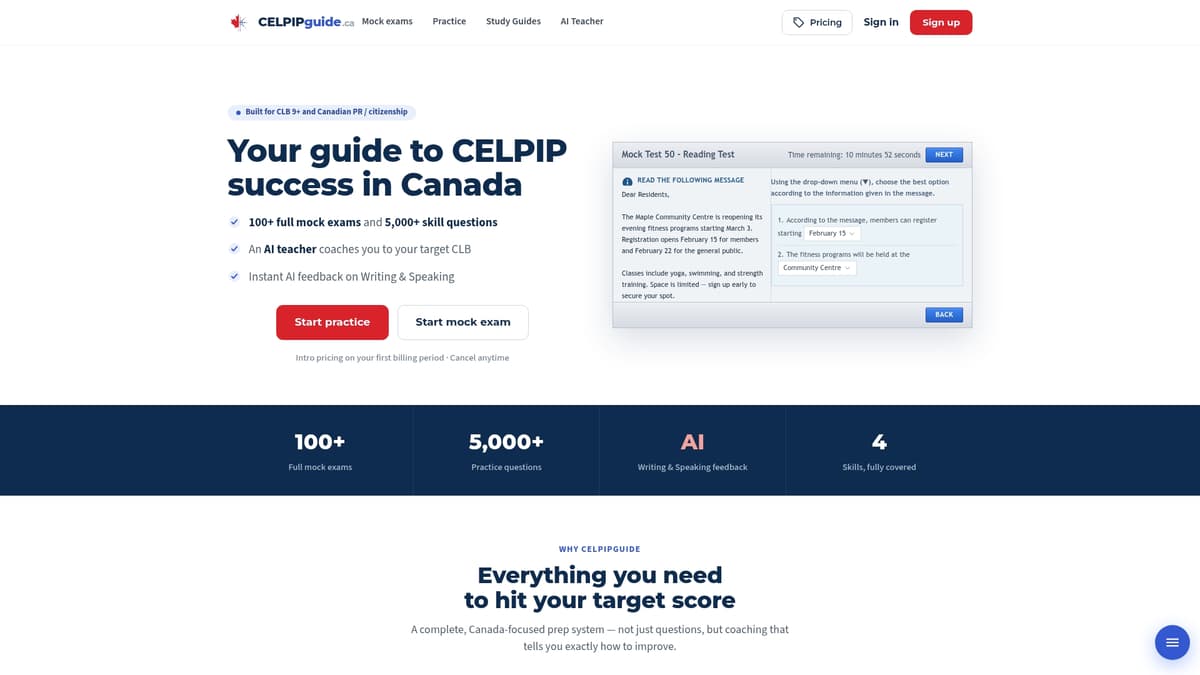
Here’s how the features map onto the study routine from this guide:
| Study routine step | Celpipguide Plus feature |
|---|---|
| Diagnose weak vocabulary | Diagnostic test |
| Build targeted word lists | Vocabulary builder |
| Practise under timed conditions | 100+ full mock exams |
| Get accuracy and register feedback | AI teacher instant feedback |
Plus is available as a one-time purchase of $29.99 through the Celpipguide Plus plans page. If you’ve been working through the phrase banks above and want to see exactly where your vocabulary still needs work, this is the direct next step.
FAQ
What vocabulary level do I need for CELPIP speaking?
It depends on your target CLB level rather than an abstract notion of “advanced” vocabulary. IRCC requires a CELPIP-General or CELPIP-General LS result of 4 or higher in listening and speaking for citizenship language proof, so check your specific immigration goal before deciding how much vocabulary range to chase.
Should I memorize long vocabulary lists for CELPIP speaking?
Long lists on their own tend to have poor transfer to actual speaking performance because they skip task-linked practice and usage notes. You’ll get more out of a smaller set of words rehearsed inside full timed answers than hundreds of words you’ve only seen on a page.
How many new words should I learn per week for CELPIP prep?
There’s no single official number, but a manageable weekly rotation of 10 to 15 target words or phrases, practised daily inside spoken answers, tends to stick better than cramming dozens at once. Retire mastered phrases and add new ones each week to keep the rotation fresh.
Does this platform help specifically with speaking vocabulary?
Yes. Its vocabulary builder and AI tools are designed to flag weak word choices in your speaking responses and provide targeted practice feedback, which pairs directly with the diagnostic approach described throughout this guide.
Are idioms important for CELPIP speaking?
Safe, commonly used idioms and collocations like “meet a deadline” or “make a decision” can add natural flow when used correctly. Obscure or risky idioms are best avoided since an incorrect usage costs more than a correct plain phrase ever gains.