
CELPIP Blog
Raise Your CELPIP Score in 6 Weeks with Adaptive Learning
Raise Your CELPIP Score in 6 Weeks with Adaptive Learning

Adaptive learning works for CELPIP prep because it puts you in front of questions matched to your actual skill level instead of wasting hours on items you’ve already mastered or ones too far above your reach. That precision is why it beats generic practice books for most test takers. Your immediate move: take a short adaptive diagnostic, like the CELPIP readiness check, so your first study hour targets a real gap instead of a guess.
TL;DR:
- Adaptive learning reduces study time by targeting your true weak points, ensuring you focus only on skills where improvement is needed.
- Systems with item-level adaptivity and low standard error of measurement provide more stable, precise assessments with fewer questions.
- Full-length mock tests remain essential for evaluating stamina and pacing, complementing adaptive drills during your CELPIP prep.
- Reliable platforms must offer explicit CLB level mapping, detailed diagnostics, and sample reports before purchase to verify their effectiveness.
- A six-week, targeted study plan combining diagnostics, adaptive cycles, and periodic mocks can significantly improve your CLB level, guiding you toward test readiness.
Table of Contents
- What adaptive learning means for CELPIP candidates
- How adaptive CELPIP platforms actually work
- What adaptive CELPIP study tools usually include
- How to use adaptive study for each CELPIP skill
- How to choose an adaptive CELPIP programme
- A practical 6 week adaptive study plan
- Why we build adaptive features at CELPIPguide
- Get a personalized CELPIP plan with CELPIPguide
- Sources
- FAQ
What adaptive learning means for CELPIP candidates
Adaptive learning is a study method where the difficulty of what you practise shifts based on how you just performed. Get a question right, and the system nudges you toward something harder. Get it wrong, and it backs off to find where you’re actually struggling. Adaptive testing applies the same logic to assessment itself: instead of every candidate answering the same fixed set of questions, the test selects items based on your responses in real time.
For CELPIP prep, this matters because your score doesn’t live on one difficulty level. You might read at a Canadian Language Benchmark (CLB) 8 but write at a CLB 6. A fixed-form practice test treats you like one number. Adaptive tools treat you like four separate skill profiles, which is closer to how CELPIP itself is actually scored.
Research on adaptive testing backs this up with a fairly blunt finding: adaptive tests can be substantially shorter than fixed-form tests and still measure more precisely, because every question a candidate answers is doing real diagnostic work rather than padding out a test booklet. Nobody wastes time on ten easy warm-up questions when the system already knows you can handle them.
Computer adaptive language tests extend this idea further. A review of computer adaptive language testing (CALT) found that adaptive designs reduce test length while maintaining accuracy, and they open the door to immediate feedback and a personalized route through the material rather than a one-size-fits-all sequence.
Here’s what that translates to for your CELPIP prep, in plain terms:
- You spend study time on your actual weak points, not on skills you’ve already got.
- The system’s read on your level improves with every answer, so your study plan gets sharper over time, not staler.
- You get exposed to questions right at your edge of competence, which is where most durable learning happens.
- You avoid the false confidence that comes from acing easy practice questions that don’t reflect exam difficulty.
None of this means fixed-form practice tests are useless. A full-length CELPIP-style mock still matters, and we’ll get to exactly when to use one. But for the bulk of your weekly study hours, adaptive practice is the more efficient engine.
How adaptive CELPIP platforms actually work
Most people picture adaptive testing as a single algorithm quietly adjusting one question at a time. That’s one model, but it’s not the only one, and understanding the difference helps you judge whether a study tool’s “adaptive” label is doing real work or just marketing.
Item-level adaptivity adjusts after every single question. Answer correctly, and the next question is harder. This is precise but can feel jarring, since one lucky guess or one careless slip can swing what you see next.
Multi-stage adaptivity, sometimes called CAMST (computer adaptive multi-stage testing), works in blocks instead of single items. You complete a small cluster of questions, called a testlet, at a moderate difficulty. Based on how you did across that whole cluster, the system routes you to an easier or harder testlet next. Avant Assessment’s breakdown of test design notes that this testlet-based approach stabilizes measurement by smoothing out the noise a single unlucky answer would otherwise cause, while still adapting meaningfully to your level.
Cambridge Assessment English uses a version of this for its Linguaskill test: an initial “gauge” test estimates your rough level, then a “track” test drills into testlets suited to that range. The documentation explains that the system applies stopping rules based on the standard error of measurement (SEM), meaning the test keeps going until it’s confident enough in your score, then stops. Lower SEM equals higher confidence in the result; that’s the actual number behind “the test knows enough about you now.”
Statistic Callout: Adaptive testing research going back to Weiss and Kingsbury’s work in the 1980s, cited again in later reviews, has consistently found that adaptive formats need fewer items than fixed-form tests to reach the same level of measurement precision. Less time in the seat, same or better read on your ability.
Writing and speaking don’t lend themselves to item-by-item adaptivity the way reading and listening do. You can’t “adapt” mid-essay. This is where semi-adaptive design comes in: the system uses your performance on receptive skills (reading, listening) to select a writing or speaking prompt at an appropriate difficulty level, rather than adjusting within the task itself. Avant Assessment describes this approach as a practical way to make productive skill prompts better matched to a learner’s demonstrated level, so a candidate isn’t handed a CLB 10 email-writing scenario when their receptive scores suggest CLB 6.
The mechanics that matter for you as a candidate:
- Testlet-based (CAMST) systems feel less erratic than pure item-by-item adaptivity.
- A lower SEM in your dashboard means the platform is more confident in your reported level.
- Semi-adaptive prompt selection means your writing and speaking practice should reflect your actual receptive skill level, not a random draw.
What adaptive CELPIP study tools usually include
Not every platform calling itself “adaptive” delivers the same substance. Some just randomize question order and call it personalization. Here’s the actual feature set worth paying for, and why each one earns its place.
- A diagnostic placement test. This is the entry point. It should take your baseline and map it against CLB levels across all four skills, not just give you one vague overall score.
- A personalized study plan that updates as you improve, built from your diagnostic results rather than a generic calendar everyone gets.
- Spaced repetition for vocabulary and grammar patterns, so what you learn in week one is still retrievable in week five instead of forgotten by Thursday.
- Full-length mock tests that simulate real CELPIP timing and format, used periodically rather than constantly.
- Instant, rubric-based feedback on writing and speaking, ideally referencing the same criteria CELPIP examiners use.
- A performance dashboard that breaks results down by subskill and shows trend lines over time, not just a single score.
- CLB-aligned sample answers so you can see what a benchmark 8 response actually looks like next to your own.
The features that correlate with real score movement are the diagnostic, the rubric-based feedback, and the dashboard tracking. These three work together: the diagnostic finds the gap, feedback closes it, and the dashboard proves it’s closing. Vocabulary flashcards and gamified streaks feel good but rarely move your CLB level on their own. Instant feedback on writing and speaking specifically matters because unscored practice leaves you guessing whether a revision actually helped; platforms offering immediate rubric-based responses let you iterate the same day instead of waiting for a tutor’s schedule to open up.
Before paying for anything, demand proof rather than promises.
Pro Tip: Ask any vendor for a sample diagnostic report before you subscribe. If they can’t show you what your feedback will actually look like, or how it maps to CLB levels, that’s a real gap in what you’re buying, not a minor detail.
A word of caution worth sitting with: adaptive learning research is still uneven in quality, and a paper from Cambridge on adaptive learning and personalization notes that vendor-published claims aren’t always independently verified. That’s exactly why sample reports and CLB mapping matter more than marketing copy. The official CELPIP site offers its own sample tests and prep modules across all four skills, which is a useful baseline to compare any third-party adaptive tool against.
How to use adaptive study for each CELPIP skill
Adaptive practice isn’t one-size-fits-all across the four skills. Each one calls for a slightly different tactic if you want the algorithm working for you instead of just around you.
Listening
Let the adaptive system push you toward edge-level exposures rather than replaying comfortable material. If you’re consistently nailing CLB 7 listening passages, you should be routed to CLB 9 material almost immediately, because CELPIP listening rewards stamina at the harder end just as much as comprehension. Build note-taking practice into every adaptive session, since CELPIP listening tasks often require you to track details across a longer passage, not just catch a single answer.
- Focus adaptive reps on the passage types you personally miss most, whether that’s a discussion, a news report, or an information passage.
- Combine adaptive drills with real listening comprehension practice that trains sustained attention, not just quick answer-spotting.
Reading
Reading gains come from targeting question types, not just passage difficulty. If a diagnostic shows you consistently missing inference-based questions while acing detail-lookup ones, a good adaptive system routes you toward more inference practice rather than more of everything. Let the algorithm also choose your timing drills: a candidate who reads accurately but slowly needs different practice than one who reads fast but sloppily, and the system should notice which one you are within a few sessions.
Writing
This is where rubric-based feedback earns its cost. Draft a response, get instant scoring against the same criteria CELPIP examiners use, revise, and resubmit within the same sitting if possible. Spacing your revisions over a few days, rather than fixing everything in one sitting, helps the correction actually stick instead of fading by your next practice session. Track whether your revised drafts are gaining points on task fulfillment, coherence, or vocabulary range specifically. That’s the diagnostic value a dashboard should be giving you.
Speaking
Record yourself, then compare that recording against a model response or rubric breakdown. Semi-adaptive speaking prompts, chosen based on your reading and listening performance, should feel appropriately challenging rather than randomly easy or brutally hard. Two things matter more than most candidates realize: listenability (are you clear and fluent enough to follow without strain) and task completion (did you actually answer what was asked, fully). A technically fluent response that dodges half the prompt still loses marks.
Pro Tip: Record every speaking practice response, even the ones that feel like throwaways. Listening back after a week, once you’ve forgotten what you meant to say, is the fastest way to hear what a real examiner hears.
Adaptive drilling should never fully replace full-length mocks. Practical test-prep guidance consistently recommends pairing focused adaptive practice with periodic complete mock tests under real time pressure, because skill gains on isolated drills don’t automatically transfer to stamina and pacing across a full three-hour exam. Run a full mock every couple of weeks to confirm your adaptive gains are holding up under real conditions.
How to choose an adaptive CELPIP programme
Picking a platform without a checklist is how people end up subscribing to something that’s adaptive in name only. Run any programme you’re considering through these questions before you commit.
- Does it map explicitly to CLB levels? If a platform can’t tell you where you sit on the Canadian Language Benchmark scale, its scoring isn’t useful for immigration purposes.
- How detailed is the diagnostic? A single overall number is a red flag. You want subskill breakdowns for all four components.
- Will they show you a sample report before you pay? Vendors confident in their product show this readily.
- How good is the feedback, really? Ask specifically whether writing and speaking feedback is rubric-based or just a generic AI summary.
- Does it include full-length mock exams, not just isolated drills?
- What’s the trial length, and is there a refund path if the tool doesn’t fit how you learn?
- Is pricing transparent, with no vague “contact us” pricing for a consumer product?
Statistic Callout: The Cambridge paper on adaptive learning and personalization is direct about this: evidence quality across the adaptive-learning space varies enough that independent verification matters more than vendor claims. Treat every marketing page with a healthy dose of “show me the sample report.”
Watch for these red flags specifically: no visible CLB mapping anywhere on the platform, feedback that reads like a template regardless of what you submitted, no sample diagnostic report available before purchase, and pricing that only appears after you’ve handed over an email address and sat through a sales call. None of that is normal for a straightforward SaaS study tool, and all of it should make you pause.
If a vendor’s answers to these questions are vague, ask directly: “Can you show me a sample diagnostic report and explain how it maps to CLB levels?” A platform with a real adaptive engine behind it will answer that in under a minute.
A practical 6 week adaptive study plan
Here’s a realistic schedule that uses adaptive tools the way they’re actually meant to be used: diagnostic first, targeted cycles next, full mocks as checkpoints, not as your only form of practice.
- Week 1: Diagnostic and baseline. Take a full adaptive diagnostic covering all four skills. Review your CLB breakdown by subskill, not just your overall band. Set two priority skills based on the widest gaps.
- Week 2 to 3: Focused adaptive cycles. Spend 60 to 90 minutes daily inside adaptive drills on your two priority skills, letting the system route difficulty. Submit at least one writing task and one speaking task every few days for rubric feedback.
- Week 4: First checkpoint mock. Sit a full-length mock under timed conditions. Compare the dashboard’s subskill trend against your week 1 diagnostic. Expect visible movement in your priority skills; if a skill hasn’t budged, that’s the signal to shift tactics, not just grind harder.
- Week 5: Rebalance. Shift adaptive focus toward whichever skill showed the least improvement, while maintaining light spaced-repetition maintenance on the skills that improved.
- Week 6: Final mock and review. Run a second full mock. Use the dashboard comparison across all three data points (diagnostic, checkpoint, final) to decide whether you’re ready to book the real exam or need another cycle.
Realistic expectations matter here. A candidate starting a full CLB level below their target can often see meaningful movement within this six-week window with consistent daily practice, but jumping two full CLB levels in six weeks is not typical for most learners. If your dashboard shows two consecutive mocks landing at or above your target CLB, that’s your signal to book the official test. If scores are still bouncing around inconsistently, extend the plan by two to three more weeks rather than gambling on test day. You can build a version of this schedule automatically through a study plan generator tied to your own diagnostic results.
Why we build adaptive features at CELPIPguide
I’ve watched enough CELPIP candidates burn a month on generic practice books to have a strong opinion here: the biggest waste in language test prep isn’t lack of effort, it’s misdirected effort. Someone spends three weeks drilling reading comprehension because it “feels productive,” while their actual scoring bottleneck is task completion in writing. Adaptive design exists specifically to stop that from happening.
The conventional wisdom is that more practice equals a better score. That’s only half true. More targeted practice, informed by a diagnostic that actually breaks down your CLB level by subskill, moves the needle faster than raw volume ever does. This is why CELPIPguide builds around a diagnostic test and a personalized study plan first, rather than just handing every subscriber the same 5,000-question bank in the same order.
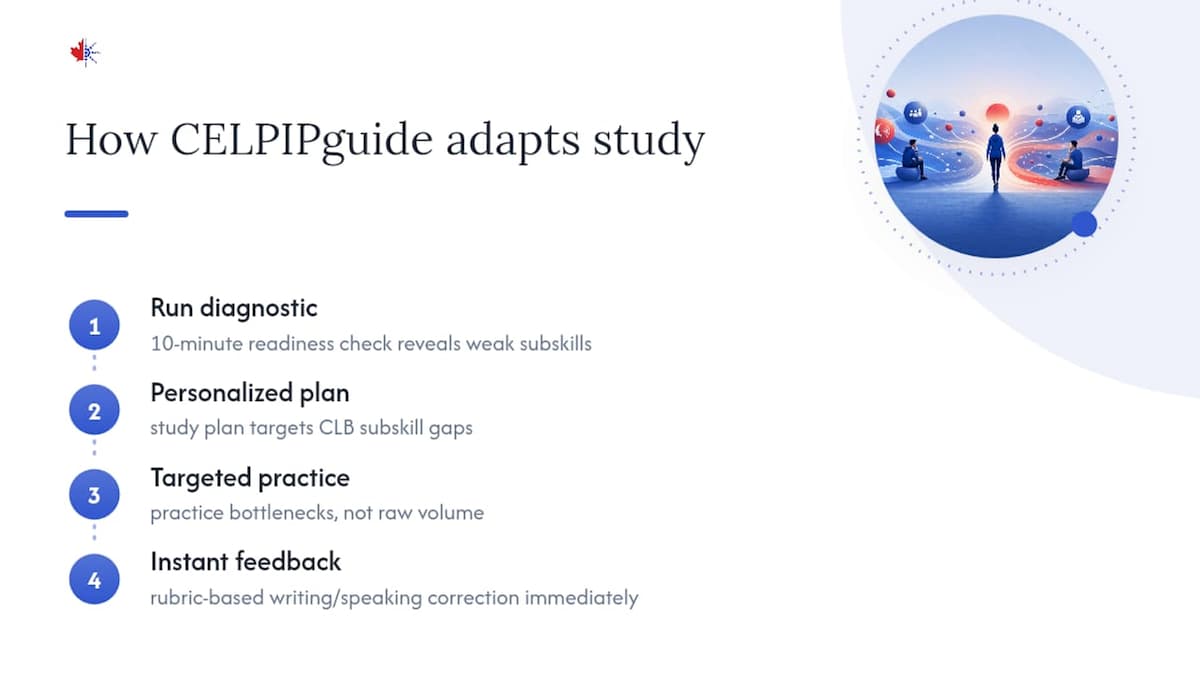
What convinces me adaptive feedback specifically matters, more than adaptive question selection alone, is the writing and speaking bottleneck. You can’t self-correct a writing task the way you can self-correct a reading answer, because you don’t know what’s wrong with your own paragraph. Instant rubric-based feedback closes that blind spot immediately instead of leaving you waiting days for a human tutor’s calendar to open.
If you’re deciding whether adaptive study is worth your time before your CELPIP date, my honest advice is to stop deciding in the abstract and just run a real diagnostic. The readiness check will tell you more about where your effort belongs in ten minutes than another week of guessing ever will.
— Reza
Get a personalized CELPIP plan with CELPIPguide
Some adaptive CELPIP study platforms include a diagnostic that maps CLB level by subskill, personalized study plans that update as users improve, instant rubric-based feedback on writing and speaking, and full-length mock exams built from a large bank of practice questions.
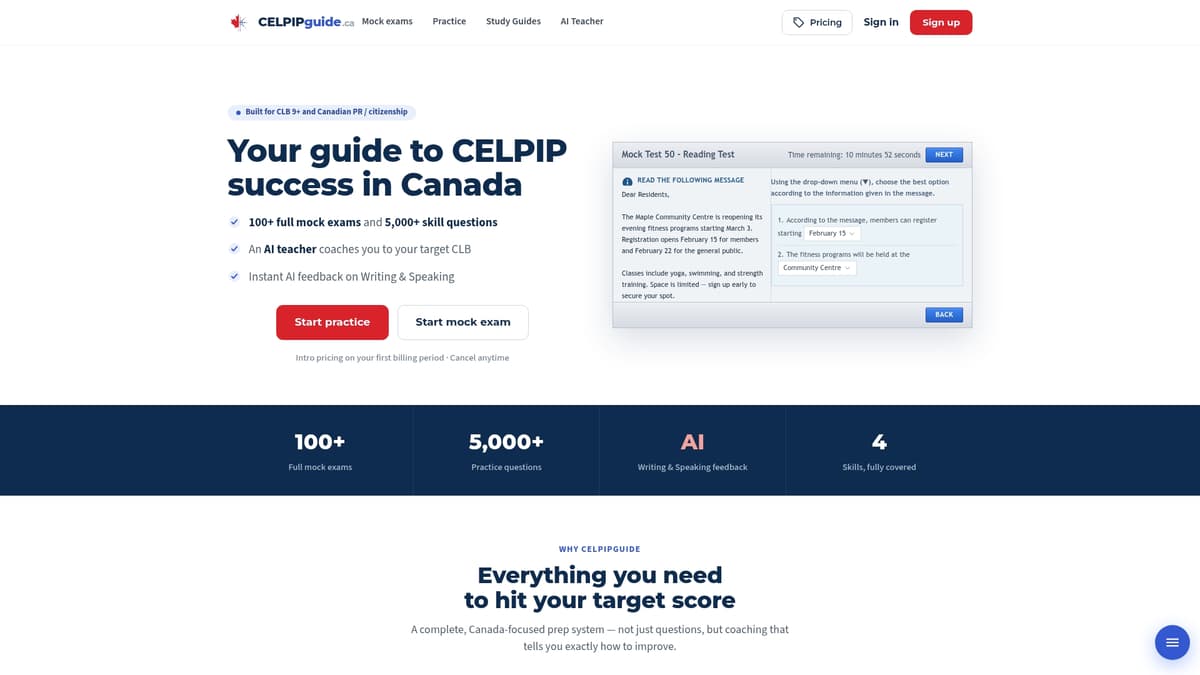
Start with the CELPIP readiness check to see your baseline across all four skills in one sitting. From there, the study plan generator builds a week-by-week schedule from your actual results, and the full-length mock exams let you check your progress under real timing before test day. If you’re weighing options, the comparison page walks through exactly how the diagnostic, feedback, and dashboard fit together. Take the readiness check today and start studying the parts of CELPIP that are actually holding your score back.
Sources
- Why an adaptive test is the only answer - ClarityEnglish blog
- Fixed-form vs adaptive test design in language proficiency testing — Avant Assessment
FAQ
Is a CLB 7 a good CELPIP score?
A CLB 7 is a solid, competitive score for many federal immigration pathways and meets the language requirement for several Express Entry categories, though your target should always be checked against the specific program you’re applying under, since some pathways or provincial programs ask for CLB 9 or higher.
Can I prepare for CELPIP in 3 days?
Three days is enough time to learn the test format and practise timing under an adaptive diagnostic, but it’s rarely enough to move your actual CLB level; a well-structured plan built on adaptive practice and periodic mocks gives you a far more realistic shot at real score improvement.
What does 33 out of 38 mean on CELPIP listening?
CELPIP listening scores are reported on the Canadian Language Benchmark (CLB) scale rather than as raw fractions, with levels reflecting the test’s adaptive assessment of your ability, so exact conversions vary by test administration.
What is the best study material for CELPIP?
The most effective combination pairs official CELPIP sample tests and prep modules with an adaptive platform that offers a diagnostic, personalized study plan, and instant rubric-based feedback on writing and speaking, since that combination targets your specific subskill gaps instead of generic review.