
CELPIP Blog
What your CELPIP result letter actually tells you
What your CELPIP result letter actually tells you

A CELPIP test result letter is the official score report listing your Listening, Reading, Writing, and Speaking numeric scores, and those four numbers are what get converted into your Canadian Language Benchmark (CLB) levels for immigration purposes. Nothing on that letter is decorative. Every field either identifies you and your test, or it feeds directly into a decision an immigration officer, university, or employer will make about you.
Here’s what to have ready before you dig into your letter:
- Your official IRCC conversion reference, since your raw scores mean nothing to Immigration, Refugees and Citizenship Canada until they’re mapped to CLB
- A calculator or tool that does that mapping instantly, so you’re not squinting at a table trying to match numbers by hand
- A plan for what happens next, whether that’s filing your application, retaking a weak section, or targeting specific practice
We’ll walk through each part below, starting with the letter itself.
Key Takeaways
Your CELPIP result letter drives real immigration outcomes only after its four skill scores are converted to CLB using IRCC’s official table, not the raw numbers themselves.
| Point | Details |
|---|---|
| Four scores, four decisions | Immigration programs check Listening, Reading, Writing, and Speaking separately, not as an average. |
| CLB conversion is mandatory | Use the IRCC conversion table to turn raw scores into the CLB level that actually counts. |
| Validity has a clock | Most results hold for two years for immigration filing, so check that date the day you get your letter. |
| One weak skill can cap everything | A single skill below threshold can disqualify an otherwise strong application or cut CRS points. |
| Celpipguide targets the gap | The score calculator and readiness check convert scores and prescribe focused practice for the weakest skill. |
Table of Contents
- What does test result letter mean on a CELPIP report?
- What do your Listening, Reading, Writing, and Speaking scores mean?
- How do CELPIP scores convert to CLB levels?
- What should you do after reading your result letter?
- Turn your result letter into your next move
- Sources
- FAQ
What does test result letter mean on a CELPIP report?
Your CELPIP result letter is a single-page document, but it packs in more than most test-takers realize the first time they open it. Knowing where to look saves you from misreading a field, and misreading a field on an immigration document is the kind of mistake that costs weeks.
Here’s what typically appears on the letter, in the order you’ll usually see it:
- Candidate identification — your full legal name and test-taker ID, which must match your passport exactly for immigration filing.
- Test date and test centre — confirms when and where you sat the exam.
- Test version — CELPIP General or CELPIP General LS, since each serves a different purpose (immigration versus specific work permit pathways).
- Four skill score lines — Listening, Reading, Writing, and Speaking, each shown as its own numeric score.
- Validity note — most CELPIP results are valid for two years from the test date for immigration applications, so this line tells you your filing window.
A typical score line reads something like “Listening: 9” or “Writing: 7.” That number alone is the raw CELPIP score. It is not yet your CLB level. The letter doesn’t always show the CLB conversion directly, which is exactly why so many test-takers stall out here, unsure whether a 9 is good or just average.
Pro Tip: Cross-check every identification field against your passport the day you receive your letter. IRCC applications get bounced for name mismatches far more often than for low scores, and catching a typo early is a five-minute fix instead of a delayed application.
What do your Listening, Reading, Writing, and Speaking scores mean?
Each of the four numeric scores on your letter tells a different story about your real-world ability, and immigration programs treat them separately, not as an average. That last part surprises a lot of applicants. You can’t average a strong Speaking score with a weak Writing score and hope the math works in your favour. Most programs need every single skill to clear a minimum CLB threshold.
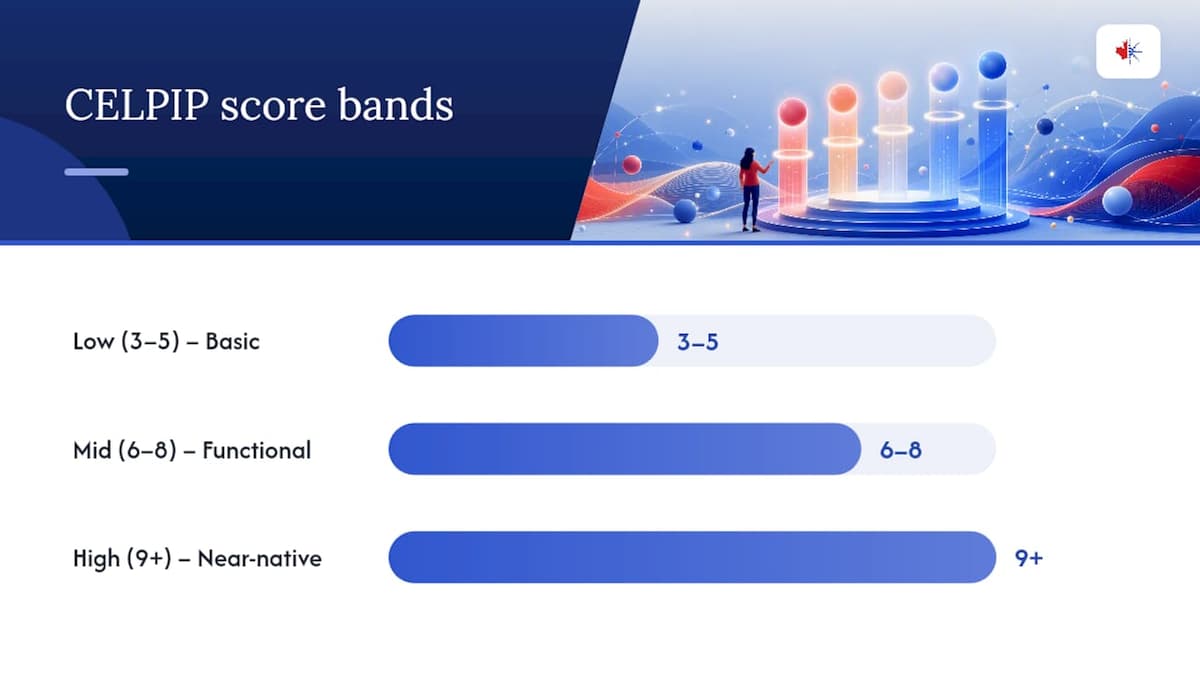
Here’s roughly what different score bands tend to indicate:
- Low scores (CELPIP 3–5): You can handle basic exchanges but struggle with nuance, longer passages, or organizing extended responses. This band usually sits below CLB 6, which knocks out eligibility for several immigration streams outright.
- Mid scores (CELPIP 6–8): Solid functional ability. You can work, study, and communicate day to day, but the score often reflects gaps in precision, like weak transitions in writing or hesitation in speaking under time pressure.
- High scores (CELPIP 9+): Strong command across the skill, close to native-level fluency in practical contexts.
The immigration stakes compound quickly. A single weak skill, even when the other three are strong, can cap your Express Entry points or disqualify you from a program with a flat CLB 7 requirement across all four abilities. CELPIPguide’s breakdown of how each skill maps to CLB walks through exactly how one lagging score drags down an otherwise strong application.
Writing tends to be the skill that trips up the most test-takers, largely because it’s graded on structure and task fulfillment, not just grammar. A detailed look at why writing scores affect CLB level shows how small formatting and organization issues, not vocabulary gaps, are usually what caps the score.
If your letter shows a Reading score lower than you expected, targeted reading skill practice tends to move the needle faster than general review, because CELPIP reading rewards specific skimming and scanning techniques over raw comprehension speed. For Speaking and Writing, instant AI feedback against the actual CELPIP rubric usually closes gaps faster than self-study, simply because you find out what’s wrong the same day you practise, not weeks later.
How do CELPIP scores convert to CLB levels?
Your raw CELPIP number is not the figure IRCC uses to decide eligibility. That number gets run through an official conversion, and the resulting CLB level, not your CELPIP score itself, is what shows up in your Express Entry profile and program eligibility checks.
IRCC maintains a published conversion table that maps each CELPIP numeric score to a corresponding CLB level, from CLB 4 up through CLB 10. A CELPIP score of 9, for example, doesn’t automatically mean CLB 9. The mapping is specific per skill, and officers rely on this exact table, not an estimate, when assessing your file.
The official IRCC conversion table is the only source that matters here. Third-party estimates and blog charts can help you get oriented, but they need to reflect that same government table or they’re not worth trusting for a real application.
Why does the exact CLB number matter so much? A few reasons:
- Express Entry CRS scoring ties directly to CLB bands, not raw CELPIP scores, so a one-point difference in CELPIP can shift your Comprehensive Ranking System points meaningfully.
- Program eligibility for streams like Canadian Experience Class or Federal Skilled Worker sets hard CLB minimums per skill, and falling one CLB level short on even one skill disqualifies you.
- Provincial nominee programs often set their own CLB thresholds, layered on top of federal requirements.
Running your scores through CELPIPguide’s score calculator gives you the CLB conversion and an estimated CRS point impact in one step, so you’re not manually cross-referencing a government PDF while you’re already stressed about your application timeline.
What should you do after reading your result letter?
Once you know your CLB levels, you’re at a decision point. Check the validity window first, since it dictates how much time pressure you’re actually under.
- Confirm your validity dates. Most CELPIP results hold valid for a specified time period for immigration purposes, so mark that filing deadline immediately.
- Compare your CLB levels against your target program’s requirements. If every skill clears the threshold, you’re ready to file.
- Identify your weakest skill. If even one score falls short, that’s your study priority, not a general review of everything.
- Decide: file, retake, or study first. Filing makes sense if you clear every threshold. A retake makes sense if you’re one CLB level short on a single skill. Focused study makes sense if you’re more than one level short or short on multiple skills.
Pro Tip: Don’t retake the full exam blind. Run a readiness check first so your retake targets the exact skill dragging your score down, instead of re-testing everything and hoping for a better roll.
From there, full-length mock exams and skill-specific drills give you a realistic read on whether your retake will actually clear the CLB you need before you spend the money on a real sitting.

A realistic view on closing the CLB gap
Most test-takers I’ve seen come back from a disappointing letter can move up one CLB level with four to eight weeks of focused, diagnostic-driven practice, not months of unfocused review. The gap is rarely “you don’t know English well enough.” It’s usually one specific weakness, like Writing organization or Speaking fluency under time pressure, that a diagnostic catches in minutes but general studying misses for weeks. Matching your study intensity to your actual filing deadline, rather than studying everything equally, is what separates people who improve fast from people who plateau.
— Reza
Turn your result letter into your next move
Reading your CLB levels is only half the job. The other half is doing something about the gap before your validity window closes, and that’s where a lot of applicants lose momentum, bouncing between generic study guides instead of working the specific skill dragging their score down. Celpipguide is built around that exact problem: a readiness check flags your weak skill first, then a personalised study plan and AI teacher target it directly, with instant rubric-based feedback on Writing and Speaking so you’re not waiting days to find out what’s wrong.
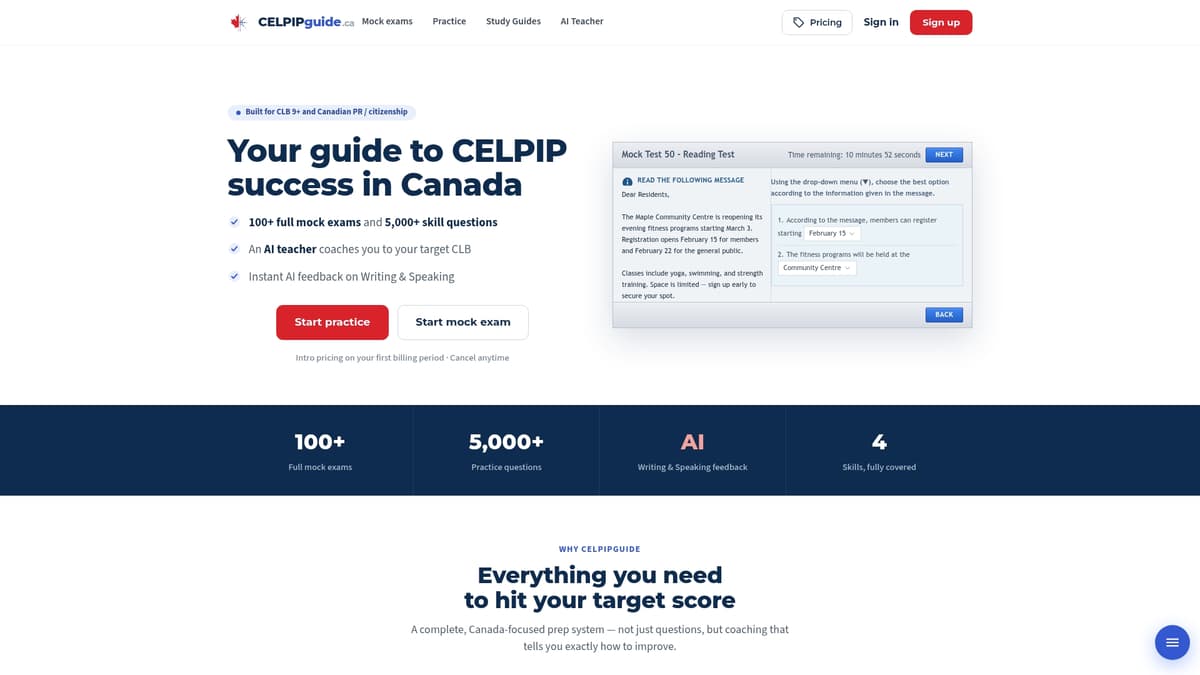
Once your plan is set, full-length mock exams let you confirm the improvement is real before you book a retake.
FAQ
What does a CELPIP test result letter show?
It shows your identification details, test date, test version, and your four numeric skill scores for Listening, Reading, Writing, and Speaking, plus a validity note.
How long is a CELPIP result letter valid?
Most CELPIP results remain valid for a limited time from the test date for immigration purposes, so check that date on your letter before you file or plan a retake.
How do I convert my CELPIP score to CLB?
Use the official IRCC conversion table, which maps each skill’s numeric score to a CLB level from 4 to 10, or run your scores through Celpipguide’s score calculator for an instant CLB and CRS estimate.
Can one low skill score affect my whole immigration application?
Yes. Most programs set a minimum CLB threshold per skill, so a single weak score, even with three strong ones, can disqualify you or reduce your Express Entry points.
What should I do if my result letter shows a score below my target CLB?
Run a readiness check to confirm which skill needs work, then use targeted practice and mock exams before deciding whether to retake the full test.