
CELPIP Blog
Fix your weakest exam skill fast before test day
Fix your weakest exam skill fast before test day

If you have a few days before you can start focused prep, here’s the plan: identify your single weakest skill with one timed mock test, then throw most of your remaining study hours at that skill alone. Get corrected feedback on every attempt, not just repetition. Then rehearse the actual exam conditions, timing and interface at least once before test day. That sequence, in that order, beats scattered review every time.
Here’s how to start in the next three days:
- Take one full, timed mock exam today or tomorrow and score it honestly against the real criteria.
- Build a simple error log the moment you finish marking it.
- Pick two targeted drills for your weakest skill only.
- Schedule a second full mock under strict exam conditions near the end of your window.
This won’t fix everything. You won’t erase a genuine grammar gap in three days. But you can absolutely reduce careless errors, sharpen your timing, and walk in calmer, which often shows up as a real score bump.
Key Takeaways
Fixing weak skill areas before an exam works best when students diagnose with one full mock, prioritize the highest-impact and lowest-effort fixes, and rehearse real exam conditions before relying on broad review.
| Point | Details |
|---|---|
| Diagnose first | Take one full timed mock exam and build an error log before choosing what to study. |
| Prioritize by impact | Fix errors that are high impact and low effort before chasing harder, low-impact issues. |
| Allocate time by priority | Spend most of your study time on your weakest skill, not an even split. |
| Rehearse real conditions | Complete at least one full mock under strict timing and check the exam interface in advance. |
| Use targeted feedback tools | Celpipguide’s readiness check, AI feedback, and full mock exams map directly onto each step of this plan. |
Table of Contents
- How to fix your weak skill areas before the exam
- Which weaknesses should you fix first?
- Skill-by-skill drills that fit a tight schedule
- Building your 1 to 2 week pre-exam study plan
- Rehearse the exam itself, not just the language
- Tracking progress and knowing when to call in a tutor
- What discipline actually looks like in the final week
- Get a diagnostic and feedback plan built for your weak spots
- Sources
- FAQ
How to fix your weak skill areas before the exam
The fastest, most reliable way to fix weak skill areas before an exam is to take one full, timed mock under real exam conditions and let the score breakdown tell you where to focus. Guessing which skill needs work wastes the one resource you don’t have much of right now: time.
Here’s the sequence that actually works:
- Sit a complete mock exam, timed, with no pauses, exactly like test day.
- Mark it immediately using the real scoring criteria, not a gut feeling.
- Build an error log while the mistakes are still fresh in your memory.
- Map each error to a specific test criterion rather than a vague “I’m bad at writing” label.
Your error log needs four columns to be useful: the module (Speaking, Listening, Reading, Writing), the specific question or task number, the exact error type, and the time you spent on it. “I got question 4 wrong” tells you nothing. “Missed a True/False/Not Given distinction because I skimmed too fast and ran out of time” tells you exactly what to drill.
Pro Tip: Record your speaking responses on your phone and play them back the next day. You’ll hear hesitation, repetition and weak transitions you never noticed while speaking, because your brain edits itself in real time but a recording doesn’t lie.
Once you’ve got real data, map it to test criteria. A writing problem might trace to task response, coherence, or plain grammar accuracy, and each one gets fixed differently. A speaking weakness might be fluency, vocabulary range, or pronunciation, three very different drills.
Which weaknesses should you fix first?
Fix the weaknesses that are both high impact on your score and low effort to correct. That combination gives you the fastest return before test day, and it’s the opposite of how most people naturally study.
The trap is spending three days trying to eliminate a mild accent (low impact, extremely high effort) while ignoring that you never write a proper concluding sentence (high impact, almost no effort to fix). One of these differentiates high-impact but low-effort fixes from low-impact but high-effort ones, and the students who improve fastest before an exam are the ones who ruthlessly sort their errors this way.
Run your error log through this filter:
- Does this error show up in three or more of my practice attempts? If yes, it’s a pattern worth fixing, not a fluke.
- Can I correct it with a rule, a template, or a checklist? If yes, it’s low effort.
- Does it touch a major scoring criterion like task response or coherence? If yes, it’s high impact.
Example: A writing student missing paragraph structure (high impact, low effort, fixable with a template) should tackle that before chasing a rare pronunciation issue that barely affects intelligibility (low impact, high effort).
Skill-by-skill drills that fit a tight schedule
Each skill has one drill that moves the score fastest. Do that one first, then layer in the others if time allows.
Speaking: Record two or three timed responses to sample prompts, then compare them against the band descriptors line by line. The single biggest lever is expanding your answers with specific detail instead of stopping after one sentence. Set a measurable goal, like cutting hesitation pauses by two to three seconds per response, and check your speaking samples and structure to see what a well-built answer actually sounds like.
Writing: Run a plan, write, edit cycle on one task per session, roughly 25 to 30 minutes total. After writing, check specifically for a clear topic sentence in every paragraph and scan for whichever grammar error keeps repeating in your log. Score it against a rubric rather than trusting your own read of it, since writers are notoriously bad judges of their own drafts. Reviewing sample Task 1 responses helps you spot structural gaps fast.
Listening: Practise the specific question type that produces most of your errors, not a random mix. Use a simple note-taking template (keyword, number, name) so you’re not trying to hold everything in your head. Run 20-minute sessions focused on distractor questions, since misidentifying a distractor is the most common listening error.
Reading: Drill scanning and skimming separately from close reading. If True/False/Not Given questions are your weak spot, isolate 15 to 20 of them and time yourself strictly, aiming to shave 10 to 15 seconds off each one by the end of the week.
Deliberate, corrected practice beats unmonitored repetition, since drilling without feedback often just reinforces the same mistake at higher speed.
Building your 1 to 2 week pre-exam study plan
Once you know your weakest skill, allocate your time accordingly instead of splitting it evenly across four skills. Concentrating effort this way tends to produce faster, more visible gains than spreading attention thin.

| Day | Focus | Activity |
|---|---|---|
| 1 to 2 | Diagnosis | Full mock exam, build error log, identify top skill |
| 3 | Weakest skill | Daily 30 minute targeted drills with self-scoring |
| 6 | Second priority | Shorter drills plus one skill-specific mock section |
| 8 | Weakest skill again | Repeat drills on patterns still showing errors |
| 11 | Full rehearsal | Second full timed mock under exam conditions |
| 13 | Review and rest | Light review only, protect sleep, confirm logistics |
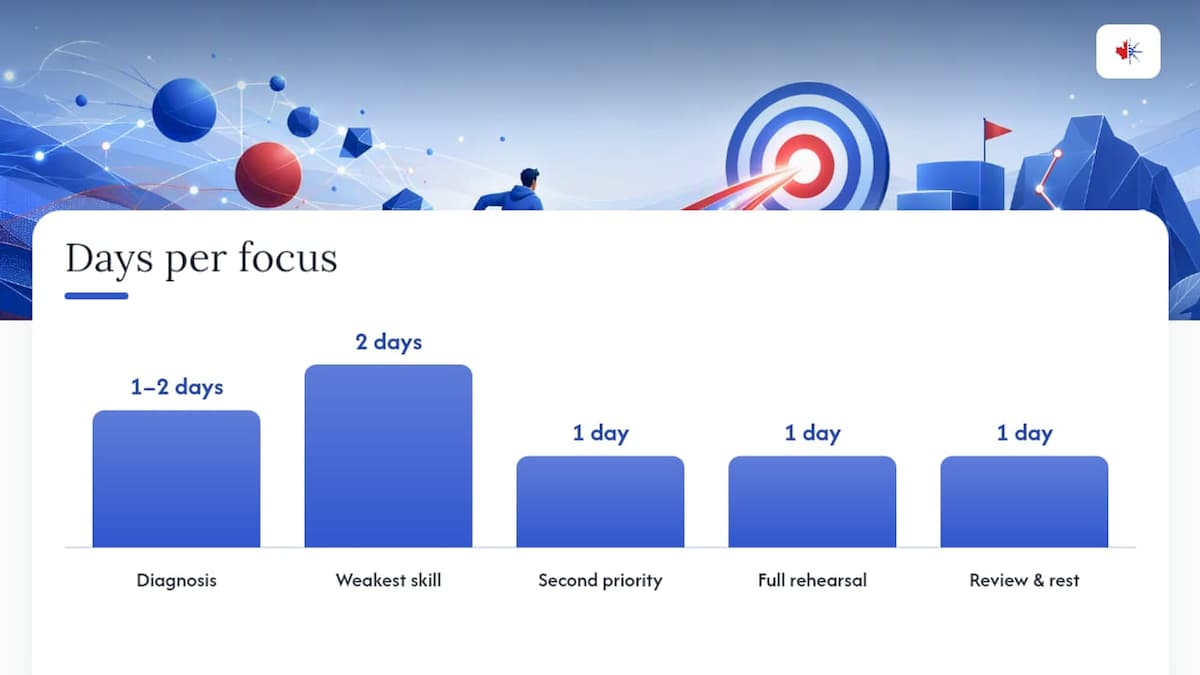
The study plan generator can build this out automatically once you know your priority skill, which saves you from guessing your own schedule.
Before test day, run through a quick countdown: confirm your ID and appointment details, do a full tech check if your exam is computer-based, plan a light dinner and a real bedtime the night before, and pack everything you need the evening prior, not the morning of.
Rehearse the exam itself, not just the language
Simulating the exact test environment, including timing and interface, protects your score from mistakes that have nothing to do with your English. A student who knows the material but fumbles the computer interface or misjudges the clock can lose points that better logistics prep would have saved.
Before test day:
- Complete at least one full mock exam under strict timing with no breaks beyond what’s allowed.
- Practise navigating the actual computer interface if your exam is delivered digitally.
- Time each section separately and note where you consistently run short.
Check your permitted materials list in advance, confirm your test centre’s tech requirements, and rehearse the speaking segment aloud into a microphone if that’s how your exam records responses. Familiarity with test-day technology and time-management routines is one of the most overlooked ways to reduce day-of anxiety for language learners.
Tracking progress and knowing when to call in a tutor
Watch two numbers: your trend across mock scores, and how often the same error type reappears in your log. If a specific error keeps showing up after three focused rounds of self-corrected practice, that’s your signal to bring in live feedback.
Track these signals weekly:
- Section score movement across your last two or three mocks.
- Repeat-error frequency for the same tag in your error log.
- Response length and hesitation count for speaking.
- Time per question for reading and listening.
Around one in two students plateaus on a single error type without outside correction, which is why scaffolded, targeted instruction tends to outperform unguided repetition on standardized tests.
Pro Tip: When you book a tutor session, hand over your error log and pick just one or two specific tasks to review. A focused 20-minute session on your actual mistakes beats an hour of generic conversation practice.
What discipline actually looks like in the final week
Most students practise what they already enjoy. If writing feels comfortable, they write more; if speaking feels awkward, they avoid it, which is exactly backward. Real progress in a short window comes from deliberately spending more time on the skill you’d rather ignore.
The framework I’d trust is simple: diagnose honestly, drill the weakest skill without excuses, rehearse the real conditions once, then review and stop. Don’t cram new material the night before. Protect sleep and eat normally. A well-rested student with a smaller vocabulary gap almost always outperforms an exhausted one who crammed until 2 a.m.
Small, measurable targets beat vague ambition. “Reduce hesitation by two seconds” is something you can actually check.
Get a diagnostic and feedback plan built for your weak spots
Everything in this plan, the fast diagnostic, the error log, the targeted drills, the full mock rehearsal, is exactly what Celpipguide’s platform is built to deliver in one place instead of five scattered tools. The CELPIP Readiness Check gives you a baseline score and a personalized plan in minutes, so you skip the guesswork of figuring out where to start.
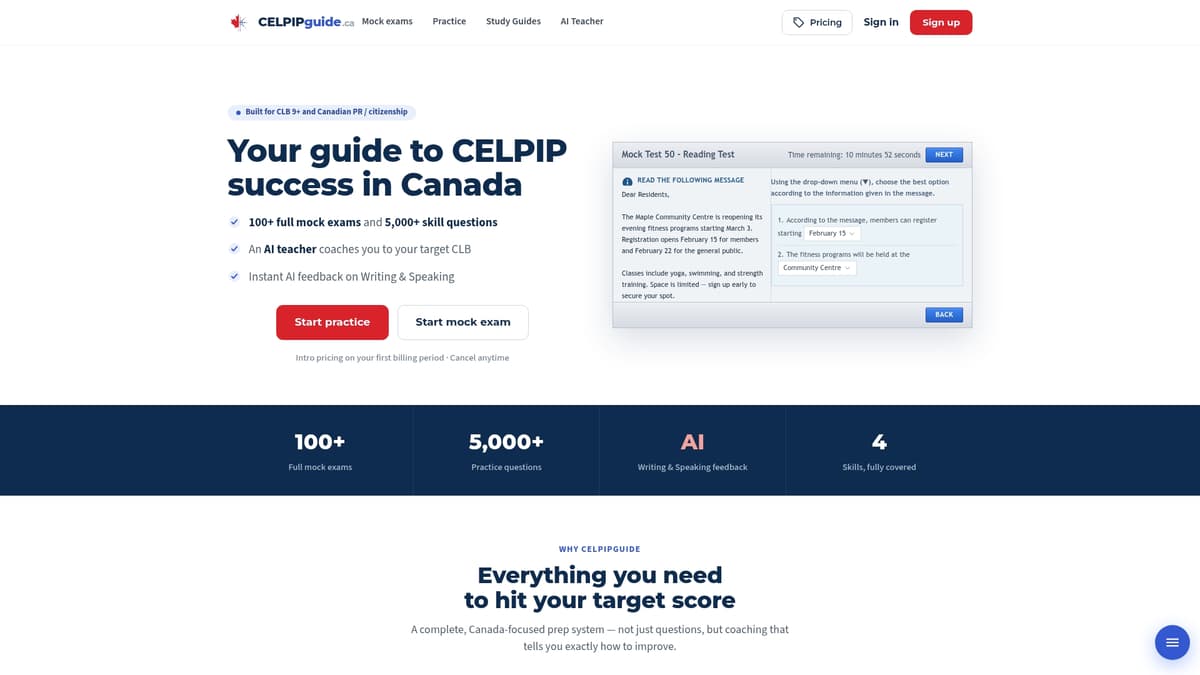
From there, Celpipguide’s AI teacher gives rubric-based feedback on your writing and speaking attempts instantly, the same kind of corrected practice that separates real improvement from repeated mistakes. Full-length mock exams let you rehearse timing and the computer interface before test day, and skill-specific sample tasks let you drill exactly the weakness your error log flags.
Sources
- Supporting English language learners for test preparation | Edmentum
- Empowering English learners for state testing success | DataWORKS
FAQ
How Do I Find My Weakest Exam Skill Quickly?
Take one full timed mock exam under real test conditions, then mark it against the actual scoring criteria and log every error by type. Celpipguide’s readiness check gives you this baseline in one sitting.
How Much Time Should I Spend On My Weakest Skill?
Can I Fix a Weak Skill In Just One Week?
You can produce measurable gains, especially in timing, structure and careless errors, but deep language gaps take longer than a week to close fully.
Should I Use an App Or a Tutor For Feedback?
Use AI-driven feedback for fast, frequent correction on writing and speaking, and bring in a tutor when the same error persists after three rounds of targeted, corrected practice.
Why Does Rehearsing the Exam Interface Matter?
Because unfamiliarity with timing and the digital interface can cost points that have nothing to do with your English ability, simulating the real environment protects the score you’ve already earned.