
CELPIP Blog
How sentence structure shapes your speaking score in 2026
How sentence structure shapes your speaking score in 2026

Your sentence structure directly determines your speaking score on IELTS, CELPIP, and TOEFL. It is not just about speaking correctly. It is about showing examiners that you can move between simple, compound, and complex sentences with ease and purpose. Grammatical range, which is how varied and accurate your sentence patterns are, is one of the four core criteria on the IELTS speaking band descriptors. CELPIP uses a similar framework tied to CLB levels. TOEFL’s SpeechRater engine scores grammatical complexity as part of its automated analysis. If you rely only on simple sentences, you cap your score, regardless of how fluent you sound.
Here is what examiners actually look for when evaluating your sentence patterns:
- Subordinate clauses: “Although I grew up in a small town, I adapted quickly to city life.”
- Relative clauses: “The job that I applied for required strong communication skills.”
- Coordinate clauses: “I enjoy cooking, and I often try new recipes on weekends.”
- Passive voice: “The decision was made by the committee after a long discussion.”
- Inversion: “So challenging was the exam that I studied every night for a month.”
- Conditional sentences: “If I had more time, I would travel across Canada.”
- Emphatic ‘do’: “I do believe that preparation makes a real difference.”
Using only simple sentences, even error-free ones, limits you to a lower band on IELTS and an equivalent lower level on CELPIP.
Why sentence structure impacts your speaking score

The IELTS Grammatical Range and Accuracy (GA) criterion measures four things: sentence length and complexity, appropriate use of subordinate clauses, the range of sentence structures you use to manage information focus, and the number and communicative effect of your grammatical errors. CELPIP’s speaking rubrics assess the same dimensions under its CLB benchmarks. TOEFL’s SpeechRater adds an automated layer, scanning for syntactic variety and clause density alongside fluency metrics.
The most common mistake test-takers make is sticking to short, safe sentences. It feels less risky, but it signals a limited grammatical range. Repetitive sentence openings and uniform sentence length create listless, disengaging speech that lowers examiner ratings even when every sentence is grammatically correct. Examiners notice the pattern within the first 30 seconds.
The second most common problem is attempting complex structures and getting them wrong. IELTS proficiency research confirms that attempts at complex grammatical structures increase at higher band levels, but error rates also rise. Examiners differentiate sharply between “attempted” complexity and “accurate” complexity. A misplaced relative clause or a broken conditional does more damage than a clean simple sentence.
“Using only simple sentences with a limited range of complex structures will restrict you to a lower band score. Higher bands require a broader mix and range of complex structures used appropriately.” — FutureLearn IELTS Speaking Course
A third issue is memorised sentences. Test-takers who rehearse complex sentences word-for-word often sound unnatural when they deliver them. Communicative effectiveness matters as much as grammatical accuracy. Robotic delivery of a technically correct sentence can actually lower your score compared to a simpler, coherent response that sounds genuine.
Advanced sentence structures that raise your score
The gap between a Band 6 and a Band 7 on IELTS, or between CLB 8 and CLB 9 on CELPIP, often comes down to three or four specific sentence types. Learning to use them naturally is the fastest way to improve your grammatical range score.
| Structure | Form | Example | Scoring impact |
|---|---|---|---|
| Complex sentence | Independent + dependent clause | “Because I studied abroad, I became more independent.” | Shows subordination; key for Band 6+ |
| Compound-complex | Two independent + one dependent clause | “I love hiking, and I go every weekend because it clears my mind.” | Demonstrates flexibility; targets Band 7 |
| Relative clause | Noun + who/which/that + clause | “The city where I grew up has changed dramatically.” | Differentiates Band 6 from Band 7 |
| Passive voice | Be + past participle | “The report was submitted before the deadline.” | Expands verb range; valued by examiners |
| Inversion | Adverb/adjective + verb + subject | “So tired was I that I fell asleep immediately.” | Native-speaker marker; targets Band 8 |
| Cleft sentence | It is/was + X + that/who | “It was the feedback that helped me improve.” | Highlights key information; advanced range |
| Conditional | If + past, would + infinitive | “If I could change one thing, I would improve public transit.” | Shows modal range; common in IELTS Part 3 |
Here is what each structure actually does for your score:
- Relative clauses are the single most important structure to master. They appear in IELTS band descriptors as a benchmark between Band 6 and Band 7 performance.
- Passive voice and modal verbs expand your grammatical range by showing complex information relationships, and examiners value them explicitly in the GA criterion.
- Inversion and cleft sentences let you manage information emphasis the way native speakers do, which directly improves your discourse competence score.
- Conditional sentences are a natural fit for IELTS Part 3 and CELPIP opinion tasks, where you are asked to speculate or give recommendations.
- Compound-complex sentences signal genuine flexibility rather than rehearsed patterns.
The Language Portal of Canada describes the difference well: writers and speakers who use only simple sentences are like drivers stuck in first gear. They can get somewhere, but the journey is slow and limited. Shifting between sentence types is what separates competent speakers from high-scoring ones.
How to improve your sentence structure for speaking tests
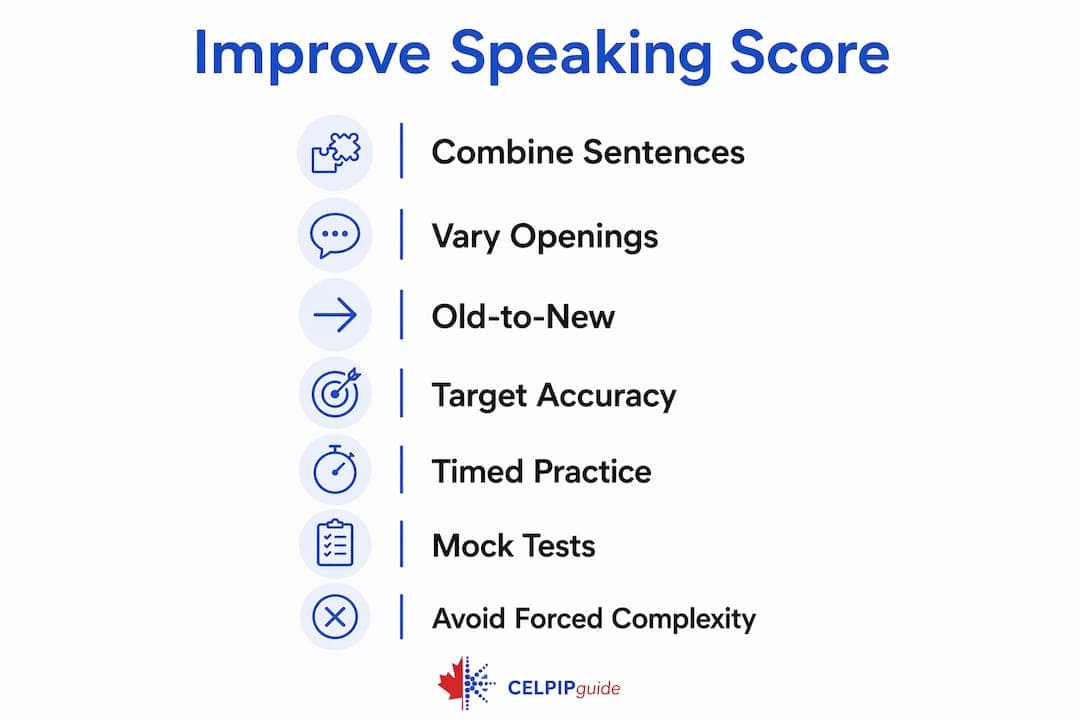
Improvement here is not about memorising grammar rules. It is about building habits that work under timed exam conditions. Here is what actually moves the needle:
1. Practise sentence combining daily. Take two simple sentences and merge them using a subordinating conjunction, a relative pronoun, or a participial phrase. For example: “I was nervous. I walked into the exam room.” becomes “Although I was nervous, I walked into the exam room with confidence.” Do this for 10 minutes a day and your instincts will shift within two to three weeks.
2. Vary your sentence openings deliberately. Starting every sentence with “I” is one of the most common patterns that lowers examiner ratings. Try opening with an adverb (“Honestly, I think…”), a prepositional phrase (“In my experience…”), or a dependent clause (“When I consider the options…”).
3. Use the old-to-new principle. Present familiar information at the start of a sentence and new information at the end. This improves listener comprehension and makes your speech easier to follow, which directly affects your fluency and coherence scores.
4. Target accuracy before complexity. A clean Band 6 sentence beats a broken Band 8 attempt. Incorrect complex structures are penalised more heavily than simple, error-free sentences. Master relative clauses and conditionals before attempting inversion.
5. Simulate timed conditions. Practise answering CELPIP and IELTS speaking prompts with a timer. Timed practice forces you to retrieve sentence structures automatically rather than constructing them consciously. This is the closest you can get to real exam conditions at home.
6. Use mock tests with feedback. Structured preparation with expert-guided test prep consistently outperforms self-study alone, especially for grammar-specific skills where you need external feedback to catch blind spots.
7. Avoid forced complexity. Examiners can tell when a sentence has been rehearsed and dropped in regardless of context. Natural, appropriate use of complex structures scores higher than technically impressive sentences that do not fit the flow of your answer.
Pro Tip: Record yourself answering three CELPIP or IELTS speaking prompts, then listen back and count how many different sentence structures you used. If you hear the same opening five times or only simple sentences, that is your target area. One recording session reveals more than an hour of passive study.
What research tells us about grammar range and speaking scores
The evidence on this is clear. A study analysing 73 IELTS speaking tests across band levels 4 to 8 found that attempts at complex structures, including conditionals, relative clauses, indirect questions, and passive constructions, increased consistently at higher band levels. The catch: error rates also rose. This confirms that the path to a higher score is not just attempting complexity, it is mastering it accurately.
Key finding: Higher-scoring candidates use a higher frequency of conjunctions, especially additive conjunctions, to build logical cohesion rather than producing isolated simple statements. Discourse competence, the ability to connect ideas across sentences, is what separates Band 7 from Band 6 speakers.
Research on communicative effectiveness in language testing adds an important nuance: the best performances balance grammatical complexity with fluency. Overly mechanical use of complex structures, even when accurate, can lower scores compared to simpler, coherent speech. The goal is natural integration, not performance.
For Canadian English proficiency tests specifically, the CLB framework aligns closely with IELTS band descriptors. CLB 9 and above requires the kind of grammatical flexibility that IELTS Band 7 to 8 demands: a range of complex structures used with consistent accuracy and natural discourse flow. Understanding why grammar matters at this level is the first step toward building that range.
Research-backed best practices for sentence structure in speaking tests:
- Use subordinate clauses (adverbial, noun, and relative) as your primary complexity markers.
- Connect ideas with additive and contrastive conjunctions to build cohesion across sentences.
- Apply the old-to-new information principle to keep listeners oriented.
- Aim for error-free sentences at your current complexity level before pushing higher.
- Practise passive voice and modal verbs to expand your verb group range without overreaching.
- Reserve inversion and cleft sentences for moments when you want to emphasise a key point naturally.
If you want to see what high-scoring sentence structure looks like in practice, reviewing CELPIP speaking samples with annotated responses is one of the most efficient ways to calibrate your own output.
Put it all together with Celpipguide
Knowing what examiners look for is half the work. The other half is practising under real exam conditions until varied sentence structure becomes automatic. Celpipguide gives you over 100 full-length CELPIP mock exams built to CEFR standards, with an AI teacher that flags grammar range issues in your speaking responses and personalises your study plan around your specific weak points. If you are aiming for CLB 9 or above for Express Entry or citizenship, that kind of targeted feedback is what closes the gap fastest.

Key takeaways
Sentence structure is the single most controllable factor in your speaking score: mastering subordinate clauses, passive voice, and conjunctions at the accuracy level your current band requires will move your score more reliably than any other grammar skill.
| Point | Details |
|---|---|
| Simple sentences cap your score | Using only simple sentences limits you to Band 5 on IELTS and an equivalent CLB level on CELPIP. |
| Accuracy beats attempted complexity | Incorrect complex structures are penalised more than clean simple sentences; master each structure before using it. |
| Conjunctions build discourse cohesion | Higher-scoring candidates use conjunctions more frequently to connect ideas rather than producing isolated statements. |
| Record and review your responses | Self-recording reveals sentence variety gaps faster than passive study and targets your actual weak points. |
| Natural use scores higher than forced use | Examiners reward appropriate, natural integration of complex structures over rehearsed sentences dropped into answers. |
FAQ
What is the role of sentence structure in a speaking score?
Sentence structure determines your grammatical range score, one of the four core criteria on IELTS, CELPIP, and TOEFL speaking assessments. Varied and accurate sentence patterns signal higher language proficiency and directly raise your band or CLB level.
Does using complex sentences always improve your score?
Not automatically. Examiners differentiate between attempted and accurate complexity. A misplaced relative clause or broken conditional is penalised more than a clean simple sentence, so accuracy at your current level matters as much as variety.
What sentence structures matter most for CELPIP and IELTS speaking?
Relative clauses, adverbial clauses, passive voice, conditional sentences, and coordinate clauses are the core structures assessed. Inversion and cleft sentences appear in Band 7 to 9 and CLB 9 performances as markers of advanced range.
How can you practise sentence variety for a speaking test?
Combine simple sentences daily using subordinating conjunctions or relative pronouns, vary your sentence openings, and record your timed responses to identify repetitive patterns. Practising with full-length mock tests builds the automatic retrieval you need under exam pressure.
What is the importance of sentence structure for Canadian English proficiency tests?
For Canadian immigration tests like CELPIP, sentence structure directly maps to CLB levels required for Express Entry and citizenship. CLB 9 and above requires the grammatical flexibility equivalent to IELTS Band 7 to 8, making sentence variety a practical immigration priority, not just an academic one.