
CELPIP Blog
2–3 Minutes to Fix Cohesion and Lift Your CLB for CELPIP Writing
2–3 Minutes to Fix Cohesion and Lift Your CLB for CELPIP Writing

Cohesion is the glue that connects your ideas so a marker can follow your logic without re-reading a sentence twice. The fastest way to build it is to spend two to three minutes outlining your response before you write a word, marking where a connector, a pronoun, or a paragraph bridge needs to go. That small habit directly targets the content/coherence dimension of CELPIP scoring, and stronger organisation there can genuinely move you up a CLB band.
TL;DR:
- Strengthening paragraph bridges and ensuring each transition clearly signals the relationship can boost CLB levels by making ideas flow seamlessly.
- Avoid overusing “and” by choosing more precise connectors like “however” or “because,” especially when linking contrasting or cause-and-effect ideas.
- Fix pronoun ambiguity by replacing vague words like “it” or “this” with specific nouns, preventing misunderstandings that weaken cohesion.
- Prioritize fixing paragraph-starts, unambiguous pronouns, and missing links during the final review, as these have the most immediate impact on cohesion and scoring.
- Regular practice with timed responses and targeted feedback tools, such as AI scoring and connector drills, improve cohesion skills faster than passive reading alone.
Table of Contents
- Why cohesion matters for CELPIP scoring and CLB levels
- Sentence-level cohesion techniques to practise now
- Paragraph-level cohesion: building logic that carries through
- A timed checklist to catch cohesion faults before you submit
- Practice exercises and tools that actually move your CLB score
- What I see most often go wrong, and the one-line fix for each
- Practise cohesion the way CELPIPguide’s tools are built for
- Sources
- FAQ
Why cohesion matters for CELPIP scoring and CLB levels
CELPIP writing tasks are graded across several dimensions, and content/coherence sits right alongside vocabulary and grammar, not beneath it. Examiners are trained to notice whether your ideas connect logically from sentence to sentence and paragraph to paragraph, based on the CELPIP writing scoring criteria and CLB level descriptors. A response with clear paragraph structure and effective transitions signals a higher CLB level almost automatically, because organisation is one of the clearest, fastest things a trained reader picks up on.
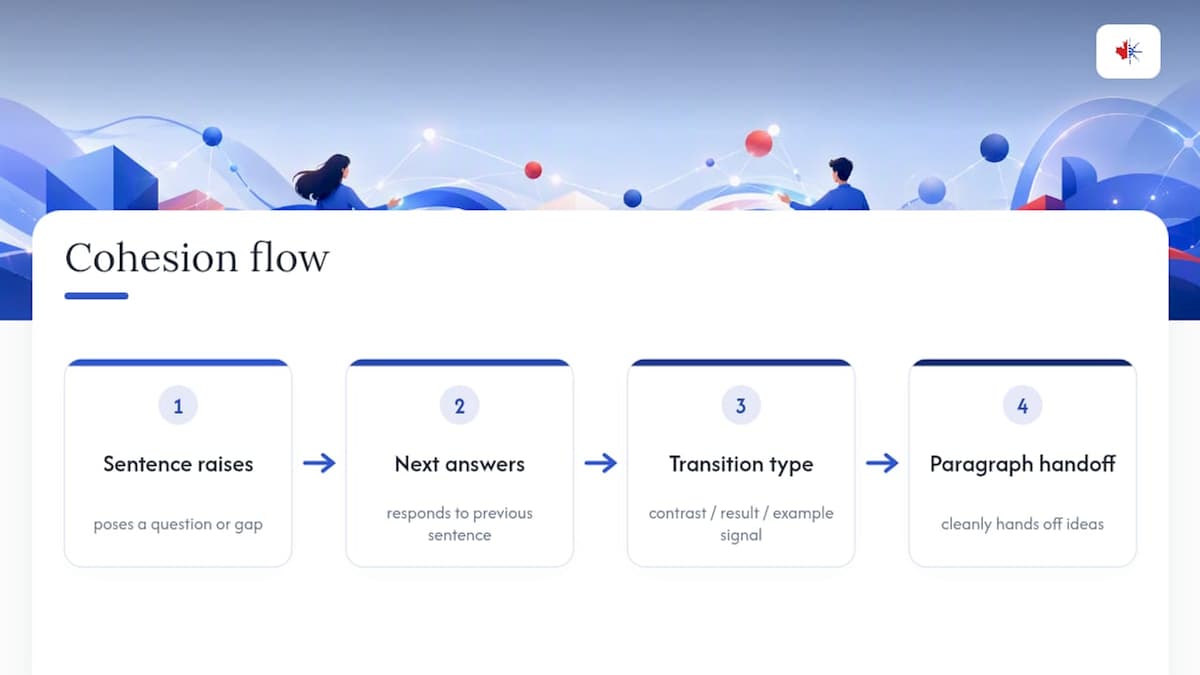
Weak cohesion shows up in predictable ways: ideas that jump without warning, pronouns with no clear reference, paragraphs that restart the argument instead of building on it. Strong cohesion looks the opposite. Each sentence answers a question the previous one raised, transitions signal exactly what relationship is coming (a contrast, a result, an example), and paragraphs hand off to each other cleanly.
Here’s the part test-takers often miss: examiners weigh content and coherence together with task fulfillment, and strong performance there can offset a few grammar slips if you’ve covered every point the task demands. Spending your last ten minutes hunting for a comma splice while your paragraphs still don’t connect is the wrong trade. Fix the structure first. Polish grammar second.
Sentence-level cohesion techniques to practise now
Cohesion at the sentence level runs on three tools: connectors, pronouns, and a smart mix of repetition and synonyms. These are the linguistic devices that link ideas between sentences and paragraphs so your response reads as one continuous argument instead of a list of separate thoughts.
Group your connectors by the relationship they signal, not just by memorizing a long list:
- Addition: “In addition,” “Also,” “On top of that” — e.g., “The new policy cuts costs. In addition, it reduces wait times.”
- Contrast: “However,” “On the other hand,” “Despite this” — e.g., “Remote work boosts flexibility. However, it can weaken team communication.”
- Cause and effect: “As a result,” “Because of this,” “Consequently” — e.g., “Traffic increased sharply. As a result, commute times doubled.”
- Example: “For instance,” “Such as,” “A good example is” — e.g., “Many cities have adapted. For instance, Toronto expanded its bike lanes.”
Pronouns do quiet, essential work. “The city introduced a new transit line. It cut commute times by nearly half” only works if “it” has exactly one possible target. If your previous sentence mentions two nouns, swap the pronoun for the specific noun instead of risking ambiguity.
Repetition and synonyms need balance too. Repeat a key term (like “immigration policy”) when precision matters, but swap in a synonym (“this approach,” “the new rule”) every second or third mention so your writing doesn’t sound mechanical.
Pro Tip: Practise a “connector insertion” drill: take a paragraph you’ve already written, strip out every transition word, then rebuild it from memory using only the connector categories above. It forces you to feel the logical relationship instead of just recalling a word.
A second drill worth five minutes: write three sentences about any topic, then rewrite them replacing every repeated noun with either a pronoun or a synonym, checking that meaning stays perfectly clear.
Paragraph-level cohesion: building logic that carries through
A strong topic sentence tells the reader exactly what the paragraph will argue, not just what it’s about. “Public transit funding should increase” works. “This essay will discuss transit funding” does not, because it describes the essay instead of taking a position.
Once your topic sentence is set, order the sentences that follow so each one answers a question the last one created. If your topic sentence claims transit funding should increase, your next sentence should say why, not jump to an unrelated benefit.
Bridging paragraphs is where most CLB 7 and 8 writers lose points to CLB 9 writers. A bridge phrase at the start of a new paragraph tells the reader how this idea connects to the last one:
- Finish paragraph one with a clear closing idea (not a summary, an idea that sets up what’s next).
- Open paragraph two with a phrase like “Beyond funding, another concern is…” or “This shortage also affects…”
- Let the new topic sentence pick up the thread rather than starting cold.
A dependable three-sentence paragraph template for Task 2 looks like this: a topic sentence stating your point, a supporting sentence with a reason or example, and a closing sentence that either reinforces the point or sets up the bridge to what comes next. This structure alone tends to satisfy the paragraph-level expectations built into higher CLB level descriptors.
A timed checklist to catch cohesion faults before you submit
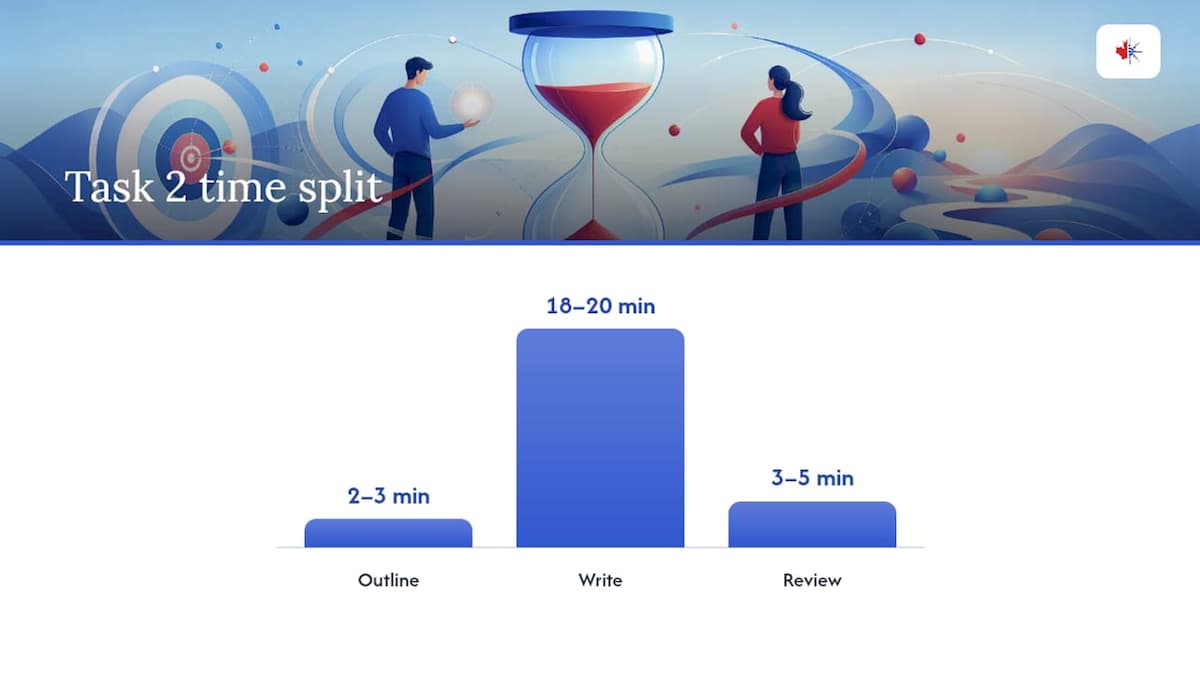
CELPIP Writing gives you 27 minutes for Task 1 and 26 for Task 2, and the split you use inside that window decides whether cohesion survives the pressure. A workable plan for Task 2: two to three minutes to outline your position and paragraph order, eighteen to twenty minutes to write, and the remaining three to five minutes strictly for review. Task 1 follows the same shape, just compressed.
That final review window is where cohesion either gets fixed or gets ignored. Run through this checklist, in this order:
- Does every paragraph open with a connector or bridge phrase linking it to the one before?
- Do all pronouns have one obvious, unambiguous reference?
- Have you repeated any term too many times without a synonym breaking it up?
- Does each paragraph actually build on the last idea, or does it restart the topic?
- Have you covered every point the task prompt asked for?
If time runs short, prioritize ruthlessly. Fix missing paragraph bridges first, since a marker sees those instantly. Fix pronoun ambiguity second. Save synonym variation for last. It matters, but it costs the fewest points when left slightly imperfect.
Pro Tip: Write your outline in the margin using single words for connectors (“However,” “Result,” “Example”) next to each planned paragraph. It turns your outline into a checklist you can glance at while writing, not just a plan you make and forget.
Practice exercises and tools that actually move your CLB score
Reading about cohesion won’t fix it. Timed, repeated practice will, because it forces you to apply connectors and pronoun logic under the same pressure you’ll face on test day. Deliberate practice with mock exams and targeted drills gives you focused feedback on the exact patterns you keep getting wrong, rather than a vague sense that your writing “needs work.”
Three drills worth repeating weekly:
- A five-minute connector drill: write one paragraph using at least one connector from each category (addition, contrast, cause/effect, example).
- A pronoun-clarity pass: rewrite an old paragraph, checking every “it,” “this,” and “they” against a single, obvious antecedent.
- A full timed Task 2 response, reviewed against the checklist above within your last five minutes.
CELPIPguide’s Free CELPIP Writing Checker gives instant AI scoring and feedback, which is genuinely useful for catching cohesion issues you can’t always see in your own writing. Studying the Task 2 samples built around CLB 9 structure shows you what strong paragraph bridging actually looks like on the page, and the connector drills built specifically for CELPIP walk through the seven connector types in more depth than a single article can.
| What to track | Why it matters |
|---|---|
| Connector accuracy | Shows whether you’re choosing the right relationship word, not just any transition |
| Paragraph linkage | Reveals whether bridges are present or your paragraphs restart cold |
| Reviewer notes from AI feedback | Flags recurring patterns you can’t catch by rereading your own work |
What I see most often go wrong, and the one-line fix for each
The most common cohesion mistake I see is overusing “and” to string ideas together instead of choosing a connector that actually signals the relationship between them. The fix: before you write “and,” ask whether you mean “because,” “but,” or “then,” and use that word instead.
The second mistake is a pronoun with no clear target, usually “it” or “this” referring back to a whole idea instead of one noun. The fix: if you can’t point to a single word the pronoun replaces, rewrite the sentence with the noun spelled out.
The third is paragraphs that restate the topic instead of building on it, which happens most when a candidate outlines too little and writes on instinct. The fix: never start a paragraph without first writing, even mentally, how it connects to the one before it.
— Reza
Practise cohesion the way CELPIPguide’s tools are built for
Reading about connectors only gets you so far. What actually moves your CLB score is writing a timed response, getting rubric-based feedback on exactly where your cohesion broke down, and fixing that specific pattern before your next attempt.
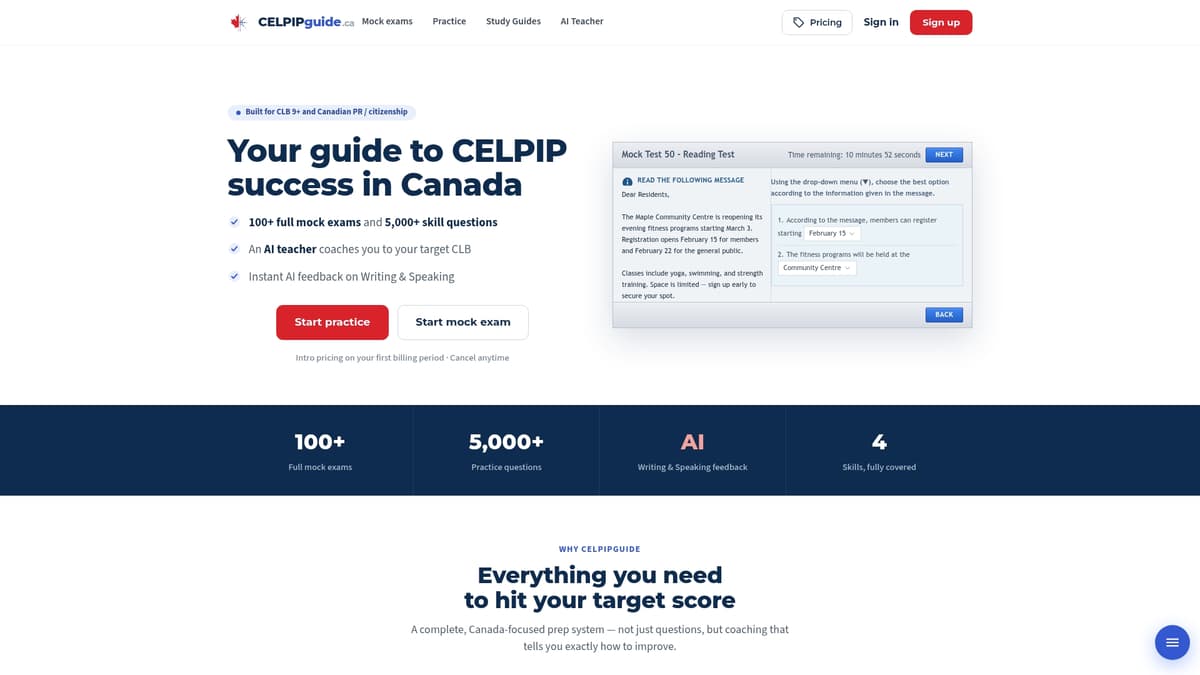
That loop is what dedicated CELPIP practice tools are built around. The Free CELPIP Writing Checker flags weak transitions and unclear pronoun references in seconds, so you’re not guessing at what a real examiner would flag. From there, the CELPIP Readiness Check builds a personalized plan around your actual weak points instead of a generic study schedule, and the full-length mock exams let you practise cohesion under the same time pressure you’ll face on test day, across all four skills. If you’re drafting a paragraph fast to test a structure before committing it to a timed response, a tool like AmmarAI’s paragraph generator can help you see a clean example quickly.
Run a readiness check this week, then attempt one timed Task 2 response and let the AI feedback show you exactly where your paragraph bridges need work.
Sources
FAQ
What is cohesion in CELPIP writing?
Cohesion is the use of connectors, pronouns, and repetition or synonyms to link ideas between sentences and paragraphs so your response reads as one connected argument rather than separate statements.
How much does cohesion affect my CLB score?
Cohesion falls under the content/coherence dimension of CELPIP scoring, and clear paragraph structure with effective transitions is one of the clearest signals examiners use to judge your CLB level.
What are the best transition words for CELPIP Writing Task 2?
Group them by relationship: “in addition” and “also” for addition, “however” for contrast, “as a result” for cause and effect, and “for instance” for examples, rather than memorizing a random list.
How can I check my own writing for cohesion problems?
Read your response aloud and check that every pronoun has one clear target and every paragraph opens with a bridge to the one before it; tools like CELPIPguide’s Free Writing Checker can flag issues you miss on your own.
How long should I spend planning before writing a CELPIP Task 2 response?
Spend two to three minutes outlining your position and paragraph order before writing, which leaves enough time in your 26 minutes to write fully and still review for cohesion at the end.