
CELPIP Blog
Boost CELPIP Cohesion With 7 Connector Types and Timed Drills
Boost CELPIP Cohesion With 7 Connector Types and Timed Drills

Focus on connectors that show addition, contrast, cause and effect, sequencing, concession, emphasis, and result. These seven categories cover almost everything CELPIP raters look for when they score cohesion and coherence in both Speaking and Writing. Get them right and you signal organized thinking, not just correct grammar. This guide gives you the exact lists, templates, drills, and annotated samples to make that happen fast.
TL;DR:
- Using well-chosen connectors at the right moment in speaking and writing helps demonstrate organized thinking beyond just correct grammar.
- In speaking, incorporating two or three connectors evenly throughout a response creates a natural flow without overloading the answer.
- For writing, using transition words at sentence starts, pronouns, and paragraph bridges boosts coherence and scores on the cohesion criterion.
- Overusing connectors or mismatching their register in formal essays often results in point deductions, so practice and precise editing are essential.
- Real-time drills and instant feedback tools focus on correct connector usage under pressure, improving both recall and contextual appropriateness.
Table of Contents
- Connectors for CELPIP grouped by function
- How to use connectors in CELPIP speaking: templates and timing
- How to use connectors in CELPIP writing: building cohesion
- Common connector mistakes and quick fixes
- Practice drills that build automatic connector use
- Annotated samples: connectors in action
- Why practice beats memorization for connector mastery
- Practise connectors with real exam feedback, not guesswork
- Sources
- FAQ
Connectors for CELPIP grouped by function
You don’t need 200 transition words memorized. You need the right one, at the right moment, used correctly. Transition words function best when learners understand the relationship each one signals rather than treating them as interchangeable filler. Here’s a working list organized by what each connector actually does.
Addition
- “In addition” — “In addition, many newcomers find the CLB scale confusing at first.”
- “Also” — “Also, the Speaking test moves faster than most people expect.”
- “Moreover” (formal) — reserve for Writing Task 2, not casual speech.
Contrast
- “However” — “However, my opinion changed after I reviewed the sample answers.”
- “On the other hand” — “On the other hand, some candidates prefer written feedback.”
- “Whereas” (formal) — pairs two clauses in one sentence for Writing.
Cause and effect
- “As a result” — “As a result, her CLB score rose from 6 to 8.”
- “Because” — informal and formal; safe everywhere.
- “Therefore” (formal) — strong choice for Writing Task 2 conclusions.
Sequencing
- “First,” “Next,” “Finally” — ideal for Speaking Task 2 and 3 structure.
- “After that” — informal, natural in spoken responses.
Concession
- “Although” — “Although the exam is timed strictly, most people finish comfortably.”
- “Even so” — good bridge between a concession and your main point.
Emphasis
- “In fact” — “In fact, connector overuse hurts scores more than underuse.”
- “Particularly” — narrows a broad claim to one specific detail.
Result
- “Consequently” (formal) — Writing only.
- “So” — informal, common in Speaking; avoid in formal essays.
Register matters here. “So” and “also” sound natural in Speaking but feel casual in a formal Writing Task 2 essay. Swap them for “therefore” and “in addition” once you’re writing, not talking.
How to use connectors in CELPIP speaking: templates and timing
Speaking responses run about one to one and a half minutes, which means you don’t have room for many connectors per answer. Two or three, placed well, beat a script stuffed with transition words. Templates give your brain a shortcut under pressure, so you spend your thinking time on content, not sentence structure.
- Opinion prompts: “I believe [opinion]. First, [reason one]. In addition, [reason two]. As a result, [conclusion].”
- Comparison prompts: “Both options have merit. However, I prefer [choice] because [reason]. On the other hand, [acknowledge the alternative].”
- Problem-solution prompts: “The main issue is [problem]. Consequently, [effect]. One solution is [idea], and as a result, [outcome].”
Aim for one connector periodically throughout your speech, spaced well enough to sound natural rather than forced. That pacing sounds conversational rather than recited.
Pro Tip: Practice saying your connector out loud with a natural pause before it, not after. “I think… however, I disagree” sounds rehearsed. “I think that, however, the opposite is true” flows like real speech.
How to use connectors in CELPIP writing: building cohesion

Cohesion, the linguistic thread that links ideas from sentence to sentence and paragraph to paragraph, is a core marker of advanced writing, and CELPIP raters score it directly under the Coherence criterion. You build it at two levels.
Sentence level:
- Transition words at the start of a sentence (“However,” “As a result,”)
- Pronoun reference to avoid repeating the same noun (“the program” becomes “it”)
- Synonym rotation instead of repeating one word five times in a paragraph
Paragraph level:
- A clear topic sentence that states the paragraph’s single idea
- Logical progression from claim to evidence to conclusion
- A bridge sentence at the end that connects to the next paragraph’s topic
One consistent finding across academic writing guidance is that transition words, repeated key terms, pronoun reference, and paragraph bridges together produce measurably more coherent writing than sentences strung together without any linking device. On punctuation: use a comma before a coordinating conjunction (“I disagree, but I understand the reasoning”) and a semicolon to join two related independent clauses without a connector at all (“The policy has flaws; it still deserves support”).
Common connector mistakes and quick fixes
Most point losses come from three habits, and all three are fixable in a single revision pass.
- Overuse: Stacking “Also,” “In addition,” and “Moreover” in three consecutive sentences reads as padding, not structure. Cut two of the three and let one sentence stand without a connector.
- Register mismatch: “So” and “plus” belong in Speaking, not in a formal Writing Task 2 essay. Swap them for “therefore” and “in addition” before you submit.
- Punctuation errors: Writing “However I disagree” without a comma, or joining two full sentences with a comma alone (“I disagree, this seems unfair”), are two of the most common fixes needed. Add the comma after “However,” and replace the comma splice with a semicolon or a period.
Practice drills that build automatic connector use
Automatic connector use comes from repetition under time pressure, not from reading lists. Short, timed speaking drills force real-time selection and placement of connectors in a way that passive review never does.
- 60 second speaking drill: Pick any Task 2 style prompt and answer it using exactly two connectors, one for structure and one for contrast or emphasis. Record yourself and check the pacing.
- Paragraph rewrite drill: Take a paragraph you wrote last week and rewrite it using only formal connectors. Notice how many informal ones you originally used.
- Connector swap drill: Replace every “so” and “also” in a sample essay with a formal equivalent, then read both versions aloud to hear the register shift.
- Edit for cohesion drill: Read a paragraph and mark every place a pronoun or synonym could replace a repeated noun.
Run these drills against a timer, then check your writing with the free CELPIP writing checker for instant feedback on where connectors misfire. Follow up with a timed section from the CELPIP practice hub to test the same skill under full exam conditions.
Annotated samples: connectors in action
Seeing a connector do its job in context teaches more than any list. Here’s a short speaking sample and a short writing paragraph, both annotated.
Speaking sample (Opinion task, roughly 70 seconds): “I think remote work benefits most employees. First, it removes commute time, which most people spend over an hour on daily. In addition, it gives workers more control over their schedule. However, some jobs simply don’t allow it. As a result, companies need flexible policies rather than one blanket rule.”
Writing paragraph (annotated):
Many newcomers underestimate how much preparation the Speaking test requires. In fact, it rewards structure just as much as vocabulary. Therefore, candidates who practice with templates tend to score higher than those who improvise. Having a regular drill routine matters more than last minute cramming.
After each sample, check for three things: did the connector match the relationship it signals, did register stay consistent throughout, and did every connector earn its place instead of just filling space. Review more model answers in the CELPIP speaking samples and Writing Task 2 samples to see the same pattern across different prompts.
Why practice beats memorization for connector mastery
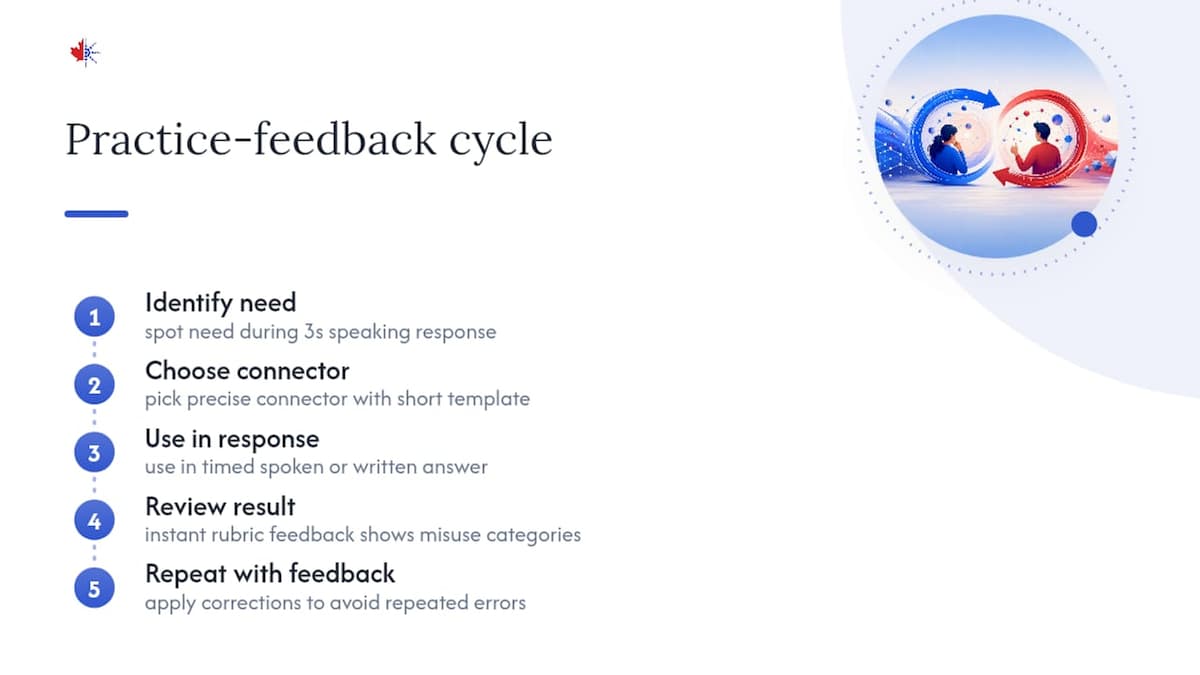
Memorizing fifty connectors doesn’t help if you can’t retrieve the right one in three seconds during a live speaking response. Pairing each connector with a short template creates a retrieval cue that actually works under time pressure, which is why templates outperform vocabulary lists in real testing conditions.
The bigger issue is feedback speed. A learner who writes ten practice paragraphs without correction repeats the same connector errors ten times. Instant, rubric based feedback interrupts that pattern immediately, showing exactly which category, contrast, concession, or result, gets misused most often. That’s the difference between practicing and practicing correctly.
— Reza
Practise connectors with real exam feedback, not guesswork
Reading a list of connectors won’t fix a habit of overusing “also” or mixing up “however” and “although” under time pressure. You need to write, get scored, and correct the exact error before your next attempt. That’s what Celpipguide’s tools are built to do: catch connector misuse the moment it happens, not weeks later when a real exam result arrives.
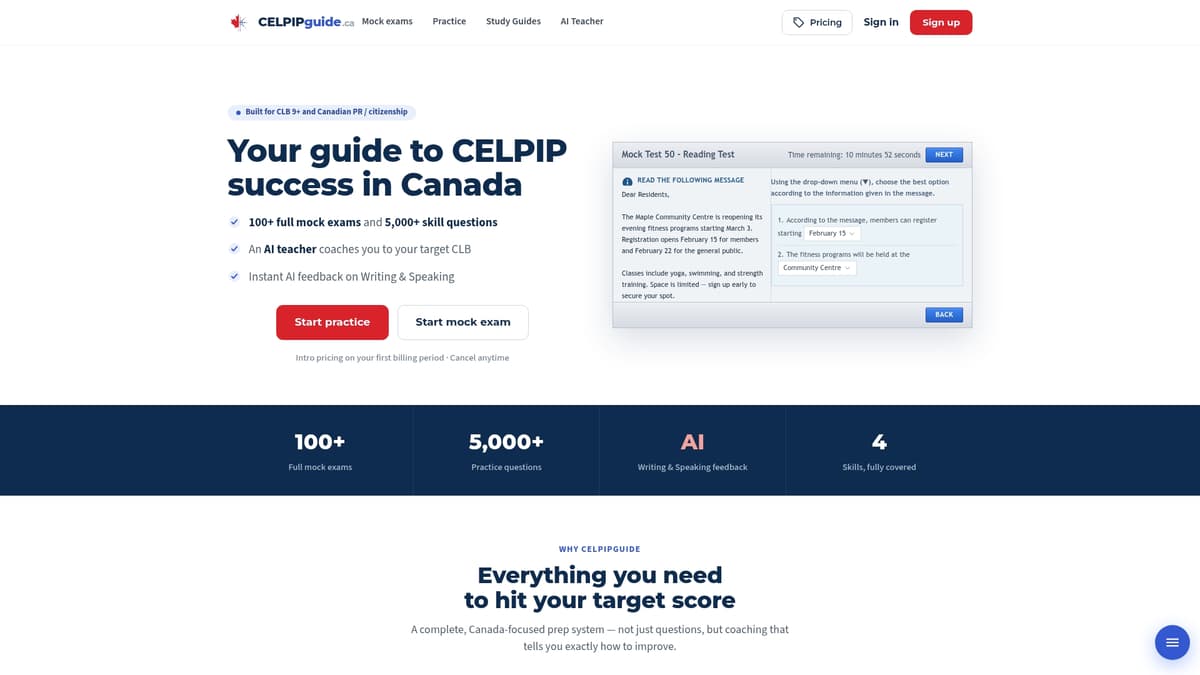
Start with the free CELPIP writing checker to get instant, rubric based feedback on a Task 2 paragraph and see exactly where your cohesion breaks down. Then move into a full timed session on the CELPIP practice hub to test the same skills under real exam conditions. If you want your connector practice built into a broader plan around your test date, the CELPIP study plan generator targets weak areas automatically.
Sources
FAQ
What are some good connecting words for CELPIP writing?
Strong options for CELPIP writing include “in addition,” “however,” “as a result,” “although,” and “therefore.” Match the connector’s formality to the task. Save “so” and “also” for Speaking rather than a formal Writing Task 2 essay.
What are 10 common connectors in English?
Ten common connectors are “and,” “but,” “so,” “however,” “therefore,” “although,” “because,” “in addition,” “as a result,” and “for example.” Each signals a different relationship: addition, contrast, result, cause, or illustration.
Which part of CELPIP is the hardest?
Many candidates find Speaking the hardest part of CELPIP because it demands instant, structured responses with no time to plan or revise. Practising with timed templates, like the ones described above, closes most of that gap within a few weeks.
How do I get CLB 7 in CELPIP?
CLB level generally requires clear, organized responses with accurate grammar and appropriate vocabulary across all four skills, including consistent, correctly used connectors that show logical structure. Timed practice with rubric based feedback, such as the tools on the CELPIP practice hub, helps identify the specific gaps holding a score back.