
CELPIP Blog
How to raise your CLB level quickly with a focused study plan
How to raise your CLB level quickly with a focused study plan

The fastest way to raise your CLB level quickly is targeted, timed practice on your weakest productive skill (speaking or writing) combined with frequent full mock tests. This isn’t guesswork. It’s how you turn vague “get better at English” goals into a measurable weekly climb.
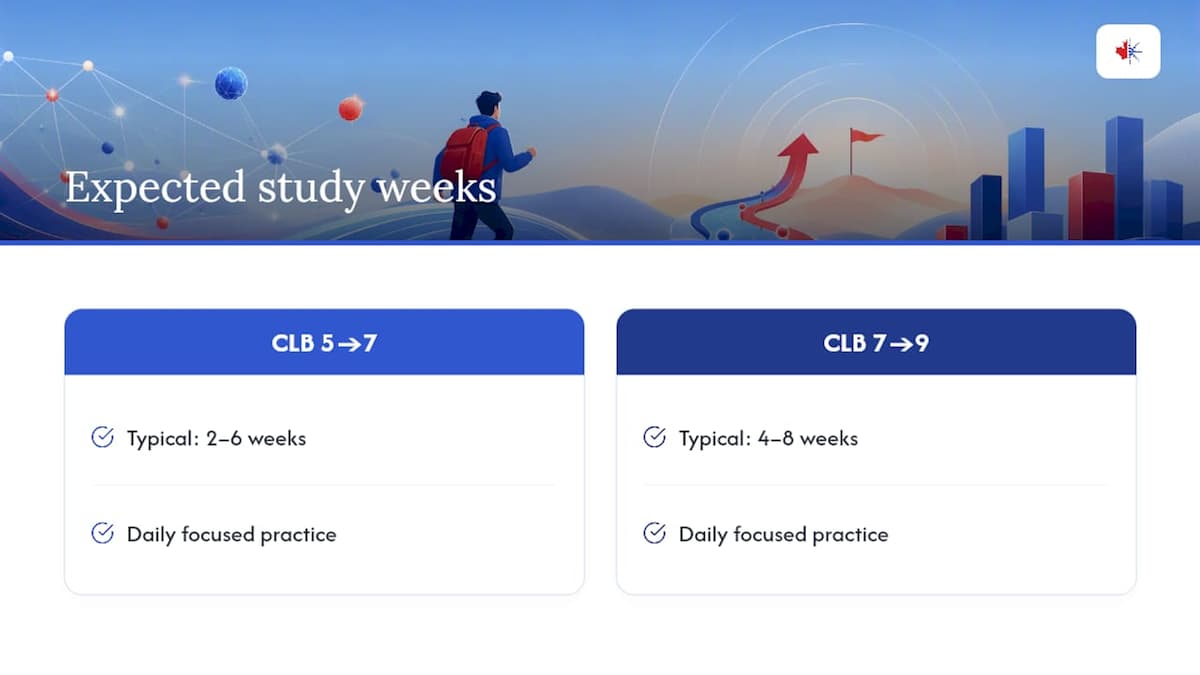
Realistic timeframes depend on your starting point:
- CLB 5-6 to CLB 7: 2 to 6 weeks of focused daily practice
- CLB 7-8 to CLB 9: 4 to 8 weeks, since gains get harder near the top of the scale
Your first move today: take a diagnostic mock test, whether through CELPIPguide’s practice hub or an official sample test, and pick a retake date before you close this tab. Without a deadline, “studying more” tends to drift.
Key Takeaways
Raising your CLB level quickly depends on prioritizing your weakest productive skill, running a disciplined mock-test cadence, and converting results against official CLB benchmarks before you book a retake.
| Point | Details |
|---|---|
| Diagnose before you study | Take a diagnostic mock on day 1 to find your weakest skill and set a numeric target. |
| Weight productive skills higher | Spend 60 to 70% of daily study time on speaking or writing, whichever is weaker. |
| Run mocks every 6 to 10 days | Space full mock tests out to leave time for remediation between attempts. |
| Convert scores officially | Use IRCC’s CLB conversion tables to confirm real gains before booking a retake. |
| Use CELPIPguide to compress the plan | The diagnostic check, AI feedback, and study plan generator turn this six-week plan into a guided routine. |
Table of Contents
- How can you raise your CLB level quickly with a study plan?
- Which speaking drills raise your CLB score fastest?
- What writing routine builds CLB gains the quickest?
- How do you improve listening scores without wasting hours?
- What reading techniques cut errors fastest?
- When should you take a full mock test?
- How do you convert practice results into an official CLB level?
- Realistic expectations and pitfalls to avoid
- Accelerate your plan with CELPIPguide’s diagnostic and AI feedback
- Sources
- FAQ
How can you raise your CLB level quickly with a study plan?
A six-week plan (compress to two weeks if you’re already close to your target) works best when it’s built around daily reps, not vague review sessions.
- Day 1: Take a diagnostic test. Identify your weakest productive skill (usually speaking or writing) and set a numeric goal.
- Week 1-2: Spend 2 to 3 hours daily. Put 60 to 70% of that time into your weakest skill, and 30 to 40% into maintaining the other three.
- Daily tasks: Timed speaking prompts (30, 60, and 90 seconds), one full 27-minute writing task, a 10-minute listening note drill, and a quick 15-minute reading skim session.
- Weekly milestone: Complete one full mock test by day 6 or 7 and adjust your ratio based on which skill lagged.
- Week 3-6 (if needed): Repeat the cycle, tightening your weakest area each time and adding a second weekly mock as your exam date nears.
Pro Tip: Treat your daily writing task like a fire drill. Set a timer for 27 minutes, write with zero pauses to “think,” and only allow yourself two minutes at the end to edit. That pressure mimics exam conditions far better than untimed practice ever will.
Speaking and writing tend to move your CLB fastest because they’re graded on production, not just comprehension, so a corrected error today shows up in your score tomorrow, not weeks later.
Which speaking drills raise your CLB score fastest?
Speaking is often the highest-leverage skill in a short prep window. Most test-takers lose marks not from bad grammar but from short answers, dead air, and weak structure. CELPIPguide’s speaking guide breaks down exactly what raters expect at each task.
- Record yourself answering 30, 60, and 90-second prompts, then compare your response length against CELPIP task expectations.
- Practise task-specific structures (opinion, comparison, description) rather than free-talking, since raters score task fulfilment directly.
- Use AI feedback or a qualified tutor to flag recurring pronunciation or cohesion issues instead of guessing at what’s wrong.
- Watch for these progress markers: fewer filler pauses, longer sustained responses, and more connected sentences instead of short fragments.
According to official CLB descriptors, higher benchmarks require sustained, organized discourse, not just correct vocabulary. That’s a concrete target: measure your response length and structure, not just how confident you feel.
What writing routine builds CLB gains the quickest?
CELPIP writing rewards structure as much as vocabulary. Split your 27 minutes per task into roughly 3 minutes planning, 20 minutes writing, and 4 minutes editing.
- Memorize two or three flexible templates for common tasks (email requests, complaints, surveys) rather than writing from scratch each time.
- Focus your editing pass on the three things markers weigh most: task completion, coherence between paragraphs, and appropriate vocabulary range.
- Use instant AI feedback, like the rubric-based scoring in CELPIPguide’s writing guide, to catch the same grammar mistake before it repeats across five more essays.
- Run one timed writing drill daily. Speed and accuracy only improve with repetition under the actual time limit, not relaxed practice.
Writing gains compound fast once you stop making the same correction-worthy error over and over. That’s the entire point of instant feedback: catching the pattern on day 3 instead of day 20.
How do you improve listening scores without wasting hours?
Listening rewards efficient technique more than raw study hours. The right note-taking approach matters more than listening volume.
- Capture key words and numbers, not full sentences. You don’t have time to write everything, and you don’t need to.
- Practise with test-format audio (short conversations, longer discussions) rather than general podcasts, since question types differ by section.
- Run 10-minute daily drills focused on prediction: read the question first, then listen for the answer.
- Cap listening at 30 to 40% of your daily study time unless it’s genuinely your weakest skill. Overinvesting here often steals hours from speaking and writing, where gains show up faster.
CELPIPguide’s listening guide includes note-taking templates that mirror the actual test format, which saves you from building your own system from scratch.
What reading techniques cut errors fastest?
Reading rewards a question-first approach. Read the question before scanning the passage, then hunt for the specific answer instead of reading top to bottom like a novel.
- Scan for keywords and paraphrases rather than rereading full paragraphs.
- Prioritize practice on the passage types most common in CELPIP (diagrams, correspondence, viewpoints) instead of generic reading comprehension.
- Run timed 10-minute drills to catch careless errors, like misreading a negative or missing a qualifier word.
- Track your accuracy weekly. Even a 5 to 10% error reduction on reading can nudge your overall CLB up when combined with productive-skill gains.
Reading rarely moves the needle alone, but shaving off careless mistakes here removes a ceiling on your overall score when your speaking and writing are already strong.
When should you take a full mock test?
Mock-test cadence is what separates a fast plan from a slow one. Random practice without full simulation leaves you guessing at your real level.
- Take an initial diagnostic mock on day 1 to establish your baseline across all four skills.
- Schedule a full mock every 6 to 10 days if you’re on an intensive plan, since spacing them too close leaves no time to fix what you found wrong.
- After each mock, score it against the rubric and build a short remediation checklist (2 to 3 fixable issues, not 15).
- Simulate real test-day conditions: same time block, no pauses, same environment, to build the stamina the actual exam demands.
Pro Tip: Don’t book your official retake the same week as your last mock. Give yourself at least one more practice cycle to apply the fixes from your remediation checklist. A retake booked in panic rarely reflects the level you’ve actually reached.
How do you convert practice results into an official CLB level?
IRCC’s official conversion tables map CELPIP scores to CLB levels per skill, and many skilled immigration streams expect a minimum of CLB 7 across all four abilities.
- Score each mock against the official bands, not a rough guess, so you know exactly which skill is holding back your overall level.
- Keep an evidence log: date, mock score per skill, and remediation notes, so you can see real movement instead of relying on how confident practice felt.
- If one skill sits below your target CLB while the others are strong, delay your retake and hammer that single skill for one more cycle rather than booking the exam prematurely.
| Skill | Target CLB 7 Signal |
|---|---|
| Speaking | Sustained, organized responses meeting task length expectations |
| Writing | Task completion with coherent paragraph structure |
| Listening | Accurate note capture on prediction-based questions |
| Reading | Consistent accuracy on paraphrase and keyword scanning |
Realistic expectations and pitfalls to avoid
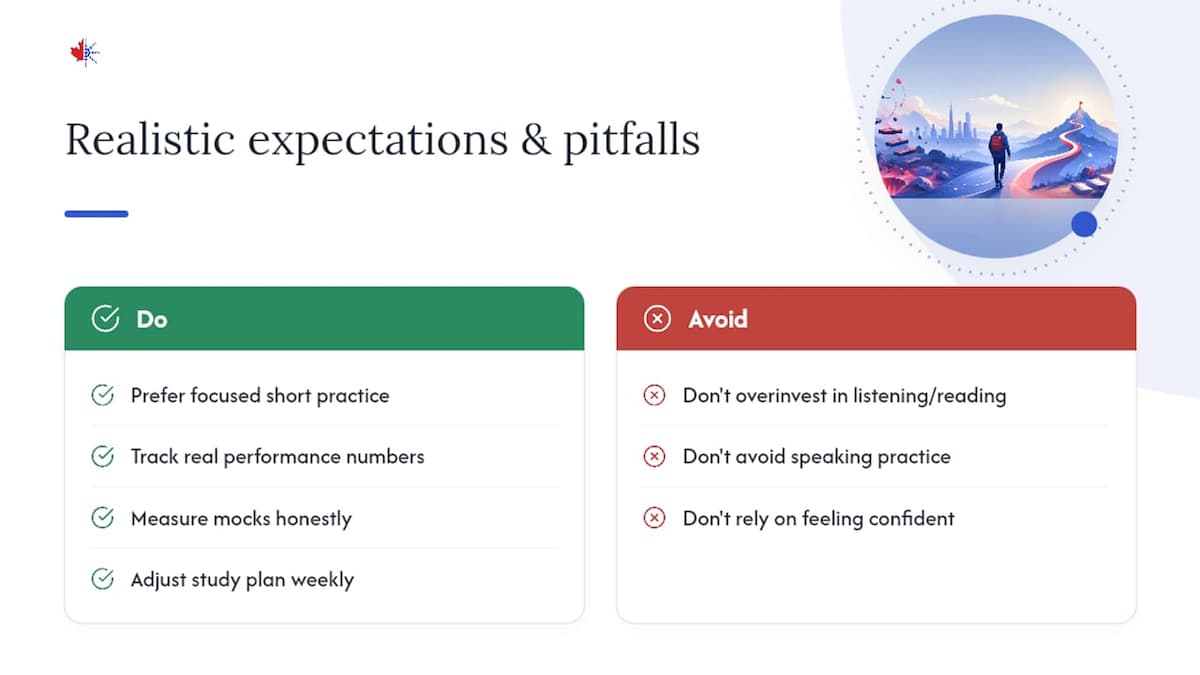
Fast doesn’t mean reckless. Six weeks of focused, measured practice beats six months of unfocused review, but only if you’re tracking real numbers, not just how confident you feel walking out of a study session.
The biggest mistake I see is overinvesting in listening and reading because they feel comfortable, while avoiding speaking because it’s uncomfortable to hear your own recorded voice. That avoidance is exactly what keeps your CLB stuck. Measure your mocks honestly, adjust weekly, and let the data (not your mood) decide what to study next.
Accelerate your plan with CELPIPguide’s diagnostic and AI feedback
Every step in this plan gets faster when you’re not building your own study system from scratch. CELPIPguide maps directly onto the six-week plan above: the diagnostic readiness check replaces your day-1 baseline test, the AI teacher gives instant rubric-based feedback on speaking and writing instead of waiting days for a human tutor, and the study plan generator turns your available hours into a week-by-week schedule automatically.
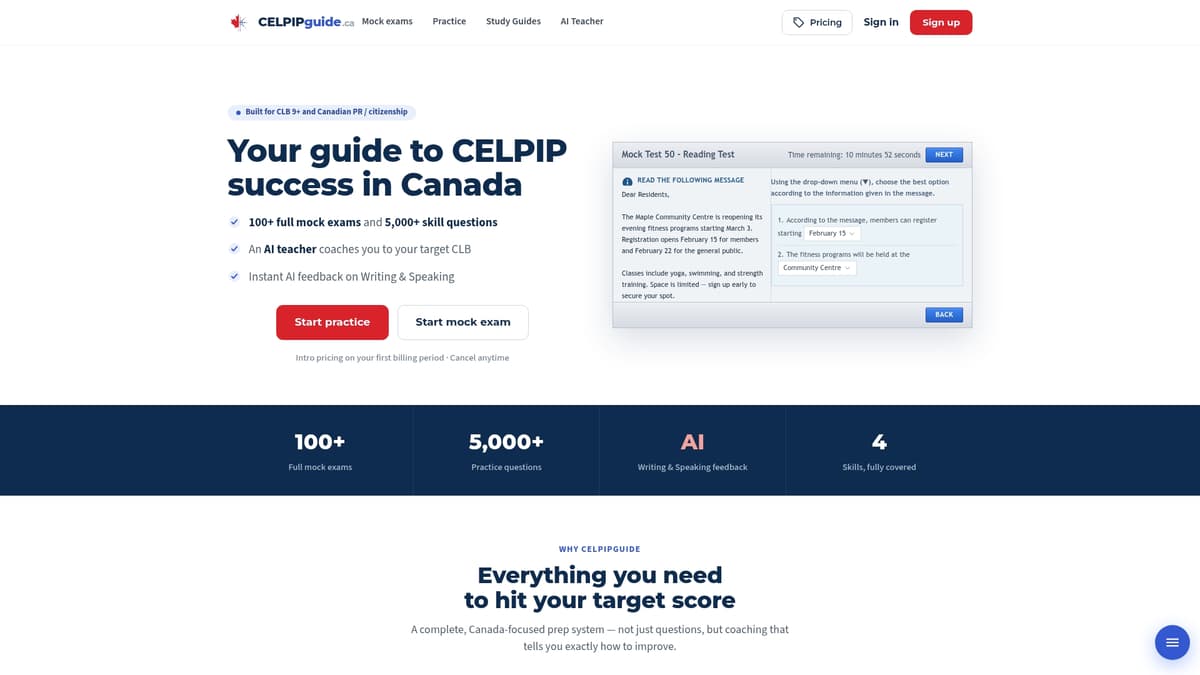
If you’re running the two-week intensive version of this plan, lean on the full mock exams for your 6 to 10 day cadence, since they simulate real test-day timing and give you the remediation checklist this article recommends, without you having to build one by hand.
Sources
For readers who want to verify conversion tables or immigration eligibility directly, IRCC’s Express Entry language testing page lists accepted tests and official CLB minimums. The Canadian Language Benchmarks document details all 12 benchmark descriptors across the four skills. For the legal framework behind how CLB affects Express Entry scoring, see section 102.3 of the Immigration and Refugee Protection Regulations.
- Canadian Language Benchmarks (CLB) — official document
FAQ
How fast can you realistically raise your CLB level?
Most test-takers moving from CLB 5-6 to CLB 7 need 2 to 6 weeks of focused daily practice, while CLB 7-8 to CLB 9 typically takes 4 to 8 weeks.
Which skill should you prioritize to raise CLB quickly?
Prioritize your weakest productive skill, usually speaking or writing, since these are scored directly on production and respond fastest to corrected practice.
How often should you take a full mock test?
Take an initial diagnostic, then a full mock every 6 to 10 days on an intensive plan, giving yourself time to fix issues between attempts.
Can CELPIPguide help you raise your CLB level quickly?
Yes. CELPIPguide’s diagnostic test, AI feedback on speaking and writing, and full mock exams are built to match a fast, prioritized study plan rather than generic English review.
How do you know your practice scores reflect a real CLB gain?
Compare your mock results against official IRCC conversion tables per skill, and keep an evidence log across multiple mocks before booking your official retake.