
CELPIP Blog
CELPIP Speaking Strategies: Task Templates, Recorded Mocks for CLB 9+
CELPIP Speaking Strategies: Task Templates, Recorded Mocks for CLB 9+
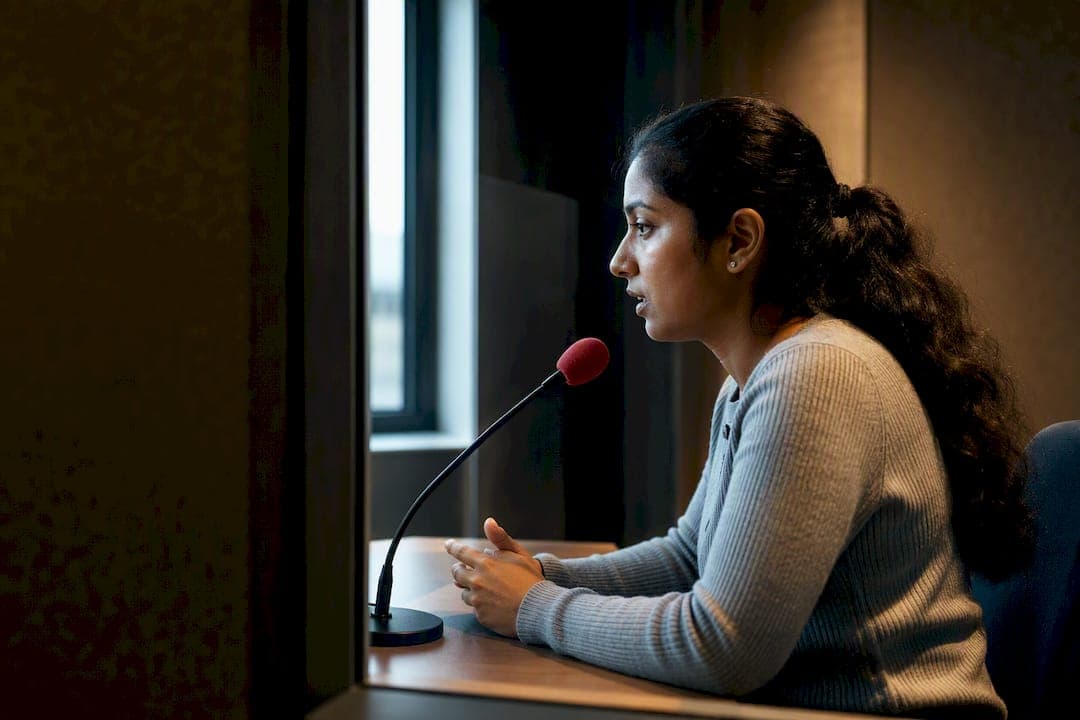
The single highest-impact change you can make is practicing task-specific responses that fully answer the prompt while still sounding natural. Prioritize complete task fulfilment, listenable delivery, and organized content over memorized scripts. Start today: plan three keywords instead of full sentences during prep time, record every practice response, and review each one against the four performance standards before you move on.
TL;DR:
- Practicing task-specific templates and recording responses helps improve content coherence, vocabulary, listenability, and task fulfillment.
- Using keywords during preparation and ensuring responses fully address all prompt parts maintains focus and completeness within the time limits.
- Targeted review of recordings against sample answers and standards accelerates progress more than generic speaking practice alone.
- Managing speaking anxiety through repetition and familiarity with timing reduces nervousness that can lower response quality.
- Improving involves fixing one performance standard at a time, with a focus on clarity, natural tone, and precise vocabulary suited to each task type.
Table of Contents
- What is the CELPIP speaking test format and how is it scored?
- Task-by-task strategies and micro-templates for CELPIP speaking tasks 1 to 8
- How should you structure a CELPIP speaking practice routine?
- What common CELPIP speaking mistakes are quietly lowering your score?
- Why rubric-driven practice beats generic study advice
- How do you self-assess and use peer review for CELPIP speaking?
- How much do idioms and advanced vocabulary matter for CELPIP speaking?
- How do you manage speaking anxiety during the CELPIP test?
- The tactics that actually separate CLB 7 from CLB 9
- Practise these CELPIP speaking strategies with CELPIPguide
- Where to verify CELPIP speaking scoring and sample responses
- Sources
- FAQ
What is the CELPIP speaking test format and how is it scored?
You get eight speaking tasks, and they fall into two formats. Some are text-only prompts (giving advice, expressing opinions, describing a personal experience), and others pair a prompt with an image (describing a scene, making predictions, comparing two options). Every response is recorded on the spot and rated later by trained human raters, not scored in real time, which means your delivery has to hold up on playback, not just in the moment.
That last point trips up a lot of test-takers. You are not performing live for a judge. You are creating an audio file that a stranger will listen to once, cold, with no context beyond the prompt. If your organization is messy or your tone is flat, there is no facial expression or hand gesture to save it.
Raters score every response against four performance standards. Understanding them is not academic. Each strategy in this guide exists to target one of these directly:
- Content and coherence — does your answer stay on topic, develop an idea, and flow logically from point to point?
- Vocabulary — do you use a range of words appropriate to the task, including some less common ones, or do you lean on the same 20 words for every answer?
- Listenability — does it sound like natural spoken English, with appropriate rhythm, tone, and pacing, or does it sound memorized and robotic?
- Task fulfilment — did you actually do what the prompt asked, completely, using the time you were given?
Preparation time varies by task, usually somewhere between 30 seconds and one minute, and response time runs from around 60 seconds to 90 seconds depending on the task. That window is short enough that wasting it on writing full sentences is a real cost. Seasoned test-takers use those seconds to jot three to five keywords or phrases, not scripts, which keeps the eventual delivery sounding spoken rather than read. The CELPIP Speaking Guide breaks these standards down further with sample responses at different levels, which is worth a look before you start drilling individual tasks.
Task-by-task strategies and micro-templates for CELPIP speaking tasks 1 to 8
This is where most study guides get vague. “Speak clearly and stay on topic” is not a strategy. What follows is a specific, repeatable template for each task type, built around what raters are actually listening for.
1. Task 1: Giving Advice
The rater wants to see you acknowledge the person’s situation, then commit to one clear recommendation with reasoning, not three wishy washy options. A response that hedges between two suggestions without landing on one reads as weaker on content and coherence, even if the grammar is flawless.
Micro-template: acknowledge the problem → recommend one option clearly → give two supporting reasons → close with a practical next step. For example: “I understand you’re torn between the two apartments, but I’d go with the one closer to downtown. First, your commute would drop significantly, which matters if you’re working full-time. Second, that neighbourhood has better access to transit if your car ever breaks down. Honestly, I’d book a second viewing this weekend before someone else takes it.”
Watch your timing here. You typically get between half a minute and one minute to prepare and around one minute to ninety seconds to respond. Use prep time for three keywords only, such as “location, commute, transit,” not full sentences. CLB 9 sounds like: a clear stance stated early, two distinct reasons (not two versions of the same reason), and a natural closing line that sounds like real advice, not a summary.
2. Task 2: Personal Experience
Raters expect a specific, well-sequenced story, not a general statement about the topic. Vague answers (“I really like travelling”) score lower on content because there’s nothing concrete to evaluate. Specific answers (“Last spring, I visited my grandmother’s hometown for the first time”) give the rater something to follow.
Micro-template: set the scene (when/where) → introduce the event or challenge → describe what you did → explain the outcome or lesson. This is the structure covered in more depth in the 3-stage story method for Task 2, and it’s worth internalizing because this exact shape recurs across several other tasks.
Sample phrases that help here: “It all started when…”, “What made it memorable was…”, “Looking back, I realized…”. These aren’t fillers, they’re transition markers that signal organization to the rater. CLB 9 sounds like: past tense used consistently and correctly, a clear narrative arc, and at least one reflective sentence at the end rather than an abrupt stop.
3. Task 3: Describing a Scene
This is an image-based task, and the trap is narrating a checklist of objects instead of describing a scene. “There is a man. There is a dog. There is a tree.” is grammatically fine and scores poorly, because it shows no coherence or vocabulary range.
Micro-template: general overview of the scene → describe the main subject/action → add spatial detail using location words → note anything unusual or noteworthy. Practising lexical sets in advance, prepositions of place, sequence markers, location vocabulary, reduces hesitation considerably when you’re staring at an unfamiliar image under time pressure.
For a full walkthrough of turning a short prep window into a reliable answer here, the guide on CELPIP Speaking Task 3 covers the planning-to-delivery sequence step by step. CLB 9 sounds like: varied spatial vocabulary (“in the foreground,” “toward the back,” “just behind the counter”) rather than repeated use of “there is.”
4. Task 4: Making Predictions
You’re shown an image and asked to predict what happens next. The common mistake is describing the image itself instead of projecting forward. Raters want speculation, framed with appropriate hedging language.
Micro-template: brief note on current scene → predict outcome one → predict outcome two → justify with reasoning tied to visible details. Useful phrases: “It looks like…”, “I’d guess that…”, “Given the expression on her face, I imagine…”. CLB 9 sounds like: confident use of future-oriented structures (going to, will, might) mixed naturally, and predictions grounded in specific visual evidence rather than generic guesses.
5. Task 5: Comparing and Persuading
Two options, one choice, and a case for it. This task rewards a firm decision early, followed by comparative reasoning. Sitting on the fence between both options for the whole response is the single most common way candidates lose marks on task fulfilment here.
Micro-template: state your choice immediately → compare on criterion one → compare on criterion two → close with a persuasive final line. For example: “I’d choose the smaller venue for the party. It’s more affordable, which matters given our budget, and it also feels more intimate for a group our size. The bigger space just doesn’t make sense for twenty guests.”
Pro Tip: Pick your side within the first five seconds of your prep time and don’t revisit the decision. Indecision costs you far more marks than picking the “wrong” option confidently ever will.
6. Task 6: Difficult Situations
You’re given a scenario with competing obligations and asked what you would do. This one tests both content organization and appropriate tone, since the situations are often mildly stressful (missing an event, disappointing a friend, managing a scheduling conflict).
Micro-template: acknowledge the difficulty → state your decision → explain the reasoning → address how you’d handle the fallout (an apology, an alternative plan, a compromise). Tone matters enormously here. A flat, unemotional delivery on a scenario about letting someone down reads as unnatural to raters, who expect a hint of genuine regret or empathy in your voice.
7. Task 7: Expressing Opinions
A prompt asks whether you agree or disagree with a statement. This is one of the more straightforward tasks structurally, but candidates often lose marks by restating the question instead of developing an actual argument.
Micro-template: state your opinion clearly → reason one with an example → reason two with an example → brief closing restatement. CLB 9 sounds like: an argument that builds across two distinct points rather than repeating the same idea in different words, plus at least one concrete example rather than pure abstraction.
8. Task 8: Describing an Unusual Situation
The final task shows an image depicting something odd or unexpected, and you need to describe what’s happening and why it’s unusual. This combines the scene description skills from Task 3 with the analytical framing of Task 4.
Micro-template: describe the scene briefly → identify what makes it unusual → speculate on how the situation came about → note the likely reaction of people involved. Finishing well before your time is up is a common error on this task specifically, since candidates often run out of things to say once they’ve described the obvious detail. Push yourself to add the “why” and “what happens next” layers every time.
Across all eight tasks, timing discipline matters as much as content. Finishing dramatically early on any task can hurt your task fulfilment score, since it signals an incomplete response even if what you did say was accurate. The guide to time management across CELPIP test sections has more detail on pacing if timing is your specific weak point.
How should you structure a CELPIP speaking practice routine?
Random practice, ten minutes here, an unrelated task there, produces slow, uneven improvement. A structured routine that cycles through drills and full mocks over four weeks gets you further with the same amount of study time.
Here’s a routine that balances targeted drills against realistic simulation:
- Week 1: Learn the eight task formats and their micro-templates. Do two untimed practice responses per task, focusing purely on structure, not speed.
- Week 2: Add timing. Redo all eight tasks under real prep and response time limits. Record every response.
- Week 3: Run two full timed mock speaking tests, then spend the rest of the week drilling your two weakest tasks specifically, three to four repetitions each.
- Week 4: One full mock test early in the week, review thoroughly, then spend remaining days on the specific fixes that review revealed. One final mock two days before your test date.
The review step matters more than the recording step. A practice method built around recording, listening back, and fixing one target at a time consistently produces faster, more measurable gains than trying to improve five things simultaneously. Pick one performance standard per session, maybe vocabulary this time, listenability next time, and grade yourself only on that.
When you play back a recording, listen for these specifically:
- Did you fully answer every part of the prompt, or drift off-topic partway through?
- Did you use at least two or three less common words instead of defaulting to simple, repeated vocabulary?
- Did your tone shift appropriately (apologetic for a difficult situation, enthusiastic for advice, curious for predictions), or did it stay flat throughout?
- Did you use the full response time without adding filler or awkward pauses?
Comparing your own recording against an annotated sample response at the CLB 9 level is one of the more effective self-assessment techniques available, since it shows you the exact gap between what you produced and what a stronger answer sounds like, not just an abstract score. The CELPIP speaking samples page collects these side-by-side comparisons by task and level.
Pro Tip: Keep a running list of five or six advanced words or phrases you want to work into your next mock session, then deliberately force them into your answers even if they feel slightly unnatural at first. Repetition makes them automatic within a week or two.
Rhythm drills help listenability more than most candidates expect. Reading a short paragraph aloud, then re-reading it while exaggerating natural stress and pausing on key words, trains your mouth and ear to produce that pattern automatically when you’re improvising an answer under pressure.
What common CELPIP speaking mistakes are quietly lowering your score?
Most low speaking scores don’t come from bad grammar. They come from a handful of repeatable habits that are easy to fix once you know to look for them.
- Over-memorizing template phrases. Reciting a script you rehearsed at home sounds exactly like what it is: memorized. It flattens your listenability score because natural speech has small imperfections and variation that scripted speech lacks. Fix: practise the structure, not the wording, so every delivery comes out slightly different.
- Monotone delivery. A flat tone on a prompt about a disappointing situation or exciting news signals disconnection to the rater. Fix: before you speak, decide on the emotional register the prompt calls for, and let your voice actually shift with it.
- Incomplete answers. Skipping part of a multi-part prompt (describing the scene but skipping the prediction, for instance) directly damages task fulfilment. Fix: use your prep-time keywords as a checklist, one word per required element of the prompt.
- Finishing far too early. Wrapping up at 30 seconds on a 60 second task suggests you ran out of things to say, which reads as an underdeveloped response even when what you said was correct. Fix: build in a closing sentence or extra supporting detail specifically to use remaining time.
Quick drill for each: record a 20 second version of any answer, then a 60 second version of the same prompt, and compare what you added. That gap is usually where your extra vocabulary and detail should live going forward.
Pro Tip: If you keep finishing early, practise adding one “because” clause and one specific example to every answer before you consider it finished. Both additions naturally extend your response without padding it with filler.
Why rubric-driven practice beats generic study advice
Most CELPIP prep advice treats speaking practice like general conversation practice: talk more, get comfortable, build fluency. That’s not wrong, but it’s incomplete. Fluency without task fulfilment still loses marks. Confidence without vocabulary range still loses marks.
What actually moves a score is practice tied directly to the four standards raters use. Recording your own responses and reviewing them against content and coherence, vocabulary, listenability, and task fulfilment, one at a time, turns vague self-improvement into a targeted correction. That’s a fundamentally different exercise than just “practising speaking more.”
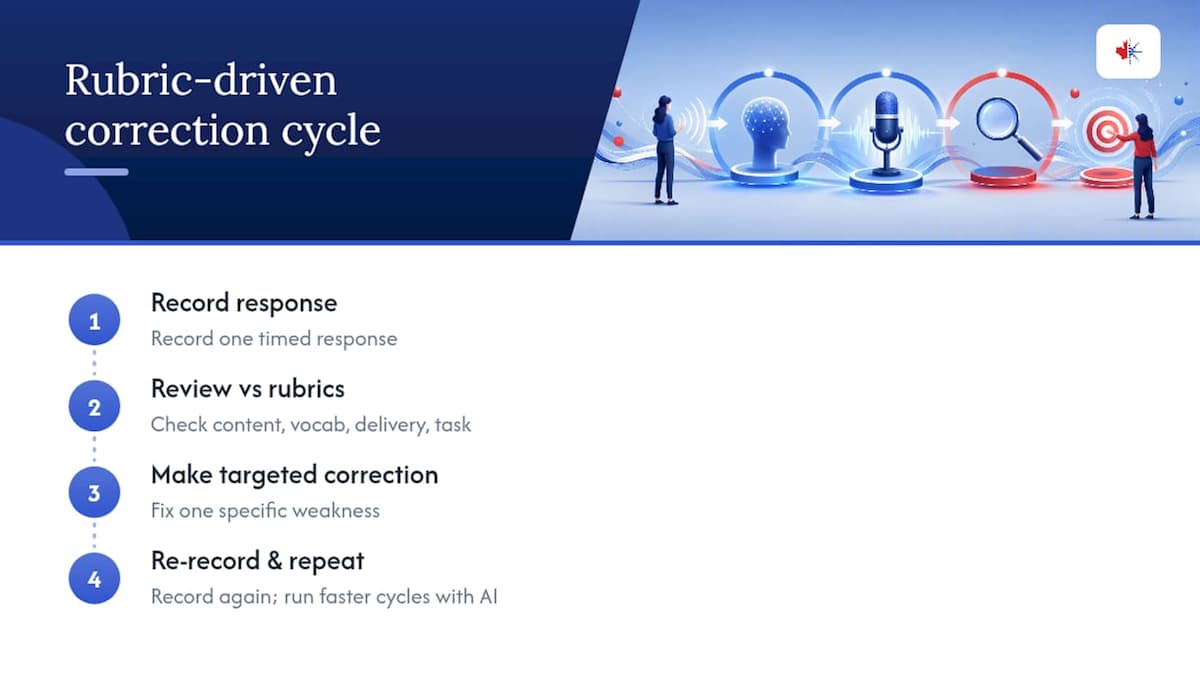
AI-driven feedback tools shorten that loop considerably. Instead of waiting days for a tutor’s notes or guessing whether your delivery improved, you get an assessment of a specific response within minutes, tied to the same standards a human rater uses. That speed matters more than most candidates realize, because it means you can run three or four correction cycles in the time it used to take to run one.
How do you self-assess and use peer review for CELPIP speaking?
Self-assessment only works if you have something concrete to measure against, not just a vague sense of whether an answer “sounded okay.” The most reliable method is comparing your own recorded response, word for word, against an annotated sample response at the level you’re targeting.
Start by transcribing five minutes of your own recording. Then look at where your vocabulary repeats itself, where your sentences are all roughly the same length, and where a section feels thin compared to a strong sample answer on the same task type. Those three gaps, vocabulary repetition, uniform sentence length, and underdeveloped sections, are the most common differences between a CLB 7 response and a CLB 9 response.
Peer review adds a second perspective you can’t get from your own recording alone. A study partner or tutor listening cold, the way an actual rater would, often catches issues you’ve gone deaf to through repeated practice: a tone that sounds flatter than you think, a transition that doesn’t quite land, or a habit of trailing off at the end of responses.
If you don’t have a study partner, simulate the effect by leaving a few days between recording and reviewing your own response. Listening with fresh ears after time has passed approximates what a stranger hears the first time. Varying your sentence length deliberately and adding a small set of cohesive devices, linking words like “however,” “as a result,” “in addition to that,” tends to raise content and coherence scores reliably without introducing new grammatical risk, which makes it one of the safer self-editing targets to practise.
How much do idioms and advanced vocabulary matter for CELPIP speaking?
Vocabulary range is one of the four performance standards, but it’s frequently misunderstood as “use big words.” That’s not quite right, and chasing it that way can backfire.
What actually helps is precision and variety, not complexity for its own sake. Instead of saying “it was good,” a stronger response might say “it exceeded my expectations” or “it turned out better than I’d anticipated.” That’s a vocabulary upgrade that still sounds natural in speech, which matters because listenability is scored alongside vocabulary, not separately from it.
Idiomatic expressions can help, but only when they’re used naturally and appropriately for the context. A well-placed phrase like “it was a blessing in disguise” or “I was on the fence about it” signals comfortable, native-like control of English. Forcing in an idiom that doesn’t quite fit the prompt, or that sounds rehearsed rather than spontaneous, does more harm than saying nothing unusual at all.
A practical way to build this without overreaching: keep a running bank of eight to ten phrases per task type that you’ve heard used naturally, in podcasts, in sample responses, in conversation, and drill working two or three into a practice response until they feel automatic rather than performed. Task-specific vocabulary matters more than general “impressive” vocabulary. For Task 6 (difficult situations), phrases around compromise and regret serve you better than technical vocabulary that would fit Task 3’s scene description better.
How do you manage speaking anxiety during the CELPIP test?
Anxiety on a speaking test isn’t just uncomfortable, it directly damages listenability, since nervous delivery tends to speed up, flatten in tone, or trail off mid-sentence. Managing it is a scoring strategy, not just a comfort measure.
The most effective tool against test-day anxiety is familiarity built through repetition well before test day. If you’ve recorded and reviewed dozens of practice responses under real timing conditions, the actual test format stops being a novel stressor, since you’ve already rehearsed the specific rhythm of a short prep window followed by a timed response, over and over.
A few in-the-moment techniques help too. Before each task, take one slow breath during the first few seconds of prep time rather than rushing straight into planning. It costs you almost nothing and resets your pacing. If you stumble on a word mid-response, keep going rather than restarting the sentence. Raters expect small natural disfluencies; a smooth restart draws less attention than a panicked pause.
Physical familiarity with the format also reduces anxiety. Knowing exactly how long 30 seconds of prep time feels, because you’ve timed it dozens of times in practice, removes one layer of uncertainty on test day. Candidates who’ve only read about the format, rather than rehearsed it under timed conditions, tend to burn early seconds just getting oriented to the clock instead of planning content.
The tactics that actually separate CLB 7 from CLB 9
Most CELPIP prep content treats speaking as one undifferentiated skill you improve through general practice. That framing is comfortable, but it’s not what the scoring rubric rewards. The rubric splits speaking into four distinct standards, and candidates plateau at CLB 7 or 8 precisely because they keep practising the same generic way instead of targeting whichever standard is actually holding them back.
The conventional advice, “speak more, get comfortable,” isn’t wrong, but it’s incomplete on its own. Comfort without task fulfilment still caps your score. Fluency without vocabulary range still caps your score. What the evidence in webinar materials and sample response analysis actually supports is narrower and more useful: identify your weakest standard first, drill that one specifically, and use annotated CLB 9 responses as your benchmark rather than a vague sense of “sounding good.”
If you take one thing from this guide, prioritize the feedback loop over the study volume. Ten recorded responses reviewed carefully against the four standards will move your score further than thirty recorded and never reviewed. Recording without structured review is just talking to yourself.
— Reza
Practise these CELPIP speaking strategies with CELPIPguide
Every strategy in this guide depends on one thing: fast, accurate feedback on your recorded responses. That’s the part most self-study candidates can’t do well on their own, and it’s exactly what Celpipguide is built to solve. Instead of guessing whether your Task 6 tone landed or your Task 3 vocabulary was varied enough, Celpipguide’s AI teacher gives you instant, rubric-style feedback tied to the same four performance standards covered above.
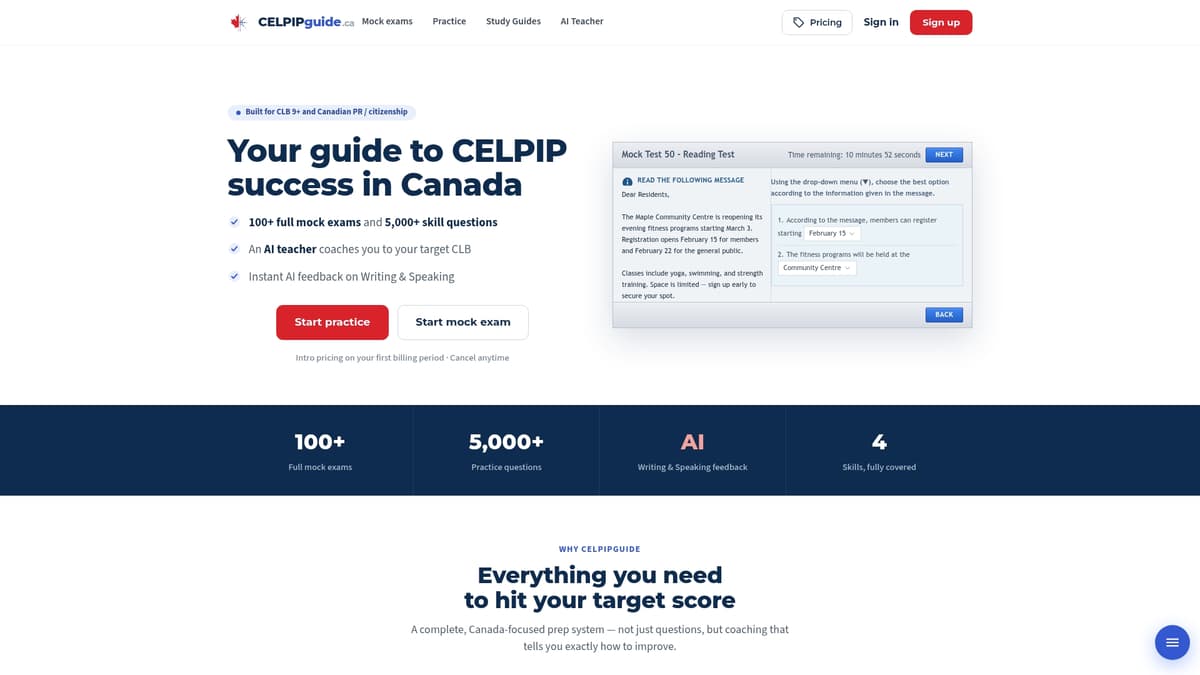
The platform gives you over 100 full mock exams and more than 5,000 practice questions to run the four-week routine outlined earlier without running out of fresh material by week two. The diagnostic test pinpoints which of the four standards is actually costing you marks before you waste a week drilling the wrong one, and the study-plan generator turns that diagnosis into a week-by-week schedule instead of leaving you to guess your own sequencing.
Ready to put these task-specific templates into practice? Check the CELPIP Plus plan for current pricing and discounts. If you’d rather try a sample task first, the practice hub has full-length mock exams ready to start today.
Where to verify CELPIP speaking scoring and sample responses
The strategies above are built around publicly available scoring guidance and sample material, not guesswork. A few sources are worth bookmarking directly.
CELPIP webinar materials, covered here, include sample speaking and writing responses at every level with detailed analysis, useful for understanding exactly what separates one CLB level from the next. The free online sample test mirrors the actual recorded response format and timing, making it a solid choice for realistic timed rehearsal. For a full breakdown of the CLB scoring scale itself, including why finishing too early can cost you on task fulfilment, Langogh’s CELPIP score system explainer lays out the scale clearly.
Sources
- CELPIP: Get The Facts and Discover How Your CELPIP Test Responses Are Evaluated
- Free online sample test (paragontesting)
- CELPIP Score System: 1 to 12 CLB Scale Fully Explained (2026) | Langogh
FAQ
How do I improve my CELPIP speaking?
Focus on task-specific templates rather than general fluency practice, and record every response so you can review it against the four performance standards: content and coherence, vocabulary, listenability, and task fulfilment. The fastest gains come from fixing one standard at a time instead of trying to improve everything at once, using tools like Celpipguide’s AI feedback to speed up that review cycle.
What are some good speaking topics for CELPIP?
CELPIP speaking topics cover everyday situations across eight task types: giving advice, describing a personal experience, describing a scene, making predictions, comparing options, handling a difficult situation, expressing an opinion, and describing an unusual situation. None require specialized knowledge, since they’re designed to test communication skills using familiar, everyday scenarios.
How to score 9 in CELPIP speaking?
A CLB 9 response fully addresses every part of the prompt, uses a varied vocabulary range with a few less common words, and sounds natural rather than memorized or flat. Comparing your recordings against annotated CLB 9 sample responses is one of the more reliable ways to see exactly where your own answers fall short of that standard.
What is 33 out of 38 in CELPIP listening?
That question relates to the listening section’s raw-score-to-CLB conversion, not speaking, and CELPIP does not publish a single fixed conversion table since scoring can vary slightly by test administration. For listening-specific scoring detail, the CELPIP score system overview explains how raw scores generally map to the CLB scale.