
CELPIP Blog
Turn 30 Second Prep into a Reliable CELPIP Speaking Task 3 Answer
Turn 30 Second Prep into a Reliable CELPIP Speaking Task 3 Answer
The fastest fix for CELPIP Speaking Task 3 is a memorized opening line plus a three part structure: describe the big picture in one sentence, then zoom into one focal area with two or three specific details, then close with a short wrap-up. Say it at a steady, clear pace rather than rushing to cram in every object you see. That single habit, repeated in practice, is what turns a shaky 60 seconds into a scoreable one.
TL;DR:
- Using a fixed opening line and a three-part structure ensures quick initiation and clear organization, maximizing full use of the 60 seconds.
- Describing a focal area with two to three detailed points within the first 45 seconds improves coherence and depth without rushing or omissions.
- Prioritizing spatial vocabulary and consistent grammar habits helps create vivid, organized descriptions that are easier for raters to follow and score higher.
- Practicing timed responses daily with AI feedback enhances fluency, pacing, and template recall, leading to more natural and complete answers during the test.
- Memorizing simple, versatile phrases for describing people, settings, and actions boosts retrieval speed and reduces hesitation, which is crucial for maintaining a confident rhythm.
Table of Contents
- What is CELPIP Speaking Task 3 actually asking you to do?
- What do raters actually listen for?
- The memorize and use template for a 60-second answer
- The spatial words and grammar habits that keep you fluent
- Vocabulary and phrases you can rehearse for instant recall
- Three timed model answers with examiner-style notes
- Build a daily practice routine that mirrors exam timing
- How Celpipguide fits into your Task 3 practice plan
- A quick note before you walk into the test
- Start practising Task 3 with real timing and feedback
- Sources
- FAQ
What is CELPIP Speaking Task 3 actually asking you to do?
Task 3 gives you a short preparation time followed by one minute to speak, with no way to pause the clock once you start. The screen shows a single image, and the prompt asks you to describe it in as much detail as possible for someone who cannot see it. That last part matters more than most candidates realize: you’re not narrating for yourself, you’re painting a picture for a blind listener, which is why vague phrases like “there are some people” score lower than “a woman in a red coat is waiting at a bus stop.”
The typical prompt reads something close to this:
- “Take a look at this picture. Please describe it in as much detail as you can.”
- You’ll see a preparation timer counting down from 30 seconds before your microphone opens automatically.
- Once you start speaking, the full 60 seconds runs without interruption, so your structure has to be automatic, not improvised.
Aim to mention several distinct elements in your response: enough to sound complete, not so many that each one gets a rushed half-sentence. This range is a practical target, not a rule, but it helps keep your pacing realistic.
What do raters actually listen for?
CELPIP raters score your response using four categories: Content/Coherence, Vocabulary, Listenability, and Task Fulfillment, combining these into one final task score. Knowing what each label means in practice lets you aim your 60 seconds at the right target instead of just talking and hoping.
- Content/Coherence asks whether your ideas connect logically. Group related details together instead of jumping around the image.
- Vocabulary rewards precise nouns and verbs over generic ones. Say “a toddler is reaching for a balloon” instead of “a kid is doing something.”
- Listenability covers pace, pronunciation, and rhythm, and the official performance standards treat fluency and clarity as core markers here, not just accuracy.
- Task Fulfillment simply asks: did you answer what was asked, and did you fill the time with relevant content?
Raters also reward organized grouping over an exhaustive scan of the picture, which means describing one area well beats racing to name everything you notice.
Pro Tip: In the last 10 seconds, silently ask yourself: “Did I describe a place, at least one person, and one action?” If any of those three is missing, add it in your closing line.
The memorize and use template for a 60-second answer
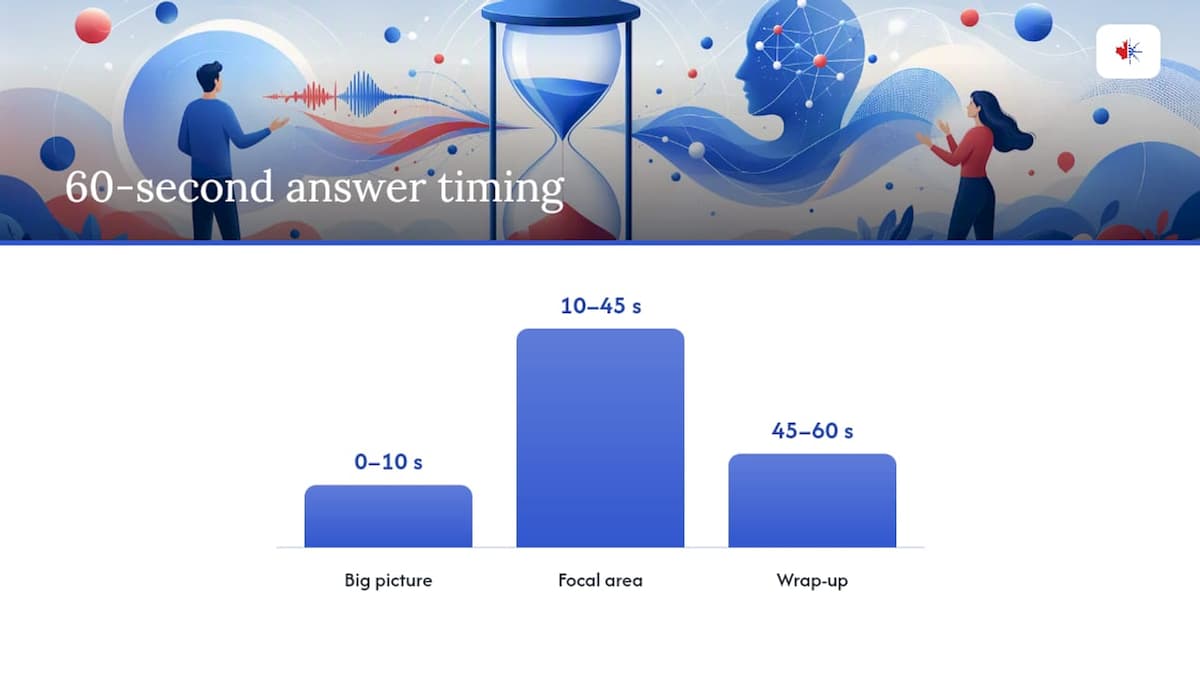
Practising the same skeleton until it’s automatic is what separates a fluent 60 seconds from a hesitant one. Instructors who work directly with CELPIP candidates consistently point to this: memorizing a short starter and a three-part shape means your first sentence comes out instantly, without the internal scramble of deciding how to begin.
Try one of these starters, and pick the one that fits your natural speaking rhythm:
- “This picture shows a [place] where [brief overall action] is happening.”
- “In this image, I can see a busy [setting] with several things going on.”
- “Looking at this picture, it appears to be a [place] during [time of day/season].”
Once you’re past the opener, follow this timing:
- Seconds 0 to 10, the big picture. Name the setting, the general mood, and roughly how many people or main elements are present.
- Seconds 10 to 45, one focal area with two or three details. Pick the busiest or most visually clear section of the image and describe it fully: who’s there, what they’re doing, what they’re wearing or holding.
- Seconds 45 to 60, the wrap-up. Add a secondary detail you noticed (weather, background object, an emotion on someone’s face) and close with a short summary sentence like “Overall, it looks like a relaxed afternoon at the park.”
Crowded scenes need one adjustment: don’t try to name everyone. Pick two people or one small group, describe them well, then gesture broadly at the rest (“Several other people are walking around in the background”). Single-subject images, like a lone figure in a room, flip the ratio: spend more time on posture, expression, and surroundings rather than searching for a second focal point that doesn’t exist. Action-focused scenes, such as a sports photo, benefit from present continuous verbs stacked close together: “The players are running, jumping, and reaching for the ball,” which naturally boosts your Vocabulary and Listenability scores at once.
The spatial words and grammar habits that keep you fluent
Spatial vocabulary is the connective tissue of a good Task 3 answer. Without it, your description turns into a list of nouns; with it, the listener can actually picture the layout.
Useful spatial and sequencing words include:
- In the foreground / in the background
- On the left side / on the right side
- Next to, behind, in front of, near
- At the top of the picture / at the bottom
- Meanwhile, at the same time, while this is happening
A few grammar habits make a real difference under time pressure. Use present continuous (“is walking,” “are talking”) for actions in progress, but switch to simple present with state verbs like “is,” “looks,” or “seems” for descriptions (“The room looks bright and tidy”). Don’t drop the third-person “s” on singular subjects: “The man walks” not “the man walk,” which raters do notice even in a fast 60-second response. Watch your articles too: “a woman,” “the bench,” not bare nouns.
Mini-examples worth rehearsing:
- “In the foreground, a young boy is riding a bicycle, while his mother watches from a bench nearby.”
- “At the top of the picture, dark clouds suggest it might rain soon.”
- “Behind the counter, a barista is preparing coffee while a customer waits patiently.”
Pro Tip: Practise saying one spatial phrase before every noun for a week. It becomes reflexive faster than you’d expect, and it’s the single easiest way to sound more organized without learning new vocabulary.
Vocabulary and phrases you can rehearse for instant recall
A compact word bank beats a huge one you can’t retrieve under pressure. Focus on words you can say without hesitating.
People and actions: pedestrians, commuters, a vendor, a toddler, elderly couple; chatting, browsing, strolling, gesturing, waiting.
Places and settings: a marketplace, a waiting room, a residential street, a playground, a train platform.
Weather and mood: overcast, drizzling, sunny with a slight breeze; relaxed, chaotic, festive, tense.
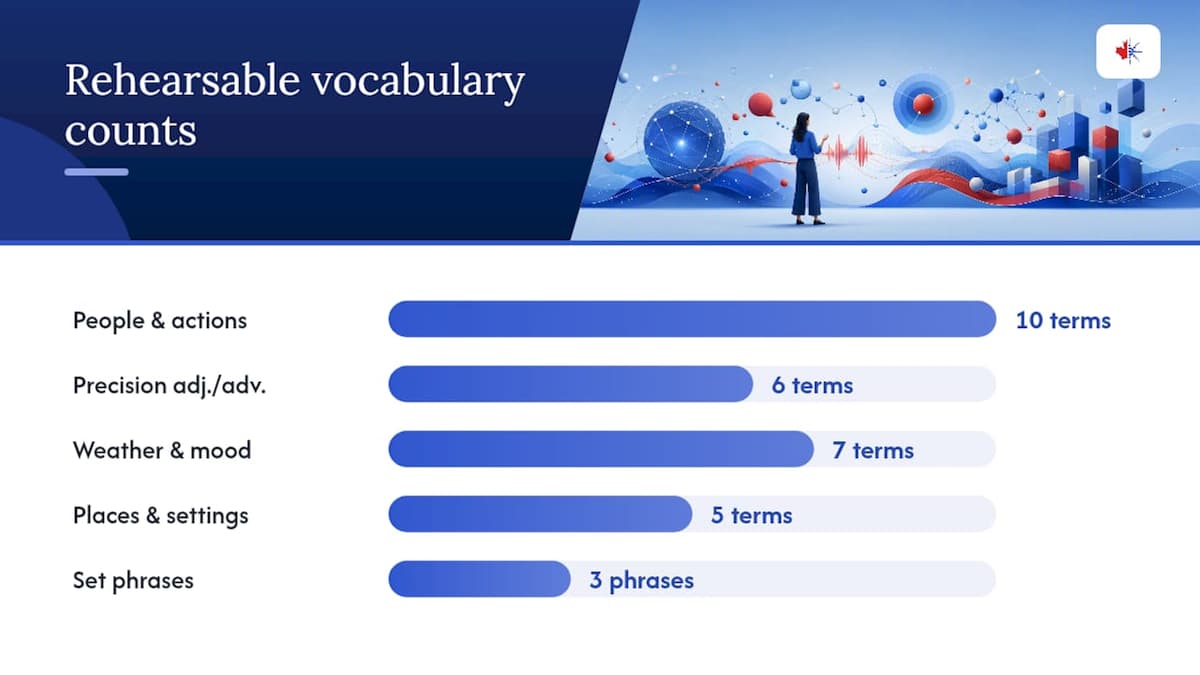
Precision adjectives and adverbs: crowded, spacious, dimly lit; casually, hurriedly, cautiously.
Set phrases worth memorizing:
- Opening: “This scene takes place in…”
- Simultaneous actions: “While [person] is doing X, [another person] is doing Y.”
- Closing: “Overall, the atmosphere seems…”
Rehearse these out loud, not just on paper. The exam rewards retrieval speed, not just recognition.
Three timed model answers with examiner-style notes
Model 1: a simple park scene (targets consistent CLB performance)
“This picture shows a park on a sunny afternoon. (0:05) In the foreground, a family is having a picnic on the grass, with a mother pouring drinks and two children eating sandwiches. (0:30) Behind them, a man is jogging along a paved path, and a dog is running beside him. (0:45) In the background, tall trees line the edge of the park. Overall, it looks like a peaceful weekend outing.” (0:58)
This works because every sentence adds a new detail without repeating structure. Nothing fancy, but it’s complete and easy to follow.
Model 2: mid-complexity scene using spatial range
- Opens with “In this image, I can see a busy train station during rush hour.”
- Groups details by zone: “On the left, commuters are lining up to buy tickets,” then “Meanwhile, on the right, a group of travellers is checking a departure board.”
- Closes with a mood observation: “The atmosphere feels hurried but organized.”
This scores well on Content/Coherence because each sentence stays anchored to a location before moving on.
Model 3: high-scoring answer with cohesion and range
This answer earns marks across all four categories: varied verbs, clear spatial grouping, a natural pace, and a genuine wrap-up rather than an abrupt stop.
Build a daily practice routine that mirrors exam timing
Short, frequent drills beat occasional marathon sessions, and the timing has to match the real test exactly or your instincts won’t transfer.
- Run six 60-second drills daily, each with a genuine 30-second prep beforehand. Use random images, not the same one twice.
- Self-score immediately against Content/Coherence, Vocabulary, Listenability, and Task Fulfillment before checking anything else.
- Get outside feedback from a partner, teacher, or an AI tool, and ask them specifically to flag repeated words, awkward pauses, and whether your description felt organized or scattered.
- Move to full mock exams once you can consistently hit five to seven details without hesitation, then track your scores weekly rather than daily to see real trends.
Pro Tip: Record yourself. Listening back the next day, with fresh ears, catches filler words and pacing issues you completely miss in the moment.
How Celpipguide fits into your Task 3 practice plan
Celpipguide’s free speaking practice area gives you a place to run the timed drills described above without hunting for new prompts every day. The platform’s AI teacher gives instant, rubric-based feedback on your speaking responses, which is exactly the kind of targeted correction the four scoring categories call for. For most learners, the fastest path is: try three timed Task 3 drills on the speaking practice page, review the AI feedback for Vocabulary and Listenability specifically, then adjust your template before your next attempt.
A quick note before you walk into the test
Clarity beats a flawless accent every time. Raters need to follow your ideas, not admire your pronunciation. Before you speak, take one slow breath during the prep window. It steadies your pace and stops you from rushing the first sentence, which is usually where hesitation shows up most.
— Reza
Start practising Task 3 with real timing and feedback
Reading about the template is one thing; saying it out loud against a real 30-second countdown is another, and that gap is where most candidates lose points they didn’t need to lose. Celpipguide gives you that timed environment directly, along with AI feedback that tells you which of the four scoring categories needs work instead of leaving you guessing.
Start with the CELPIP Practice Test hub to run timed Task 3 drills against real prompts, or take the CELPIP Readiness Check first if you want a quick diagnostic before committing to a study plan. Once you’re ready to go deeper, the full CELPIP mock exam hub lets you practise Task 3 inside a complete, realistically timed test.
FAQ
What topics come up in CELPIP Speaking Task 3?
Task 3 images typically show everyday scenes such as parks, markets, workplaces, transit stations, and households, always featuring people engaged in some visible activity for you to describe.
Is 32 out of 38 a good CELPIP Listening score?
Listening is scored on its own scale separate from Speaking, and a raw score in that range typically converts to a strong CLB level, though the exact benchmark depends on the current CELPIP conversion table for that test date.
How do I pass CELPIP Speaking overall?
Consistent, timed practice across all six speaking tasks matters more than any single trick, and using a memorized template for structure-heavy tasks like Task 3 frees up mental space to focus on vocabulary and pacing during the actual response.
Which part of CELPIP is considered hardest?
Many candidates find Speaking Task 3 the most demanding because both require organizing a lot of visual or comparative information into a short, unpausable response, which is exactly why a rehearsed structure helps so much here.
How long do I have to prepare and speak in Task 3?
You get 30 seconds to prepare and exactly 60 seconds to speak, with no option to pause once your response begins.