
CELPIP Blog
2–4 Business Days for CELPIP Results, Express 1–2 Days for Immigration
2–4 Business Days for CELPIP Results, Express 1–2 Days for Immigration

Your CELPIP scores normally appear online in 2 to 4 business days after your test date. Log into your CELPIP account to check them, and watch for an email notification the moment they’re ready. If you’re racing a deadline, an express rating option can shrink that wait to roughly 1 to 2 calendar days for an extra fee.
TL;DR:
- Results typically appear online within two to four business days, excluding weekends and Canadian statutory holidays, unless you pay for an express rating service.
- The standard timeline counts only business days, so timing estimates can shift by up to several days if the test is taken before a holiday or on a weekend.
- Paying for an express rating can reduce wait time to one or two calendar days, which includes weekends and is recommended only for strict deadlines.
- Most delays are caused by account issues or registration errors, not system failures, and support should be contacted only if the result remains pending beyond the official window.
- Score re-evaluation requests focus on the writing and speaking sections are available but rarely lead to score changes; a retake may be more effective if several points are at stake.
Table of Contents
- Official CELPIP results time: what Paragon actually promises
- Business days vs calendar days: converting the wait into real dates
- Express rating: what it promises and when it’s worth paying for
- How to check your scores and send them to IRCC
- Why results get delayed and what to do about it
- Requesting a score re-evaluation: process, cost, and odds
- What to do productively while you wait
- Author perspective: realistic expectations for the first 72 hours
- How Celpipguide keeps you moving while you wait
- Sources
- FAQ
Official CELPIP results time: what Paragon actually promises
Paragon Testing Enterprises, the organization behind CELPIP, states plainly that your scores go live in your online account within 2 to 4 business days of your test date. That’s the number to anchor on. No guessing, no “it depends on the season” caveat from the source itself.
Other reputable explainers land in the same neighbourhood, though you’ll see slightly different wording depending on where you read it. Some describe the window in “business days,” others simplify it to a rough day count without spelling out the weekend exclusion. That’s not a contradiction. It’s just looser language from sources trying to keep things simple. The official CELPIP results page is the version to trust when the wording differs.
A few things worth knowing about how this plays out in practice:
- Your official score report lives in your CELPIP account first. This is the version that counts for immigration and school applications.
- A mailed hard copy is not the default delivery method. Most test takers never need one, since electronic reports satisfy Immigration, Refugees and Citizenship Canada (IRCC) and most institutions.
- Independent test-prep resources like ILAC’s CELPIP score breakdown confirm the same 2 to 4 business day range, along with the express option covered further down.
Treat the official page as the baseline and everything else as confirmation, not competing information.
Business days vs calendar days: converting the wait into real dates
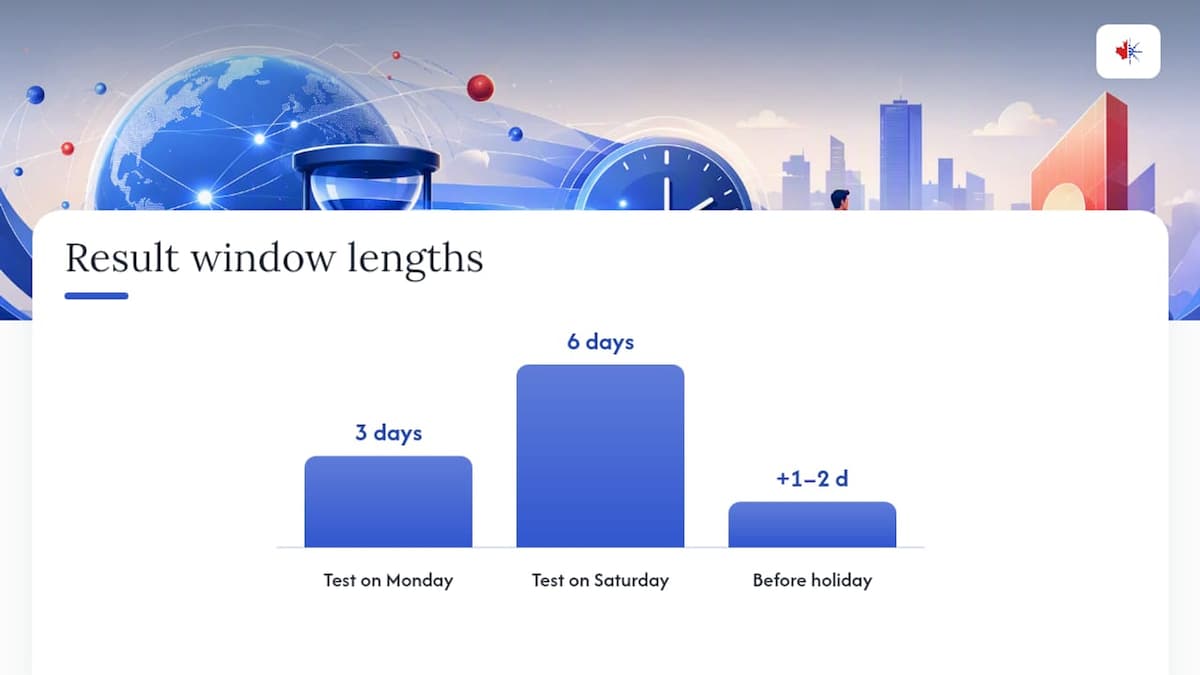
This is where most of the confusion actually starts. A “business day” excludes Saturdays, Sundays, and Canadian statutory holidays. A “calendar day” counts every single day on the calendar, holiday or not. CELPIP’s standard timeline runs on business days, which matters more than it sounds like it should once you map it against a real week.
Here’s how that plays out with actual test dates:
- Test taken on a Monday. Business days start counting Tuesday. A 2 to 4 business day window puts your results between Wednesday and Friday of the same week.
- Test taken on a Saturday. Since weekends don’t count, your business-day clock effectively starts Monday. Expect results somewhere between Wednesday and the following Monday.
- Test taken right before a long weekend or a holiday like Victoria Day or Thanksgiving. Add a day or two of buffer, since several explainers recommend factoring in statutory holidays when the standard window brushes up against one.
If you’re booking travel, an immigration submission, or a school deadline around your results, build in that buffer deliberately. Assuming the fastest possible turnaround and planning nothing else around it is how people end up stressed for no good reason.
Express rating: what it promises and when it’s worth paying for
If your CELPIP results time genuinely can’t stretch to four business days, CELPIP offers a paid express rating option. Multiple sources, including ILAC’s breakdown, report that express rating aims for a turnaround of roughly 1 to 2 calendar days rather than the standard business-day window.
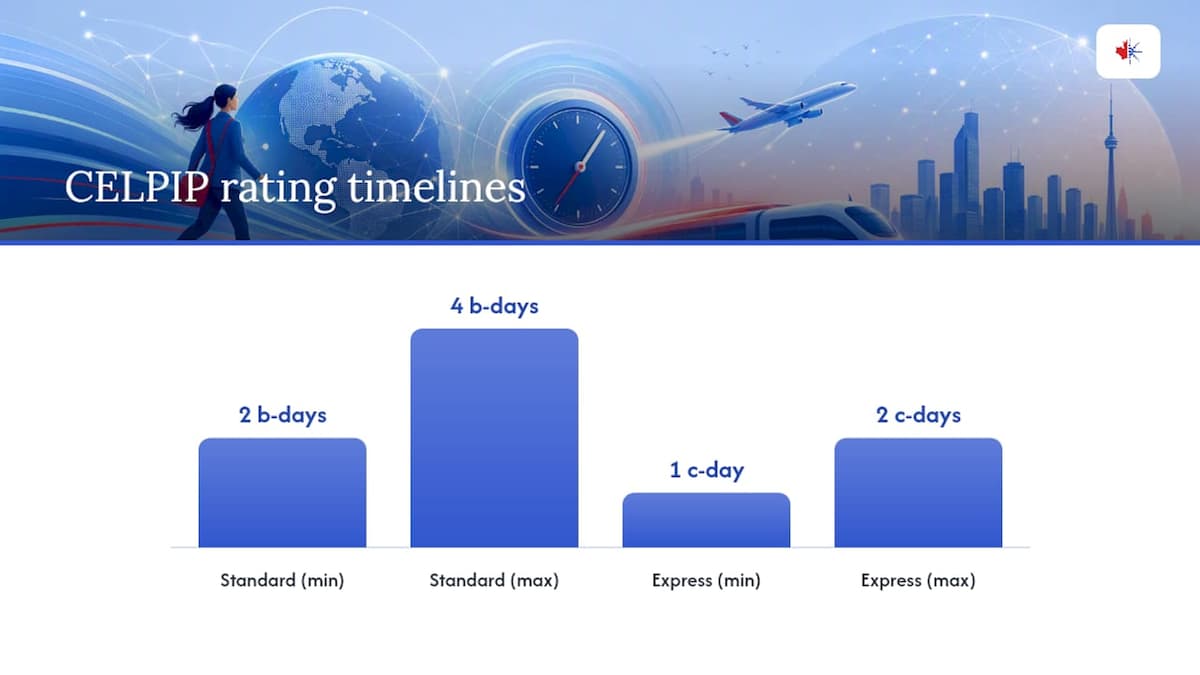
Fast fact: Express rating typically runs on calendar days, not business days, which means it can also cover weekends when the standard timeline can’t.
A few practical notes before you pay for it:
- You request express rating through your CELPIP account, usually at the time of registration or shortly after, depending on the testing centre’s process.
- It carries an additional fee on top of your test cost. Exact pricing varies by location and should be confirmed directly through your test centre or the official CELPIP site.
- It makes sense when you’re up against a hard immigration or admissions deadline that the standard window would miss. It’s overkill if your deadline has a week or more of breathing room.
Some guidance specifically flags that test takers under IRCC time pressure are the ones who benefit most from paying the express fee. If you’re not in that position, the standard timeline usually gets you there without the extra cost.
How to check your scores and send them to IRCC
Once your results are live, everything happens through your CELPIP account. Log in using the same credentials you used to register for the test, and you’ll see your score breakdown across all four skills: listening, reading, writing, and speaking.
Here’s what to expect and check:
- You’ll receive an email notification the moment scores are released. If it doesn’t show up, check your spam or junk folder before assuming something’s wrong.
- Your dashboard displays your official score report, including your CLB equivalent for each skill.
- You can send your results directly to IRCC or to other organizations from within your account, without needing a mailed paper copy for most immigration purposes.
- A physical hard copy isn’t the default. If you specifically need one, check your test centre’s process, since it typically comes after the online release, not instead of it.
Keep your login details somewhere you won’t lose them. A surprising number of support tickets are just people who can’t remember their account email months after testing.
Why results get delayed and what to do about it
Most delays trace back to something fixable, not a system failure. Before you panic, run through this:
- Confirm your account status. Log in and check whether your results section says “pending” or shows an error. Sometimes the issue is a payment hold that never fully processed.
- Check your spam folder. Notification emails land there more often than they should, especially with strict corporate or school email filters.
- Verify your ID and registration details match. A mismatch between the name on your ID and your registration can quietly hold up processing.
- Wait out the published window first. Four business days is the outer edge of normal, not a red flag. Contacting support on day two rarely helps.
- Contact CELPIP support with your test ID and a screenshot if you’re past the window with no results and no error message.
Pro Tip: Save a screenshot of your registration confirmation and test ID the day you write the exam. If you ever need to contact support about a delay, having that information ready cuts the back-and-forth in half.
If you’re staring down a missed immigration deadline because of a delay, contact CELPIP support immediately and document every step. IRCC sometimes allows for documented delays outside your control, but only if you can show you acted promptly.
Requesting a score re-evaluation: process, cost, and odds
If your results feel off compared to how you think you performed, CELPIP allows you to request a rating review through your online portal. This isn’t a full retake. It’s a second look at your existing responses, usually focused on the writing and speaking sections where scoring involves more human judgment than the machine-scored listening and reading sections.
A few things to weigh before requesting one:
- Reviews carry a fee, and that fee is typically not refunded even if your score doesn’t change.
- Turnaround for a review takes longer than the initial scoring window. Build in real time before you count on a revised result.
- Scores rarely swing dramatically after review. If you were one or two points short of a CLB threshold and feel confident in your performance, it can be worth the cost. If you’re several points away, a retake with focused practice is usually the better bet.
- When you submit a review request, be specific about which section concerns you and why. Vague requests don’t get prioritized any differently, but a focused one at least shows you’ve thought it through.
What to do productively while you wait
The 2 to 4 business days between your test and your results is dead time only if you let it be. Use it instead to get ahead of whatever comes next, whether that’s a retake or simply confirming you’re in good shape.
- Take a timed diagnostic. A short, structured diagnostic can flag weak spots you didn’t notice mid-test, especially in speaking and writing where self-assessment is notoriously unreliable.
- Run one or two focused mock sections rather than a full four-hour exam. Targeted repetition beats marathon cramming when you don’t yet know your actual score.
- Get feedback on writing and speaking specifically. These two skills carry the most subjective scoring variance, and targeted drills with immediate feedback tend to move scores faster than unfocused review.
- Hold off on booking a readiness check if your deadline has real breathing room. If it doesn’t, weigh the express rating fee against the cost of a retake before deciding your next move.
None of this guarantees a higher score. It does mean you won’t be starting from zero if your results come back lower than expected.
Author perspective: realistic expectations for the first 72 hours
Waiting on CELPIP results feels worse than it needs to, mostly because people convince themselves that any delay past 24 hours means something went wrong. In practice, most scores land right in that 2 to 4 business day window, and the rare outliers usually trace back to a spam filter or a payment hiccup, not a systemic failure.
Here’s the checklist I’d actually run in the first 72 hours: confirm your account shows a pending or complete status, note your real deadline (immigration, school, employer) against the release window, and spend an hour on a focused practice drill instead of refreshing your inbox every twenty minutes. The wait is short. Use it deliberately instead of anxiously.
— Reza
How Celpipguide keeps you moving while you wait
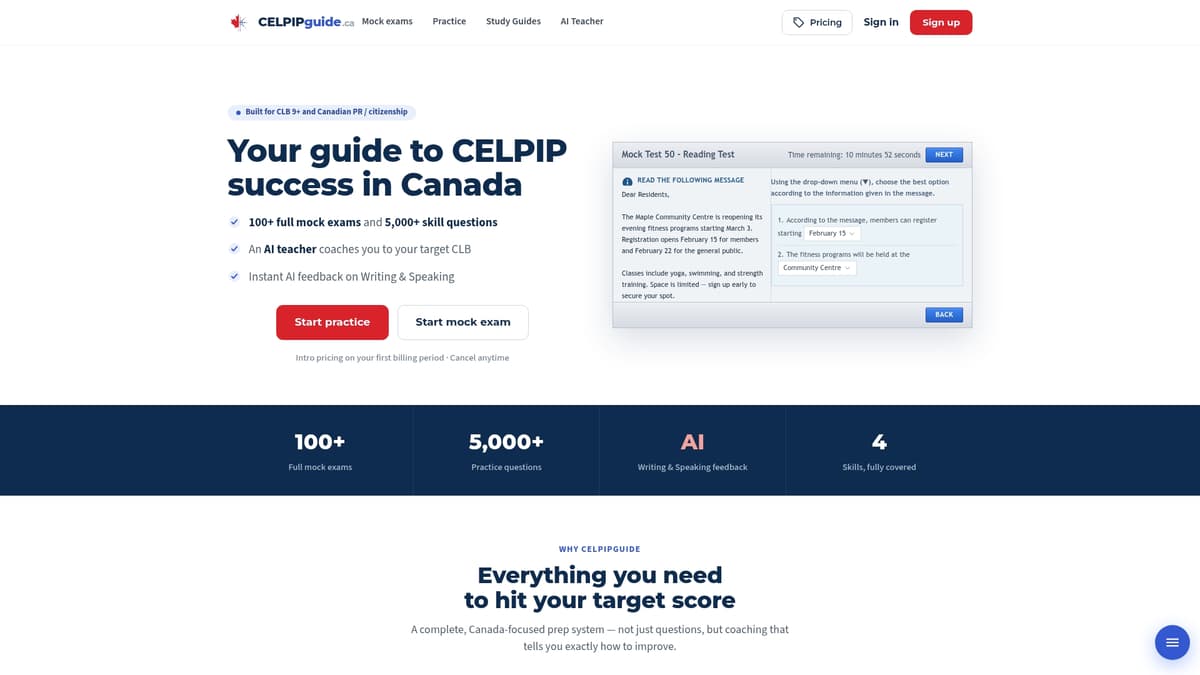
You don’t have to spend your CELPIP results time staring at your inbox. Celpipguide gives you a direct way to use those days: a diagnostic that pinpoints exactly which skill is holding your score back, full-length mock exams that mirror the real test format, and AI feedback on writing and speaking that tells you what to fix in minutes instead of days.
That speed matters more than it sounds like it should. Unfocused review can burn a whole weekend without touching your weakest skill, while a targeted diagnostic and a couple of scored mock sections can show you precisely where your CLB level is stuck. If your results come back lower than you hoped, you’ll already know your next move instead of starting research from scratch.
Start with the CELPIP practice hub and check the site for current subscription offers. Whether you’re prepping for a possible retake or just want proof your score will hold up, a focused hour with real feedback beats another day of guessing.
Sources
- Canada
- CELPIP Score Chart Breakdown | ILAC
- CELPIP Test Canada 2026: Score chart and CLB guide | Go Far Global
FAQ
How long does CELPIP results time normally take?
CELPIP scores typically appear in your online account within 2 to 4 business days of your test date, according to the official CELPIP results page.
What is a CLB 7 score in CELPIP?
A CELPIP score of 7 in a given skill maps directly to Canadian Language Benchmark (CLB) 7 for that same skill, which is a common threshold for several immigration and work permit categories.
What is 34 out of 38 in CELPIP reading?
CELPIP reading scores are reported as a CLB level rather than a raw fraction, so raw scores convert to a CLB level based on CELPIP’s official scoring scale rather than a simple percentage. Use the CELPIP score calculator to see how raw performance typically maps to CLB and CRS points.
What is CLB 9 in CELPIP?
A CELPIP score of 9 in any skill corresponds to CLB 9, a high benchmark often required for competitive immigration streams or professional licensing where advanced English proficiency is expected.
How do I know if I passed CELPIP?
CELPIP doesn’t use a pass or fail system. Your results show a CLB level for each skill, and whether that level “counts” depends entirely on the CLB threshold your program, employer, or immigration application requires.