
CELPIP Blog
1–4, 8–12, 4–6+ Months to Hit CLB: CELPIP Preparation Timeline with AI
1–4, 8–12, 4–6+ Months to Hit CLB: CELPIP Preparation Timeline with AI

If you’re already sitting at CLB 8–9, a 1–4 week sprint built around mock tests and format drills is usually enough to walk into your official CELPIP test ready. If your diagnostic puts you at CLB 5–7, plan on 8–12 weeks of balanced, skill-by-skill work. Below CLB 5, or if you’re chasing a high CLB target for a competitive immigration stream, give yourself 4–6 months or more. Every one of these paths starts the same way: a timed diagnostic mock to find out where you actually stand.
TL;DR:
- Candidates with a diagnostic score of CLB 8-9 can often prepare in 1-4 weeks with mock tests and format drills, while those below CLB 5 need 4-6 months of consistent work.
- A full-length mock exam is essential before starting, and scores should be mapped against CLB requirements to identify skill gaps and set realistic timelines.
- Practice should be tailored to each skill, with regular mocks, detailed review, and feedback, especially for writing and speaking to track progress effectively.
- Longer timelines (beyond 6 months) allow for foundational work, task-specific practice, and language immersion, leading to higher CLB gains.
- Consistent, data-driven practice and mock testing are more effective than guessing or unstructured study, with three consecutive mocks at or above target CLB indicating readiness.
Table of Contents
- How to measure your starting level and set a realistic CLB target
- 1–4 week sprint: a step-by-step plan for advanced test-takers
- 8–12 week balanced plan: steady skill-building and consolidation
- 4–6+ month foundation plan: building fluency and large CLB gains
- Copyable sample schedules for each timeline tier
- Tactical practice for Listening, Reading, Writing and Speaking
- Mock-test cadence, interpreting trends, and readiness checkpoints
- When to extend or compress the plan and common mistakes that cost time
- How CELPIPguide’s diagnostic tests, AI teacher and mock exams fit these timelines
- Tips for managing test day stress and boosting confidence
- Detailed breakdown of each test component format and timing
- Incorporating language immersion or practice in daily routine
- Author’s perspective on realistic expectations and feedback-driven practice
- Start with a diagnostic and build your plan from real data
- Sources
- FAQ
How to measure your starting level and set a realistic CLB target
You cannot build a CELPIP preparation timeline on guesswork. The first move, before you buy a single workbook or download a single app, is a full-length timed diagnostic mock exam scored separately across Listening, Reading, Writing, and Speaking. Most people assume their English is “pretty good” across the board. In practice, scores are almost never even. I’ve seen candidates land CLB 9 on Listening and CLB 5 on Writing in the same sitting.
Once you have those four numbers, map them against the CLB requirement your immigration pathway actually needs. CELPIP scores translate directly to Canadian Language Benchmarks, and most programs require CLB 7 in every skill, not just an average across four. One weak skill below the threshold can sink an otherwise strong application.
From there, three things shape your timeline:
- The gap: how many CLB levels separate your weakest skill from your target.
- Booking lead time: test centre availability can add weeks to your plan.
- Score expiry: CELPIP results stay valid for two years from the test date, and IRCC checks that date against your application submission, so timing the test near your filing window matters more than people expect.
Use these three inputs to set weekly milestones. If you need to move two CLB levels in Writing over 10 weeks, that’s a concrete, trackable target, not a vague hope.
1–4 week sprint: a step-by-step plan for advanced test-takers
This tier is for candidates who scored CLB 8–9 on their diagnostic and mainly need to get comfortable with CELPIP’s format, timing, and question style rather than build new language skill. A short sprint only works at this starting level. Attempting a 1 to 4 week timeline from a lower baseline tends to leave weaker skills underprepared going into test day.
- Days 1 to 3: Take your diagnostic, review every wrong answer, and identify which task types cost you the most time.
- Days 4 to 10: Run daily 60 to 90 minute sessions combining one timed section (Listening or Reading) with one focused Writing or Speaking drill, then review immediately against a scoring rubric.
- Days 11 to 14 (or week 3 for a 4 week sprint): Take your first full mock under real test conditions and compare section scores to your diagnostic.
- Final week: Take a second full mock, tighten timing on any section that dipped, and rehearse your Speaking response templates out loud.
Watch for two full mocks in a row scoring at or above your target CLB in every skill. That consistency is your green light to book the official test.
Pro Tip: Record your Speaking responses on your phone during practice. Hearing yourself back exposes filler words and pacing issues that are invisible when you’re just thinking through an answer in your head.
8–12 week balanced plan: steady skill-building and consolidation
This is the timeline for most CELPIP candidates. It fits a CLB 5–7 starting point aiming for CLB 7 to 9, with roughly 60 to 90 minutes of daily study spread across three months.
Month 1 centres on your diagnostic results. Spend the first two weeks fixing fundamentals in your weakest skill, whether that’s grammar accuracy in Writing or note-taking speed in Listening, before moving to broader practice.
Month 2 shifts into focused cycles. Rotate through Listening, Reading, Writing, and Speaking in structured blocks, giving your two weakest skills more time than your two stronger ones. Take one full mock at the end of the month to check trajectory.
Month 3 is about timing and exam tactics: full-length mocks under strict time limits, review sessions the same day, and drilling the specific templates that CELPIP rewards in Writing Task 1 and Speaking Tasks 3 and 4.
- Build one buffer week into month 3 in case work or life disrupts your schedule.
- Keep a running log of section scores across all mocks so trends are visible, not just individual results.
- Alternate a “practice day” with a “review day” rather than cramming new material every single session.
A study-plan generator that adjusts weekly targets based on your latest mock results removes a lot of the planning overhead here.
4–6+ month foundation plan: building fluency and large CLB gains
If your diagnostic lands below CLB 5, or your target is a high CLB score for a competitive stream, compressing your prep into weeks will likely backfire. Give this timeline 4 to 6 months minimum, with daily sessions of 45 to 60 minutes and one longer weekend block for full mocks. Common study-plan guidance puts a 6-month comprehensive plan at roughly this pace for candidates working toward a substantial CLB jump.
Structure it in three phases:
- Months 1 to 2, foundation: grammar accuracy, core vocabulary, and basic sentence structure across all four skills. This is unglamorous work, but skipping it means every later phase takes longer.
- Months 3 to 4, skill depth: task-specific practice, timed sections, and CLB-targeted vocabulary building, with regular full mocks every two to three weeks.
- Months 5 to 6, consolidation: high-frequency mock testing, tight timing discipline, and Speaking and Writing feedback loops to catch remaining errors before test day.
Realistically, expect a full CLB level of improvement roughly every 8 to 10 weeks of consistent practice, faster in Listening and Reading, slower in Writing and Speaking since those skills depend on active production, not just comprehension. Mix general English immersion (reading, podcasts, conversation) with CELPIP-specific task practice throughout, especially in the foundation phase, since general fluency underpins every task type on the test.
Copyable sample schedules for each timeline tier
Pick the template that matches your tier and adapt the time blocks to when you’re actually alert, not when you feel you should study.
- One-week crash schedule (sprint tier): Monday to Friday, 60 minutes each evening split between one timed section and one review pass; Saturday, full mock plus same-day review; Sunday, rest or light vocabulary review only.
- 4-week daily template (sprint tier): 90 minutes per day, six days a week, rotating two skills daily; mocks at the end of week 2 and week 4.
- 12-week weekly template (balanced tier): weeks 1 to 4, 60 minutes daily on foundations plus one mock at week 4; weeks 5 to 8, 75 minutes daily on skill cycles plus mocks at weeks 6 and 8; weeks 9 to 12, 90 minutes daily on timed practice plus mocks at weeks 10 and 12.
- Morning variant: 30 minutes of Listening or Reading before work, 30 to 45 minutes of Writing or Speaking practice in the evening.
- Evening-only variant: one longer 75 to 90 minute block after dinner, alternating skill focus by day of the week.
Short, mobile-friendly practice apps work well for filling gaps between these blocks, a quick vocabulary drill on transit or a five-minute Listening clip on a lunch break adds up over a 12-week plan. Whatever template you use, protect at least one full rest day per week. Burnout quietly erodes retention, especially in the final two weeks before a test.
Tactical practice for Listening, Reading, Writing and Speaking
Generic “practice more” advice wastes time. Here’s what actually moves scores in each skill, and how often to work on each one depending on your timeline.
- Listening: Practise note-taking shorthand on short clips, then answer questions using only your notes, not your memory. Do this three to four times weekly on a balanced or long timeline, daily on a sprint.
- Reading: Time yourself strictly per passage and track where you lose speed, usually inference questions rather than direct fact-finding. Two to three timed passages weekly is enough on a balanced plan.
- Writing: Use a fixed template for Task 1 (email) and Task 2 (survey response), then score your own drafts against the CLB descriptors before ever submitting to feedback. Aim for two full writing tasks weekly minimum.
- Speaking: Record every practice response for all eight tasks and compare pacing and fluency week over week. Three sessions weekly is a reasonable floor on any timeline.
Celpipguide’s listening guide breaks down note-taking strategy by task type if that’s your weakest section.
Pro Tip: Score your own Writing and Speaking against the actual CLB rubric before you ever get outside feedback. You’ll catch obvious errors yourself and use expert feedback for the subtler stuff that’s harder to self-diagnose.
Mock-test cadence, interpreting trends, and readiness checkpoints
How often you test depends on your tier: weekly on a sprint, every two to three weeks on a balanced plan, every three to four weeks in the early foundation phase and weekly by month five or six. Track section scores in a simple spreadsheet rather than trusting memory.
- A single low score is noise. A pattern across two or more mocks is signal.
- Look for the trend line, not the single data point, small dips are normal even as your overall trajectory improves.
Combining full mocks with structured, rubric-aware feedback on Writing and Speaking tends to close gaps faster than repeating practice tests without any review loop attached. As a booking rule of thumb: three consecutive mocks at or above your target CLB across all four skills is a solid signal you’re ready to book the real exam.
When to extend or compress the plan and common mistakes that cost time
Extend your timeline when two or more mocks show the same skill stuck below target. Compress only when your scores have been stable at or above target across multiple sittings, not just one lucky result.
The most common time-wasters:
- Skipping the review step after a mock, meaning you repeat the same mistakes untested.
- Taking mock after mock without any feedback loop, which just measures stagnation instead of fixing it.
- Booking a test date too close to when your score’s two-year validity will lapse against your application deadline, since IRCC checks that date directly.
Build one contingency week into any plan longer than eight weeks. There’s no enforced waiting period between CELPIP attempts, so a retake buffer costs you time, not eligibility.
How CELPIPguide’s diagnostic tests, AI teacher and mock exams fit these timelines
The article recommends the sequence: diagnose, target, practise, consolidate.
- Numerous full-length mock exams and practice questions cover prep timelines from one-week sprints to six-month foundation plans.
- A diagnostic test can establish your starting CLB across all four skills before committing to a timeline.
- AI-generated personalised study plans can be created from diagnostic results and adjusted based on mock outcomes.
- Instant, rubric-based feedback on Writing and Speaking can replace guesswork of self-scoring against CLB descriptors.
None of this replaces disciplined, consistent practice. The platform’s job is to shorten the distance between “I think I improved” and “here’s the score data that proves it,” which matters most in the consolidation phase of any timeline.
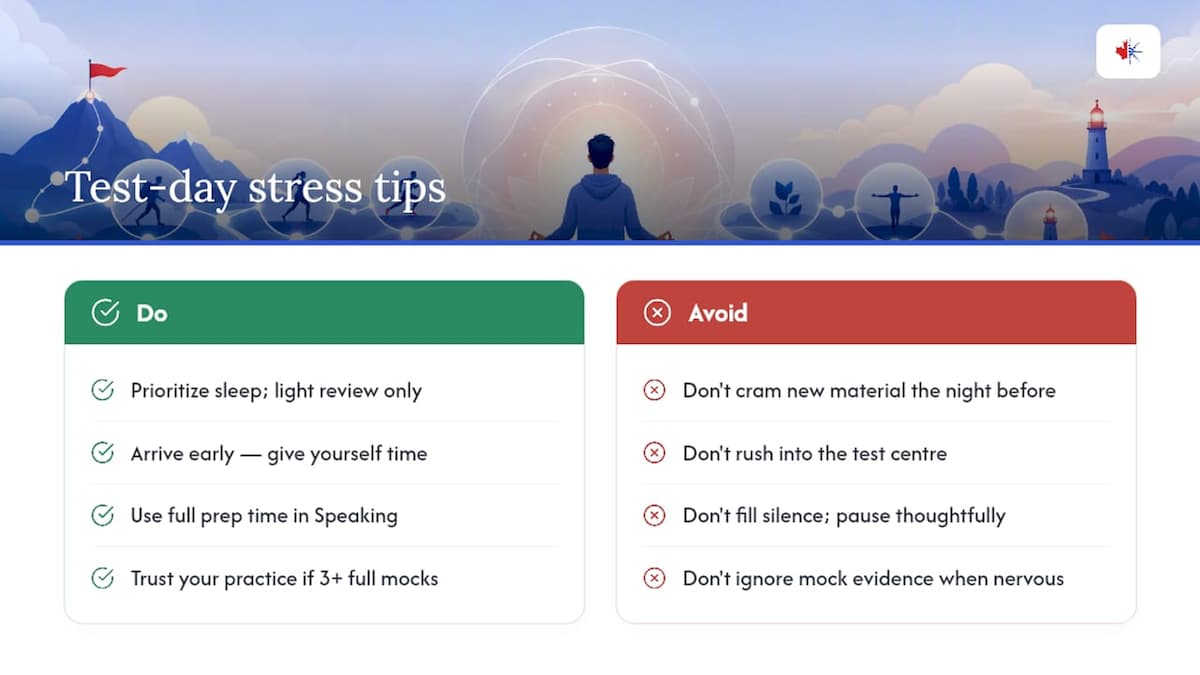
Tips for managing test day stress and boosting confidence
Test day nerves cost real points, mostly in Speaking, where hesitation reads as lower fluency even when your grammar is fine. A few habits reliably help.
Sleep matters more than one last cram session. A rested brain processes Listening passages and Reading inference questions noticeably faster than a tired one, and CELPIP’s computer-based format leaves no room for re-reading at leisure. Do a light review the night before, vocabulary flashcards, maybe one Writing template, then stop. Cramming new material the night before a test rarely sticks and often just raises anxiety.
Arrive at the test centre with time to spare. Rushing in flustered carries into your first Listening section, and first impressions of your own performance tend to colour how you feel about the rest of the test, even when they shouldn’t.
During the Speaking section, treat silence as normal. You get preparation time for a reason; use every second of it rather than rushing to fill the recording. A one or two second pause before answering reads as thoughtful, not weak.
If you’ve run three or more full mocks at your target CLB, lean on that evidence when nerves hit. You’re not walking in hoping for a good score, you’re confirming a result your own practice data already predicted. That reframing, from hope to confirmation, is one of the more underrated tools available to a well-prepared candidate.
Detailed breakdown of each test component format and timing
CELPIP’s computer-delivered format runs in a fixed sequence, and knowing the timing cold removes one more source of test-day stress.
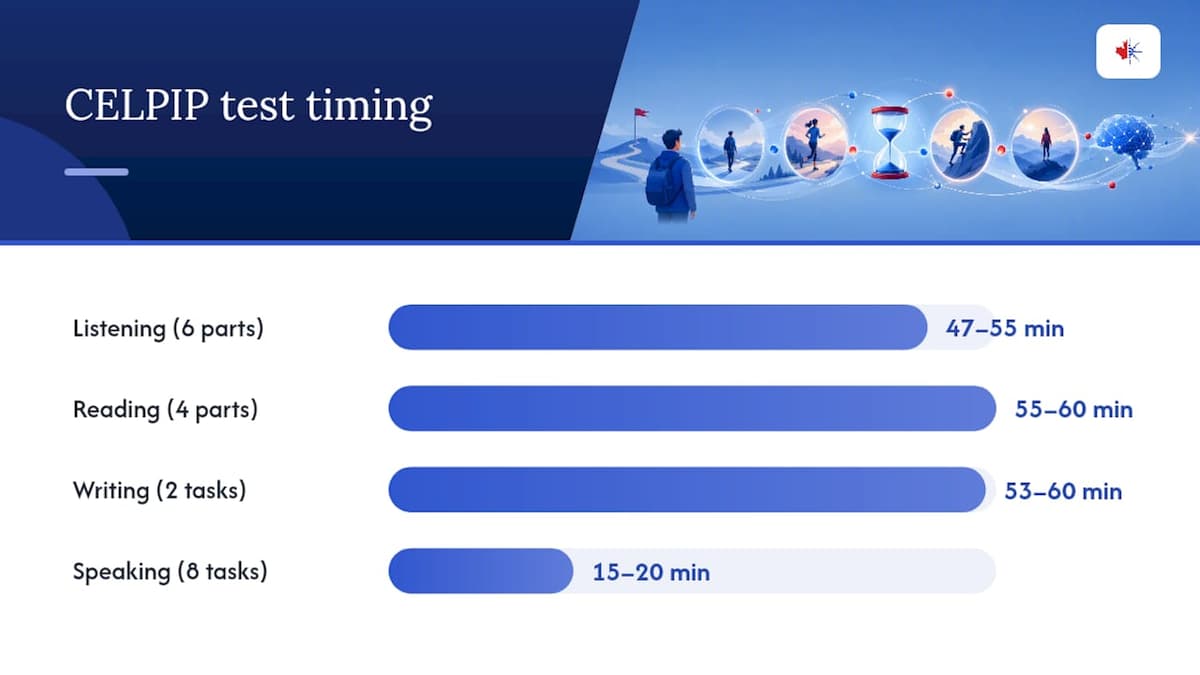
Listening runs roughly 47 to 55 minutes across six parts, covering everyday conversations, discussions, news items, and problem-solving scenarios. You hear each clip once, so note-taking discipline matters more here than in almost any other section.
Reading takes about 55 to 60 minutes across four parts: a correspondence task, an informational passage, a diagram-based task, and a viewpoint comparison. Time pressure is real. Budget your minutes per passage before you start rather than discovering with two minutes left that you haven’t touched the final section.
Writing gives you about 53 to 60 minutes for two tasks: an email response and a survey response, each requiring roughly 150 to 200 words. The onscreen typing environment is unforgiving of poor time management, since there’s no partial credit for an unfinished second task.
Speaking runs about 15 to 20 minutes across eight tasks, each with a short preparation window (typically 30 to 60 seconds) followed by a recorded response of similar length. This section moves fast, and knowing the eight task types cold, rather than encountering them for the first time on test day, is one of the highest-leverage things a sprint-tier candidate can do in their final week.
Incorporating language immersion or practice in daily routine
Structured CELPIP drills only get you so far if your everyday English exposure is thin. Immersion fills the gap between “I know the grammar rule” and “I can produce it fluently under time pressure,” which is exactly what CELPIP tests.
Small changes compound. Switch your phone’s interface language to English. Listen to a Canadian news podcast during a commute instead of music. Narrate your own day in your head in English, what you’re doing, why, what comes next, as informal speaking practice with zero setup cost. None of this replaces timed mock practice, but it builds the underlying fluency that makes timed practice easier.
For longer timelines especially, pairing CELPIP-specific work with general fluency practice, structured academic English exercises among them, tends to produce steadier gains than CELPIP drills alone, since general comprehension and production speed underpin every task type on the test.
If you’re on a sprint timeline, immersion won’t move the needle much in one to four weeks; your time is better spent on format and timing. But on an 8-week or 6-month plan, 20 to 30 minutes of daily immersion alongside your structured practice adds up to real fluency gains that show up in your Speaking and Writing scores specifically, where natural production speed matters as much as accuracy.
Author’s perspective on realistic expectations and feedback-driven practice
Most people overestimate what a sprint can fix and underestimate what consistent, feedback-driven practice can achieve over three or four months. The candidates who move fastest aren’t the ones who study the longest hours, they’re the ones who take a diagnostic seriously, adjust their plan when a mock says to, and treat feedback as data rather than criticism. Favour that iterative loop over a fixed script, and the timeline tends to take care of itself.
— Reza
Start with a diagnostic and build your plan from real data
Guessing your CLB level and hoping a generic study guide covers your gaps wastes weeks you probably don’t have. Celpipguide’s readiness check gives you that starting diagnostic first, scored across all four skills, so your plan is built on your actual results instead of assumptions.
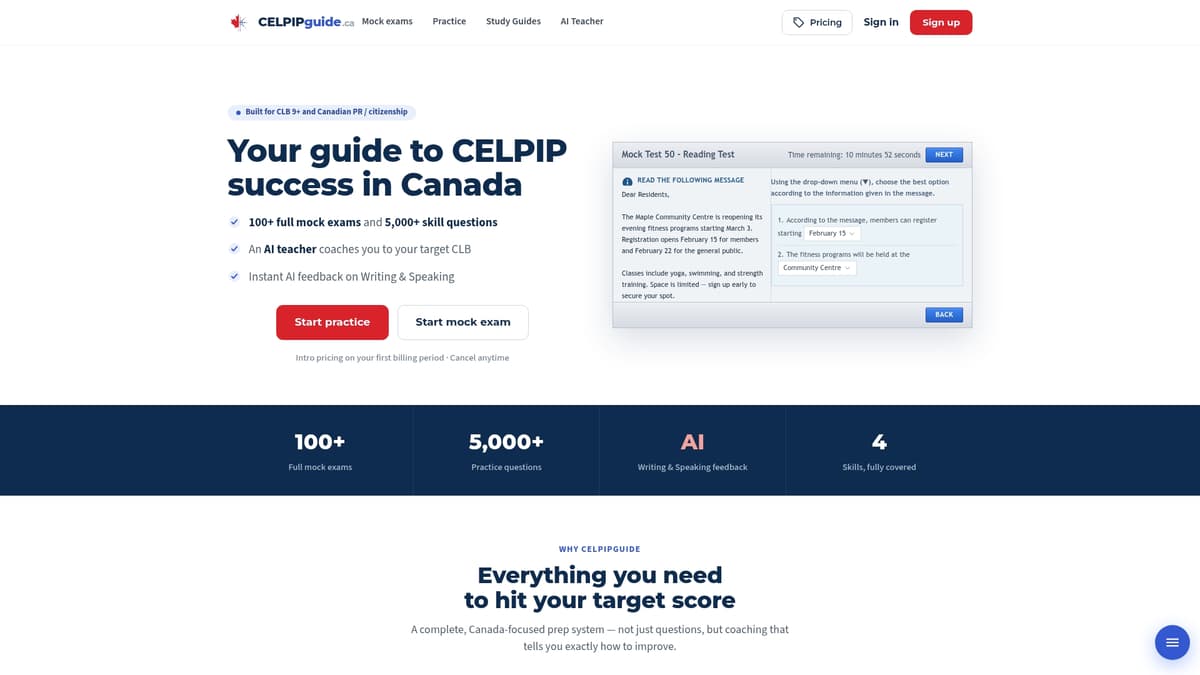
From there, the sequence matches everything in this guide: take the diagnostic, generate a personalised weekly study plan, use AI feedback on your Writing and Speaking to fix errors before they become habits, and run scheduled full mock exams to confirm you’re hitting target CLB consistently, not just once. If you’re on a sprint timeline, the 14-day readiness check is built specifically for that compressed window.
New users may have access to a limited free trial to test diagnostic and study-plan tools before committing. No plan here promises a guaranteed score, what it gives you is a clear, data-backed way to see your progress and adjust before test day arrives.
Sources
FAQ
How much time does it take to prepare for CELPIP?
It depends on your starting CLB: a few weeks if you’re already at a high CLB level, several weeks for mid-level CLB starting points, and several months or more if you’re starting at a lower CLB level or aiming for significant improvement.
What is 34 out of 38 in CELPIP reading?
Raw scores convert to a CLB level through CELPIP’s official scoring scale rather than a simple percentage, and the exact CLB cutoff varies by section, so check your official score report against the CLB mapping table rather than estimating from the raw number alone.
Is it hard to get a 9 in CELPIP?
CLB 9 requires strong, consistent accuracy and fluency across all four skills, which typically means several CLB levels of improvement from an average starting point and a longer preparation timeline, often 4 to 6 months of focused work rather than a short sprint.
Is 7 a good CELPIP score?
CLB 7 in every skill meets the threshold most immigration programs require, making it a genuinely solid, functional target for many applicants, though some streams or professional requirements call for CLB 9 or higher.