
CELPIP Blog
Raise Your Score Fast: CELPIP Listening Strategies for Each of the Six Parts
Raise Your Score Fast: CELPIP Listening Strategies for Each of the Six Parts

The fastest way to raise your CELPIP listening score is to combine part-specific practice with a compact, predictive note-taking system and regular timed mock tests. Start with a diagnostic mock to see which of the six parts is dragging your score down, then drill that part with focused shorthand notes before moving into full timed practice. Aim your prep at your target CLB band from day one, not just a raw score.
TL;DR:
- Focus on diagnosing your weakest CELPIP listening parts with a mock test before customizing your practice.
- Use part-specific note-taking templates and preview questions to increase accuracy and save time during the test.
- Prioritize timed mock exams over extended listening to build pacing and adapt to real exam pressure.
- Practice with CELPIP-format audio regularly, combining untimed drills and timed mocks, to improve question prediction and note organization.
- Track errors by category to identify bottlenecks like paraphrase recognition or pacing, and adjust your study plan accordingly.
Table of Contents
- What is the CELPIP listening test format and scoring?
- How do you take notes fast enough for CELPIP listening?
- What listening strategy works for each of the 6 parts?
- How should you structure your CELPIP listening study routine?
- How do you manage your time during CELPIP listening?
- What common CELPIP listening mistakes should you fix?
- How Celpipguide turns these strategies into a study plan
- Why part-by-part practice beats generic listening drills
- Ready to put these listening strategies into practice?
- Sources
- FAQ
What is the CELPIP listening test format and scoring?
CELPIP listening has six parts, and each one tests a different skill. Knowing the shape of the test before you walk in changes how you listen, because you stop reacting to audio and start hunting for exactly what each part wants.
- Part 1: Problem Solving — a conversation about an everyday problem, six questions.
- Part 2: Daily Life Conversation — a short, casual exchange, five questions focused on details.
- Part 3: Information — one speaker delivering facts, five questions.
- Part 4: News Item — a short news-style report, four to five questions.
- Part 5: Discussion — two people discussing a topic from different angles, eight questions.
- Part 6: Viewpoints — one speaker giving an opinion with reasons, five questions.
The whole listening section runs a little under an hour once you include instructions and question-reading time, and it sits early in the full CELPIP test, right after the untimed items and before Reading. The official CELPIP listening study pack breaks down the timing and question counts for every part if you want the exact structure in front of you while you plan.
Scoring matters more than most test takers realize going in. Your raw listening score converts to a Canadian Language Benchmark (CLB) level, and that CLB level is what immigration programs actually check. Canada show how a listening score lines up with CLB 7, a common threshold for post-graduation work permit and skilled worker pathways. For citizenship applications specifically, Canada.ca requires a CELPIP General listening and speaking result of 4 or higher. Know your target CLB before you start studying. It tells you exactly how much room for error you have.
How do you take notes fast enough for CELPIP listening?
Your notes are the bridge between what you hear once and what you answer minutes later. Messy notes cost more points than weak vocabulary ever will, because you simply cannot remember six details from a 90-second clip without writing something down.
Here is the sequence that works, in order:
- Preview the questions first. You get a short window before each part’s audio starts. Use every second of it to skim the questions and underline the keywords they’re asking about (a name, a time, a reason, a decision).
- Predict the shape of the answer. If a question asks “what does the woman decide to do,” you already know you’re listening for an action verb tied to her, not a date or a place.
- Use a fixed template for problem-solving audio. For Parts 1 and 2, jot four columns in your head or on paper: Who / Action / Time / Constraint. Most problem-based conversations resolve around those four elements.
- Build a personal shorthand. Use an arrow for speaker change, a plus sign for agreement, a minus sign for disagreement, and numbers in brackets for anything listed in sequence.
- Mark opinions separately from facts. In Parts 5 and 6, circle or star anything that sounds like a stance (“I think,” “the real issue is,” “what worries me”) because questions often ask you to identify whose opinion is whose.
- Drill speed with short timed clips. Play a one-minute news clip or podcast segment and force yourself to capture five details in shorthand before it ends. Repeat with fresh clips until your hand keeps up with the speaker.
Pro Tip: Practise your shorthand on anything, not just CELPIP audio. Take notes on a coworker’s story at lunch using your Who/Action/Time/Constraint template. The more automatic the format becomes, the less brainpower it takes on test day.
The official CELPIP listening study pack recommends practising note-taking across all six parts before test day, not just the ones that feel hardest. A CELPIPguide breakdown of note-taking templates walks through sample formats for each part if you want a starting point to adapt.
What listening strategy works for each of the 6 parts?
Every part rewards a slightly different listening posture. Treating them all the same is the single biggest reason strong readers still underperform on listening. Mapping a clear goal to each part before the audio starts also cuts down on the panic of trying to figure out what to listen for mid-clip.
Part 1: Problem Solving. Listen for the problem stated early, the action someone proposes, and who ends up responsible for that action. A quick micro-drill: after any two-person conversation you overhear this week, silently answer “what’s the problem, what’s the fix, who does it?”
Part 2: Daily Life Conversation. This part hides real answers inside small talk. Ignore greetings and filler, and lock onto concrete details like names, times, and places the moment they appear. Practise by listening to a short exchange once, then quizzing yourself on three hard facts before checking your notes.
Part 3: Information. One speaker, straight facts, no back-and-forth to help you catch a missed detail. Number your notes as the facts arrive rather than trying to organize them by category while listening.
Part 4: News Item. Catch the headline idea in the first sentence or two, since news audio almost always front-loads the main point. Everything after that is supporting detail you can slot underneath. Drill this by listening to the first ten seconds of any short radio-style clip and writing a one-line headline before the rest plays.
Part 5: Discussion. Two speakers, often disagreeing. Track who says what using a simple left/right or A/B column, and flag stance words the moment you hear them (“actually,” “I disagree,” “on the other hand”). This is the longest part at eight questions, so a clean speaker-tracking system pays off more here than anywhere else.
Part 6: Viewpoints. One speaker builds an argument with reasons. Map each claim to the evidence given for it as you go, because CELPIP loves testing whether you can spot a paraphrased distractor that sounds similar to the real reason but isn’t quite it. A fast checklist: claim, reason, example, repeat.
Working part by part instead of treating listening as one undifferentiated skill lowers the mental load during the actual test, since you walk into each section with a short checklist instead of a blank slate.

How should you structure your CELPIP listening study routine?
A study plan without structure turns into passive re-listening, and passive re-listening barely moves your score. What actually works is a rotation between focused drills, mixed practice, and honest review.
A simple four-week structure:
- Week 1: Diagnostic mock test, then isolate your two weakest parts and drill only those with untimed practice.
- Week 2: Add timed part-drills for your weak areas, plus one full timed mock at the end of the week.
- Week 3: Mix all six parts in randomized order to break pattern recognition, plus a second full timed mock.
- Week 4: Full timed mocks every two to three days, with a 15-minute error review after each one.
Use official CELPIP-format audio for the bulk of your drilling. The CELPIP listening study pack recommends alternating untimed practice, which builds accuracy without pressure, with timed practice, which trains pacing. Broader listening input like podcasts and news broadcasts is a useful supplement for vocabulary and accent exposure, but it should never replace CELPIP-format practice entirely, since generic audio doesn’t train you on the question patterns you’ll actually face.
Short, frequent sessions consistently beat long, infrequent ones for building the kind of focus listening tests demand, a pattern also seen in research on focused study sessions more broadly. Thirty minutes of sharp, focused drilling most days will outperform one exhausting three-hour session on a Sunday.
Log your errors by type, not just by score. If you keep missing paraphrase-based questions in Part 6 but nailing factual recall in Part 3, that tells you exactly where to spend tomorrow’s session. Tracking mistakes by category turns a vague sense of “I’m bad at listening” into a specific, fixable pattern.
How do you manage your time during CELPIP listening?
Time pressure is where good preparation falls apart if you don’t have simple rules to fall back on. The test doesn’t wait for you to feel ready, so build habits now that remove decision-making later.
- Use every second of pre-audio reading time to skim questions and underline what each one is really asking for, not just the topic.
- Answer as you go, don’t wait until the end of a clip to fill in bubbles from memory. Most parts give you time after each question to select an answer before the next one plays.
- Cap your dwell time. If you genuinely miss a detail, mark your best guess and move on immediately. Chasing one lost point often costs you three more on the questions that follow.
- Expect accent and speed variation. CELPIP audio includes a range of Canadian and international English accents at natural speaking speed. Practising with varied real-world audio during the week builds tolerance so a slightly faster speaker doesn’t throw you off in Part 5.
- Reset after every part. Treat each part as its own mini-test. A rough Part 2 has zero bearing on Part 3 if you let it go immediately.
Pro Tip: Give yourself two mental cues for panic moments: “guess and go” when you miss a detail, and “next part, clean slate” when a section goes badly. Saying them in your head, even once in practice, makes them automatic under pressure.
What common CELPIP listening mistakes should you fix?
- Keyword-only listening. Test takers often listen for the exact words in the question and miss the answer when it’s paraphrased. Train this by rewriting question keywords as synonyms before checking answers.
- Disorganized notes. If you can’t read your own shorthand ten seconds later, switch to a fixed template and run one-minute review drills where you glance at old notes and reconstruct the answer cold.
- Too much untimed practice. Comfort with untimed audio doesn’t transfer to real pacing. Shift your final two weeks toward mixed-timing sessions, as community feedback from test takers repeatedly points to timing, not vocabulary, as the real struggle.
- Freezing after a missed answer. One missed question is not a failed section. Build the “guess and go” habit in practice so it’s automatic on test day. A full list of frequent CELPIP mistakes covers patterns beyond listening if you want the wider picture.
How Celpipguide turns these strategies into a study plan
Reading about strategy is one thing. Actually applying it, part by part, with feedback on where you’re weak, is what moves your score.
- Run a diagnostic mock first to find out exactly which of the six parts is costing you points, instead of guessing.
- Feed those results into the study-plan generator, which schedules part-specific drills instead of generic review.
- Use instant feedback on practice sets to catch patterns, like consistently missing paraphrase-based questions, faster than reviewing alone.
- Follow the sequence: free diagnostic, then a two-week focused sprint on your weakest parts, then a full timed mock to confirm the gains stuck.
That loop, diagnose, drill, test again, is what turns scattered study time into a measurable climb toward your target CLB.
Why part-by-part practice beats generic listening drills

Most CELPIP advice treats listening as one skill you either have or don’t. That’s backwards. The research and the test structure both point the same direction: Part 5 discussion tracking has almost nothing in common with Part 3 fact-capture, and studying them the same way wastes your limited prep time.
The conventional wisdom to “listen to more English” isn’t wrong, but it’s incomplete. Generic podcasts build vocabulary and accent tolerance, not the specific skill of predicting a CELPIP question from a preview window or catching a paraphrased distractor in Part 6. If your practice never touches CELPIP-format audio, you’re training a related but different skill.
What I’d prioritize first, before vocabulary lists or grammar drills, is a diagnostic mock. Most test takers assume their weakness is comprehension when it’s actually pacing or note organization. You cannot fix a problem you haven’t correctly identified. Once you know whether Part 1 or Part 5 is your real bottleneck, every hour of practice after that gets sharper.
— Reza
Ready to put these listening strategies into practice?
Reading a strategy guide gets you halfway there. The other half comes from practising against real CELPIP-format audio and seeing exactly where your notes fall apart. A comprehensive CELPIP preparation plan gives you full access to timed mock exams, part-specific drills, and a study plan that adjusts based on your diagnostic results, so you’re not guessing which parts need more work.
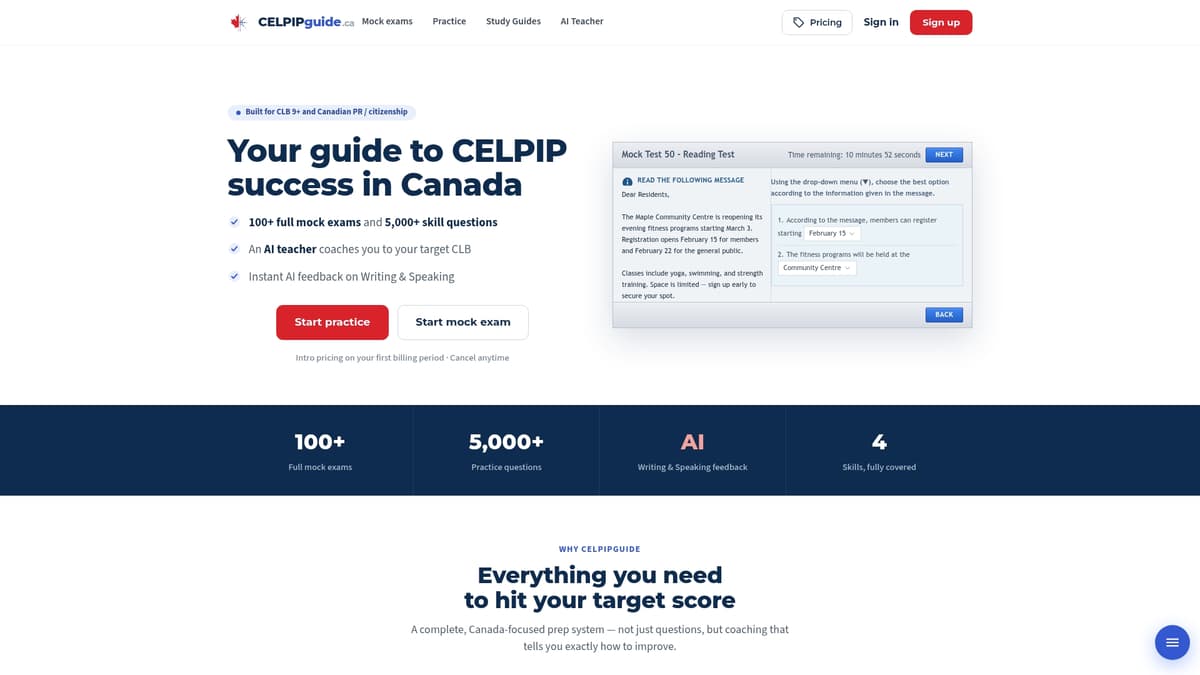
Start with a free diagnostic listening test to see how you score across all six parts right now. From there, the CELPIP study plan generator builds a focused two-week sprint around your weakest areas, and the full exam practice hub lets you run timed mocks once you’re ready to test under real conditions. Plus unlocks the full library for a one-time cost of $29.99 through the plans page.
Sources
FAQ
What is 32 out of 38 in CELPIP listening?
A raw score near the top of the scale typically corresponds to the higher CLB bands, often CLB 7 or above depending on CELPIP’s current conversion table. Check the exact conversion using Canada.ca’s official CLB tables since bands can shift slightly between test versions.
Is 7 a good CELPIP score?
A CELPIP score of 7 usually corresponds to CLB 7, which meets the threshold many skilled worker and post-graduation work permit pathways require. It’s a solid, workable target for most programs and applicants aiming to meet immigration requirements.
How do I actually prepare for the CELPIP listening test?
Combine part-specific drills with predictive note-taking and regular timed mock tests, starting with a diagnostic to find your weakest parts. Tools like Celpipguide’s listening practice module let you test these celpip listening strategies against real exam-format audio before test day.
How do you get a high score in CELPIP speaking?
A strong CELPIP speaking score comes from clear structure, specific examples, and fluent delivery within the time limit for each task, rather than perfect grammar alone. The CELPIP speaking guide breaks down sample answers and task-specific tactics for each speaking prompt.