
CELPIP Blog
72 Hour CELPIP ID Checklist to Avoid Being Turned Away in Canada
72 Hour CELPIP ID Checklist to Avoid Being Turned Away in Canada
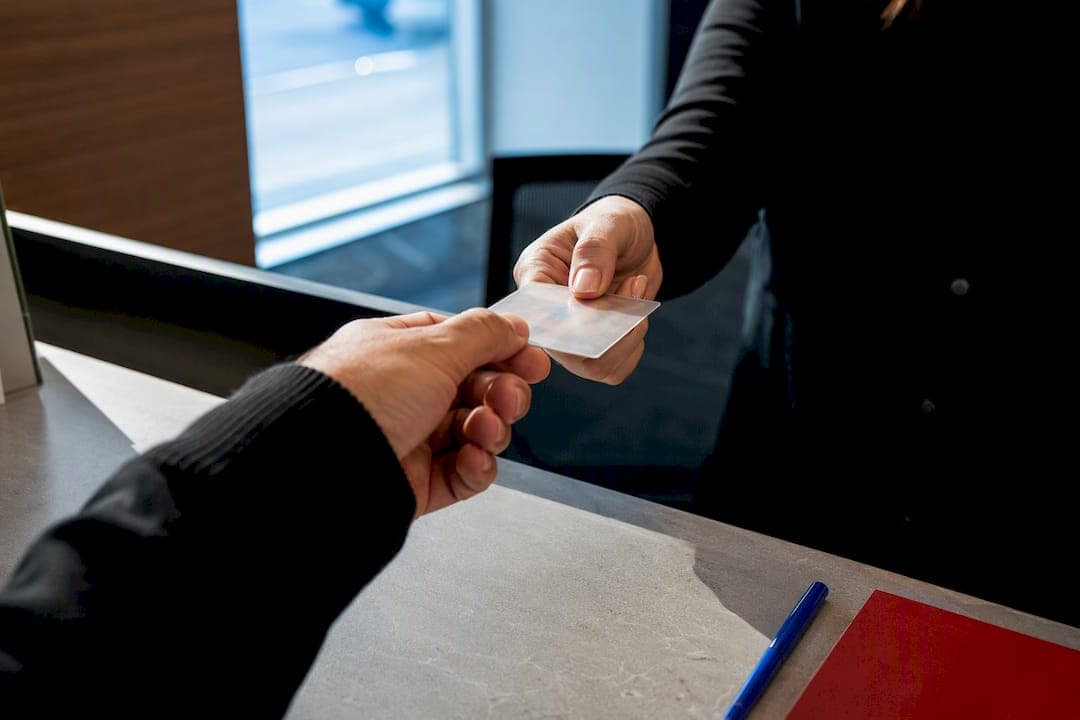
Bring the original, government-issued photo ID you used to register for CELPIP, unexpired and matching your registration name exactly. Photocopies are never acceptable, no matter how clear the scan looks. If you show up without that exact document, test centre staff can turn you away, and you could lose your test fee entirely.
TL;DR:
- Photocopies or digital versions of your original ID are never accepted; only valid, unexpired government-issued photo IDs are permitted.
- Valid IDs must match your registration details exactly, including full name, middle names, and accents, with no discrepancies or damage.
- Acceptable IDs include passports, Canadian permanent resident or citizenship cards with photos, and some provincial driver’s licenses, but always verify specific centre policies beforehand.
- Bringing an ID that is expired, damaged, or does not show your face will likely result in test refusal, requiring rescheduling and possibly additional fees.
- Contact CELPIP support early if your ID details change, get lost, or if you have special circumstances like name changes or headwear, to prevent issues at check-in.
Table of Contents
- Celpip id requirements: which photo IDs are accepted in Canada
- ID rules and common issues that lead to refusal at check-in
- What to bring on test day and how staff verify your identity
- Special cases: name changes, lost ID, temporary residents, and headwear
- A pre-test ID verification checklist for 24 to 72 hours before your exam
- Do you need secondary identification for CELPIP?
- What if your ID is damaged or hard to read on test day?
- Are digital or electronic IDs accepted for CELPIP?
- What happens if you arrive without acceptable ID?
- Author perspective: the small mistakes that cause big problems
- How CELPIPguide gets you ready for more than just the test content
- Sources
- FAQ
Celpip id requirements: which photo IDs are accepted in Canada
CELPIP does not leave the ID question open to interpretation, and that is genuinely good news. The rules are narrow, published, and consistent across Canadian test centres, so once you know the short list of accepted documents, you can stop guessing and just check your own ID against it.
The core rule, straight from CELPIP’s official test day guidance, is that you must present the original, valid identification you used when you registered. Not a similar document. Not a newer version of the same document type. The exact one on file.
Passports (Canadian and foreign)
A passport is the most universally accepted photo ID for CELPIP, and for good reason. It has a government-issued photo, a full legal name, and an expiry date printed right on the page. Whether you hold a Canadian passport or one from your home country, it works as long as it is unexpired and the photo still looks like you.
Check three things before test day: the expiry date has not passed, the name matches your registration exactly (including middle names if you registered with them), and the photo is not so old or damaged that staff can’t recognize you against it. A passport that’s falling apart at the spine, with a laminate bubble over your face, can cause problems even if it’s technically still valid.
Canadian permanent resident card and citizenship card
If you registered using your Canadian permanent resident (PR) card or a Canadian citizenship card that includes your photo, that same document works on test day. This matters a lot for the exact audience CELPIP serves: people already living in Canada who are testing for permanent residence renewal, citizenship applications, or professional licensing, not just newcomers applying from abroad.
One nuance worth flagging: some older citizenship certificates do not carry a photo. For those preparing immigration documents or permanent resident applications, professional guidance on how to write a resume for remote jobs in Canada can also help streamline your overall application process. If yours doesn’t, it will not satisfy CELPIP’s photo ID requirement on its own, and you’ll need to register with a document that does show your face, like a passport or PR card.
Provincial and territorial photo ID
Provincial driver’s licences and provincial photo ID cards are accepted at many Canadian test centres, but this is the one category where you genuinely need to check specifics rather than assume. Acceptance can depend on the test centre location and whether the province’s ID meets CELPIP’s format standards for a clear photo and full legal name.
Because this varies, don’t rely on a driver’s licence as your only option if you have any doubt. Check the CELPIP FAQs or contact your specific test centre directly, and confirm before you register rather than the week of your test.
Documents that typically don’t work
A few document types come up again and again as points of confusion, so it’s worth naming them directly:
- Provincial health cards are not accepted anywhere in Canada as CELPIP ID, even though they carry a photo in some provinces. They’re not designed as general identity documents and CELPIP treats them as such.
- Student ID cards from colleges or universities are not accepted, regardless of how official they look with a photo and institutional seal.
- Employee ID badges, gym membership cards, and similar photo cards issued by non-government bodies never qualify.
- Expired versions of otherwise acceptable documents (an expired passport, an expired PR card) do not work. Full stop.
The pattern here is simple: CELPIP accepts government-issued photo identification only, and it has to be current. Other Canadian language testing organizations, including CAEL, follow essentially the same logic, which tells you this isn’t an arbitrary CELPIP quirk. It’s standard practice across the industry because test centres need identity verification that can’t be faked or borrowed.
If you’re still deciding which version of the exam fits your goals, CELPIPguide’s CELPIP test guide walks through the format differences and what each version expects from you on ID day.
ID rules and common issues that lead to refusal at check-in
Most test-day ID refusals aren’t about fraud or bad faith. They’re about small mismatches that candidates didn’t think would matter, and then suddenly did.
Why “original” really means original
CELPIP staff cannot accept a photocopy, a scanned PDF, or a photo of your ID on your phone screen, even if the original document exists somewhere at home. The official test day rules state this plainly, and government identity-verification guidance backs the same standard: a copy can be altered in ways an original cannot, so test centres simply don’t have discretion here.
The confusion usually happens when someone renews their passport shortly before the test but registered with the old one, or vice versa. If you renew your ID after registering, you have two choices: update your registration to match the new document, or bring the original document you registered with, even if it’s now expired on paper by a day or two. Contact CELPIP support well before test day if this happens to you.
Name mismatches are the most common trip-up
If your ID says “Maria Elena Rodriguez Garcia” and your registration says “Maria Rodriguez,” that’s a mismatch that can hold up your check-in. This comes up constantly with:
- Married names that appear on one document but not another.
- Accented characters that get dropped or altered during online registration.
- Middle names included on a passport but omitted from the CELPIP account.
- Hyphenated or multi-part surnames typed inconsistently.
If you’ve had any legal name change since registering, or you notice a discrepancy between your ID and your registration, contact CELPIP support before test day. Trying to resolve it in the check-in line, with other candidates waiting behind you, rarely goes smoothly.
Damaged or unexpired but questionable documents
An ID that’s technically unexpired but has a torn photo page, a faded laminate, or water damage obscuring your name can still cause a refusal. Test centre staff need to visually confirm your identity and your name field. If either is unreadable, they may treat the document as invalid regardless of its expiry date.
What actually happens if your ID doesn’t pass
Consequences vary by situation, but candidates who cannot present acceptable ID are typically not permitted to write the test that day. Depending on the test centre’s policy, this can mean forfeiting your test fee, needing to reschedule and pay again, or in some cases having your results invalidated after the fact if an issue is discovered post-test. None of these outcomes are pleasant, and all of them are preventable with a five-minute check the week before.
Pro Tip: Take a photo of your ID next to your CELPIP registration confirmation email a week before test day, and read both names aloud, letter by letter. Mismatches hide in plain sight when you’re used to seeing your own name and your brain autocorrects it.
What to bring on test day and how staff verify your identity
Arrive at your test centre with enough buffer that a small hiccup doesn’t turn into a missed test. Most Canadian test centres recommend arriving early before your scheduled start time, though checking your specific confirmation email for the centre’s exact instructions is worth the two minutes it takes.
At check-in, staff will typically:
- Ask for your original photo ID and compare the name, photo, and expiry date against your registration.
- Confirm your registration number or booking confirmation, either printed or on your phone.
- Verify your test type (General or General LS, depending on what you registered for) matches what’s scheduled.
- Have you store personal belongings, including phones, smartwatches, and bags, in a designated area or locker before you enter the testing room.
The ID check itself is a visual and physical inspection in almost every case. A staff member looks at the document, looks at you, and checks the name against the system. It’s not usually an electronic scan, which is exactly why the original document matters so much: there’s no backup system verifying you if the physical document falls short.
What you can typically bring into the test room is minimal: your ID (until it’s verified), sometimes a clear water bottle, and little else. Wallets, notes, phones, and smartwatches almost always stay outside the room. If you’re unsure what your specific centre allows, CELPIPguide’s guide on how to prepare for the CELPIP exam covers the practical side of arrival and check-in in more detail.
If an ID issue does come up at check-in, ask to speak with the test centre supervisor immediately rather than the front-desk staff alone. Supervisors sometimes have more context on edge cases, and they can tell you on the spot whether a same-day fix (like calling CELPIP support) is even possible before your session starts.
Special cases: name changes, lost ID, temporary residents, and headwear
Not every candidate fits the standard profile, and CELPIP’s rules account for a handful of common exceptions.
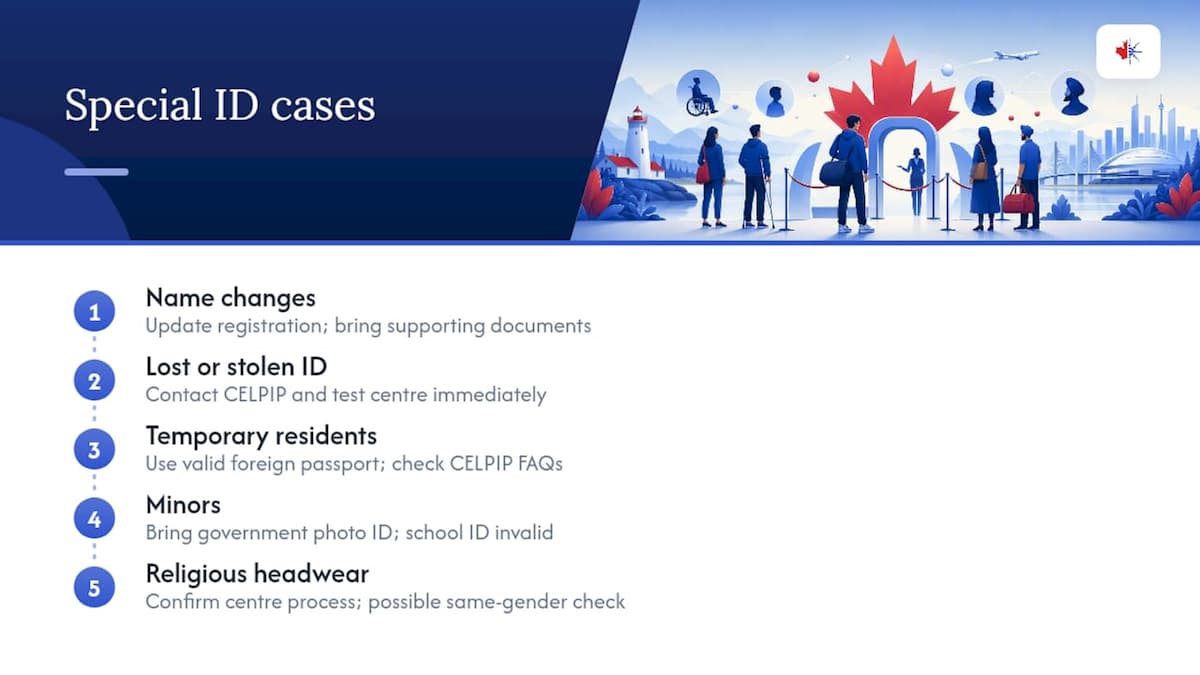
Name changes: if you’ve legally changed your name since registering, whether through marriage, divorce, or a legal name change, update your CELPIP registration as soon as possible and bring supporting documentation (a marriage certificate or court order) alongside your current photo ID. Don’t wait until test week if you can avoid it.
Lost or stolen ID: if your ID goes missing before test day, contact CELPIP support and your test centre immediately, not the morning of the test. A police report for a stolen document can sometimes support a temporary travel document or an expedited replacement, but this needs coordination in advance since test centres have very limited flexibility on test day itself.
Temporary residents and non-Canadian documents: temporary residents and international candidates can generally use a valid foreign passport as primary ID. If you’re testing for a specific immigration purpose, check the CELPIP FAQs for guidance tied to your application type, since IRCC’s own operational guidance treats language test ID verification and immigration application documentation as separate steps. Passing CELPIP with valid ID doesn’t replace what you’ll eventually submit to IRCC for your application.
Minors: younger candidates still need government-issued photo ID that meets the same standards as adult candidates; a school ID does not qualify.
Religious headwear: candidates wearing religious headwear are generally not required to remove it for identification, though a private, brief visual confirmation with a same-gender staff member may be requested in specific cases. Confirm your test centre’s exact process ahead of time if this applies to you.
A pre-test ID verification checklist for 24 to 72 hours before your exam
Run through this short audit a few days before your test, not the morning of.
- Match your name, character for character. Compare your ID’s full legal name against your CELPIP registration, including middle names, hyphens, and accented letters.
- Check the expiry date. If your ID expires within a few weeks of your test date, don’t take the risk. Confirm with CELPIP whether it will still be accepted, or renew if time allows.
- Photograph both sides of your ID for your own records. This is a backup for you, not something you present at check-in. Photocopies are never acceptable at the test centre itself.
- Locate your registration confirmation email or number. Save it somewhere accessible on test day, both digitally and printed if possible.
- Contact CELPIP support or your test centre with any doubt at all. A quick email now beats a stressful conversation at the check-in desk.
Store your original ID and confirmation somewhere secure and memorable the night before. Not in a jacket pocket you might swap, not in a bag someone else is carrying. If you’re finalizing your study schedule around test day, CELPIPguide’s last-minute study plan folds this kind of logistics check into the final week alongside your practice sessions.
Pro Tip: Set a calendar reminder for exactly 72 hours before your test that just says “ID check.” It takes three minutes and it’s the cheapest insurance you’ll buy all week.
Do you need secondary identification for CELPIP?
CELPIP’s published rules centre on a single, primary photo ID: the original document you registered with. There is no standard requirement to bring a second form of identification alongside it, unlike some financial or legal processes that ask for a primary and secondary document combination.
That said, bringing your registration confirmation email or printed booking reference counts as a practical companion to your ID, even though it isn’t identification in the legal sense. Staff use it to pull up your file and confirm your test type and time slot quickly, which speeds up your own check-in.
If you’re in a special-case situation, a recent name change, a temporary travel document, or a replacement ID after a loss, supporting paperwork like a marriage certificate or police report functions as informal secondary support for your primary ID, not a replacement for it. Bring these documents in addition to your government photo ID, never instead of it.
The safest approach is to treat your primary photo ID as the only document that truly matters, and everything else, confirmation emails, supporting certificates, as helpful backup rather than a formal secondary ID requirement.
What if your ID is damaged or hard to read on test day?
A cracked laminate, a faded photo, or a water-stained name field can turn a technically valid ID into a practical problem at check-in. Staff need to clearly see your photo and read your full legal name, and if either is compromised, they may not be able to accept the document even though it hasn’t expired.
If you notice damage to your ID before test day, your best move is to replace it through the issuing authority (passport office, provincial licensing body) with enough lead time to update your registration if the new document has a different number or issue date. Waiting until the week of your test rarely leaves enough time for a passport renewal, so check your ID’s physical condition as soon as you book your exam, not the night before.
If damage happens unexpectedly and you can’t replace the document in time, contact CELPIP support immediately to explain the situation. There’s no guarantee of a workaround, since test centres generally can’t exercise discretion on ID standards, but flagging the issue in advance gives you options you won’t have if you simply show up and hope for the best. In some cases, having a second acceptable ID type (a PR card alongside a damaged passport, for instance) can save your test date if you update your registration to reflect it beforehand.
Are digital or electronic IDs accepted for CELPIP?
No. CELPIP’s identification rules are built around physical, original, government-issued documents, and digital versions, including smartphone wallet apps, PDF scans, or photos of your ID stored on your device, are not accepted as valid identification on test day.
This holds even for digital driver’s licences or mobile ID apps that some provinces have started rolling out, and even when the digital format is accepted for other everyday purposes like age verification or boarding a domestic flight. Test centre staff need a physical document they can hold, inspect closely, and compare against your registration details in person.
The reasoning tracks with why photocopies are banned too: a screen display can be manipulated, cropped, or shown from an old screenshot in ways a physical passport or PR card cannot. Until CELPIP publishes updated guidance stating otherwise, treat digital ID as unacceptable across the board and always bring the physical original.
If your only form of a particular document is digital (some newer government services default to app-based credentials), check the CELPIP FAQs or contact support directly to confirm what physical alternative will work for your situation well before your test date.
What happens if you arrive without acceptable ID?
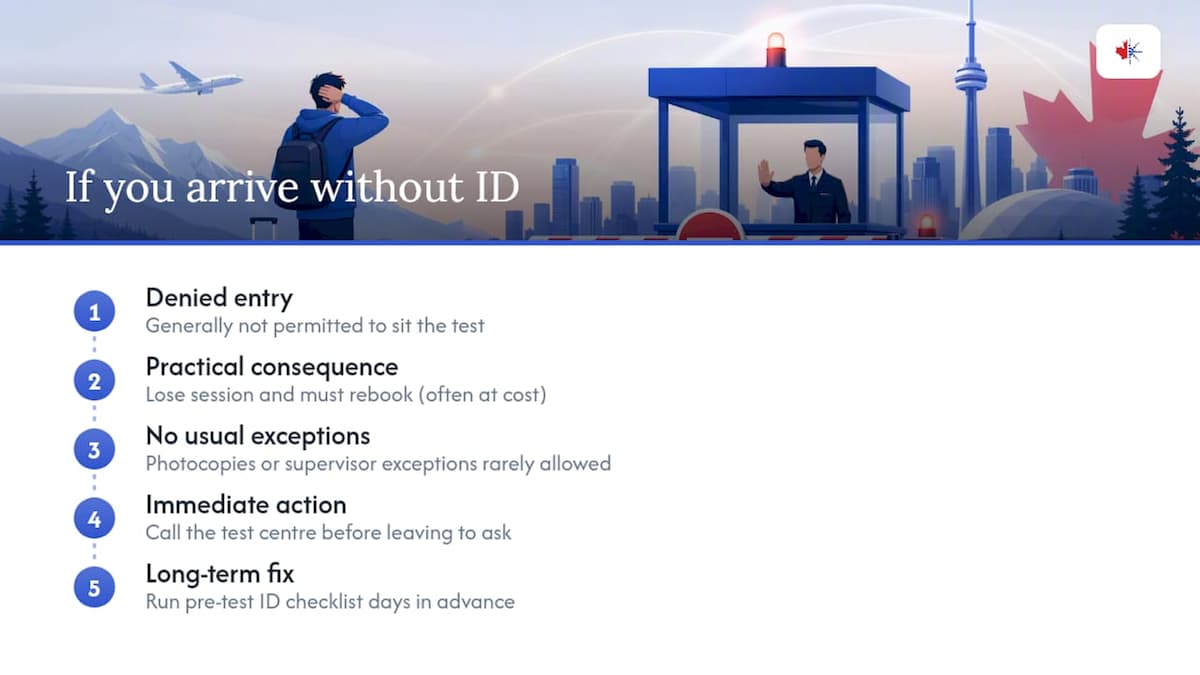
Candidates who arrive without their original, valid photo ID are generally not permitted to sit the test that day. This is one of the few areas where CELPIP test centres have very little flexibility, since the entire identity verification system depends on staff being able to confirm, in person, that the person taking the test is the person who registered.
The practical consequences typically include losing your scheduled test session and needing to rebook, often at your own cost since missed appointments due to ID issues are usually treated the same as a no-show. Some candidates assume a same-day workaround exists, like a staff supervisor making an exception or accepting a photocopy “just this once.” In practice, that flexibility rarely exists because it would undermine the entire verification process for every other candidate in the room.
If you realize on the morning of your test that you don’t have acceptable ID, your best option is to contact your test centre immediately, before you even leave for the appointment, to ask whether any same-day option exists. It usually won’t, but confirming this by phone beats discovering it in person after a long drive. Going forward, the fix is prevention: run the pre-test ID checklist days in advance so this scenario never becomes your reality.
Author perspective: the small mistakes that cause big problems
The ID errors that derail candidates are almost never dramatic. It’s an expired passport nobody double checked, a married name that never got updated in the CELPIP account, or a driver’s licence with a photo taken a decade and one hairstyle ago. None of these feel like a big deal until you’re standing at the check-in desk and staff can’t reconcile what’s in front of them.
What consistently prevents these problems is treating your ID check with the same seriousness as your writing or speaking practice. A five minute name comparison the week before your test costs you nothing. Scrambling to explain a mismatch on test morning can cost you your entire test fee and a rescheduled date weeks out. Store your ID somewhere you won’t lose track of it, confirm the name match early, and you remove one of the few test-day variables that has nothing to do with your English skills at all.
— Reza
How CELPIPguide gets you ready for more than just the test content
Knowing the right vocabulary and grammar structures only solves half the problem. The other half is arriving prepared for the logistics, and that’s where a lot of otherwise well-prepared candidates stumble.
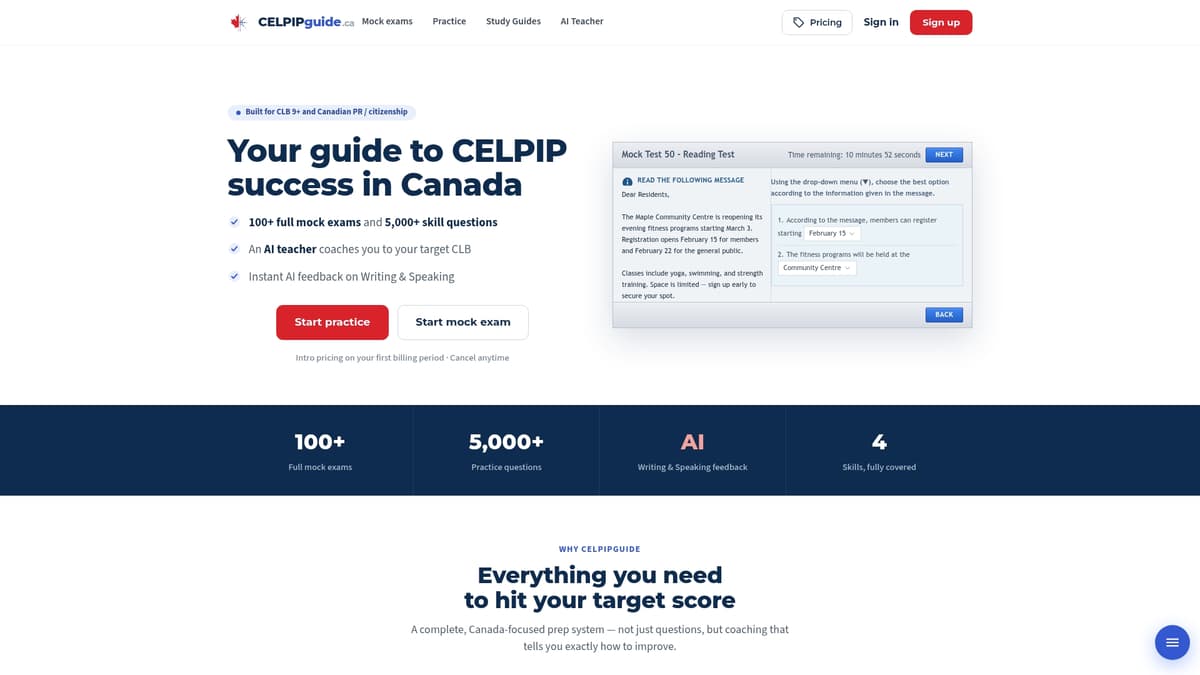
CELPIPguide’s readiness check does more than test your language skills. It’s built to simulate real test-day conditions, including timing pressure and task flow, so the actual exam room feels familiar rather than stressful. Because it flags gaps early, including administrative details like registration information that doesn’t line up cleanly, it catches the kind of small errors that otherwise surface for the first time at check-in.
Pair that with full-length mock exams that mirror real test timing across all four skills, and you walk in on test day having already rehearsed the experience once.
Sources
Always verify your specific situation against CELPIP’s own published pages, since policies can be updated and your circumstances (immigration status, test type, province) affect which rules apply to you.
- Language requirements — IRCC operational guidance
- Immigration, Refugees and Citizenship Canada (IRCC)
FAQ
What ID do I need to bring to my CELPIP test?
Bring the original, unexpired, government-issued photo ID you used when you registered, such as a passport, Canadian PR card, or citizenship card with a photo. Photocopies and digital versions are never accepted.
Is a CELPIP score valid for 3 years?
Yes, CELPIP test results are generally valid for two years from the test date for most immigration purposes, so check the specific validity period listed on your score report and confirm current requirements with IRCC for your application type.
How much CELPIP score equals CLB 4?
CLB 4 corresponds to specific score bands across CELPIP’s four skills, and the exact numeric ranges are listed on CELPIP’s official scoring pages, so check your score report against CELPIP’s FAQs for the precise conversion tied to your test type.
What CELPIP score is required for permanent residence?
Required CLB levels for permanent residence vary by immigration program and category, so confirm the exact benchmark for your specific application on the IRCC language requirements page rather than assuming one score fits every pathway.
Is a CELPIP score of 7 considered good?
A CELPIP score that meets CLB 7 typically meets many federal skilled worker and citizenship thresholds, though whether it’s “good enough” depends entirely on which program or benchmark you’re applying against.
Can I use a driver’s licence as my only ID for CELPIP?
Some Canadian test centres accept provincial driver’s licences, but acceptance varies by location, so confirm directly with your specific test centre or through CELPIP’s test day page before relying on it as your sole document.