
CELPIP Blog
What is a computer-delivered English test for IELTS takers
What is a computer-delivered English test for IELTS takers
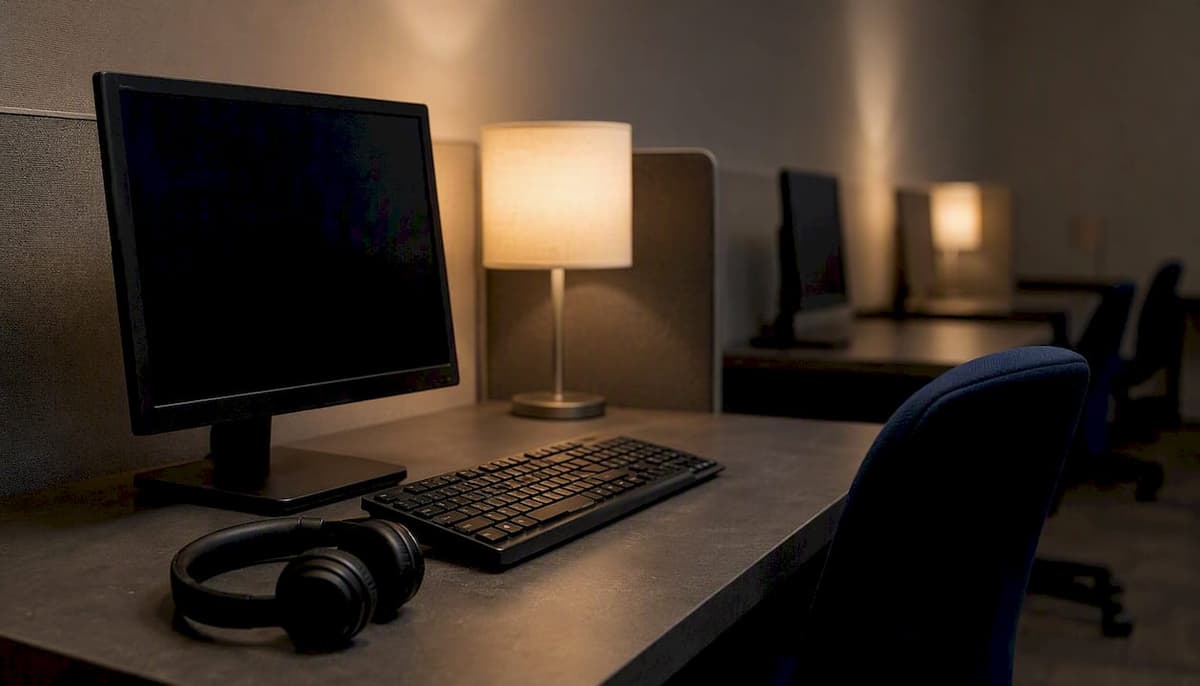
A computer-delivered English test is an official English proficiency exam where you complete the Listening, Reading, and Writing sections on a computer at an authorised test centre. The Speaking section remains face-to-face with a trained examiner. Both British Council and IDP Education offer this format across Canada, and it carries the same IELTS certification as the paper version.
The three computer-delivered sections are:
- Listening — you hear the audio through headphones and type answers directly into on-screen boxes
- Reading — you navigate passages on screen and select or type your responses
- Writing — you compose both tasks in a text editor with a visible word count
Speaking is scheduled either on the same day or separately and is always conducted in person with an examiner.
Table of Contents
- What each section looks like on a computer
- How does computer-delivered IELTS differ from the paper test?
- Booking, results timing, and acceptance in Canada
- Key takeaways
- The computer format rewards preparation, not luck
- Celpipguide can help you prepare for computer-style exam conditions
- Useful sources
- FAQ
What each section looks like on a computer
Listening
You hear each recording once through headphones and type your answers directly into labelled on-screen boxes. Because there is no separate transfer time, the section ends when the audio ends. A short review window lets you check your answers before moving on.
Pro Tip: Keep your eyes on the question, not the keyboard. Practise typing short answers without looking down so you do not miss the next question cue in the audio.
Reading
Passages appear on the left side of the screen; questions appear on the right. You can scroll within each passage, use the on-screen highlight tool to mark key phrases, and navigate between questions using forward and back arrows. There is no need to flip physical pages, which many candidates find faster once they are comfortable with the layout.
Writing
Both Writing tasks appear in a text editor with an answer box. A live word count updates as you type, so you always know where you stand against the minimum word targets. Auto-save runs in the background throughout.
Pro Tip: Spend the first 60 seconds of each Writing task planning your response before you type. The word count is visible, but planning time is not shown separately, so build that habit in practice.
Speaking
Speaking is not computer-delivered. You sit with a certified examiner in a private room, and the conversation is recorded for quality assurance. The marking criteria and band descriptors are identical to the paper test.
How does computer-delivered IELTS differ from the paper test?
The content and scoring are identical. IDP confirms that both formats use the same questions, marking criteria, and band scale. The differences are practical:
| Feature | Computer-delivered | Paper-delivered |
|---|---|---|
| Listening answers | Typed directly on screen | Written on question paper, then transferred |
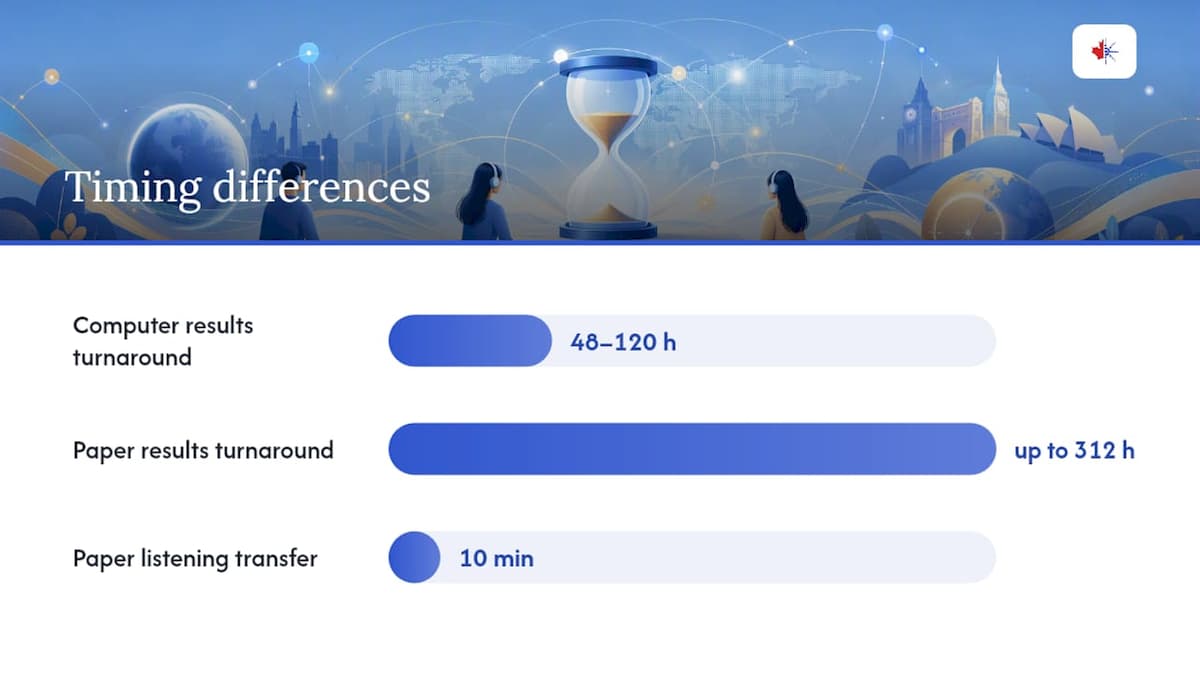
| Listening transfer time | None | 10 minutes |
| Reading navigation | On-screen scroll and arrows | Flip physical pages |
| Writing | Typed in answer box with word count | Handwritten |
| On-screen tools | Highlight, notes, timer, auto-save | Pencil and paper notes |
| Results turnaround | Commonly 48 hours to 5 days | Typically up to 13 days |
| Test date frequency | Often daily, multiple sessions per day | Less frequent |
A common question is whether one format is easier. The honest answer: neither is. The tasks, timing, and scoring are the same. The difference is how you interact with the material. Candidates who type comfortably and feel at ease navigating on screen tend to prefer the computer format. Those who think better with a pen in hand sometimes prefer paper. Choose based on your own working style, not on a belief that one version is marked more generously.
From 1 May 2025, the paper test no longer permits pencils in some jurisdictions, so even paper-test logistics have shifted.
Booking, results timing, and acceptance in Canada
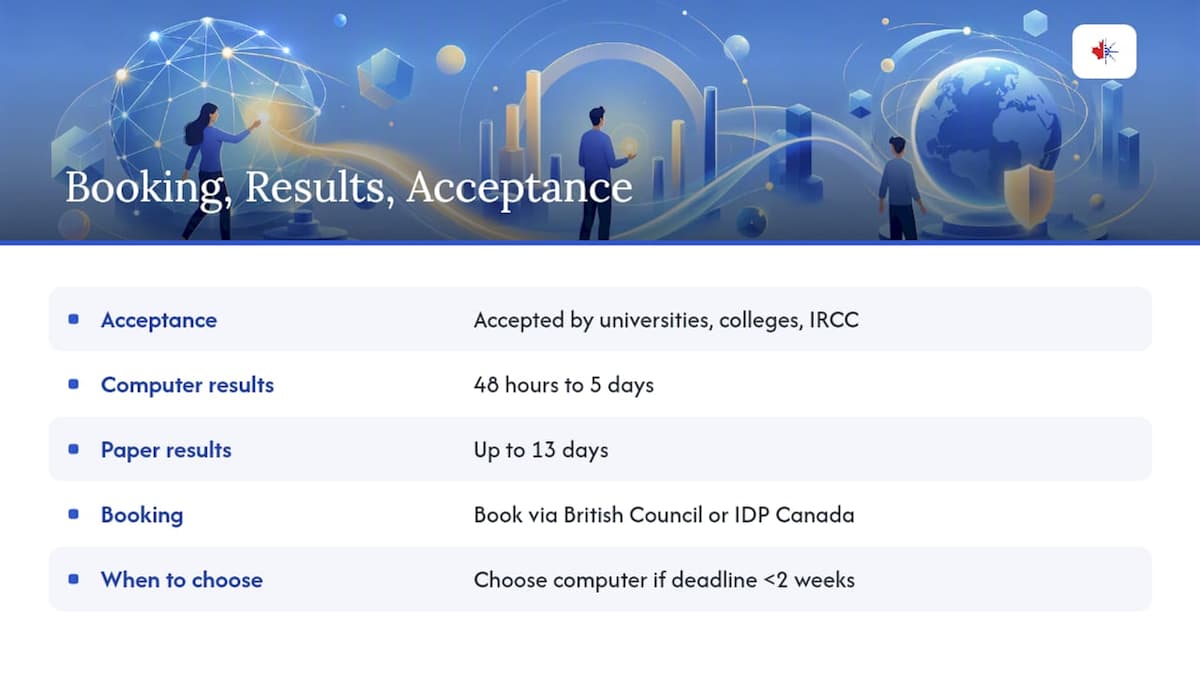
Computer-delivered IELTS is accepted by Canadian universities, colleges, and immigration authorities including Immigration, Refugees and Citizenship Canada (IRCC). IELTS.org confirms that the digital format is valid for admissions and immigration purposes, though you should always verify specific requirements with your institution or visa category.
Results arrive faster than paper: IDP reports a typical turnaround of 48 hours to 5 days, compared with up to 13 days for paper. Test dates are also more flexible. British Council notes that some centres offer test sessions frequently throughout the week, often multiple times per day.
To book, visit the British Council Canada or IDP Canada websites, select a test centre near you, and choose from available computer-delivered slots. The test is always taken at an official centre, not from home.
Pro Tip: If you have a visa application or program deadline within two weeks, the computer-delivered option is the safer choice. The faster results window gives you time to request a re-mark or book a second sitting if needed.
Key takeaways
Computer-delivered IELTS delivers Listening, Reading, and Writing on a computer at an official test centre, with Speaking remaining face-to-face, and results typically arrive within 48 hours to 5 days.
| Point | Details |
|---|---|
| Sections on computer | Listening, Reading, and Writing are computer-delivered; Speaking stays face-to-face. |
| Same scoring as paper | Content, marking criteria, and band scale are identical across both formats. |
| Faster results | Results typically arrive faster than paper tests, which generally take longer to process. |
| More test dates | Many centres offer sessions daily with multiple sittings, giving greater scheduling flexibility. |
| Practise on-screen tools | Run at least one official familiarisation test and one full timed mock before test day; Celpipguide’s mock exams replicate timed exam conditions. |
The computer format rewards preparation, not luck
Most candidates who struggle with computer-delivered IELTS are not struggling with English. They are struggling with the interface. The highlight tool, the on-screen navigation, the rhythm of typing answers while audio plays — these are learnable skills, and they respond quickly to deliberate practice.
My recommendation is straightforward: if you need results fast or your schedule is tight, the computer format is the practical choice. More dates, faster turnaround, and the auto-save safety net make it the lower-risk option for time-sensitive applications. If you genuinely think better with a pen, paper is still valid and equally accepted. But do not choose paper simply because the computer feels unfamiliar. Familiarity is something you build in an afternoon with a familiarisation test.
The candidates who do best are the ones who treat the interface as part of the test itself, not just a delivery mechanism. Practise the tools. Time yourself. Know where the help button is. That preparation is what separates a confident test day from a stressful one.
Celpipguide can help you prepare for computer-style exam conditions
Timed, on-screen mock exams are the fastest way to close the gap between knowing English and performing under computer-delivered exam conditions. Celpipguide offers over 100 full-length mock exams that replicate timed test conditions, plus skill-level practice tasks for targeted rehearsal in Listening, Reading, and Writing. An AI teacher reviews your Writing and Speaking responses with instant rubric-based feedback, so you know exactly what to fix before test day.
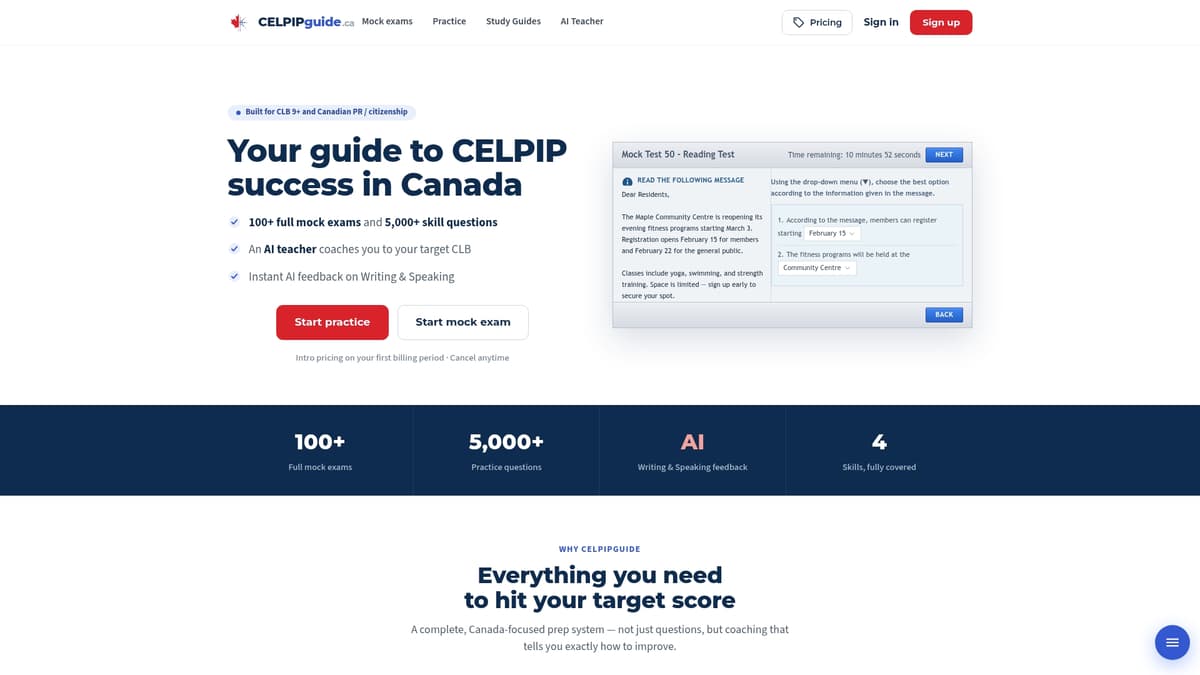
For candidates preparing for Canadian immigration or admissions, Celpipguide also includes a personalised study plan generator that maps your weak areas to a week-by-week schedule. Use coupon BLG30 at checkout for 30% off any plan. Start your free practice session and see where you stand before you book your test.
Useful sources
- IELTS computer vs paper: All you need to know — IELTS test in Canada | British Council
- IELTS Computer And Paper Differences | IDP IELTS Canada
- FAQ on IELTS on Computer | IELTS IDP Canada
- IELTS on Computer with British Council | IELTS Computer Based
- Features of IELTS on Computer | IELTS IDP Canada
- Take IELTS Academic online (IELTS.org)
FAQ
How does the IELTS computer-delivered test work?
You complete Listening, Reading, and Writing at a dedicated workstation in an official test centre, typing answers directly on screen. Speaking is conducted face-to-face with an examiner and is scheduled on the same day or separately.
Is computer-delivered IELTS easier than the paper test?
No. The questions, timing, and band-score criteria are identical for both formats. Your result depends on your English proficiency, not the delivery mode.
Is computer-delivered IELTS accepted in Canada?
Yes. Canadian universities, colleges, and immigration authorities including IRCC accept computer-delivered IELTS results. Always confirm specific score requirements directly with your institution or visa category.
What is the difference between paper and computer-delivered IELTS?
The main differences are how you enter answers (typing vs handwriting), the absence of a Listening transfer period on computer, results turnaround (48 hours to 5 days vs up to 13 days for paper), and the frequency of available test dates.
Where can I practise for the computer-delivered format?
Use the official familiarisation tests on the British Council Canada or IDP Canada websites to learn the interface. Celpipguide’s full mock exams and skill-level practice tasks let you rehearse under timed, on-screen conditions.