
CELPIP Blog
Mock exam practice strategy: a student's 2026 guide
Mock exam practice strategy: a student’s 2026 guide

The most effective mock exam practice strategy for students combines timed, full-length practice under real exam conditions with deliberate, structured review of every mistake. Passive rereading after a test does almost nothing. What actually moves the needle is active recall during practice, followed by targeted re-testing of weak areas within 24–48 hours. Here is the short version of what works:
- Practise under real exam conditions every time: timed, quiet, no notes unless the actual exam allows them
- Mark your work within 10–15 minutes of finishing, then categorise every error by type
- Re-solve missed questions from scratch, without peeking at the answer, to build genuine understanding
- Re-test those weak areas within a couple of days to lock in the learning through spaced repetition
- Schedule mock tests regularly throughout your study plan, not just in the final week
How to plan your mock exam practice schedule
Good results start with a plan you can actually stick to. Before you sit a single mock test, write out a study calendar that maps your available weeks against the topics you need to cover. Assign more time to your weaker areas and less to subjects you already handle well. A realistic calendar prevents the last-minute panic that pushes students toward cramming, which consistent daily practice consistently outperforms.
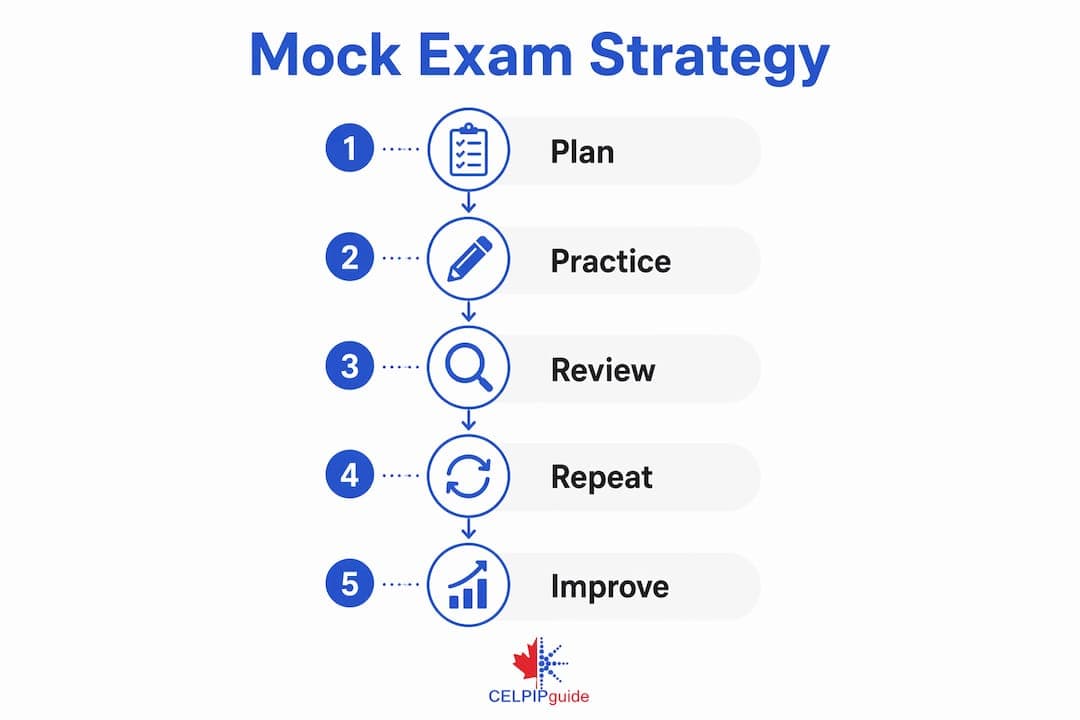
When you build that calendar, treat your mock tests as fixed appointments, not optional extras. Space them out so you have time to review and re-study between each one. A rough pattern that works well: study a topic block, sit a timed mock, review it thoroughly, address the gaps, then sit another mock before moving on.
Your study environment matters more than most students expect. A dedicated, quiet space with your phone out of reach and a timer running replicates the pressure of the real exam. That pressure is actually useful: retrieving answers under pressure through regular mock practice builds durable memory and reduces anxiety on the actual test day.
- Set one specific, measurable goal per study session (e.g., “score above 70% on the reading section”)
- Block rest days into your calendar; mental fatigue kills retention faster than any knowledge gap
- Review new material in the days before a mock, then switch to light revision the night before
- Keep your mock test conditions identical each time: same desk, same time of day, same materials
Pro Tip: Start a “Mistake Notebook” from day one. After every mock, log each error with the question type, the mistake you made, and the correct approach. Reviewing this notebook before your next mock is one of the highest-return habits you can build, because it focuses your review on your actual weaknesses rather than topics that already feel comfortable.
Study techniques and test-taking strategies that actually work
The single biggest mistake students make with mock exams is skipping the review phase. Without a thorough review, a mock test is just a confidence check. With one, it becomes your most powerful study tool.
Before the mock
Take a practice exam before you have fully studied a topic. Research on the generation effect shows that attempting questions first activates prior knowledge and makes the subsequent study session stick better. You will not score well, and that is fine. The point is to prime your brain.
Focus your preparation on past papers and official practice questions from your specific exam board. Generic study materials are useful, but nothing replaces the actual question style and format you will face. Use official mark schemes to grade your own answers; understanding examiner expectations through those schemes is what separates a good answer from a top-scoring one.
During the mock
Apply the 3-Pass Rule to every timed exam. On the first pass, answer every question you find straightforward. On the second pass, tackle the medium-difficulty ones. Leave the hardest questions for the third pass if time allows. This approach, recommended by McGill University’s academic support team, prevents you from losing easy marks because you spent twelve minutes on one difficult question.

Learn your exam’s command words cold. “Analyse,” “evaluate,” “describe,” and “explain” each require a different type of answer. Misreading a command word is one of the most common reasons students lose marks on questions they actually understand.
After the mock
Re-solve every question you got wrong, without looking at the solution first. Rereading a corrected answer creates the illusion of understanding. Working through the problem again from scratch confirms it. Then, within 24–48 hours, re-test yourself on those specific concepts using new questions on the same topic.

Avoid comparing your scores with classmates. Your mock results are diagnostic data for you, not a competition. Focusing on your own error patterns is far more productive than measuring yourself against someone else’s baseline.
Pro Tip: Identify the two or three topic areas that appear most frequently in your exam’s past papers. Prioritise those in your study plan. High-frequency topics carry more weight, and improving on them moves your overall score faster than spreading effort evenly across everything.
Mental preparation and managing exam day
Anxiety before a mock exam is normal, and it is actually useful in small doses. The goal is not to eliminate nerves but to keep them from interfering with your performance. Breathing exercises are one of the fastest tools available: breathe in for four counts, hold for two, and breathe out for seven. Repeating this a few times before you start lowers your stress response noticeably.
Sleep and nutrition are not optional extras. A well-rested brain retrieves information faster and makes fewer careless errors. Aim for a consistent sleep schedule in the week before a major mock, and eat a proper meal beforehand. Avoid last-minute cramming the night before; a light review of your Mistake Notebook is enough.
Physical preparation cues help more than most students realise. Sitting at a proper desk, wearing the clothes you would wear to an actual exam, and removing your phone from the room all signal to your brain that this is a serious test. These cues help trigger what you might call “test-mode” thinking, and they make the transition to the real exam feel familiar rather than jarring.
- Prepare all your materials the night before: pens, ID, water, any permitted resources
- Read all instructions carefully at the start of the exam before writing a single word
- Start with the questions you find easiest to build momentum and settle your nerves
- If you get stuck, move on and return to the difficult question later rather than freezing
- After the mock, do a brief reflection on what went well, then let it go. Dwelling on mistakes between sessions drains energy you need for the next round of study
How Celpipguide helps Canadian students prepare for their exam
For students preparing for the CELPIP exam specifically, Celpipguide is built around exactly the kind of deliberate, structured practice this guide describes. The platform offers over 100 full mock exams and 5,000 practice questions, all aligned to CEFR language standards, so every session you complete maps directly to the CLB benchmarks that matter for Canadian immigration and citizenship.
What sets Celpipguide apart from generic preparation methods is the AI teacher at its core. Rather than leaving you to guess at your weaknesses, the AI analyses your performance and builds a personalised study plan that targets the specific areas holding your score back. Students who use personalised, targeted preparation consistently see faster score improvements than those working through undifferentiated practice material.
The platform’s timed exam simulations replicate real CELPIP conditions closely, which reinforces the exam-condition practice habit described throughout this guide. Instant feedback on writing and speaking tasks means you do not have to wait days to understand where your answer fell short. Combined with a diagnostic test at the start and a vocabulary builder woven through the programme, Celpipguide gives you a complete system rather than a collection of disconnected resources.
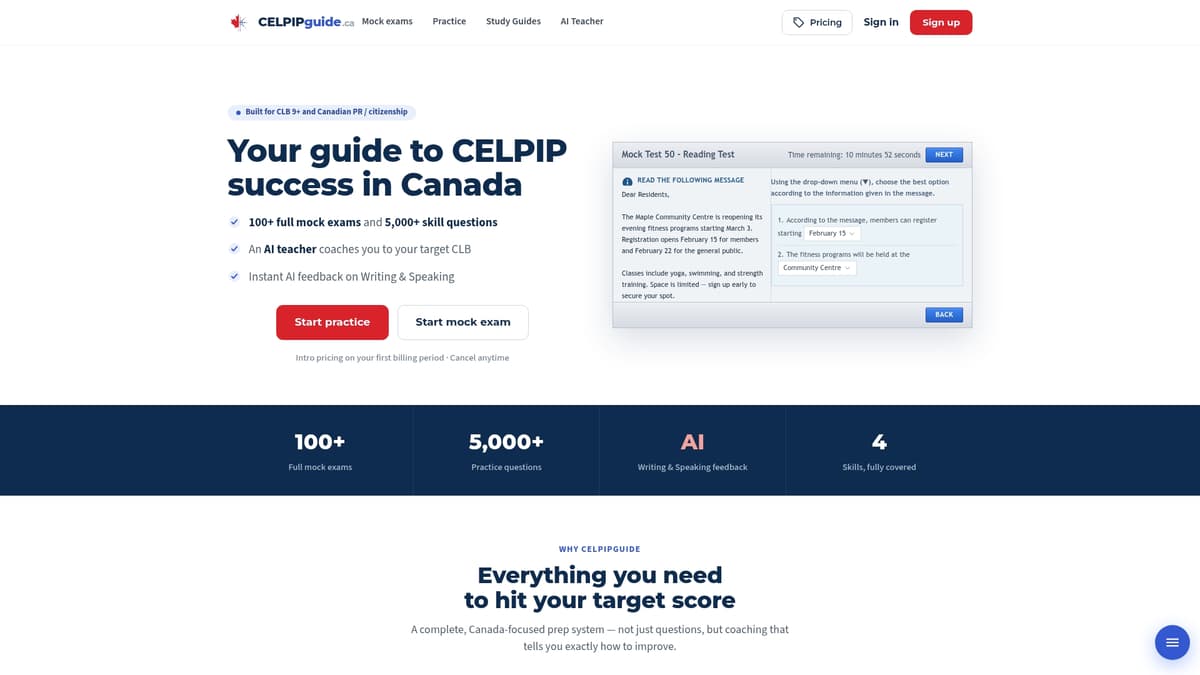
Start with Celpipguide’s diagnostic test and practice hub to get a clear baseline, then use the AI-generated study plan to direct your mock exam sessions. Pair that with the error-review habits in this guide and you have a preparation system that builds both skill and confidence before exam day.
Key takeaways
Consistent, timed mock exam practice combined with structured error review and spaced repetition is the most reliable path to measurable score improvement.
| Point | Details |
|---|---|
| Practise under real conditions | Timed, quiet, distraction-free sessions replicate exam pressure and build durable memory. |
| Review within 10–15 minutes | Marking your work promptly and categorising errors sharpens targeted improvement. |
| Re-test weak areas within a couple of days | Spaced repetition within this timeframe solidifies learning and prevents knowledge gaps from recurring. |
| Use the 3-Pass Rule during exams | Answer easy questions first, then medium, then hard to avoid losing marks on simpler items. |
| Personalise with Celpipguide | Over 100 mock exams and AI-driven study plans help CELPIP candidates target individual weaknesses efficiently. |
FAQ
What is the 1-3-5-7 rule for studying?
The 1-3-5-7 rule is not a single standardised framework; definitions vary across study guides. A common version refers to spacing review sessions at increasing intervals within a few days after first learning material, which aligns with spaced repetition principles.
How do you practise effectively for a mock test?
Sit the mock under real exam conditions, timed and without notes, then mark your work within 10–15 minutes and re-solve every question you got wrong from scratch before checking the solution.
What is the 3-2-1 method for studying?
The 3-2-1 method typically involves writing down several things you learned, a few things you found interesting, and questions you still have after a study session. It is a reflection tool rather than a full exam preparation strategy.
Is two weeks enough time to prepare for mocks?
Two weeks is enough to make a meaningful difference if you practise daily with timed mock tests, review errors immediately, and re-test weak areas within 24–48 hours. The key is focused, deliberate practice rather than covering large volumes of material passively.