
CELPIP Blog
Canada's CELPIP Reevaluation: Policy, Real Odds, and When $55 Helps
Canada’s CELPIP Reevaluation: Policy, Real Odds, and When $55 Helps

A CELPIP re-evaluation is worth the fee if you missed a Speaking or Writing band by one point and genuinely believe your performance deserved higher marks. You have six months from your test date to request it, only Speaking and Writing get re-scored by a human, and each section costs roughly $55 CAD, refunded if your score goes up. If you finished every task, stayed on topic, and answered within the time limits, a re-evaluation is low risk. If you rushed, ran out of time, or skipped a task, a retake will serve you better.
TL;DR:
- Re-evaluations are primarily effective if you are exactly one band short on Speaking or Writing and have completed all test tasks properly.
- Most successful re-evaluations result in score increases or no change, with very few reports of score decreases occurring.
- The process costs around $55 CAD per section, takes one to two weeks technically, but results often arrive within a week, and timing is crucial for deadline management.
- If your application deadline is within two weeks, a retake may be more reliable than waiting for a re-evaluation outcome.
- Running a diagnostic practice test and using AI scoring tools beforehand can help determine whether a re-evaluation is worth pursuing or if a retake would be more effective.
Table of Contents
- What does the official CELPIP re-evaluation policy actually allow?
- What can actually change, and what’s the real risk?
- How much does a CELPIP re-evaluation cost and take?
- What do real CELPIP re-evaluation results actually look like?
- Re-evaluation or retake: how do you decide?
- How do you submit a CELPIP re-evaluation request?
- Why do CELPIP re-evaluation results sometimes differ from the original score?
- CELPIPguide’s view: validate before you pay
- Practical tools to boost your score before a retake
- Where to verify CELPIP re-evaluation policy and timing
- Sources
- FAQ
What does the official CELPIP re-evaluation policy actually allow?
CELPIP’s re-evaluation policy is narrower than most test-takers assume, and knowing the boundaries saves you from paying for something that can’t change.
You have six months from your test date to request it, and the request goes through your CELPIP registration account on the Paragon Testing portal, not by email or phone. That window is firm. Miss it, and your only option is a fresh test.
The policy also draws a hard line between components. Reading and Listening are computer scored, so there’s no human judgment to revisit and no realistic path to a different result. Speaking and Writing are the only sections CELPIP re-scores by hand, which is why every serious re-evaluation conversation centres on those two skills.
A few operational details matter when you’re planning:
- You can request re-evaluation for one component or both, but each is billed and processed separately.
- You’re limited to one re-evaluation request per test sitting, so there’s no second attempt on the same result.
- Fee amounts can shift, so check the current rate on your registration account before submitting.
- The request applies only to the specific test date in question, not to past attempts.
What can actually change, and what’s the real risk?
A re-evaluation moves your score in one of two directions: it goes up or it stays the same. Crowdsourced reports collected from forums and test-taker communities show no confirmed cases of a re-evaluation lowering a score, though CELPIP’s written policy doesn’t explicitly rule it out, so treat “scores can’t drop” as a strong pattern, not a guarantee.
The pattern that shows up again and again: aggregated reports on re-evaluation outcomes show most publicly shared results were either an increase or no change at all, with decreases essentially absent from the sample.
The refund mechanic is straightforward. If your re-evaluated component’s band level goes up, Paragon refunds that section’s fee automatically. If it stays the same, you don’t get the money back, but you also don’t lose ground.
The real risk isn’t a lower score. It’s timing:
- A two-week turnaround can collide with an application deadline if you request too close to a cutoff date.
- Waiting to see if you “feel like” requesting one can eat into your six-month window.
- If your PR or citizenship file is time-sensitive, a retake booked immediately might beat waiting on a re-evaluation.
How much does a CELPIP re-evaluation cost and take?
Budget around $55 CAD per section, plus applicable tax. Requesting both Writing and Speaking roughly doubles that, so confirm the exact current rate on your account before paying, since fees do get adjusted over time.
Officially, CELPIP quotes one to two weeks for a re-evaluation result. In practice, many test-takers report getting updated scores in under a week. Still, plan around the official window, not the fastest anecdote you’ve read, especially if an application deadline is involved.
A short checklist before you submit:
- Confirm your test date falls within the six-month eligibility window.
- Check your target deadline and subtract two full weeks as a buffer.
- Decide now whether you’re requesting one component or both, since each is billed separately.
- Save your payment confirmation and note the submission date for your own records.
Pro Tip: If your immigration deadline is inside that two-week buffer, don’t gamble on re-evaluation. Book a retake instead. A retake gives you a guaranteed new score on a fixed schedule; a re-evaluation gives you a possible improvement on an uncertain one.
What do real CELPIP re-evaluation results actually look like?
Official CELPIP materials don’t publish aggregate re-evaluation statistics, so the closest thing test-takers have to real-world odds comes from crowdsourced reports scraped from Reddit threads and independent blogs. Treat these as directional, not definitive.
Across the reports compiled by CelpipSpeaking’s aggregated analysis, the most common outcome was a one-band increase in either Writing or Speaking, with a smaller cluster reporting two- or three-band jumps and another meaningful share reporting no change at all.
A few patterns worth knowing before you decide:
- Reported increases were almost exclusively in Speaking and Writing, matching the policy’s own scope.
- Reading and Listening changes were rare to nonexistent in the samples reviewed, which lines up with those sections being computer scored.
- Turnaround anecdotes clustered around two to five days for many test-takers, with some cases stretching closer to the official two-week mark.
The caveat matters as much as the numbers. People who post about re-evaluations online tend to be the ones who got a favourable result, or who felt strongly enough to write about a frustrating one. That self-selection means the real population of outcomes could look somewhat different from what shows up in public threads. Use these reports to calibrate expectations, not to guarantee an outcome.
Re-evaluation or retake: how do you decide?
Work through this in order. Each step either confirms re-evaluation is your move or points you toward a retake instead.
- Check the gap. Are you exactly one band short of your target on Speaking or Writing, and only those two skills? If you’re two or more bands away, or the shortfall is in Reading or Listening, re-evaluation won’t help.
- Review your own performance honestly. Did you complete every task in Speaking and Writing within the time given? An unfinished task or a skipped question almost always caps your score regardless of quality, and no re-evaluation fixes that.
- Check your deadline math. Can your application timeline absorb a one to two week wait? If your CRS submission or citizenship deadline is inside that window, book a retake now rather than gamble on turnaround speed.
- Run a quick diagnostic if you’re unsure. Re-record your Speaking answers, or rewrite your Writing responses cold, and compare them against sample band descriptors. If your redone version looks meaningfully stronger than what you submitted, that’s a signal you were likely underscored. A tool like Celpipguide’s writing checker can give you an instant reference point against CLB-aligned criteria.
- Weigh the cost against the retake price. A re-evaluation at roughly $55 CAD per section is far cheaper than a full retake, so when in doubt on a single-band gap, re-evaluation is the lower-cost bet.
Pro Tip: Use the CELPIP score calculator to see exactly how one extra band on Speaking or Writing shifts your CLB level and CRS points before you spend anything. Sometimes the gap you’re chasing doesn’t move your immigration outcome at all, and that changes the math entirely.
If you finish this checklist and you’re still not confident your performance matched your target band, that’s a real signal too, just pointing the other way: toward focused practice and a retake rather than a re-evaluation gamble.
How do you submit a CELPIP re-evaluation request?
The process itself is short. Here’s the sequence:
- Sign in to your account at celpip-registration.paragontesting.ca using the same credentials from your test booking.
- Locate the re-evaluation option under your completed test result and select whether you want Speaking, Writing, or both re-scored.
- Pay the fee for each component you select and download or screenshot your payment confirmation immediately.
- Record your submission date somewhere you’ll actually check it, since that date determines when your one to two week window starts.
- Watch your email and account inbox for the updated result notification, which typically arrives faster than the official estimate suggests.
- Check for a refund if your score increases. Paragon processes this automatically to your original payment method, but it can take a billing cycle to appear, so don’t panic if it’s not instant.
Keep your confirmation email until the whole process closes out. If something goes sideways with a refund or a missing notification, that record is your only proof of submission date and payment.
Why do CELPIP re-evaluation results sometimes differ from the original score?
CELPIP’s scoring model explains why a second look at Speaking or Writing can land differently than the first. Paragon Testing Enterprises trains and certifies raters against standardized rubrics tied to Canadian Language Benchmarks, but human scoring still carries some judgment, especially near a band boundary.
A few things worth understanding about how this works:
- Re-evaluation requests are typically reviewed by a senior rater, separate from whoever scored your original response.
- Borderline responses, ones sitting right between two band levels, are the most likely to shift under a second review.
- Rater training and calibration exercises are designed specifically to reduce this variation, but they can’t eliminate it entirely when a response genuinely sits on a line.
- This is precisely why re-evaluation exists as a formal option rather than an informal complaint process. The system acknowledges that borderline calls happen and builds in a structured way to revisit them.
If your response was clearly strong or clearly weak, a second rater is unlikely to see it differently. The value of re-evaluation concentrates almost entirely on that narrow band of borderline performances.
CELPIPguide’s view: validate before you pay
Here’s what I’d tell a friend: don’t pay for a re-evaluation on a hunch. Run a diagnostic mock test and get AI feedback on your Writing and Speaking tasks first. If your practice results consistently land at the band you’re hoping for, a re-evaluation is a smart, low-risk move. If they don’t, that fee is better spent on focused prep and a retake.
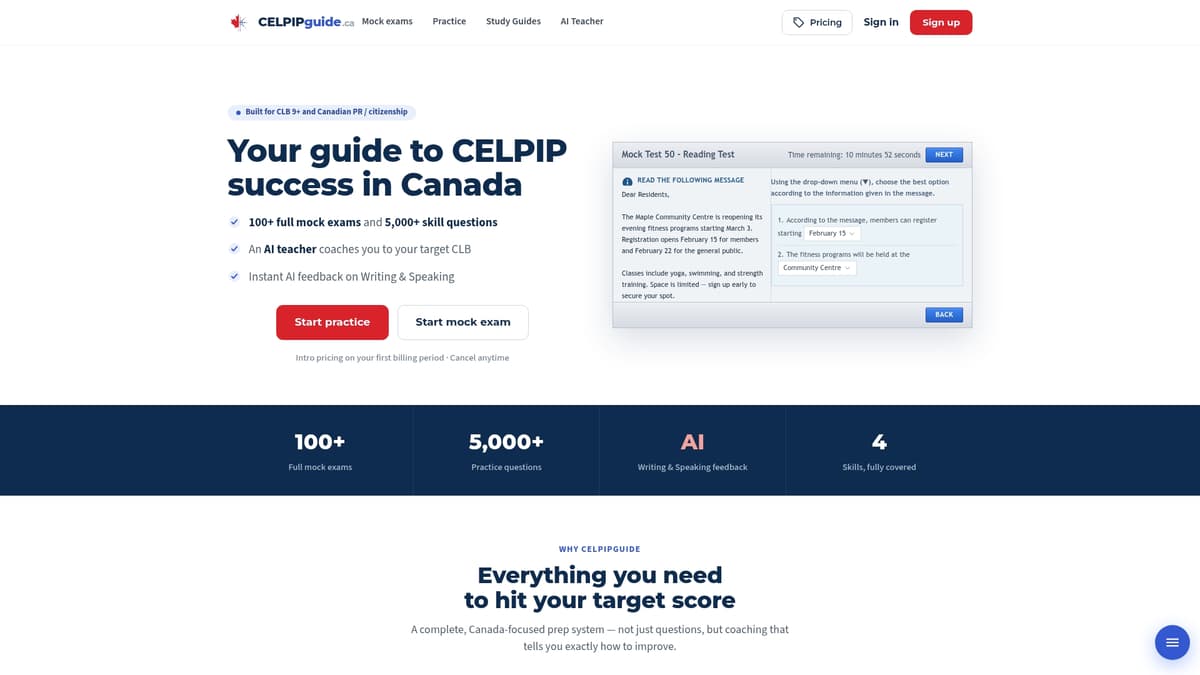
Start with Celpipguide’s exam practice hub to see where you honestly stand.
— Reza
Practical tools to boost your score before a retake
If your diagnostic points to a retake instead of a re-evaluation, there are resources available that give you a faster, cheaper path than booking blind and hoping. Instead of guessing which skill cost you the band, you get a direct readout of what to fix and a plan to fix it before your next attempt.
Start with the CELPIP exam practice hub for full-length mock exams that mirror the real test format. Pair that with the CELPIP study plan generator to build a week-by-week plan targeting your weakest skill, and use the AI feedback tools to get instant, rubric-based scoring on your Writing and Speaking responses instead of waiting weeks to find out where you stand. Head to the exam practice hub now to book your next mock test and see your real band before you commit to a retake.
Where to verify CELPIP re-evaluation policy and timing
For anything time-sensitive or fee-related, go to the source rather than a secondhand summary.
- CELPIP registration portal is where you submit the actual re-evaluation request and where the six-month window is enforced.
- Government of Canada language proof guidance explains how your CELPIP result maps to Canadian Language Benchmarks for citizenship purposes.
- Express Entry program page outlines how language scores factor into permanent residence applications.
Sources
- CELPIP registration — Paragon Testing Enterprises
- Language proof for Canadian citizenship — Government of Canada
FAQ
How many days does a CELPIP re-evaluation take?
CELPIP officially states one to two weeks, but many test-takers report results within a few days. Plan around the two-week window if you have a hard deadline.
How do I request a CELPIP re-evaluation?
Sign in to your CELPIP registration account, select the re-evaluation option for your completed test, choose Speaking, Writing, or both, and pay the fee.
How much is the CELPIP re-evaluation fee?
The fee is roughly $55 CAD per section, plus applicable tax, so requesting both Speaking and Writing costs about double.
Can a CELPIP re-evaluation lower your score?
Aggregated test-taker reports show no confirmed cases of scores decreasing, with outcomes limited to an increase or no change, though this pattern isn’t an official guarantee.
Should I request a re-evaluation or just retake CELPIP?
Choose re-evaluation if you missed your target by exactly one band on Speaking or Writing and completed every task fully; choose a retake if the gap is wider or your deadline can’t absorb the wait. A quick diagnostic through a tool like Celpipguide’s writing checker can help you decide with more confidence.