
CELPIP Blog
Why formal tone matters in CELPIP writing
Why formal tone matters in CELPIP writing

TL;DR:
- Formal tone in CELPIP writing involves using professional, precise language that matches the social context. Mastering tone calibration is essential for achieving higher scores and demonstrating social awareness in Canadian settings.
Formal tone in CELPIP writing is defined as the deliberate use of professional, objective, and grammatically precise language that matches the social context of the task. Understanding why formal tone matters in CELPIP writing is the single most direct path to higher scores, because examiners assess your ability to communicate appropriately in Canadian professional and institutional settings. Achieving CLB 9+ requires a precisely calibrated formal tone matched to the task and relationship. That calibration signals linguistic maturity, not just grammar knowledge. Formal writing functions like a dress code: it establishes professional boundaries and demonstrates social awareness in Canadian workplace contexts.
Why formal tone matters in CELPIP writing tasks
Formal tone is not simply about sounding polished. It is about showing examiners that you understand who you are writing to, why you are writing, and what register that relationship demands. CELPIP writing tasks place you in real Canadian scenarios: emailing a landlord, responding to a workplace survey, or addressing a community concern. Each scenario carries a social context, and your tone must match it.

The role of formal writing in your CELPIP score is direct. Examiners use scoring rubrics that assess tone as a distinct category alongside vocabulary, grammar, and coherence. Candidates who write casually in a formal task lose marks not because their grammar is wrong, but because their register is wrong. That is a costly and avoidable mistake.
Examiners look for consistent, appropriate tone as a signal of linguistic maturity and the ability to handle professional Canadian scenarios. This matters especially for immigration candidates, where high CLB ratings are tied directly to permanent residency eligibility.
What are the key features of a formal tone?
Formal tone has specific, identifiable characteristics. Once you know what to look for, you can check your own writing against this list before you submit.
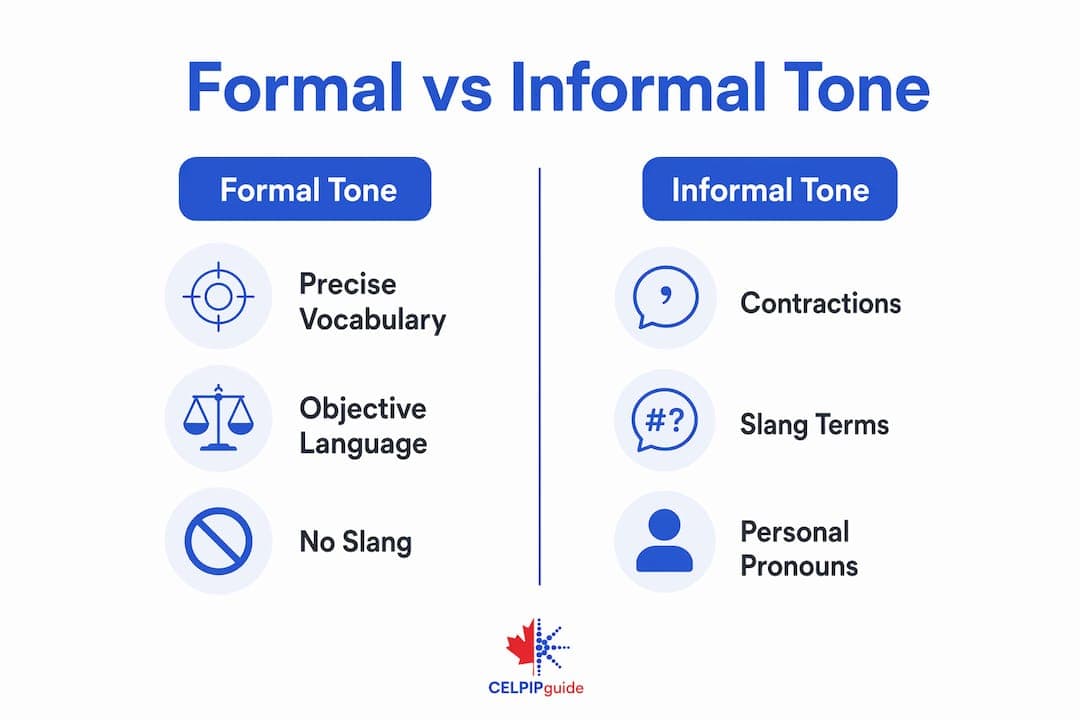
- Professional vocabulary. Choose precise words over casual ones. Write “I would like to request” instead of “I want to ask.”
- No contractions. Write “do not” instead of “don’t,” and “I am” instead of “I’m.” Using complete words contributes directly to a formal tone.
- Avoid slang and colloquial phrases. Phrases like “kind of,” “a lot,” or “you know” signal informality and lower your register.
- Limit personal pronouns. Avoiding personal pronouns and slang creates professional distance, allowing your argument to rely on evidence rather than emotion.
- Objective and neutral language. Avoid emotional outbursts or exaggerated claims. Write “This situation has caused significant inconvenience” rather than “This is absolutely terrible.”
- Grammatical accuracy. Errors in subject-verb agreement, tense, or punctuation undermine your credibility even when your ideas are strong.
- Clear sentence structure. Formal writing favours direct, complete sentences over fragments or run-ons.
Pro Tip: Before you submit your CELPIP writing task, read it aloud. If a sentence sounds like something you would say to a friend at a coffee shop, rewrite it. Formal writing should sound like something you would say to a manager or a government official.
Formal tone is less about rigid rules and more about demonstrating social awareness. Academic and professional writing requires an objective and persuasive tone that avoids first and second person pronouns, slang, and vague language. That combination of clarity and authority is exactly what CELPIP examiners reward.
How does formal tone impact your CELPIP score?
The connection between formal tone and your CELPIP score is not subtle. Tone is a marked category in the writing rubric, and ignoring tone is one of the most common mistakes that lower scores in Writing Task 1. Candidates often focus entirely on grammar and vocabulary, then lose marks because their email to a property manager reads like a text message to a friend.
“Better CELPIP scores come more from vocabulary range, structural variety, and precise tone calibration than from grammar drills alone. Advanced collocations and stylistic control improve impressions of professionalism.” — CELPIP CLB Scoring Decoded
This is a significant insight. Grammar practice alone will not get you to CLB 9. Tone calibration, which means choosing the right register for the right audience, is what separates a CLB 7 response from a CLB 9 response. You can have perfect grammar and still score lower if your tone does not match the task.
Formal language increases social distance by avoiding personal references and slang, and signals expertise to the reader. CELPIP examiners are trained to recognise this. A response that maintains consistent formality throughout tells the examiner that you understand Canadian professional communication norms. That understanding is exactly what the exam is designed to test.
For candidates aiming at CLB 9 or above, reviewing how to get CLB 9+ in both speaking and writing gives you a clear picture of what examiners expect at each level.
What is the difference between formal and informal tone?
The gap between formal and informal tone is wider than most candidates expect. The table below shows the contrast across four key areas.
| Feature | Formal tone | Informal tone |
|---|---|---|
| Vocabulary | “I would like to express my concern” | “I just wanted to say I’m not happy” |
| Contractions | “I do not agree with this decision” | “I don’t agree with this” |
| Sentence structure | Complete, structured sentences | Fragments or run-on sentences |
| Emotional language | “This has caused significant disruption” | “This is really frustrating and unfair” |
The vocabulary column tells the clearest story. Formal writing chooses precise, measured words. Informal writing chooses whatever comes naturally in speech. CELPIP tasks that ask you to write to a supervisor, a landlord, or a government office require the left column every time.
Common pitfalls include starting sentences with “So,” using “a lot” instead of “considerably,” and writing “Thanks” instead of “Thank you for your time.” These small choices add up. Maintaining tone consistency appropriate to the writing prompt relationship type is one of the most critical skills for CELPIP task success.
Candidates also confuse semi-formal and formal tone. A letter to a neighbour about a shared concern may allow a slightly warmer register than a complaint letter to a city council. Reading the prompt carefully and identifying the relationship between writer and recipient is the first step in choosing the right tone. Reviewing Writing Task 2 samples helps you see how tone shifts across different task types.
How can you maintain a formal tone throughout your writing?
Maintaining formal tone consistently across 150–200 words is harder than it sounds. Most candidates start formally and drift into casual language by the second paragraph. These steps prevent that drift.
- Read the prompt twice. Identify the recipient, the purpose, and the relationship. A complaint to a building manager is more formal than a suggestion to a community group.
- Plan before you write. Spend 2–3 minutes outlining your points. Candidates who plan write more consistently because they are not searching for ideas mid-sentence.
- Avoid contractions throughout. Write “cannot” not “can’t,” “will not” not “won’t.” Make this a non-negotiable rule for every CELPIP writing task.
- Replace vague words. Swap “good” for “beneficial,” “bad” for “detrimental,” and “a lot” for “considerably.” Precise vocabulary signals vocabulary range to examiners.
- Check your opening and closing. Openings like “Hey” or “Just writing to say” and closings like “Thanks a bunch” immediately signal informality. Use “Dear [Name/Title]” and “I look forward to your response.”
- Review for emotional language. Remove phrases like “I am so upset” or “This is completely unacceptable.” Replace them with measured, objective statements.
Pro Tip: After writing your response, underline every contraction, slang word, and personal pronoun. Then replace each one with a formal equivalent. This single revision habit can raise your tone score by a full CLB level.
Better scores come from vocabulary range and precise tone calibration, not from grammar drills alone. Practise writing formal responses to a variety of prompts, and check your work against the features listed earlier in this article. Reviewing common CELPIP mistakes gives you a useful checklist of tone errors to avoid.
Key takeaways
Formal tone is the single most underestimated scoring factor in CELPIP writing, and candidates who master it consistently outperform those who focus only on grammar.
| Point | Details |
|---|---|
| Tone is a marked category | CELPIP rubrics assess tone separately from grammar, vocabulary, and coherence. |
| CLB 9+ requires calibrated tone | Precise tone matched to the task relationship is a requirement, not a bonus, at higher CLB levels. |
| Contractions and slang cost marks | Replacing “don’t” with “do not” and “a lot” with “considerably” directly raises your register score. |
| Tone consistency matters throughout | Candidates who start formally but drift into casual language in paragraph two lose marks for inconsistency. |
| Planning prevents tone drift | Spending 2–3 minutes outlining before writing keeps your register stable from opening to closing. |
My honest take on tone and CELPIP writing
I have reviewed hundreds of CELPIP writing samples, and the pattern is always the same. Candidates who score below CLB 8 are not failing because they lack ideas. They are failing because their tone tells the examiner they do not yet understand Canadian professional communication norms.
The most common mistake I see is what I call the “casual drift.” A candidate opens with a perfect formal salutation, writes a solid first sentence, and then by the second paragraph they are writing “I just think this is not fair” or “Honestly, this needs to change.” That drift costs real marks, and it is entirely preventable.
What actually works is treating tone as a separate editing pass. Write your response first. Then go back and read it only for tone. Ask yourself: would I say this to a hiring manager? If not, rewrite it. This two-pass approach takes an extra two minutes and consistently produces cleaner, more formal responses.
The other thing I want you to know is that formal tone is learnable. You do not need to be a native speaker to write formally. You need to know the rules, practise them deliberately, and check your work. Every candidate I have seen improve significantly did so by focusing on tone first, not grammar.
— Reza
Practise formal writing with Celpipguide
Knowing the rules is one thing. Applying them under exam conditions is another.

Celpipguide offers over 100 full mock exams and 5,000 practice questions built specifically for CELPIP candidates. The CELPIP exam practice hub includes writing tasks across both Task 1 and Task 2 formats, with AI-powered feedback that flags tone issues, vocabulary gaps, and structural problems in real time. You get the kind of specific, immediate feedback that tells you exactly where your register slips. If you want to see how your formal writing holds up before exam day, the free writing practice test is the fastest way to find out. Start there, identify your tone gaps, and practise smart.
FAQ
What is formal tone in CELPIP writing?
Formal tone in CELPIP writing is the use of professional, objective, and grammatically precise language that matches the social context of the task. It avoids contractions, slang, and emotional language.
Does tone affect my CELPIP writing score?
Yes. Tone is assessed as a distinct category in the CELPIP writing rubric. Ignoring tone is one of the most common mistakes that lower scores in Writing Task 1.
What is the difference between formal and informal tone in CELPIP?
Formal tone uses complete words, precise vocabulary, and objective language. Informal tone uses contractions, slang, and emotional phrasing, which signals a lower register to examiners.
How do I avoid tone drift in my CELPIP writing?
Plan your response before writing, and do a separate editing pass focused only on tone. Replace every contraction, slang word, and emotional phrase with a formal equivalent.
Do I need a formal tone for every CELPIP writing task?
The required level of formality depends on the prompt’s recipient and relationship. Tasks addressed to supervisors, government offices, or landlords require a fully formal register. Tasks addressed to neighbours or community groups may allow a semi-formal register.