
CELPIP Blog
Why consistent practice improves your CLB score
Why consistent practice improves your CLB score

TL;DR:
- Consistent daily practice builds neural pathways that improve language skills and CLB scores. Moving from CLB 7 to 9 can increase your Express Entry CRS points by 40 to 50.
Consistent daily practice is the most effective way to improve your Canadian Language Benchmark (CLB) score because it builds strong, lasting neural pathways through frequent, focused repetition. The CLB scale measures English proficiency for Canadian immigration purposes, and your CELPIP results map directly onto it. For Express Entry candidates, every CLB level gained can mean dozens of additional Comprehensive Ranking System (CRS) points. Understanding why consistent practice improves CLB score outcomes, and how to structure that practice, is the difference between stalling at CLB 7 and reaching CLB 9.
Why consistent practice improves CLB score: the neuroscience behind it
The brain physically changes when you practise a skill repeatedly. A process called myelination wraps neural pathways in a fatty coating that speeds up signal transmission. The more often you fire a pathway, the thicker that coating becomes, and the more automatic the skill feels. This is why daily 20-minute practice sessions produce better neural reinforcement than a single three-hour session once a week.

Frequency matters more than intensity. Your brain responds to how often you repeat an action, not just how long you spend on it in one sitting. Small, consistent repetitions build stronger brain pathways than occasional intense efforts. That is the neuroscience case for daily practice, and it applies directly to every CELPIP skill band.
Burnout is the enemy of consistency. Candidates who push through four-hour study marathons often quit within two weeks. A manageable daily routine of 45–60 minutes, spread across all four skill areas, keeps motivation intact and lets myelination do its work steadily.
Key benefits of daily practice for CLB improvement:
- Listening and Reading skills improve through repeated exposure to Canadian English patterns and vocabulary.
- Speaking fluency increases as pronunciation and sentence structure become automatic.
- Writing accuracy grows when you practise task types under timed conditions regularly.
- Confidence on exam day rises because the format feels familiar, not foreign.
Pro Tip: Set a fixed daily practice window, even 25 minutes, rather than waiting for a long free block. Frequency beats duration every time.
What does focused, targeted practice actually look like?
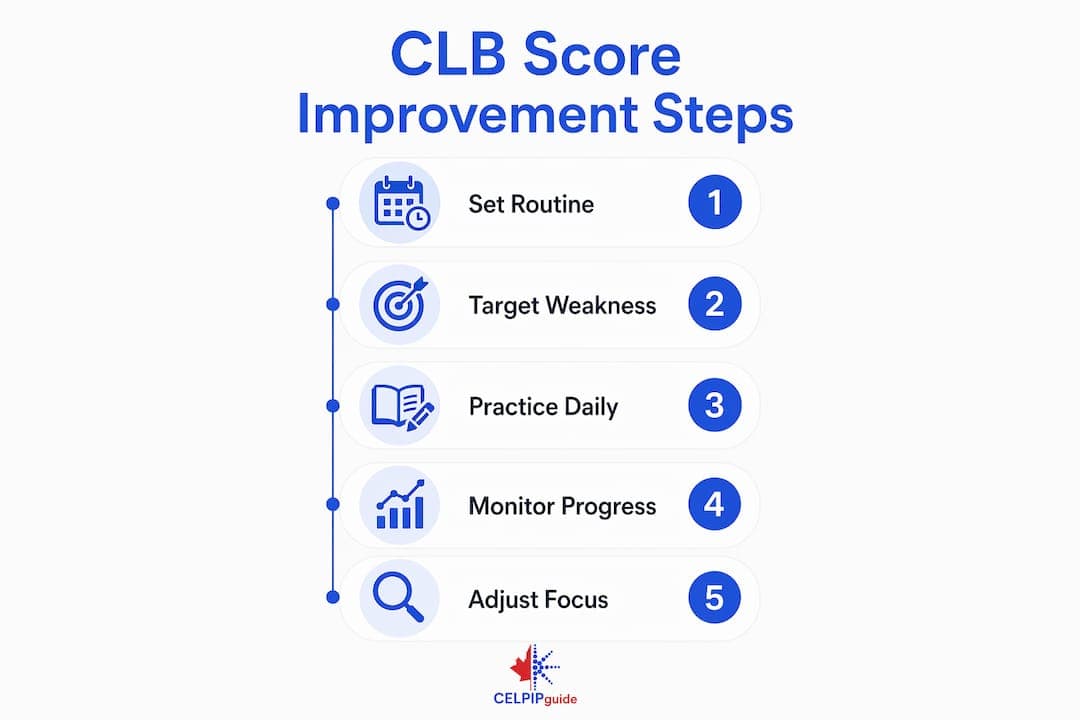
Targeted practice means working on your weakest CLB skill areas first, not the ones you already do well. Deliberate, focused practice with immediate feedback improves test performance more than unfocused repetition. Psychology research confirms that targeting specific weaknesses with corrective feedback accelerates skill acquisition. That means you need a plan, not just effort.
Here is a practical four-step approach to targeted practice:
- Take a diagnostic test first. Identify which of the four CELPIP skill areas, Listening, Reading, Writing, or Speaking, scores lowest. This tells you where to spend the most time. Celpipguide’s diagnostic feature pinpoints exactly which task types drag your score down.
- Assign daily time blocks by skill priority. Spend roughly 40% of your study time on your weakest skill and 20% each on the remaining three. Adjust weekly based on progress.
- Use rubric-based feedback for productive skills. Productive skills like Speaking and Writing improve faster with targeted output and rubric-based feedback than receptive skills like Listening and Reading. Write a response, compare it to the CLB scoring criteria, and note exactly where points were lost.
- Practise receptive skills with active attention. Passive listening does not build CLB-level comprehension. Listen to a recording, pause, summarise what you heard, then replay. Reading works the same way: annotate, question, and paraphrase.
Avoid blanket study. Spending equal time on all four skills regardless of your current scores wastes the hours you have. Focusing on tasks that directly influence CLB scoring criteria, such as task fulfillment and vocabulary range, accelerates score gains faster than reviewing grammar rules you already know.
Pro Tip: At CLB 9, grammar errors matter less than task fulfillment, vocabulary range, and tone calibration. Shift your focus accordingly once you pass CLB 7.
You can explore skill-specific sample tasks on Celpipguide to see exactly what targeted practice looks like for each CELPIP component.
How does consistent practice affect your Express Entry CRS points?
The connection between CLB scores and Express Entry points is direct and significant. Moving from CLB 7 to CLB 9 can add 40–50 CRS points, often outweighing gains from an education upgrade or additional work experience. That is a meaningful shift in your immigration prospects from a single focused effort.
The table below shows how practice duration and CLB progression connect for most candidates:
| Practice level | Daily time | Typical timeline to gain one CLB level |
|---|---|---|
| Minimal (unfocused) | Under 30 min | 6+ months with no guarantee |
| Moderate (structured) | 45–60 min | 8–12 weeks with consistent effort |
| Intensive (targeted) | 60–90 min | 4–8 weeks targeting weakest skills |
Spending 30–60 minutes daily on focused language practice can yield noticeable CLB improvements in as little as four weeks. That timeline assumes you are practising with structure, not just reading English casually.
Practical ways to integrate daily practice into a busy life:
- Use your commute for Listening practice with Canadian English podcasts or news audio.
- Write one short paragraph each morning on a CELPIP Writing task type, then review it against the scoring rubric.
- Spend 10 minutes before bed reviewing vocabulary from your weakest skill area.
- Book one full mock exam per week to track progress and simulate real exam conditions.
The CLB scores and Express Entry points relationship rewards candidates who treat language practice as a long-term investment, not a last-minute sprint.
What mistakes undermine consistent practice for CELPIP preparation?
The most common mistake is binge studying. Candidates cram for six hours on a Saturday, skip the rest of the week, and wonder why their scores plateau. Missing multiple consecutive days causes significant disruption to progress, far more than a single missed day. A University College London habit study confirms that sustained daily effort is what builds lasting language habits.
Other mistakes that slow CLB improvement:
- Practising only comfortable skills. If Speaking feels easier than Writing, you will naturally gravitate toward it. This widens the gap between your strongest and weakest bands, which hurts your overall CLB score.
- Skipping feedback. Practising without reviewing errors is the same as repeating mistakes. Every writing or speaking response needs to be checked against CLB rubrics.
- Treating hours as a proxy for progress. Three hours of passive reading does not equal one hour of deliberate, focused practice with active comprehension checks.
- Ignoring task fulfillment. Many candidates focus on grammar and vocabulary but miss the point of the task entirely. Examiners score task fulfillment first.
Recovery after a missed stretch is straightforward. Return to your routine the next day without guilt, and do not try to compensate by doubling your session length. Doubling up disrupts the frequency rhythm that myelination depends on. Review the common CELPIP preparation mistakes candidates make to avoid falling into these patterns.
Pro Tip: If you miss two or more days, do not cram. Simply restart your normal daily session and focus on your weakest skill first. Momentum rebuilds faster than you think.
Key takeaways
Consistent daily practice improves CLB scores because frequent, targeted repetition builds the neural pathways that make language skills automatic, and those gains translate directly into higher CELPIP results and more Express Entry CRS points.
| Point | Details |
|---|---|
| Frequency beats duration | Daily 20-minute sessions build stronger neural pathways than one long weekly session. |
| Target your weakest skill | Spend 40% of study time on your lowest CLB band for the fastest score gains. |
| CLB 7 to 9 adds CRS points | Moving two CLB levels can add 40–50 Express Entry CRS points, more than most education upgrades. |
| Feedback accelerates progress | Practising without rubric-based correction reinforces errors instead of fixing them. |
| Missing days disrupts habits | Skipping multiple consecutive days harms progress far more than a single missed session. |
What I have learned from watching candidates practise the wrong way
I have seen candidates put in genuine effort and still stall at CLB 7 for months. The pattern is almost always the same. They practise what they enjoy, avoid what they find hard, and measure effort by hours spent rather than skills gained.
The candidates who move from CLB 7 to CLB 9 within two months share one habit: they practise their weakest skill every single day, even when it is uncomfortable. They do not wait for a perfect two-hour window. They use 30 minutes before work, a lunch break, or the last 20 minutes before bed. Consistency is not about willpower. It is about removing the decision of whether to practise today.
I also think the neuroscience angle is underappreciated. Most candidates treat language learning as a memory task. It is actually a physical one. Your brain is literally building infrastructure each time you practise. Miss too many days and that infrastructure starts to degrade. Show up daily and it compounds.
The other thing I would tell anyone preparing for CELPIP: integrate English into your life, not just your study schedule. Watch Canadian news, listen to Canadian radio, read Canadian opinion pieces. These habits reinforce your formal practice without adding study time. The candidates who reach CLB 9 are usually the ones who stopped treating English as a subject and started treating it as a daily tool.
You can read more about reaching CLB 9 in Speaking and Writing specifically, which is where most candidates have the most room to grow.
— Reza
How Celpipguide supports your daily practice routine
Building a consistent practice habit is easier when you have the right structure behind it. Celpipguide offers over 100 full-length mock exams and 5,000 practice questions, all mapped to CLB benchmarks and CEFR language standards.
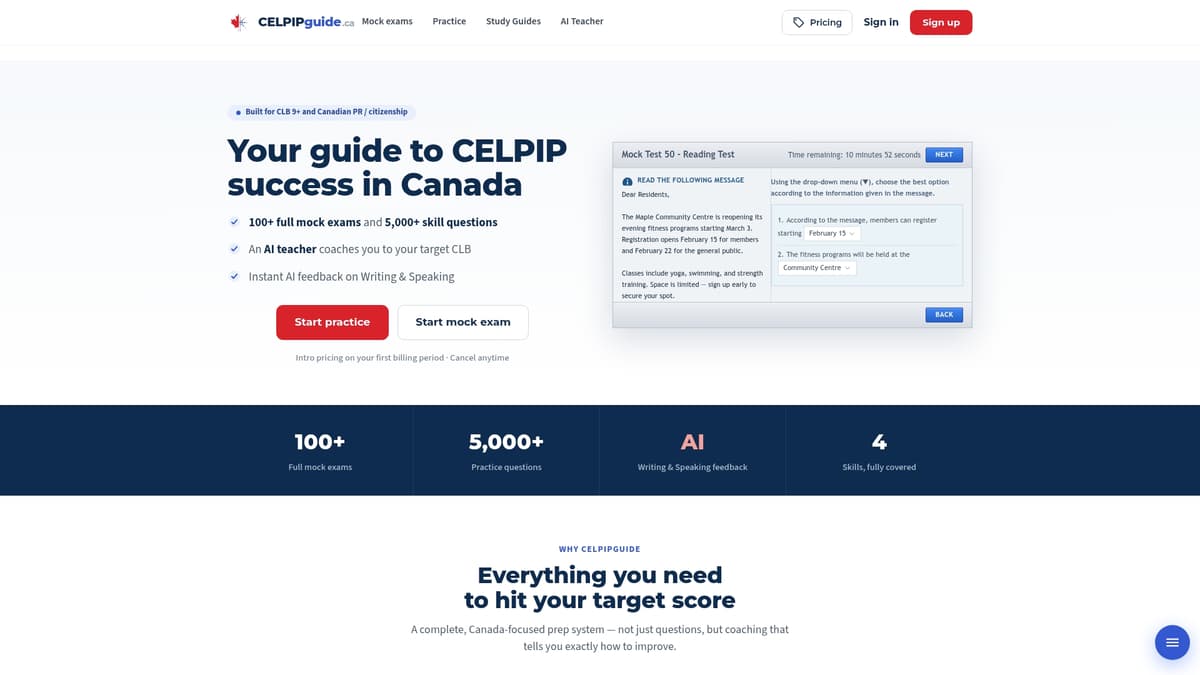
The platform’s AI teacher personalises your study plan based on your diagnostic results, so you spend time on the skills that actually move your score. Instant feedback on Writing and Speaking tasks means you correct errors in real time rather than repeating them. Whether you are starting from CLB 6 or pushing toward CLB 9, the CELPIP practice hub gives you the targeted, structured sessions that consistent improvement requires. You can also use the full-length mock exams to simulate real exam conditions and track your CLB progress week by week.
FAQ
How much daily practice is needed to improve CLB scores?
Spending 45–60 minutes daily on focused, structured practice can produce noticeable CLB improvements within four weeks. Candidates targeting CLB 9 benefit from 60–90 minutes of daily targeted practice.
Does practising every day really matter more than long sessions?
Yes. Daily 20-minute sessions produce better neural reinforcement than a single three-hour session per week because myelination responds to frequency, not total duration.
Which CELPIP skills should I practise first?
Practise your weakest skill band first and allocate roughly 40% of your study time to it. Productive skills like Speaking and Writing respond faster to targeted output practice than receptive skills.
How do CLB improvements affect Express Entry applications?
Moving from CLB 7 to CLB 9 can add 40–50 CRS points to your Express Entry profile, which often outweighs gains from education or additional work experience upgrades.
What should I do if I miss several days of practice?
Return to your normal daily session immediately without trying to compensate with a longer session. Missing multiple consecutive days disrupts habit formation, but resuming your routine quickly limits the setback.