
CELPIP Blog
Role of practice questions in skill building for exams
Role of practice questions in skill building for exams

TL;DR:
- Practice questions enhance language skills and exam scores by promoting active retrieval and memory strengthening. They are most effective when they challenge learners and are combined with timely, explanatory feedback. Varying question types and practicing consistently over time lead to better skill transfer and higher CLB ratings.
Practice questions are the most direct method for building lasting language skills and improving exam performance through active retrieval. The role of practice questions in skill building goes far beyond simple memorisation. When you answer a question from memory, your brain strengthens the neural pathways that make recall faster and more reliable. Research confirms this works. A meta-analysis of 159 studies shows retrieval practice produces a 13 percentage point improvement in test scores compared to passive review. For CELPIP test-takers aiming for high CLB ratings, that gap is the difference between a visa application that succeeds and one that falls short. Celpipguide is built around this principle, offering over 5,000 practice questions aligned to CEFR language standards.
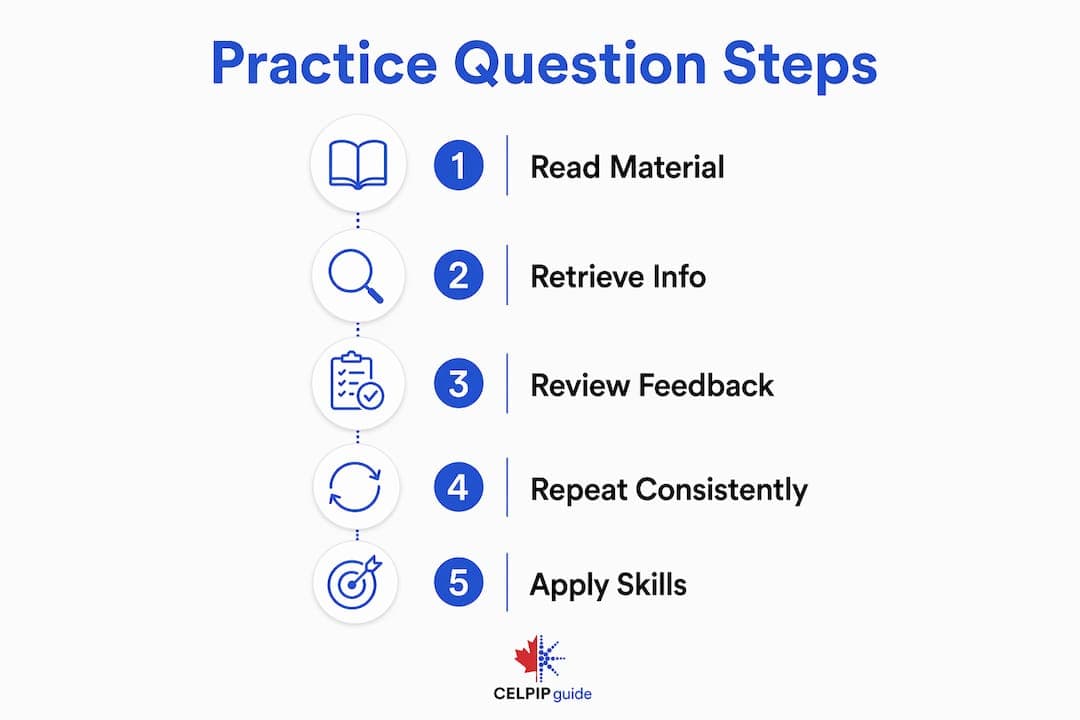
How do practice questions boost memory retention?
The testing effect is the single most well-documented finding in learning science. It describes how actively retrieving information from memory produces stronger, longer-lasting retention than passively reviewing the same material. Rereading your notes feels productive, but it is mostly recognition, not recall. Your brain sees familiar words and registers comfort, not learning.

The numbers make this concrete. Students who tested themselves three times after reading recalled 61% of material one week later. Students who reread the same material three times recalled only 40%. That 21-percentage-point gap represents real exam marks, not a theoretical advantage.
The reason this works comes down to effort. The testing effect strengthens neural pathways precisely because retrieval is effortful. Your brain treats the struggle to recall an answer as a signal to reinforce that memory. Passive review sends no such signal.
| Study method | Retention after one week | Effort level |
|---|---|---|
| Retrieval practice (tested 3×) | 61% | High |
| Rereading (reviewed 3×) | 40% | Low |
| Passive review only | Below 40% | Very low |
Pro Tip: When a practice question feels genuinely difficult, that discomfort is a sign your brain is working. Desirable difficulties train you to handle high-stakes exams with calibrated confidence, not anxiety.
Why does timing matter more than total practice hours?
Consistent, distributed practice outperforms last-minute cramming by a significant margin. Formative practice, meaning questions completed chapter by chapter as you study, produces meaningfully better results than saving all practice for the final week before an exam.
Research on formative practice shows that ongoing practice improved exam scores by nearly 2 percentage points compared to delayed practice. The same study found that 40.3% of practice done late was irrelevant to what actually appeared on the exam, compared to only 6.8% for ongoing practice. Late practice wastes your time on content that no longer matters.
For CELPIP preparation, this means you should practise listening skills actively after each study session, not only in the final days before your test date. The benefits compound when retrieval happens repeatedly over time.
The benefits of spaced, deliberate practice include:
- Reduced wasted effort. Timely questions focus on content you are actively learning, not content you have already forgotten or will not be tested on.
- Better score growth for lower-performing learners. The same research found that students who were initially at a C-minus level moved to a C grade with ongoing practice. That shift matters for CLB benchmarks.
- Stronger retrieval habits. Five minutes of post-lecture retrieval outperforms hours of rereading because it builds the habit of pulling information from memory under mild pressure.
- Reduced exam anxiety. Familiarity with the question format reduces cognitive load on test day, freeing mental energy for actual language production.
Pro Tip: Start your practice questions immediately after each study session, even if you only answer five questions. Frequency matters more than session length.
How to create and select effective practice questions
Not all practice questions produce equal results. Questions that are too easy produce recognition, not retrieval. Questions that are too hard produce frustration, not learning. The goal is optimal difficulty: questions that require genuine effort but remain answerable with focused thinking.
Writing your own questions produces a dual benefit. First, you must identify the key concepts worth testing, which forces you to process the material at a deeper level. Second, the act of writing the question itself strengthens your memory of the concept before you even answer it. Self-generated questions are retained more durably than questions written by others.
Follow these steps to create questions that actually build skill:
- Review your study material and identify the core idea. Ask yourself: what would an examiner want to test here? For CELPIP writing tasks, this might be the structure of a persuasive response or the correct use of a CLB 9 vocabulary range.
- Write the question in your own words. Avoid copying phrases directly from your notes. Paraphrasing forces deeper processing.
- Set the question aside for at least 20 minutes before answering. Delayed answering increases recall strength because the memory trace has begun to fade slightly, making retrieval more effortful and more effective.
- Check your answer against a rubric or model answer. Celpipguide’s scoring methodology provides clear criteria for evaluating writing and speaking responses against CEFR standards.
- Revise the question if you answered it too easily. Add a condition, a context shift, or a follow-up that requires application rather than simple recall.
For speaking practice, effective questions simulate real exam prompts: describe a situation, give an opinion with reasons, or compare two options within a time limit.
Does feedback change how much you learn from practice questions?
Feedback is not optional. Practice without feedback tells you whether you got an answer right or wrong. Practice with explanatory feedback tells you why you were right or wrong and how the underlying principle applies to new situations.
Elaborated feedback enhances both memory retention and conceptual generalisation more than simple correct-or-wrong feedback. This matters for language exams because CELPIP does not repeat the same prompts. You need to transfer your skills to unfamiliar contexts, not just recall practised answers.
Prior knowledge also shapes how much you gain from feedback. Learners with a stronger foundation in English grammar and vocabulary extract more value from explanatory feedback because they can connect new information to existing knowledge. This is why building vocabulary and grammar fundamentals before heavy practice testing produces better results than jumping straight into full mock exams.
| Practice condition | Memory retention | Skill transfer to new contexts |
|---|---|---|
| No feedback | Low | Very low |
| Correct-answer feedback only | Moderate | Low |
| Explanatory feedback | High | High |
The practical takeaway is straightforward. Choose practice resources that explain why an answer is correct, not just what the correct answer is. Celpipguide’s AI teacher delivers instant feedback on writing and speaking tasks with explanations tied to CEFR criteria, which supports both retention and transfer.
What are the most common mistakes with practice questions?
The biggest mistake is retaking the same practice test repeatedly and treating rising scores as proof of improvement. Repeated use of identical questions inflates scores through recognition, not deep learning. You remember the answer from last time, not because your skill has grown.
The second mistake is treating a low practice score as a verdict on your ability. Practice test scores are diagnostic data, not judgements. A low score on a CELPIP writing task tells you exactly which skill to work on next. That is the score doing its job correctly.
Do this:
- Use varied, fresh questions for each practice session.
- Treat every wrong answer as a specific instruction: find the gap, address it, retest.
- Mix question types across all four CELPIP skills: listening, reading, writing, and speaking.
- Review your errors before moving to new material.
Avoid this:
- Retaking the same mock exam within the same week.
- Skipping questions that feel uncomfortable or unfamiliar.
- Practising only your strongest skill because it feels good.
- Treating a high practice score as confirmation you are ready without checking for variety in the questions used.
Celpipguide’s library of over 5,000 questions across skill-specific tasks prevents score inflation by providing enough variety that recognition cannot substitute for genuine skill.
Key takeaways
Practice questions build durable language skills through active retrieval, timely feedback, and varied question formats, making them the most effective preparation method for CELPIP and similar proficiency exams.
| Point | Details |
|---|---|
| Retrieval beats rereading | Students using practice questions retain 61% of material after one week versus 40% for rereading. |
| Timing shapes results | Ongoing, chapter-by-chapter practice reduces irrelevant effort and improves exam scores more than last-minute cramming. |
| Write your own questions | Self-generated questions deepen processing and produce more durable memory than questions written by others. |
| Feedback drives transfer | Explanatory feedback builds the ability to apply skills to new contexts, not just recall practised answers. |
| Vary your questions | Repeating identical tests inflates scores through recognition; fresh questions measure real skill growth. |
My honest view on practice questions and language exam prep
I have watched a lot of CELPIP test-takers make the same mistake. They spend weeks rereading vocabulary lists and grammar notes, feel prepared, and then underperform on exam day. The problem is not effort. The problem is method.
The discomfort of not knowing an answer during practice is the whole point. That moment of struggle is where learning actually happens. I have seen learners avoid hard questions because a wrong answer feels discouraging. But a wrong answer in practice is free information. A wrong answer on exam day costs you a CLB level.
My honest recommendation is this: spend less time reviewing and more time retrieving. Set a timer, answer questions without looking at your notes, and check your answers against a rubric afterward. Do this daily in short sessions rather than in occasional marathon study blocks. Consistency beats intensity every time.
I also think learners underestimate the value of writing their own questions. After a study session on CELPIP Writing Task 2, try writing three questions an examiner might ask about the topic you just studied. The process of generating those questions forces you to think like an examiner, which is exactly the perspective shift that improves your responses.
The learners I have seen improve fastest are not the ones who study the most hours. They are the ones who practise the most deliberately, review their errors honestly, and treat every difficult question as a building block rather than a barrier.
— Reza
Celpipguide’s practice resources for CELPIP skill building
Celpipguide offers over 100 full mock exams and 5,000 practice questions built around the same retrieval principles this article covers.
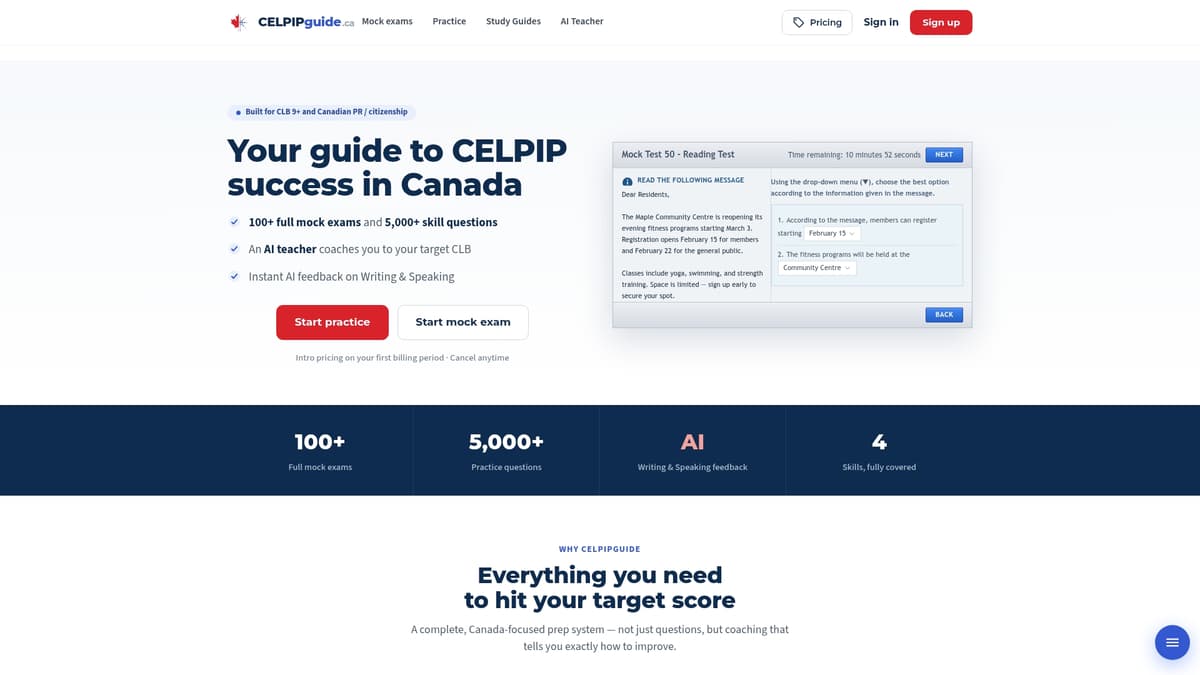
Every question is aligned to CEFR language standards, and the AI teacher delivers explanatory feedback on writing and speaking tasks so you understand why an answer meets the CLB benchmark, not just whether it does. The CELPIP practice hub gives you access to skill-specific tasks across all four exam sections, a diagnostic test to identify your weakest areas, and personalised study plans that distribute your practice over time rather than front-loading it before your test date. If you want to see what the exam format looks like before committing, the free practice test is a good place to start.
FAQ
What is the testing effect in language learning?
The testing effect is the proven finding that actively retrieving information from memory produces stronger retention than rereading. A meta-analysis of 159 studies shows retrieval practice improves test scores by 13 percentage points on average.
How often should I use practice questions when preparing for CELPIP?
Daily short sessions produce better results than occasional long ones. Practising immediately after each study session, even for five minutes, builds retrieval habits that compound over time.
Does writing my own practice questions actually help?
Yes. Self-generated questions are retained more durably than questions written by others because the process of writing them forces you to identify key concepts and shift to an examiner’s perspective.
Why is explanatory feedback more effective than just seeing the correct answer?
Explanatory feedback teaches the underlying principle, not just the right answer. This allows you to apply the skill to new prompts, which is exactly what CELPIP requires since exam prompts are never repeated.
Is it bad to retake the same practice test multiple times?
Retaking identical tests inflates your score through recognition rather than genuine skill growth. Use varied, fresh questions each session to measure real improvement accurately.