
CELPIP Blog
Professional English improvement strategies 2026
Professional English improvement strategies 2026

TL;DR:
- Consistent, deliberate practice improves professional English skills within months and builds confidence.
- Focusing on all four communication channels, especially listening, enhances overall effectiveness at work.
Deliberate, context-specific practice is the most effective method for professional English improvement, producing measurable gains in writing, speaking, and listening within months. Communication skills now outrank technical knowledge as the primary driver of promotions and performance appraisals in hybrid workplaces. The professional English improvement strategies 2026 professionals need most are not about memorising grammar rules. They are about practising real workplace language, building strong communication habits, and tracking your progress with precision. This guide covers exactly that.
1. Which daily habits most effectively enhance professional English skills?

Daily practice of 20–30 minutes sustained over three to six months produces measurable gains in workplace English. The key word is deliberate. Passive exposure, like watching TV in English, builds familiarity but not fluency. You need to practise with authentic business content: industry articles, professional emails, meeting recordings, and workplace reports.
Here are the daily habits that produce the fastest results:
- Rewrite one email per day. Take a message you sent or received and rewrite it for greater clarity, conciseness, or professionalism. This single habit sharpens written communication faster than any textbook exercise.
- Keep a “gem list.” Collect effective phrases you hear in meetings or read in professional writing. Write them down and use them within 48 hours. Phrase chunks sound more natural than vocabulary lists because they reflect how fluent speakers actually talk.
- Record yourself speaking. Read a short business text aloud, then play it back. Listen for hesitation, unclear pronunciation, or filler words. This self-observation cycle builds awareness faster than most formal lessons.
- Practise writing responses to real scenarios. Draft a reply to a difficult client email, a meeting summary, or a project update. Use actual work situations so the language you practise is immediately transferable.
Pro Tip: Before sending any professional email, read it aloud once. If a sentence sounds awkward when spoken, it will read awkwardly too. Edit for spoken clarity, and your written English will improve in parallel.
2. How does the Four-Channel Method improve communication effectiveness at work?
The Four-Channel Method defines workplace communication across four channels: verbal, nonverbal, written, and listening. Most professionals focus almost entirely on verbal and written skills. This creates a significant gap, because listening is the most undervalued channel and the one with the greatest impact on collaboration.
Here is how to develop each channel deliberately:
- Verbal. Practise speaking in structured formats. Prepare a two-minute summary of any project you are working on and deliver it without notes. This builds fluency under pressure.
- Nonverbal. Record yourself in a video call or presentation. Watch without sound first. Notice your eye contact, posture, and facial expressions. Nonverbal signals carry as much meaning as your words.
- Written. Focus on clarity and structure. Use short paragraphs, clear subject lines, and one main idea per sentence. Review your professional email writing against these criteria weekly.
- Listening. This is the channel most professionals neglect. Active listening means paraphrasing what you heard, asking clarifying questions, and tolerating silence rather than filling it with noise. Practise by summarising a colleague’s point before responding in your next meeting.
To diagnose your weakest channel, ask a trusted colleague for honest feedback. Most professionals are surprised to learn their listening habits are the real barrier to effective communication, not their vocabulary.
Pro Tip: After your next meeting, write a three-sentence summary of what was decided and who is responsible for what. If you struggle, your listening channel needs the most attention.
3. What mindset shifts accelerate English fluency for professionals?
The single most effective mindset shift is viewing yourself as a communicator, not a language learner. This distinction matters more than most professionals realise. When you identify as a learner, every mistake feels like failure. When you identify as a communicator, every interaction becomes a tool for getting your message across.
This shift directly reduces the anxiety that causes professionals to freeze during meetings or presentations. Anxiety is not a language problem. It is a self-perception problem. Changing how you label yourself changes how you perform.
“The goal is not to speak perfect English. The goal is to communicate clearly and confidently in professional contexts. Fluency follows confidence, not the other way around.”
Practical ways to reinforce this mindset:
- Acknowledge every successful interaction. After a meeting where you contributed, note what worked. Positive reinforcement builds the neural pathways that make fluency feel natural.
- Visualise before speaking engagements. Spend two minutes before a presentation imagining yourself speaking clearly and receiving positive responses. Athletes use this technique because it works.
- Separate preparation from performance. Prepare your language and structure in advance, then let go during the actual conversation. Over-monitoring your grammar mid-sentence is the fastest way to lose fluency.
4. Which measurable outcomes demonstrate effective English improvement strategies?
Evidence shows that structured, scaffolded practice produces significant and trackable results. A 16-week scaffolded learning model increased professional writing performance by 36.68%, vocabulary richness by 48.71%, and collocational accuracy by 53.49%. These are not marginal gains. They represent a fundamental shift in how professionals write and communicate.
The table below maps the key outcome areas to the practices that drive them:
| Outcome | Driving Practice | Timeframe |
|---|---|---|
| Writing clarity | Daily email rewriting and structured review | 4–8 weeks |
| Vocabulary richness | Gem list and phrase chunk collection | 6–12 weeks |
| Collocational accuracy | Corpus-based reading and phrase reuse | 8–16 weeks |
| Listening comprehension | Active listening exercises and paraphrasing | 4–8 weeks |
| Speaking fluency | Self-recording and peer feedback cycles | 6–12 weeks |
One of the most underused tools for tracking improvement is the error journal. Keeping an error journal means writing down every recurring mistake you make, whether in grammar, word choice, or pronunciation, and reviewing it weekly. This targeted approach corrects persistent errors faster than broad grammar study. After two weeks, patterns emerge. After four weeks, those patterns disappear.
5. Which strategies best integrate English improvement into busy professional routines?
The biggest obstacle for working professionals is not motivation. It is time. The solution is embedding practice into tasks you already do, not adding separate study sessions on top of a full workday.
Here is how to make that work:
- Use your inbox as a classroom. Every email you write is a writing exercise. Before sending, ask: Is this clear? Is it concise? Does it sound professional? That three-second review compounds over hundreds of emails per month.
- Turn meetings into listening labs. Set a personal goal for each meeting: paraphrase one point, ask one clarifying question, or summarise the outcome in writing immediately after. These micro-practices build the active listening skills that most professionals lack.
- Schedule focused practice in short blocks. A 20-minute session before your workday starts is more effective than a two-hour session on the weekend. Consistency beats volume every time.
- Solicit specific feedback. Ask a colleague to flag unclear phrasing in your next report or presentation. Self-recording and peer feedback create quality improvement cycles that generic study cannot replicate.
- Use spaced repetition for vocabulary. Apps built on spaced repetition algorithms resurface words and phrases at the exact moment you are about to forget them. This method is far more efficient than reviewing a vocabulary list from start to finish.
The professionals who improve fastest are not the ones who study the most. They are the ones who practise most intentionally within their existing routines.
Key takeaways
Consistent, context-specific practice combined with targeted feedback is the most reliable path to professional English improvement in 2026.
| Point | Details |
|---|---|
| Daily practice beats volume | 20–30 minutes of deliberate daily practice produces measurable gains within three to six months. |
| Four-Channel Method builds balance | Developing verbal, nonverbal, written, and listening skills together closes the gaps most professionals overlook. |
| Mindset drives fluency | Viewing yourself as a communicator rather than a learner reduces anxiety and improves spontaneous speaking. |
| Scaffolded models show real results | A 16-week structured approach improved professional writing by 36.68% and vocabulary richness by 48.71%. |
| Embed practice in real work | Using emails, meetings, and presentations as practice tools makes improvement sustainable for busy professionals. |
What I have learned about improving professional English that most guides miss
I spent years watching professionals study hard and still plateau. The pattern was almost always the same: they focused on what they did not know instead of building on what they already did well. That is a slow, demoralising approach.
The professionals who improved fastest did two things differently. First, they kept a gem list. Not a vocabulary notebook, but a running collection of phrases they heard from confident English speakers and immediately tried to use. Second, they treated every mistake as data, not failure. The error journal is not about shame. It is about pattern recognition.
The Four-Channel Method changed how I think about communication entirely. Most people assume their English is the problem when their listening is actually the bottleneck. I have seen professionals with strong vocabulary struggle in meetings simply because they were not processing what was being said. Fixing the listening channel fixed their speaking confidence too.
One more thing: perfectionism is the enemy of fluency. The professionals who wait until they feel “ready” to speak up in meetings never get the practice they need. You build confidence by communicating, not by preparing to communicate. Start with low-stakes interactions, collect your gems, track your errors, and trust the process.
— Reza
How Celpipguide supports your professional English goals
Professional English credentialing matters more than ever for Canadian immigration and workplace advancement. Celpipguide is built specifically for professionals preparing for the CELPIP exam, which measures real-world English communication at CLB benchmark levels.
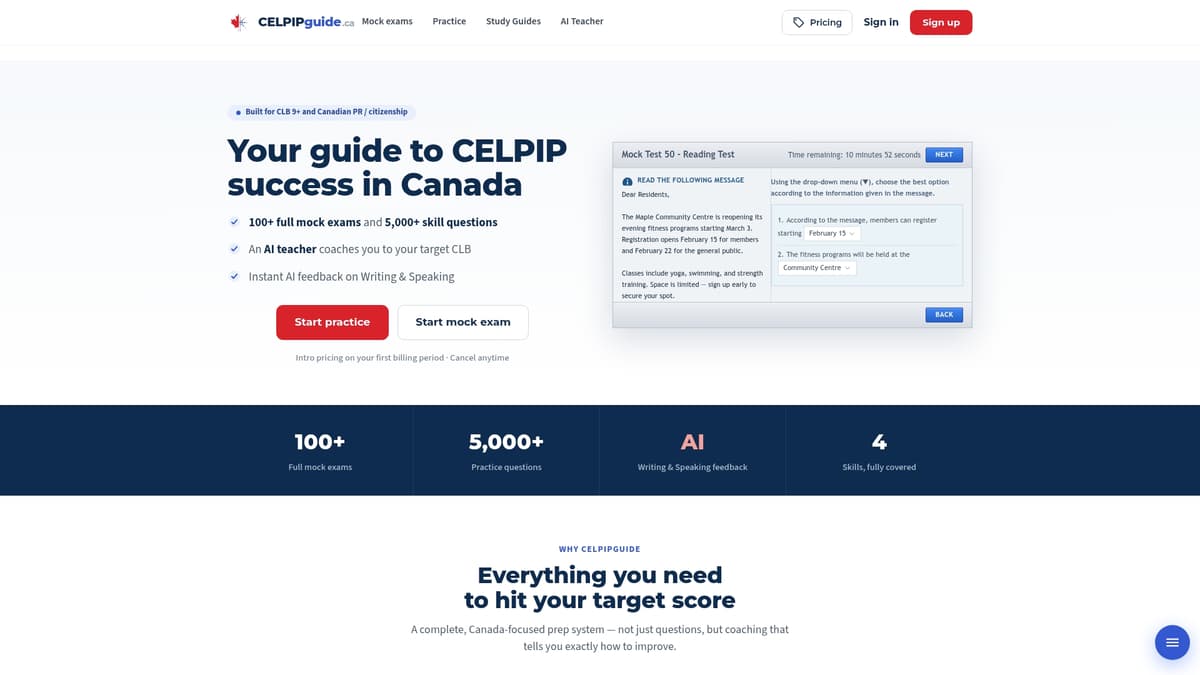
Celpipguide offers over 100 full-length mock exams and 5,000 practice questions mapped to CEFR standards, covering all four communication channels. The platform’s AI teacher delivers instant feedback on writing and speaking tasks, so you know exactly where to focus. Whether you are working on email clarity, speaking fluency, or listening comprehension, Celpipguide gives you the targeted practice that produces real CLB score gains.
FAQ
How long does it take to improve professional English skills?
Daily practice of 20–30 minutes sustained over three to six months produces measurable improvement. Structured, scaffolded programmes show significant gains in as little as 16 weeks.
What is the Four-Channel Method?
The Four-Channel Method covers verbal, nonverbal, written, and listening communication. Listening is the most undervalued channel and has the greatest impact on workplace collaboration.
Why is mindset important for English fluency?
Viewing yourself as a communicator rather than a learner reduces performance anxiety and improves spontaneous fluency in meetings and presentations.
What is an error journal and does it work?
An error journal is a record of your recurring language mistakes, reviewed weekly. It corrects persistent errors faster than general grammar study by targeting the specific patterns that hold you back.
How do I practise English without extra study time?
Use your existing work tasks as practice. Rewrite one email per day for clarity, set a listening goal for each meeting, and collect effective phrases you hear from confident colleagues. These micro-practices compound quickly without adding time to your day.