
CELPIP Blog
CELPIP CLB Goals: Why 9 to 10 Can Raise Express Entry Points
CELPIP CLB Goals: Why 9 to 10 Can Raise Express Entry Points

If Express Entry points are your goal, aim for CLB 9 to CLB 10 across all four skills, since that range unlocks the top language bracket in the Comprehensive Ranking System. Take a diagnostic test this week to find your current band. Remember that immigration applications require the CELPIP-G test, and your results stay valid for two years, so timing your prep matters as much as your score.
TL;DR:
- At CLB 9, single applicants earn 124 CRS points and applicants with a spouse earn 116; CLB 10 raises those totals to 136 and 128.
- If your CRS score is near invitation cutoffs, the extra points from CLB 10 may help; a licensing body’s minimum overrides CRS calculations.
- A section score of roughly 31 to 33 correct answers out of 38 can indicate CLB 9, but conversion varies by task and test format.
- Treat readiness as consistent target level across two or three timed full mocks; one high score may reflect normal variation, not reliable performance.
- With one month to prepare, focus on your weakest skill and complete one timed full mock weekly; this approach suits candidates already near their target.
Table of Contents
- What CLB means for your CELPIP score and why it matters for Express Entry
- How to choose a realistic CLB goal for your situation
- Assess where you are now: diagnostics, mock tests, and what the numbers mean
- Build a focused, CLB-banded study plan
- Using diagnostic tools, mock exams, and AI feedback effectively
- Practice, verification, and your test-day checklist
- Common mistakes I see in CLB goal setting, and how to avoid them
- How CELPIPguide supports your path to your CLB goal
- FAQ
- Sources
What CLB means for your CELPIP score and why it matters for Express Entry
The Canadian Language Benchmark is the national yardstick that translates your CELPIP-G performance into a standardized score immigration officers and employers actually use. Each of your four skills, speaking, listening, reading, and writing, gets its own CLB band based on your raw CELPIP results, and that band is what shows up in your Express Entry profile. The official CLB documentation was built as a planning tool, not just a scoring scale, and that distinction matters: it describes the specific tasks you should be able to perform at each level, which gives you something concrete to practise toward.
For immigration purposes, CELPIP-G is the version that counts. The General Test (as opposed to CELPIP-G LS, which only covers listening and speaking) is what IRCC accepts for Express Entry and citizenship applications.
Here’s where the CLB bands translate into real points under the CRS:
- CLB 7: a modest contribution to your language points, well below the threshold most competitive candidates need.
- CLB 9: earns 31 CRS points per ability (124 total) for single applicants, or 29 per ability (116 total) with a spouse.
- CLB 10 or higher: earns 34 CRS points per ability (136 total) for single applicants, or 32 per ability (128 total) with a spouse.
That one-band jump from CLB 9 to CLB 10 adds up to a moderate but potentially decisive increase in CRS points total for single applicants, according to official CRS criteria, according to the CRS criteria published by IRCC. For candidates sitting just under an invitation cutoff, that gap can be the entire reason an application gets selected or waits another round.
There’s a planning detail that trips people up constantly: CELPIP-G results are only valid for two years from the date they’re issued. If your scores expire before you submit your profile or your final permanent residence application, your file can be refused outright. That two-year window should shape when you test, not just how you prepare for it. Testing too early, before your other documents (education credential assessment, proof of funds, job offer) are ready, can mean retesting later for no reason other than bad sequencing.

How to choose a realistic CLB goal for your situation
Before you open a single practice book, figure out exactly what outcome you’re chasing. A CLB goal that isn’t tied to a specific requirement is just a number, and numbers without purpose are easy to abandon when prep gets hard.
- Name your end goal precisely. Are you applying through Express Entry, pursuing a professional licence, or meeting a citizenship requirement? Each has different minimum CLB thresholds, and some professional bodies set their own floors that are stricter than IRCC’s.
- Check the CLB-to-CRS table for your profile. Use the official CRS criteria to see exactly how many points each band earns given your marital status, since the totals differ meaningfully between single and married applicants.
- Pick a target band, then add one buffer level. If CLB 9 technically meets your requirement, aim your study plan at CLB 10. Test-day nerves, unfamiliar prompts, and small timing errors all tend to shave a band off your practice performance, so the buffer protects you from a near miss.
- Set a per-skill target, not just an overall one. Your weakest skill determines your CRS language points in some calculations, so a plan that only focuses on your strongest area wastes effort.
- Write down your deadline. Work backward from your application timeline, keeping the two-year validity window in mind, and give yourself enough runway to retest if your first attempt falls short.
When you’re deciding between aiming for CLB 9 or stretching for CLB 10, a few quick checks help:
- If your CRS score is currently close to recent invitation cutoffs, the extra points from CLB 10 are worth the additional study time.
- If you’re already well above typical cutoffs on other factors (age, education, skilled work experience), CLB 9 might be sufficient, and your time is better spent elsewhere.
- If your profession requires a specific CLB floor for licensing, that requirement overrides any CRS-based calculation.
Pro Tip: Write your target CLB band on a sticky note where you study. It sounds small, but a visible, specific number keeps your practice sessions focused instead of vague “getting better at English” sessions that go nowhere.
The buffer approach isn’t about pessimism. It’s about recognizing that a mock test taken in a quiet room with no stakes feels different from the real exam, and giving yourself margin means a slightly rough test day still lands you where you need to be.
Assess where you are now: diagnostics, mock tests, and what the numbers mean
You can’t build a study plan around a goal if you don’t know your starting point. A diagnostic test is the fastest way to find it, but only if you run it properly.
Treat your first diagnostic like the real exam. Set a timer for each section exactly as CELPIP does, sit somewhere free of interruptions, and resist the urge to pause or look things up. Research on test readiness consistently shows that untimed practice inflates how prepared people feel, because the real pressure of a ticking clock changes how you process questions and manage your time across tasks.
Once you have a raw score, converting it to a CLB estimate takes some judgment, since official conversion tables vary by task type and total question count. As a general guide, reaching CLB 9 on a given section typically requires scoring somewhere around 31 to 33 correct answers out of 38, based on patterns many test-takers and prep instructors have observed over time. Treat this as an estimate rather than a guarantee, and aim for the higher end of that range (33) to build in some margin.
A single mock test tells you almost nothing on its own. What matters is the pattern across several attempts:
- If you score within one band of your target across two or three full mocks, your prep is likely on track.
- If your scores swing wildly between attempts, something other than language skill (fatigue, unfamiliarity with the format, timing panic) is probably interfering.
- If you plateau below your target for several consecutive mocks, it’s a signal to change your study method, not just repeat the same drills harder.
Retake a full diagnostic every few weeks rather than after every study session. Testing too frequently measures noise more than progress, while spacing attempts out gives your actual skill improvement time to show up in the results.
Build a focused, CLB-banded study plan
Once you know your current band and your target, the plan writes itself around the gap between the two. Here’s how to structure it depending on how much runway you have.
If you have one month: focus entirely on your weakest skill and on timed, full-length mocks. Spend four days a week on targeted drills for that one skill, and sit a complete mock exam once a week to track movement. This compressed timeline works best for candidates who are already close to their target and need a final push rather than a rebuild.
If you have two months: split your time between all four skills, weighting the weakest two more heavily. In the first month, drill skills individually using CLB-banded practice materials that match your target band’s task complexity. In the second month, shift toward full mocks every five to seven days, using the results to redirect your remaining study time.
If you have three months or more: build a rotating weekly schedule. Spend the first few weeks on foundational vocabulary and grammar patterns specific to CELPIP task types, then move into skill-specific drills, and finish with a final month of mostly full-length mocks and review.
For each skill, the drills look different:
- Speaking: record yourself answering CELPIP-style prompts within the actual time limit (usually 60 to 90 seconds depending on the task), then listen back for hesitation, repeated words, and whether you actually answered the question asked.
- Writing: practise the two core task types (an email and a survey-response essay) using a fixed structure: a clear opening statement, two to three supporting points each with a brief example, and a short closing line. Time yourself at 27 minutes per task, matching the real exam.
- Listening: work through longer audio clips and practise note-taking shorthand, since many listening tasks test whether you can retain details across a multi-minute conversation, not just understand individual sentences.
- Reading: practise skimming for structure first (headings, topic sentences) before reading for detail, which saves time on tasks that ask you to locate specific information quickly.
As your scores climb, move to harder CLB-banded material rather than repeating the same level of practice. Starting at CLB 7 or 8 difficulty when your target is CLB 10 builds false confidence, since the task complexity and vocabulary range at higher bands are genuinely different, not just scored more strictly.
Pro Tip: Increase your mock-test frequency as your test date approaches, but never sit more than one full mock in a single day. Fatigue from back-to-back full-length tests will drag your scores down and give you a false read on your actual readiness.
Vocabulary work deserves its own slot in your schedule rather than getting squeezed in as an afterthought. Build word lists around common CELPIP topics (workplace scenarios, community issues, personal experiences) and practise using new words in full sentences, not just memorizing definitions.
Using diagnostic tools, mock exams, and AI feedback effectively
A diagnostic test only helps if its output tells you something specific enough to act on. A useful diagnostic breaks your performance down by skill and often by sub-skill, showing you whether a low writing score comes from weak grammar, thin content development, or poor task fulfillment, since each of those problems needs a different fix.
AI-driven feedback on speaking and writing tasks works the same way a human rubric-based evaluation does, scoring against the same criteria CELPIP examiners use: content, vocabulary, grammar, and task fulfillment. The advantage of AI feedback is speed. Instead of waiting days for a human evaluator, you get a breakdown immediately after submitting a response, which means you can apply the correction on your very next practice attempt instead of losing that window.
Industry data on CLB-banded practice tools shows this kind of targeted drilling is becoming standard across CELPIP prep platforms, reflecting a broader shift toward aligning practice tasks directly with CLB descriptors rather than generic English exercises.
A few habits make this kind of feedback actually useful:
- Review your AI feedback line by line instead of just checking the overall score, since the specific comments usually point to one or two repeated issues.
- Map feedback points back to the CLB descriptors for your target band, so you understand not just what went wrong but what the next band up requires.
- Track your scores across sessions in one place rather than relying on memory, since patterns across ten attempts are far more reliable than any single result.
- Retake full-length mocks regularly, not just isolated task drills, since your target CLB band depends on sustained performance across an entire timed exam, not one strong paragraph.
A large volume of practice material matters here too. Working through the same handful of practice questions repeatedly teaches you to recognize those specific questions, not to perform the underlying skill. Rotating through a wide pool of mock exams and practice items keeps your preparation honest.
Practice, verification, and your test-day checklist
Before you book your actual CELPIP exam, set a clear readiness bar rather than relying on gut feeling. A reasonable standard: hit your target CLB band consistently across two to three separate full-length mock exams, taken under timed, realistic conditions. One strong mock surrounded by weaker ones isn’t readiness, it’s variance.
Once you’re consistent, think carefully about scheduling. Because CELPIP-G results are valid for two years, book your test close enough to your application timeline that your results won’t expire before you submit, but early enough to leave room for a retest if needed.
On test day itself:
- Arrive early enough to get settled without rushing, since arriving flustered affects your speaking and writing responses more than any other factor.
- Bring the exact identification documents required, since mismatched ID has derailed test days for otherwise well-prepared candidates.
- Do a light review the morning of, not a cram session, since new material at this stage adds anxiety without adding skill.
- Use slow breathing between sections if you feel your heart rate spike, since a steady pace helps you read questions carefully instead of skimming under pressure.
Common mistakes I see in CLB goal setting, and how to avoid them
The biggest mistake I see is candidates practising with untimed, single-task exercises and assuming that performance will transfer directly to a full, timed exam. It doesn’t. Writing a strong essay with no clock running tells you almost nothing about whether you can do it in 27 minutes while managing fatigue from three earlier sections.
The second mistake is aiming exactly at the minimum CLB a requirement states, with no buffer. I’ve watched people hit CLB 9 on four separate practice attempts, then score CLB 8 on the actual test because of nerves or an unfamiliar prompt style. Building in that one-band cushion, and using AI feedback to catch recurring errors early, saves you from a retest that costs both time and money.
What actually works is treating your prep like a series of measurable checkpoints rather than a vague sense of “getting better.” Know your current band, know your target, know the gap, and let full mock results, not how confident you feel, tell you when you’re ready.
— Reza
How CELPIPguide supports your path to your CLB goal
Reaching a specific CLB target gets a lot more manageable with the right tools behind your practice, and that’s exactly what CELPIPguide Plus is built around. We offer a diagnostic test that pinpoints your current band across all four skills right away, so you know your starting point before you waste a single week guessing.
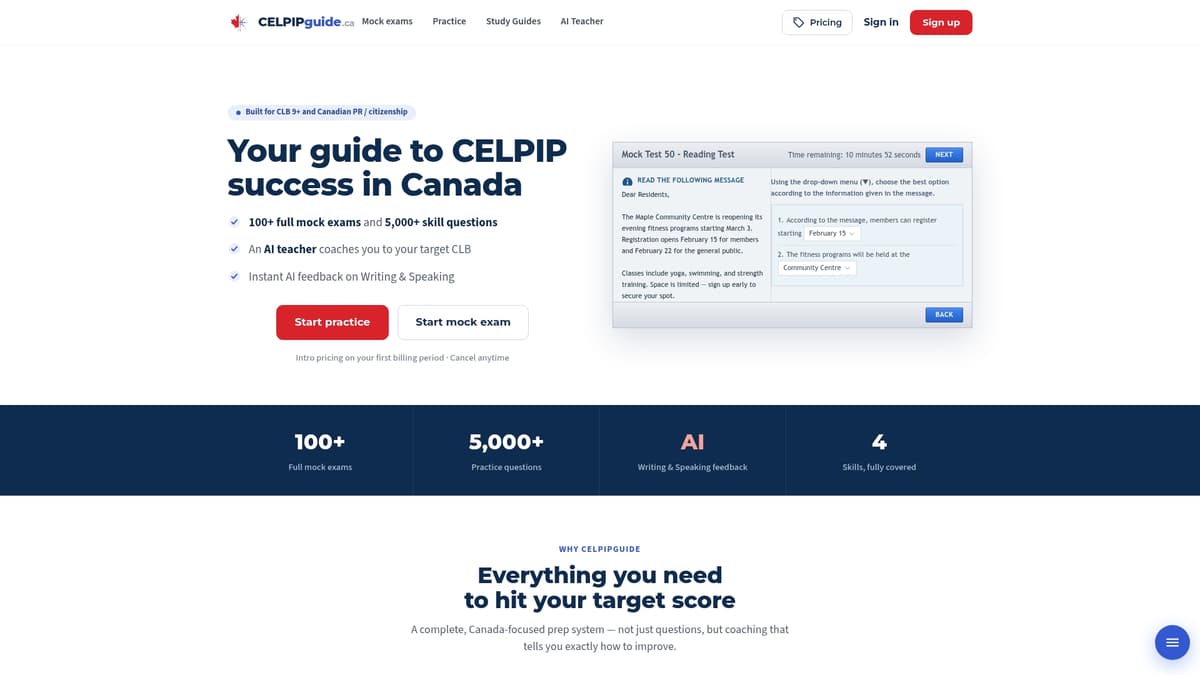
From there, our platform gives you access to more than 100 full-length mock exams and over 5,000 practice questions, all aligned to CLB-banded difficulty so you’re always practising at the level that matches your target. Our AI teacher reviews your speaking and writing responses instantly, flagging the specific issues holding your score back instead of leaving you to guess what an examiner might think. Every plan also includes personalized study plans that adjust based on your progress, plus built-in progress tracking so you can see your movement toward your target band over time.
Here’s what’s included with CELPIPguide Plus:
- A diagnostic test to establish your starting CLB band across all four skills.
- Over 100 full-length mock exams for realistic, timed practice.
- More than 5,000 practice questions covering every task type.
- AI feedback on writing and speaking tasks, scored against the same rubrics CELPIP uses.
- Personalized study plans and progress tracking that adjust as your scores improve.
Getting started takes a few minutes: try a free practice test first, then unlock full access through our Plus plan for $29.99.
FAQ
How is CLB calculated for CELPIP?
Your raw CELPIP-G scores in each of the four skills, speaking, listening, reading, and writing, get converted into a CLB band using official conversion tables published alongside the Canadian Language Benchmarks. Each skill receives its own separate CLB level rather than one combined score.
How do I score CLB 10 in CELPIP?
CLB 10 generally requires performance near the top of CELPIP’s scoring range in each skill, reflecting the highest CRS point bracket, which awards 34 points per ability for single applicants. Getting there typically means building a one-band buffer above CLB 9 through consistent, timed full-mock practice and targeted correction of recurring errors in your writing and speaking responses.
How do I get CLB 9 in CELPIP speaking?
CLB 9 in speaking usually comes from clear task fulfillment, a reasonably wide vocabulary range, and controlled grammar delivered within the time limit for each prompt. Practising with timed responses and reviewing feedback against CLB speaking descriptors helps you identify whether content, delivery, or language accuracy is holding your score back.
Is CLB 9 a good score in CELPIP?
CLB 9 is a strong score that qualifies for meaningful CRS language points, 31 points per ability for single applicants or 29 for those with a spouse. Whether it’s “good enough” depends on your specific goal: it meets many Express Entry and professional requirements, though candidates close to recent invitation cutoffs may still benefit from pushing toward CLB 10.