
CELPIP Blog
170–180 Words: The CELPIP Word Count That Wins Points
170–180 Words: The CELPIP Word Count That Wins Points

Aim for about 150 to 200 words on each CELPIP writing task, and treat roughly the middle of that range as your personal sweet spot for test day. That mid-range target gives you room to develop your ideas fully without risking a rushed, sloppy finish. The test interface has a built-in word counter, and you should glance at it two or three times while drafting, never as a constant distraction.
TL;DR:
- Writing between 170 and 180 words provides enough room for full development and avoids rushed, shallow responses that hurt task fulfillment.
- The word count should be viewed as a development guideline, not a strict limit, since CLB level and content quality determine scoring.
- During the test, check the on-screen word counter twice at strategic points to stay on pace without breaking concentration.
- Most common issues, such as underdeveloped content or repetitive phrasing, can be fixed in the last minute by adding details or trimming excess words.
- Repeated timed practice with full mock exams and AI feedback helps internalize pacing, structure, and length, improving overall response quality.
Table of Contents
- What the official instructions actually say
- How raters treat length: where word count helps or hurts
- Your exact target and minute-by-minute plan
- Using the on-screen word counter without losing your rhythm
- What 170 to 180 words actually looks like on the page
- Common mistakes and the one-minute fixes
- Why we focus on task fulfillment over counting words
- Build word-count and timing habits with Celpipguide Plus
- FAQ
- Sources
What the official instructions actually say
The official CELPIP task prompts ask you to respond “in about 150 to 200 words” for both Writing Task 1 (an email) and Writing Task 2 (a survey response). That phrasing comes straight from the official task instructions, and it is worth sitting with for a second, because the word “about” is doing real work.
“About” tells you the range has flex built in. You will not lose points for writing 148 words instead of 150, and you will not get a bonus for hitting exactly 200. What the instruction signals is depth: the task setters expect a response substantial enough to develop an idea with examples and reasoning, not a quick note that technically answers the prompt. A 60-word email might be grammatically perfect and still score poorly, because it cannot show the range of language and organization the raters are looking for.

This matters more than it might seem, because CELPIP results feed directly into Canada’s immigration system. Your writing score converts to a Canadian Language Benchmark (CLB) level, and that level affects the points you receive through pathways like Express Entry. The IRCC language test guidance lays out exactly how CELPIP results map to CLB levels used in immigration scoring.
A few things follow from this:
- The word count instruction exists to prompt adequate development, not to set a hard pass or fail line.
- Writing short and writing shallow often happen together, which is the real risk behind under-length responses.
- Your CLB level, not your raw word count, is what ends up on your immigration paperwork.
- Treating the range as a floor and ceiling, rather than a suggestion, keeps your response aligned with what the rubric actually rewards.
Once you see the word count as a proxy for development rather than a rule to satisfy mechanically, the rest of your strategy gets a lot clearer.
How raters treat length: where word count helps or hurts
Word count never appears as its own line item on the CELPIP writing rubric. Instead, it shows up indirectly through four components raters actually score: content and coherence, vocabulary, readability, and task fulfillment. Each of these depends on having enough words to work with.
Task fulfillment asks whether you addressed every part of the prompt with appropriate detail. A 90-word response might touch on the topic but skip the explanation or example that shows you understood the full task. Coherence asks whether your ideas connect logically, which is hard to demonstrate in a handful of choppy sentences. Vocabulary range needs enough text to display variety rather than repeating the same three words. None of these is a word-count rule in disguise, but all of them become harder to satisfy when you write too little.
The Canadian Language Benchmarks reinforce this directly. The framework describes communicative competence in terms of discourse organization, strategic competence, and task performance rather than prescribing an exact number of words. Strategic competence in particular covers your ability to plan a response and revise it under pressure, which is exactly why a deliberate minute-by-minute writing plan pays off: it is the kind of self-management the benchmarks are built around.
One CLB level shift in your writing score can change your Express Entry points outcome, because IRCC’s language test documentation ties CELPIP levels directly to the CLB conversion charts used across immigration programs. A thin, underdeveloped response that technically meets the minimum word count can still land you a CLB level lower than you need.
A quick list of what tends to cost marks when responses run short:
- Missing or underexplained supporting details that task fulfillment specifically rewards.
- Limited vocabulary variety because there simply is not enough text to show range.
- Weak coherence, since short responses often skip the connective sentences that tie ideas together.
- A rushed conclusion that fails to close the loop on the prompt’s requirements.
Your exact target and minute-by-minute plan
Aim for about the middle of the official range on each task. That approach gives you a cushion on both sides: enough development to satisfy task fulfillment, and enough time left over for a real edit instead of a frantic rush at the end.
CELPIP gives you 27 minutes for Task 1 and 26 minutes for Task 2. Here is a workable split for each:
- Plan (5 to 7 minutes): Jot down your main point, two supporting details, and a closing line before you type a single sentence.
- Write (17 to 20 minutes): Draft continuously without pausing to polish every phrase. Getting your ideas down matters more than perfect grammar on the first pass.
- Revise (3 to 5 minutes): Check your word count, tighten repetitive phrases, and fix the two or three errors that jump out immediately.
For an email response, distribute your 170 to 180 words across three or four short paragraphs: an opening that states your purpose in one or two sentences, a middle section of two paragraphs that each cover one supporting point with a brief example, and a closing paragraph of one or two sentences that wraps up the request or response. For a survey response, structure it as an introduction stating your position, two body paragraphs each anchored by a reason and a short example, and a conclusion that restates your stance in different words.
If you finish your draft short, the fastest fix is adding one concrete example or a brief explanatory clause to a point you already made, rather than inventing a new idea from scratch. If you run long, cut repeated phrasing first: candidates often restate the prompt’s wording in both the introduction and conclusion, which wastes 10 to 15 words that add nothing.
A practical word-counter tool is worth using during practice sessions at home, so you build an internal sense of what 170 words actually feels like on the page before you ever sit the real test.
Pro Tip: Keep two or three flexible transition phrases ready, like “for example” or “as a result.” They add clarity and a handful of meaningful words at once, which is far more efficient than padding with adjectives.

Using the on-screen word counter without losing your rhythm
The CELPIP writing interface displays a live word counter as you type, and the smart way to use it is sparingly. Check it at two natural checkpoints: once after you finish your first full paragraph, to confirm your pacing is on track, and again as you start your final paragraph, to see how much room you have left for a solid close.
Checking constantly breaks your concentration and eats into your writing time. Checking too little risks discovering with two minutes left that you are 60 words short, which forces rushed padding instead of thoughtful development.
Set an internal checkpoint around the 10-minute mark of your writing phase: if you are under 80 words at that point, you likely need to add a second supporting detail rather than wrapping up early.
A few habits worth building into your practice:
- Glance at the counter after each paragraph rather than after each sentence.
- Use the built-in spell-check for obvious typos only, never as a substitute for proofreading your grammar.
- Reserve your last 60 to 90 seconds for a final word-count check rather than new content.
- Treat a 170 to 180 count mid-draft as a sign you are on pace, not a reason to stop early.
Spell-check will catch a misspelled word, but it will not flag a wrong verb tense or a missing article, so do not let it replace a genuine read-through.
What 170 to 180 words actually looks like on the page
A response in this range typically runs five to six sentences per paragraph across three to four paragraphs, which gives you enough structure to separate your ideas clearly without stretching any single point too thin.
For an email response, a natural shape looks like this: one or two sentences to open and state your purpose, two body paragraphs of three to four sentences each covering a distinct point with a brief supporting detail, and a closing paragraph of one or two sentences. For an opinion-style survey response, use one sentence to state your position, two body paragraphs of three sentences each giving a reason and an example, and a two-sentence conclusion that reinforces your stance.
Aiming for the middle of the official range, around 170 to 180 words, is a widely recommended practice-test tactic because it balances development against the risk of rambling past 200. The goal is not to hit a number precisely but to use that number as a guide for how much detail is appropriate.
Concise language choices help you reach that target without padding:
- Replace a vague phrase like “there are many reasons why” with the specific reason itself.
- Combine two short, related sentences with “because” or “so” instead of listing them separately.
- Cut throat-clearing openers such as “I am writing to inform you that” down to the actual information.
- Use one specific example rather than two generic ones, since specificity reads as more developed even in fewer words.
Common mistakes and the one-minute fixes
Most word-count problems come down to one of two habits: writing too thin or writing past the point of usefulness. Both are fixable in the last minute if you know what to look for.
- Under 150 words: Add one concrete example to your strongest point rather than a new idea, since a single detailed example often adds 15 to 20 words and strengthens task fulfillment at the same time.
- Repeating the prompt’s wording: Cut any sentence that just restates the question, and replace it with your actual answer or position.
- Over 210 words: Trim your longest example down to one sentence instead of two, and remove any sentence that repeats a point you already made.
- Weak topic sentences: Tighten vague openers like “this is an important issue” into a direct statement of your actual point.
- Rushed conclusions: Spend your final 20 seconds confirming your closing sentence actually answers the prompt, since a vague ending can undercut otherwise strong content.
Why we focus on task fulfillment over counting words
Word count is a useful guardrail, not the goal itself. We have seen plenty of candidates hit exactly 180 words and still underperform because the content was thin or off-topic. The real skill is pairing a mid-range target with genuine development: a clear point, a specific example, a logical close.
That is the habit worth building through repeated, timed practice rather than memorizing a number. Consistency comes from doing the drafting, revising, and pacing routine enough times that it becomes automatic under real test pressure.
— Reza
Build word-count and timing habits with Celpipguide Plus
Hitting 170 to 180 words with real development is a habit you build through repetition, not a trick you apply once on test day. Our Celpipguide Plus plan gives you full-length mock exams under the same time limits you will face in the real test, so you practise the exact minute-by-minute plan described above until it feels automatic.
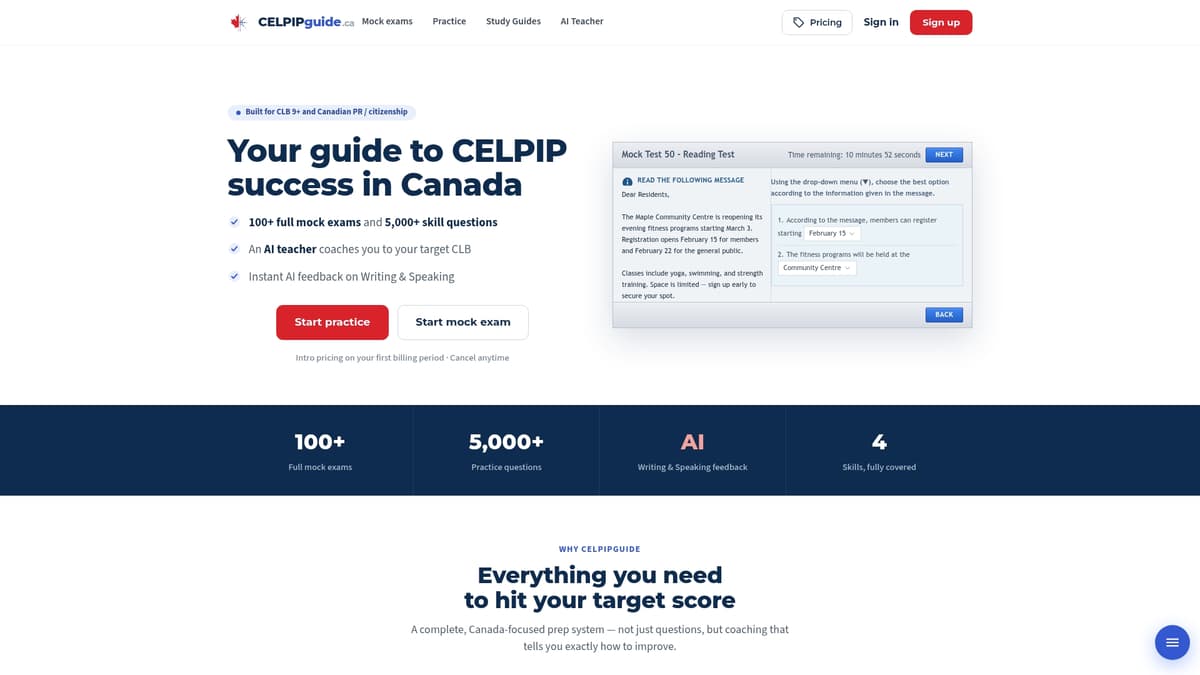
Each writing task you submit gets instant, rubric-based feedback from an AI system, which flags whether your response is underdeveloped, off-topic, or running long before you ever sit the real exam. That means you find out where your drafts fall short while there is still time to fix the habit, not after your results arrive.
Our practice service includes:
- Full mock exams that mirror official CELPIP timing and task format.
- Instant AI feedback on writing tasks, scored against official rubric components.
- A diagnostic test that helps identify weak spots such as development, coherence, or pacing.
Use code BLG30 for 30% off when you sign up through our Plus plans page.
FAQ
Is CELPIP scored out of 10 or 12?
CELPIP writing and speaking scores convert to Canadian Language Benchmark (CLB) levels, with each skill reported individually as a CLB level. Reading and listening scores also use the CLB conversion system.
Can I prepare for CELPIP in three days?
Three days is enough time to review task formats, practise the on-screen word counter, and run one or two timed mock writing tasks, but it is tight for building the pacing habits this guide describes. A longer runway with repeated timed practice gives you a better shot at consistently hitting a strong CLB level.
What does an IELTS score of 8777 equal in CELPIP?
CELPIP and IELTS use different scoring scales and are not officially converted one to one by IRCC, so there is no single confirmed CELPIP equivalent for a specific IELTS band combination. For immigration purposes, check the official CLB conversion chart for the test you actually took.
What does 34 out of 38 mean on CELPIP reading?
CELPIP reading results are reported as a CLB level rather than a raw score, since the test does not publish a simple fraction-based scale. If you see a raw score from a practice test, check it against the official CLB conversion documentation rather than treating it as your final benchmark.
Sources
For the primary documents behind the guidance above, start with IRCC’s language test results page and the Canadian Language Benchmarks framework. For practice, a simple word counter tool helps you calibrate what 170 to 180 words feels like before test day, and this Functional Skills English guide is a useful read on how length and coherence interact in written assessments generally.
- Canada