
CELPIP Blog
Beat CELPIP Time Pressure With a Part by Part Reading Plan
Beat CELPIP Time Pressure With a Part by Part Reading Plan

Use question-first reading combined with skimming and scanning, strict per-part time budgets, and elimination-based guessing. These four tactics raise accuracy and stop the time loss that sinks most CELPIP Reading scores. There’s no penalty for wrong answers, so every question gets a real attempt. The part-by-part adjustments below build directly on this base.
TL;DR:
- Proper pacing ensures each part is completed within its own time limit, preventing rushing in later sections and reducing blind guessing.
- Skimming for main ideas and scanning for keywords significantly improve speed and accuracy, particularly in diagram-based and detail questions.
- Applying the 60 second rule to unanswered questions and answering easy ones first can boost overall question accuracy under time pressure.
- Focused practice with timed mock exams and error analysis accelerates score improvements more effectively than passive reading alone.
- Recognizing common distractors like extreme or plausible but incorrect options helps eliminate wrong answers quickly and confidently.
Table of Contents
- Celpip reading strategies you can use in every part
- What is the CELPIP reading format and why does timing matter?
- Part-by-part strategies: what to do differently in Parts 1 to 4
- Time management tactics and the 60 second triage rule
- Short practice plans that build real reading speed
- Common traps and how to eliminate wrong answers fast
- Understanding the different question types in CELPIP reading
- Vocabulary building strategies tailored for CELPIP
- How to annotate and take notes while reading on screen
- Tips for handling unfamiliar topics or dense passages
- Author perspective: what actually moves scores
- Practise these celpip reading strategies with Celpipguide
- Trusted practice links and reference reading
- Sources
- FAQ
Celpip reading strategies you can use in every part
Most test-takers lose marks to time, not comprehension. They read the whole passage first, run out of minutes on Part 4, and guess blindly on the last three questions. Fix the order of operations and the scores follow.
Here are five tactics that work in every practice session and on test day:
- Read the questions first. Know what you’re hunting for before your eyes touch the passage.
- Skim for the main idea, then scan for two or three keywords tied to each question.
- Eliminate obviously wrong answers before you commit to a final choice.
- Set per-part time checkpoints and apply the 60 second triage rule (more on that below).
- Practise with a timer running, then review exactly why each missed question went wrong.
Pro Tip: Circle or mentally flag the keyword in the question stem before you scan the passage. If you can’t find it in ten seconds, it’s paraphrased, so scan for the meaning instead of the exact word.
What is the CELPIP reading format and why does timing matter?
CELPIP Reading has four parts, each with its own passage, question set, and independent timer. You cannot borrow minutes from Part 1 to rescue Part 4, which is exactly why pacing has to be planned before test day, not improvised during it.
The split-screen layout puts the passage on one side and questions on the other, so you’re constantly toggling between them rather than reading a printed page top to bottom. That interface rewards scanning skills over deep, linear reading.
| Part | Task | Questions | Suggested time | Rough seconds per question |
|---|---|---|---|---|
| Part 1 | Correspondence (email/letter) | about a dozen | about eleven minutes | about one minute per question |
| Part 2 | Diagram or informational text | several | about nine minutes | just over a minute per question |
| Part 3 | Information text (news or general topic) | close to ten | about ten minutes | about one minute per question |
| Part 4 | Viewpoints (comparing two opinions) | close to ten | about ten minutes | about one minute per question |
Timing varies slightly by test version, but the essential strategies for the CELPIP reading component confirm the core principle: each part runs on its own clock, so a slow start in Part 1 puts real pressure on Part 4. Build your pacing habits around that constraint from day one, not the week before your exam.
Part-by-part strategies: what to do differently in Parts 1 to 4
Each part of CELPIP Reading rewards a slightly different reading muscle. Treating them all the same is the single biggest strategic mistake I see in practice logs.
Part 1: Correspondence. This is a personal or business letter, and the questions usually hinge on one requested action buried in the middle paragraphs. Read the greeting and closing fast, they rarely carry marks, then hunt for what the writer is actually asking the recipient to do. Overreading the pleasantries wastes time you need for the actual request.
- Scan for keywords like “please,” “could you,” “I was wondering,” or “let me know.”
- Re-check your answer by rereading only the sentence containing the action verb, not the whole paragraph.
Part 2: Diagram-based text. You’re matching a written passage to a chart, schedule, or notice. Orient yourself on the diagram’s headers and labels before reading a single line of the paragraph. Cross-referencing between the visual and the text is where most points get lost, according to EEC’s CELPIP reading breakdown, because test-takers assume the diagram matches the text exactly when it often adds a detail the paragraph doesn’t mention.
- Scan for dates, times, room numbers, or dollar figures that appear in both the diagram and the text.
- Double-check labels twice. A mismatched label between the chart and a question option is a deliberate trap.
Part 3: Information text. This reads like a short article or workplace notice, and the fastest technique here is paragraph-mapping. Give each paragraph a one or two word mental tag (“cause,” “solution,” “cost”) as you skim, so when a question asks for a supporting detail, you already know which paragraph to search.
- Scan for named entities, numbers, and dates first. These anchor detail questions.
- Re-read only the tagged paragraph, never the whole passage, to confirm an answer.
Part 4: Viewpoints. Two people disagree on a topic, and the questions test whether you can track who believes what. As you skim, jot a quick note (even mentally) on each writer’s stance, then annotate which lines support each position. Inference questions here almost always require comparing both texts, not just rereading one.
- Scan for contrast words: “however,” “on the other hand,” “in contrast,” “unlike.”
- Re-check inference answers by asking which writer’s argument the answer choice actually echoes.
Time management tactics and the 60 second triage rule
Set a mental checkpoint at the halfway mark of every part. If you’re not roughly halfway through the questions by then, you’re behind, and it’s time to speed up rather than push through at the same pace.
The 60 second rule is simple: if you’ve spent 60 seconds on a single question with no clear answer emerging, flag your best guess and move on. Coming back later with fresh eyes beats grinding on one question while three easier ones sit unanswered.
- Answer easy questions first, then medium, then the ones that need real digging.
- Never leave a question blank. Guessing costs nothing and an informed guess often lands right.
- Track your pace with a reading speed test during practice so you know your natural words-per-minute baseline.
Practising this rule matters more than most candidates think. Instructional guidance across CELPIP prep resources consistently notes that harder questions tend to cluster later in each part, so saving a buffer of time for the back half of a section is rarely wasted.
Quick drill: Time yourself on a single Part 3 passage, and force yourself to move on the instant your mental stopwatch hits 60 seconds on any one question. Repeat this three times across a week and the habit sticks.
Short practice plans that build real reading speed
You don’t need months of study to see movement in your reading score. A tight, structured week or two, done consistently, beats scattered cramming every time.
- Days 1 to 3: Ten minutes of skimming practice each morning (headlines, short articles), plus one 20 minute timed question set focused on a single part.
- Days 4 and 5: Repeat the timed set with a different part, and log every wrong answer with a one-line reason (“missed keyword,” “overread,” “ran out of time”).
- Day 7: Review your error log, target three vocabulary gaps with a vocabulary tracker, and rebalance your pacing based on which part ran long.
- Week 2 (optional): Repeat the cycle, but shift practice time toward whichever part scored lowest in Week 1’s mock.
Daily short sessions beat one long weekend cram, and the CELPIP in 5 minutes a day approach backs that up. Reading in English daily, even briefly, keeps your scanning reflexes sharp without burning you out before test day.
Common traps and how to eliminate wrong answers fast
Distractor answers follow patterns once you’ve seen enough of them. Extreme words (“always,” “never,” “completely”) often signal a wrong choice, since real passages rarely make absolute claims. Invented facts that sound plausible but never appear in the text are another common trap, along with answers that are technically true but outside the scope of what the question actually asked.
Use this three-step elimination routine when you’re stuck between options:
- Rule out anything that directly contradicts a stated fact in the passage.
- Cut anything that answers a slightly different question than the one asked (scope mismatch).
- Compare the two remaining choices side by side, word for word, against the exact question stem.
Pro Tip: With under two minutes left in a part, stop reading new passages entirely. Eliminate one obviously wrong option on every remaining question, then guess from what’s left. That’s informed guessing, not blind guessing, and it’s a real accuracy boost.
Understanding the different question types in CELPIP reading
CELPIP Reading questions generally fall into four buckets: main idea, detail, inference, and vocabulary-in-context. Each one asks you to work with the text differently, and mixing up your approach is what causes avoidable errors.
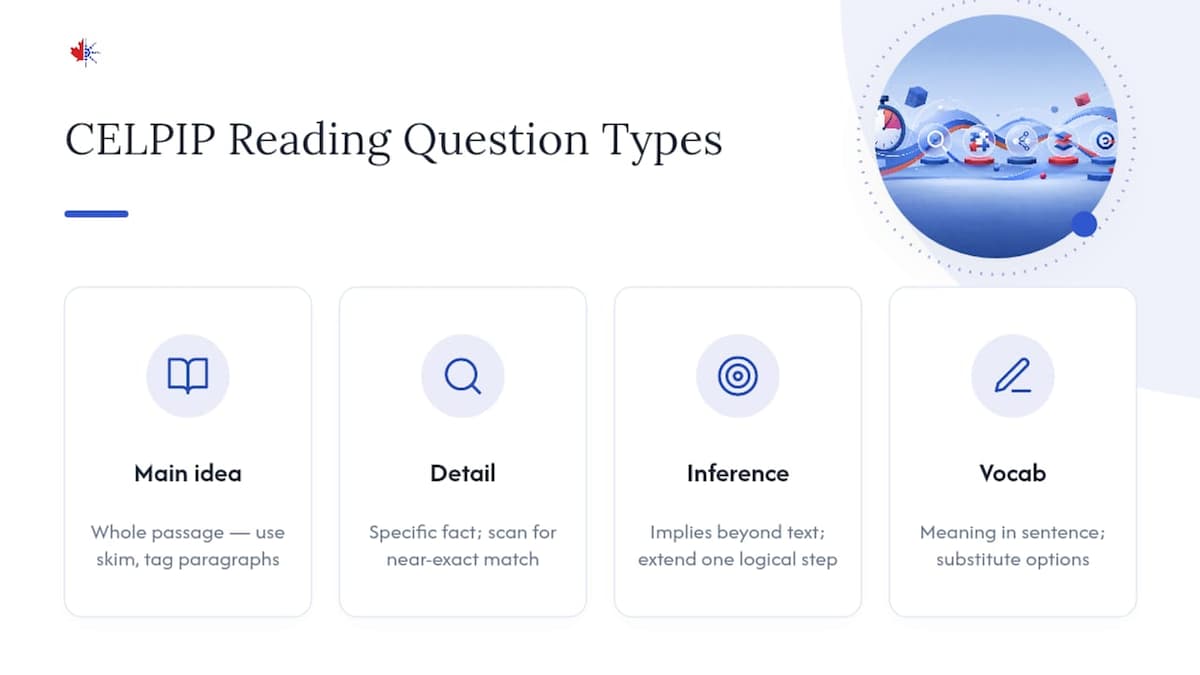
Main idea questions ask what the passage as a whole is about, or what the writer’s overall purpose is. These reward your initial skim. If you’ve already tagged each paragraph’s role while reading, the main idea question answers itself without a second pass.
Detail questions ask for a specific fact stated in the text: a date, a name, a number, a reason. These are pure scanning exercises. The answer is almost always a near-exact match to something written in the passage, so your job is locating it fast, not interpreting it.
Inference questions ask what the text implies without stating it directly. These show up most in Part 4’s viewpoints, where you compare two writers’ positions and figure out what each would likely say about a related point. Inference questions punish overthinking. The safest answer is usually the one that stays closest to what’s actually written, extended by one small logical step.
Vocabulary-in-context questions ask for the meaning of a word or phrase as it’s used in that specific passage, which sometimes differs from the word’s most common dictionary sense. Reread the sentence containing the word, then test each answer choice by substituting it back into that sentence. The option that keeps the sentence’s meaning intact is your answer.
Knowing which bucket a question falls into before you start searching the passage cuts wasted reading time significantly.
Vocabulary building strategies tailored for CELPIP
CELPIP reading passages draw from everyday Canadian contexts: workplace notices, community bulletins, news articles, personal correspondence. Building vocabulary for this test means training on that register, not on academic or literary English that rarely shows up on exam day.
Focus your word-learning on functional vocabulary first: transition words (however, therefore, in addition), request language (I was wondering, could you possibly), and comparison language (in contrast, similarly, unlike). These words carry disproportionate weight because they signal the structure of an argument or request, which is exactly what CELPIP questions test.
Build a rotating list of 10 to 15 new words per week rather than trying to memorize long alphabetical lists. Pull them directly from passages you’ve practised on, since words that already appeared in a CELPIP-style context stick better than words from a generic vocabulary book. A tool like CELPIPguide’s vocabulary tracker can help organize this by tagging words to the passage type where they appeared.
Don’t chase obscure or rare words. CELPIP Reading rewards recognizing common words used precisely, not decoding rare ones. If you’re spending study time on words you’ll never see in a workplace memo or a community notice, redirect that time toward reading speed drills instead.
How to annotate and take notes while reading on screen
CELPIP Reading is delivered on a computer, so traditional underlining and margin notes aren’t available the way they would be on paper. Your annotation strategy has to adapt to that constraint.
Mental tagging replaces physical underlining. As you skim each paragraph, silently label its function: “background,” “problem,” “solution,” “opinion A,” “opinion B.” This takes seconds and gives you a mental map you can return to without rereading everything.
If scratch paper is permitted at your test centre, use it sparingly. A quick note like “Para 2 = cost, Para 4 = deadline” saves far more time than it costs to write, especially in Part 3’s longer information texts where detail questions can point to any paragraph.

For Part 4’s viewpoints, a simple two-column mental or physical note, one side per writer, tracking their stance on two or three sub-topics, makes inference questions dramatically faster to answer. You’re no longer rereading both texts each time a question asks who believes what.
The goal of any annotation system on this test is speed of retrieval, not thoroughness. If a note takes longer to write than it saves in rereading time, skip it and rely on paragraph-mapping instead.
Tips for handling unfamiliar topics or dense passages
CELPIP passages sometimes cover topics you know nothing about: a workplace policy on a niche industry, a community debate on a bylaw you’ve never heard of. That unfamiliarity feels harder than it actually is, because CELPIP Reading tests comprehension of the text in front of you, not outside knowledge.
Every answer lives inside the passage. You never need background knowledge to answer a CELPIP reading question correctly, so resist the urge to reason from what you already know about a topic. If a passage describes a city council debate you’ve never followed, the answer is still sitting in the text, not in your general awareness of municipal politics.
When a passage feels dense or the sentences run long, slow down on the first read only enough to identify structure: who is the writer, what is the main claim, where do the paragraphs shift topic. Once you have that skeleton, the specific facts inside each paragraph become much easier to locate quickly when a question sends you back in.
Complex sentences with multiple clauses often contain one simple fact wrapped in extra qualifying language. Strip out the qualifiers (“although,” “despite the fact that,” “which some argue”) mentally, and look for the core subject-verb-object of the sentence. That’s usually where the tested detail lives.
If a passage’s topic feels intimidating before you’ve even started reading, that’s a signal to skim faster, not slower. Panic-reading a dense paragraph word by word burns time you need for the questions that follow it.
Author perspective: what actually moves scores
The candidates who improve fastest aren’t the ones who read the most practice passages. They’re the ones who time every single practice set and review their errors line by line afterward. Passive reading builds vocabulary slowly; timed practice with error analysis builds test-taking speed, which is the actual bottleneck for most people.
Start with a diagnostic to find your weak part, then pair short timed reading sets with focused vocabulary review. That combination consistently produces faster gains than broad, untimed study.
— Reza
Practise these celpip reading strategies with Celpipguide
Reading theory only takes you so far. What actually moves your score is repetition under real time pressure, with feedback that tells you exactly where you’re losing marks. The platform gives you that loop: a diagnostic that pinpoints weak question types, full-length timed mock exams that mirror the split-screen interface, and a study plan that adjusts as your scores shift.
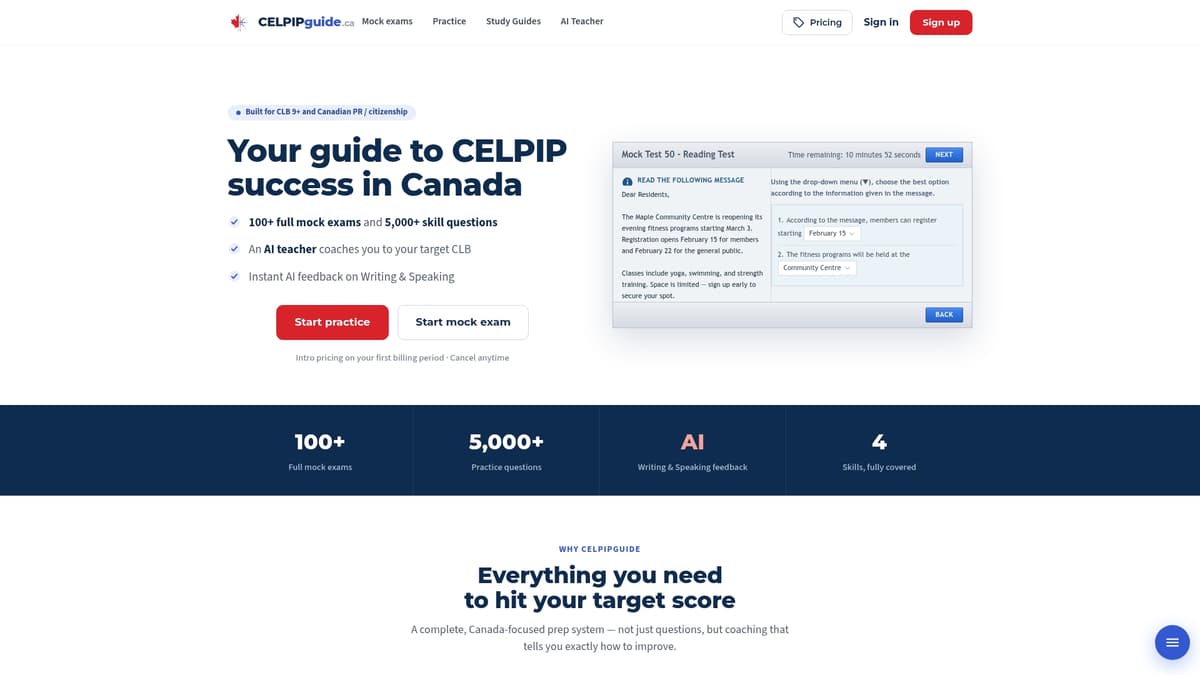
Start with the CELPIP Readiness Check if you’re not sure which part is costing you the most marks. Already know Part 4 is your weak spot? Head straight to a full-length mock exam and practise the pacing checkpoints from this guide under real conditions. A Plus plan unlocks the complete library of mock exams, feedback, and personalized study plans for a one-time fee. For current prices, see the pricing page. Use coupon code BLG30 at checkout for 30% off your Plus plan and start closing the gap between practice scores and test day.
Trusted practice links and reference reading
For hands-on practice, try Paragon’s free official sample test and Celpipguide’s reading practice test, alongside the essential strategies breakdown from CIC News.
Sources
- Essential strategies for the reading component of your CELPIP test
- CELPIP Reading Tips 2026 | All 4 Parts | EEC
- Paragon free online sample test
- reading-speed-test | TESTUNO
FAQ
How can I improve my reading in CELPIP?
Read the questions before the passage, skim for the main idea, then scan for specific keywords tied to each question. Pair that with timed practice sets and a focused review of every wrong answer to build both speed and accuracy over a few weeks.
How can I practice reading for the CELPIP test?
Use timed drills on official-style sample material, like Paragon’s free online sample test, and log your errors after every session. A short one or two-week routine of daily skimming practice plus twice-weekly full mocks, such as those on CELPIPguide’s practice hub, builds pacing skills faster than untimed reading alone.
What are the five basic reading strategies?
The five core tactics are question-first reading, skimming for the main idea, scanning for keywords and details, eliminating clearly wrong answers, and managing time with per-part checkpoints. Applying all five together, rather than just one, is what produces a measurable score improvement.
What does 34 out of 38 in CELPIP reading mean?
A raw score converts to a specific CLB level based on CELPIP’s official scoring scale, and that scale isn’t published as a simple linear conversion. Check your official score report for the exact CLB equivalent tied to your raw score, since conversion tables can shift slightly between test versions.