
CELPIP Blog
Budget Your CELPIP Prep Cost in Canada: $319 Test Fee + Real Prices
Budget Your CELPIP Prep Cost in Canada: $319 Test Fee + Real Prices

The CELPIP-General test costs $319 CAD before tax, and CELPIP-General LS costs $265 CAD before tax, straight from the official pricing page. Prep costs on top of that range from free for self-study to prices that can be high for private tutoring or intensive coaching, with many learners spending a moderate amount for a structured course. Your real total depends on tax, whether you reschedule, and which prep format you pick.
TL;DR:
- Most test-takers spend between $150 and $700 on preparation, depending on the format, duration, and whether they opt for self-study or private coaching.
- Additional costs like extra mock exams, score report fees, and retake charges can add up to $50 to $150 beyond initial expenses.
- Booking a test outside Canada can significantly increase the final fee due to higher regional prices and taxes, sometimes reaching $360 or more.
- Diagnostic-driven platforms and AI-based practice tools often provide more cost-effective solutions targeted at your actual weak skills, compared to traditional group courses.
- The most economical approach involves taking an official mock test early to identify gaps and then choosing a prep format aligned with your specific needs and timeframe.
Table of Contents
- How much does CELPIP prep cost, really?
- What do prep courses actually cost across the market?
- What you actually get at each price point
- How to budget: sample timelines and total costs
- How to choose a prep option for your budget and goals
- Refund and cancellation policies for prep courses and materials
- Additional costs to consider beyond the course fee
- Where structured practice hubs actually save you money
- Get exam-ready without overpaying for it
- Sources
- FAQ
How much does CELPIP prep cost, really?
Let’s start with the number everyone wants first: your test fee is fixed, but your prep budget isn’t. CELPIP’s official overview page lists CELPIP-General at $319 CAD and CELPIP-General LS at $265 CAD, both before applicable taxes. If you’re testing outside Canada, expect a different figure. CELPIP explicitly notes that international pricing varies by market, so don’t assume the Canadian rate applies if you’re booking from abroad.
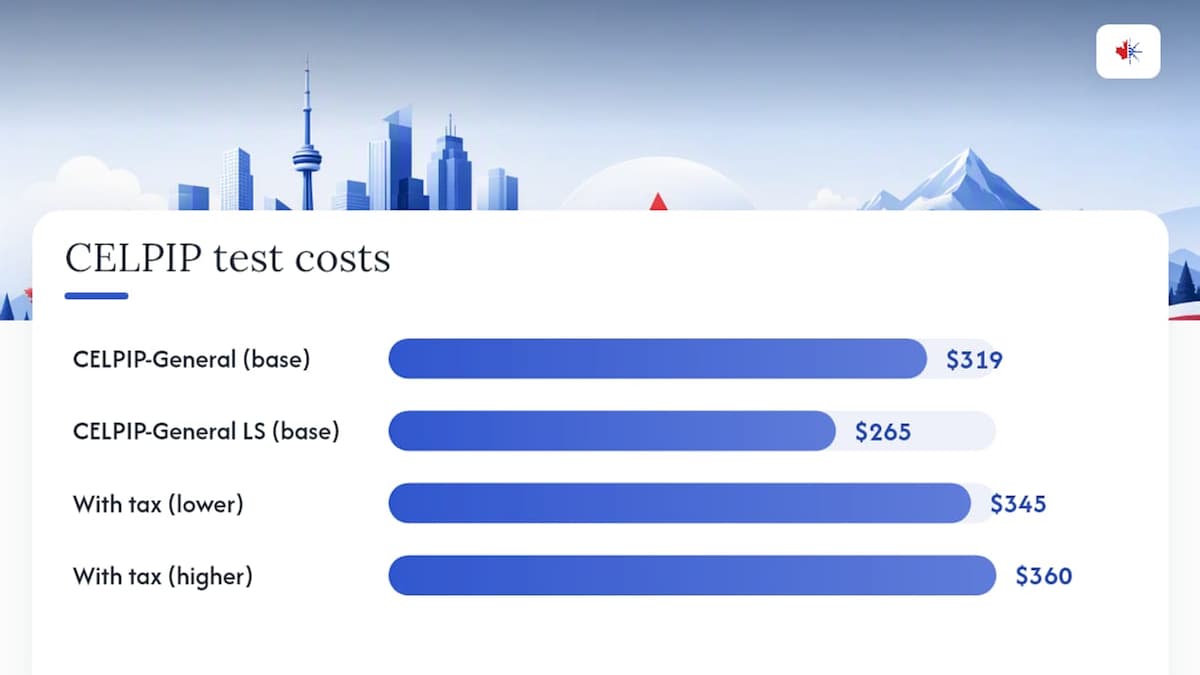
Tax adds a real chunk on top. Depending on your province, GST or HST can push that $319 fee closer to $345 to $360 once everything’s added up. That’s money most budgeting guides skip, and it’s the first place people get caught off guard.
A few policy details change your final cost more than people expect:
- Rescheduling fees apply if you move your test date, and the closer you are to your original slot, the more it typically costs.
- Late cancellation can mean forfeiting most or all of your fee, with no refund window once you’re inside the cutoff period.
- Retake fees are identical to the original test fee. There’s no discount for trying again, so a failed first attempt effectively doubles your test-fee spend.
If you want the full breakdown of retake math and how a $319 slip becomes a much bigger bill, Celpipguide’s dedicated fee guide walks through it in detail. For the current, always-accurate numbers, book directly through the official CELPIP registration portal rather than relying on any third-party estimate, including this one.
What do prep courses actually cost across the market?
Prep pricing splits into four rough bands, and knowing which one you’re shopping in saves you from either overpaying or under-preparing.
- Free to self-study: Official starter practice tests and free materials exist directly from the test maker.
- Low-cost, short-format: Roughly $100 to $300, often billed weekly or as a short block.
- Mid-range, multi-week courses: Roughly $300 to $700 for structured group instruction over several weeks.
- High-end private tutoring or bootcamps: $700 and up, sometimes well up, for one-on-one coaching.
Real numbers back this up. Paragon Testing’s instructional products page hosts free CELPIP-General starter practice tests alongside paid study materials, giving you a genuine zero-cost entry point before you spend a cent. On the live-course end, the Canadian College of English Language publishes a rate of around $110 CAD per week for online CELPIP prep, which stacks up fast over a multi-week program. Meanwhile, a Surrey, BC provider lists a 4-week CELPIP-General preparation course at $399 CAD, landing squarely in the mid-range band.
Here’s the detail that matters most when comparing these listings: a weekly rate multiplied across a full course can land you at a similar total to a flat multi-week price, even though one looks cheaper on the surface. Always calculate the full course length before comparing sticker prices, not just the per-week number. What you get for that money also varies. Some packages include scheduled class hours and instructor feedback on writing and speaking; others are closer to a self-guided module with a handful of mock tests bundled in. Read the inclusions line by line, not just the headline price.
What you actually get at each price point
Price maps pretty directly to how much personal attention and structure you’re buying. Here’s how the four main formats break down:
- Self-study (free to low cost). You’re using official starter tests and free resources, doing your own scheduling, and scoring your own practice writing. This works well if you’re already close to your target CLB and mainly need familiarity with the test format.
- Paid online platforms (subscription-based). You get ongoing access to mock exams, automated or AI-driven feedback, and progress tracking, often for a fraction of a group course’s price stretched across weeks or months.
- Group in-person or live-online classes. You get set class hours, peer practice partners, and an instructor who reviews your work, but on a shared schedule that may not match your weak spots specifically.
- Private tutoring. You get one-on-one attention and a plan built around your exact gaps, at the highest hourly rate of any format.
If you’re strong in three skills and shaky in one, a subscription platform or a few tutoring hours targeting that gap beats paying for a full group course covering skills you’ve already mastered.
How to budget: sample timelines and total costs
Your total spend depends heavily on how much time you give yourself. Compressed timelines usually cost more per week because you’re paying for intensity, not just content.
- 4-week sprint: Test fee ($319) + a short paid course or subscription (~$150 to $250) = roughly $470 to $570 total. Works if you’re already close to your target score and need focused polishing.
- 8-week steady plan: Test fee ($319) + a mid-range multi-week course (~$300 to $500) = roughly $620 to $820 total. A good middle ground for most first-time test-takers.
- 12-week gradual plan: Test fee ($319) + self-study plus targeted paid practice materials (~$100 to $250) = roughly $420 to $570 total, spread thin enough to fit around a job or school schedule.
Registration lead times matter here too. Book your test date once you have a realistic sense of your prep timeline, since slots fill up and last-minute booking limits your choice of date and location.
Pro Tip: Before you spend a dollar on a course, take one full official-style mock test to see where you actually stand. It’s far cheaper to discover you only need to fix one skill than to pay for a full course covering four.
How to choose a prep option for your budget and goals
Match the format to your situation before you match it to your wallet. Ask yourself these three questions:
- What’s my current level versus my target CLB? A one-point gap needs far less than a four-point gap.
- How much time do I actually have before my target date? Be honest here, not optimistic.
- Do I need personalised feedback, or just repetition? Writing and speaking usually need feedback; listening and reading often just need volume.
Before paying anyone, run through this checklist:
- Confirm the decision criteria: current level, target score, time available, and whether you need feedback versus just practice volume.
- Ask any provider directly: What’s your refund policy? Can I see a sample mock test? What are the instructor’s credentials?
- Watch for red flags: vague or absent refund terms, no sample materials offered upfront, or instructor bios that skip actual CELPIP-specific experience.
A provider who can’t answer those three questions clearly probably isn’t worth your money, regardless of price.
Refund and cancellation policies for prep courses and materials
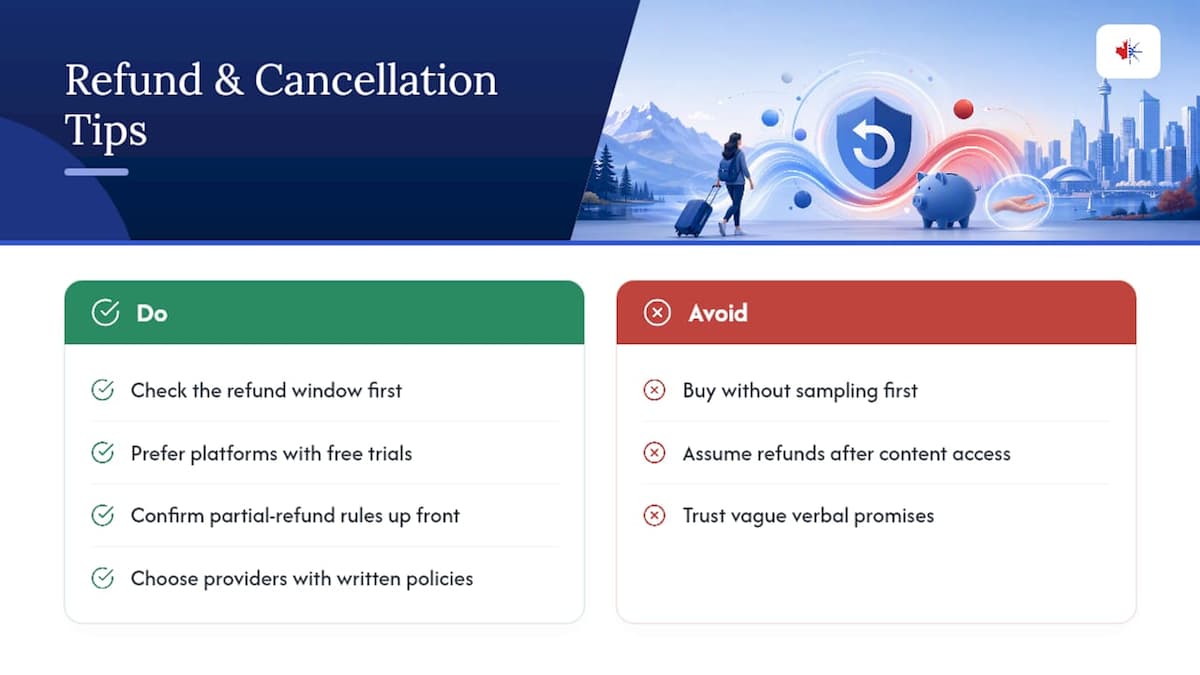
Refund terms vary enormously between providers, and this is where a lot of learners lose money they didn’t expect to lose. Some paid courses offer a short cooling-off window, often a matter of days, where you can cancel for a full or partial refund before materials or class access are unlocked. Once you’ve accessed course content or attended a first session, many providers switch to a no-refund policy, treating the course as delivered.
Subscription-based platforms tend to work differently. Many offer a free trial or a limited free practice test before you commit financially, letting you evaluate the product before any money changes hands. That structure shifts risk away from you compared to a paid course you can’t sample first.
Materials purchased outright, workbooks, downloadable practice sets, and similar one-time purchases are usually non-refundable once accessed or downloaded, since there’s no practical way for a provider to “return” digital content.
Before paying for anything, read the specific refund window, whether it’s calendar days or a number of sessions attended, and whether partial refunds exist once you’ve started. A course with a clear, written refund policy posted on its site is a better sign than one that only mentions refunds if you ask directly. Vague answers here often predict a frustrating experience later if your plans change.
Additional costs to consider beyond the course fee
The advertised course or test price is rarely your entire spend. A few extra costs show up consistently and deserve a line in your budget.
Extra mock tests are the biggest hidden cost. If your course only includes one or two practice exams and you want more repetition before test day, additional mock exams are often sold separately, sometimes at $20 to $50 each depending on the provider.
Upgraded materials or add-on modules are common too. Some courses price their base package low, then charge extra for specific skill modules, like a dedicated speaking-feedback add-on or an extended writing-correction service.
Retake costs deserve a spot in your initial budget even if you’re optimistic. Since a retake costs the same as your original test fee, with no discount, it’s worth treating your first attempt’s prep budget as insurance against paying that fee twice.
Score reports and rush processing can also carry small fees if you need results sent to additional institutions or faster than the standard timeline. None of these individually breaks the bank, but stacked together they can add another $50 to $150 onto whatever you initially budgeted, so leave room for them.
Where structured practice hubs actually save you money
Here’s what conventional advice gets wrong: the assumption that more class hours automatically means better prep. A multi-week group course charges for scheduled time, whether or not that time addresses your actual weak spot. A diagnostic-driven platform flips that logic. It identifies exactly which skill is holding your score back, then routes your study time there instead of spreading it evenly across four skills you don’t equally need help with.
Celpipguide’s diagnostic-first approach is built on that idea: over 100 full mock exams and 5,000 practice questions, paired with an AI teacher that gives instant feedback on writing and speaking rather than waiting days for a human marker. For a candidate who’s one CLB point away from their target, a focused subscription month often costs less than a single week of group tutoring, and targets the actual gap instead of the whole syllabus.
— Reza
Get exam-ready without overpaying for it
Celpipguide is the practical alternative to booking a multi-week course when you only need to fix one or two skills. Instead of paying for scheduled hours covering material you’ve already mastered, you get instant AI feedback on writing and speaking, a diagnostic that pinpoints your actual weak spot, and access to over 100 full mock exams built to CLB standards, all without a long-term commitment.
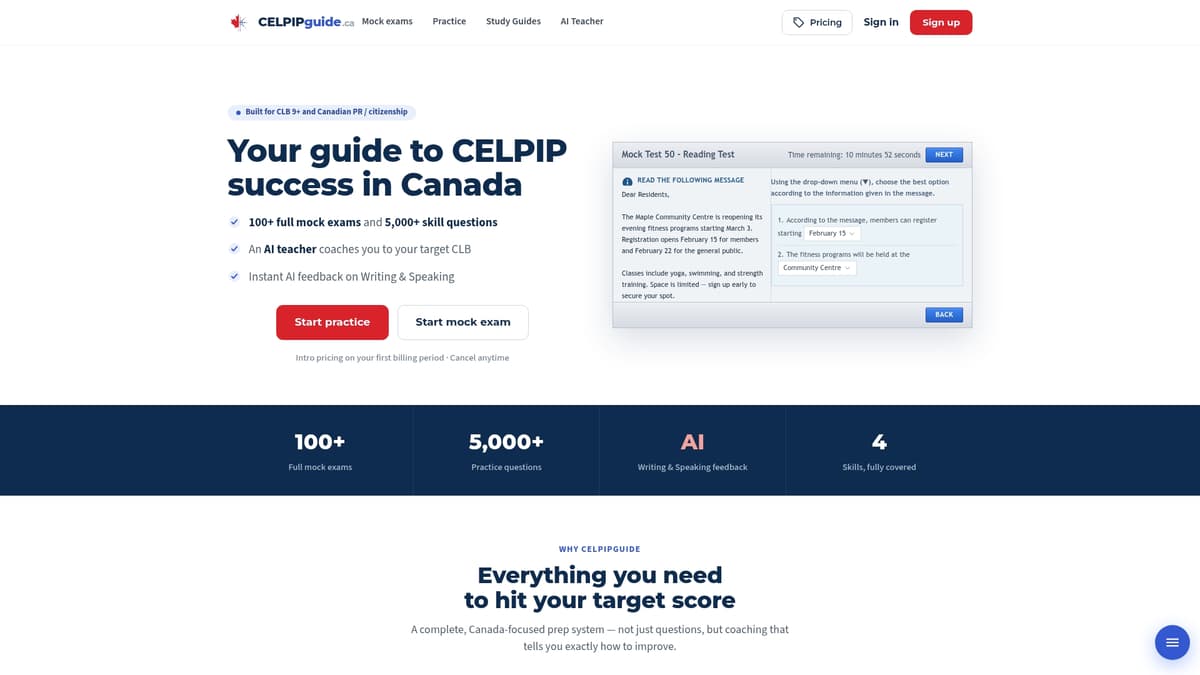
Start with a readiness check to see exactly where you stand before spending on anything else. If you’re ready to commit, the CELPIP Exam Practice Hub gives you full mock-exam access and personalised study plans, and you can use coupon code BLG30 at checkout for 30% off any plan. From there, the study plan generator builds you a week-by-week schedule matched to your test date, so your prep budget goes toward the skills that actually move your score.
Sources
- CELPIP Online Study Materials
- CELPIP Preparation Course Online | Canadian College of English Language
FAQ
Can I prepare for CELPIP in 3 days?
You can review test format and instructions in three days, but building actual skill improvement, especially in writing and speaking, usually needs several weeks. A short sprint works best if you’re already close to your target CLB and just need familiarity with question types.
How much does CELPIP coaching cost?
Private one-on-one coaching typically starts above $700 CAD and can run higher depending on hours booked, while group classes and online subscriptions cost considerably less. The right choice depends on whether you need personalised feedback or just structured practice volume.
Is 7 a good CELPIP score?
Meeting a Canadian Language Benchmark (CLB) level required for many federal immigration thresholds, including Express Entry under certain programs, is commonly targeted. Whether your level is “good enough” depends entirely on the specific program or job requirement you’re applying against.
How much does it cost to take CELPIP?
CELPIP-General costs $319 CAD and CELPIP-General LS costs $265 CAD, both before tax, according to the official CELPIP overview page. International test-takers should confirm local pricing, since it can differ from the Canadian rate.