
CELPIP Blog
Six Part CELPIP Listening Playbook: Question Types and CLB Targets
Six Part CELPIP Listening Playbook: Question Types and CLB Targets

The CELPIP listening test consists of multiple parts with repeated core question types, including general meaning, specific detail, inference, and speaker purpose. To improve your score, focused timed practice and note-taking on specific parts are more effective than passive listening. Let’s break down exactly where these question types show up and how to train for each one.
TL;DR:
- Focusing practice on parts four through six is essential because they contain more inference, attitude, and tone questions that learners find challenging.
- Memorizing and practicing shorthand note-taking techniques can significantly speed up response times and improve accuracy during the test.
- Full-length, timed mock exams with instant feedback help identify specific weaknesses, especially in parts five and six, leading to faster scoring improvements.
- A CELPIP-G listening score of nine or higher maximizes points for Express Entry, whereas a score of four or higher meets citizenship proof requirements.
- Repeating questions with paraphrase answer choices makes recognizing synonym patterns crucial for avoiding distractors during the exam.
Table of Contents
- Listening test format at a glance
- Six parts, six jobs: what each section really asks
- The four question types you’ll see again and again
- Timed tactics that make a real difference
- How to practise effectively using full mock exams and diagnostics
- What your listening score means for your immigration goals
- Common mistakes and how to fix them fast
- A quick note from someone who’s seen this work
- Try CELPIPguide Plus for focused listening prep
- FAQ
- Sources
Listening test format at a glance
Before you can target your practice, you need to know the map. The CELPIP listening component typically lasts around 45 to 55 minutes and includes multiple scored questions across six parts, though session timing may vary slightly. You may also notice a few extra items that look identical to the scored ones. These are unscored pilot questions the test uses to try out future content, and they don’t count toward your result, so don’t waste energy trying to spot them.
Here’s how the parts generally break down:
- Part 1 (Problem Solving) and Part 2 (Daily Life Conversation) lean on gist and specific-detail questions.
- Part 3 (Information Exchange) mixes detail questions with purpose-driven ones.
- Part 4 (News Item) tests main idea, detail, and inference together.
- Part 5 (Discussion) and Part 6 (Viewpoints) push harder into inference, attitude, and tone.
Knowing this layout matters because it tells you where to spend your limited practice hours. If inference questions are your weak spot, Parts 4 through 6 deserve more of your attention than Parts 1 and 2.
Six parts, six jobs: what each section really asks
Each part of the CELPIP listening test has its own personality. Treat them as six separate mini-skills rather than one long listening marathon, and your prep gets a lot more efficient.
- Part 1, Problem Solving. You’ll hear a short conversation where someone describes a problem and a few possible solutions. The trick is listening for the final decision, not just the first idea mentioned. Questions often ask “What will the speaker do?” so train yourself to track the conversation’s turning point rather than every detail along the way.
- Part 2, Daily Life Conversation. These are brief, casual exchanges, often two people chatting about everyday plans or situations. Expect questions on specific details (dates, prices, locations) and overall gist. Because the exchanges are short, you get less time to recover if you miss something, so quick, accurate notes matter here.
- Part 3, Information Exchange. This part features a longer question-and-answer style conversation, often between someone seeking information and someone providing it. You’ll see a blend of detail questions and purpose questions, things like “Why does the speaker call?” Practise distinguishing between what was said and why it was said.
- Part 4, News Item. You’ll hear something closer to a radio or news broadcast style monologue. This is where main idea, specific detail, and inference questions all show up together, which makes it one of the toughest parts for many learners. If you only practise one part this week, make it this one.
- Part 5, Discussion. Multiple speakers debate a topic, and you need to track who believes what. This part tests your ability to separate viewpoints and notice shifts in tone. A simple trick: jot a quick symbol or initial next to each speaker’s stance as they talk, so you’re not trying to remember three opinions at once.
- Part 6, Viewpoints. This is an extended piece where one speaker shares a perspective in depth. Expect tone, inference, and “what does the speaker conclude” style questions. Since there’s more content to track, strong note-taking habits pay off the most here.
Treating these six parts as distinct challenges, rather than one long blur of audio, is the single biggest mindset shift that helps learners improve faster.
The four question types you’ll see again and again
Across all six parts, the questions tend to repeat the same four patterns, plus a fifth related skill: vocabulary in context.
- General meaning (gist) questions ask what the conversation or passage is mainly about. Listen for the topic sentence, usually in the first few lines, and resist the urge to get distracted by secondary details.
- Specific detail questions test whether you caught names, numbers, times, or specific facts. A short note (just the number or word itself) is often enough to confirm your answer later.
- Inference questions ask you to connect what was said to what was implied. The speaker rarely states the conclusion directly, so you need to link an explicit clue (a tone shift, a hesitation, a specific word choice) to the unstated meaning.
- Speaker purpose or attitude questions ask why someone said something or how they feel about it. Discourse markers like “actually,” “to be honest,” or “I’m afraid” are strong signals worth noting as they happen.
- Vocabulary-in-context or paraphrase questions test whether you recognize a synonym or reworded version of what you heard. The answer choices often restate the audio using different words, so practise spotting paraphrase patterns rather than expecting exact word matches.
Pro Tip: When you hear a word like “however” or “in other words,” underline or circle it in your notes immediately: it almost always flags the sentence the question will target.
Timed tactics that make a real difference
Technique matters as much as vocabulary when it comes to listening scores. Here’s a practical system you can start using in your next practice session.
- Build a shorthand note system. Write down names, numbers, and key choices using symbols, arrows, or abbreviations. Skip full sentences entirely: you don’t have time to write them, and you don’t need to.
- Listen for signposts. Words like “first,” “however,” and “in other words” act like road signs pointing to the answer. Train your ear to catch these and treat them as cues to pay closer attention.
- Use elimination on multiple choice. Cross out answers you know are wrong the moment you hear something that contradicts them. This narrows your choices fast, even when you’re unsure of the exact answer.
- Set pacing checkpoints. Know roughly how long each part should take you, and check in with yourself as you practise. If you’re consistently running out of time on Part 4 or 5, that’s your sign to slow down and drill those parts specifically.
- Simulate real test conditions. Play the audio only once, answer within the time given, and keep the room silent between items, exactly as it will be on test day.
Pro Tip: Practise with single-play audio only, even when you’re tempted to replay a clip. The test gives you one listen, so your practice should match that from day one.
How to practise effectively using full mock exams and diagnostics
Full-length, timed mock exams come closest to replicating real exam pressure, and they reveal pacing problems that short drills simply don’t expose. If you only ever practise in bite-sized chunks, you might never notice that you consistently run out of time on Part 5.
A diagnostic test is the fastest way to find out which parts and which question types need the most work before you commit your study hours. Once you know your weak spots, adaptive study plans and instant feedback let you correct course quickly instead of guessing at what to fix.
When you’re choosing a practice platform, a few features matter more than the rest:
- Volume of full mock exams, so you can simulate real test day repeatedly rather than running the same one or two tests.
- Clear explanations for each answer, not just a right or wrong mark.
- Timing controls that match the real exam’s pacing.
- Progress tracking that shows which question types and parts are improving and which aren’t.
Some advanced CELPIP practice platforms build their libraries around these features, offering many full mock exams alongside tools that give instant feedback on writing and speaking tasks and flag weak spots across all four skills.
What your listening score means for your immigration goals

Your listening score isn’t just a number: it feeds directly into Canada’s immigration points system and citizenship requirements. Under Express Entry’s language test scoring, a CELPIP-G scores translate to points per ability, with higher scores earning more points according to the official Express Entry language test scoring table.
For citizenship purposes, the bar is lower: IRCC’s language proof guidance confirms that CELPIP-General results at or above a minimum level in both listening and speaking meet the basic language-proof threshold for citizenship eligibility for test dates since April 1, 2014.
- If your goal is Express Entry points, aim for at least a 9 in listening to maximize your score per ability.
- If your goal is citizenship proof, a 4 or higher clears the requirement.
A CELPIP-G listening score of 9 or higher earns the maximum 6 Express Entry points per ability, according to IRCC’s own table, which is a meaningful gap compared to the 4 points awarded at a 7.
Common mistakes and how to fix them fast
A handful of errors show up again and again, and most are fixable with small adjustments to how you practise.
- Writing too much in your notes. Switch to a consistent shorthand template (initials, arrows, plus and minus signs) and rehearse it until it’s automatic.
- Changing answers after the next item starts. Set a mental checkpoint and move on once it passes: going back costs you the next question.
- Falling for paraphrase distractors. Practise mapping synonyms during review so rewordings don’t catch you off guard.
- Freezing after missing a question. If you lose track, skip it, take your best guess, and refocus on the next item immediately rather than dwelling on the miss.
A quick note from someone who’s seen this work
Most learners improve fastest when they combine full timed mock tests with focused practice on their single weakest part, rather than spreading effort evenly across everything. If you’re not sure where to start, take one timed Part 4 or Part 5 practice test this week and review every mistake carefully. Diagnostic feedback that tells you exactly where you’re losing points will move your score faster than untimed, unfocused listening ever will.
— Reza
Try CELPIPguide Plus for focused listening prep
If you want full mock exams and a large question bank in one place, CELPIPguide’s Plus plan gives you AI-driven diagnostics and instant feedback built to pinpoint exactly where your listening practice should go next.
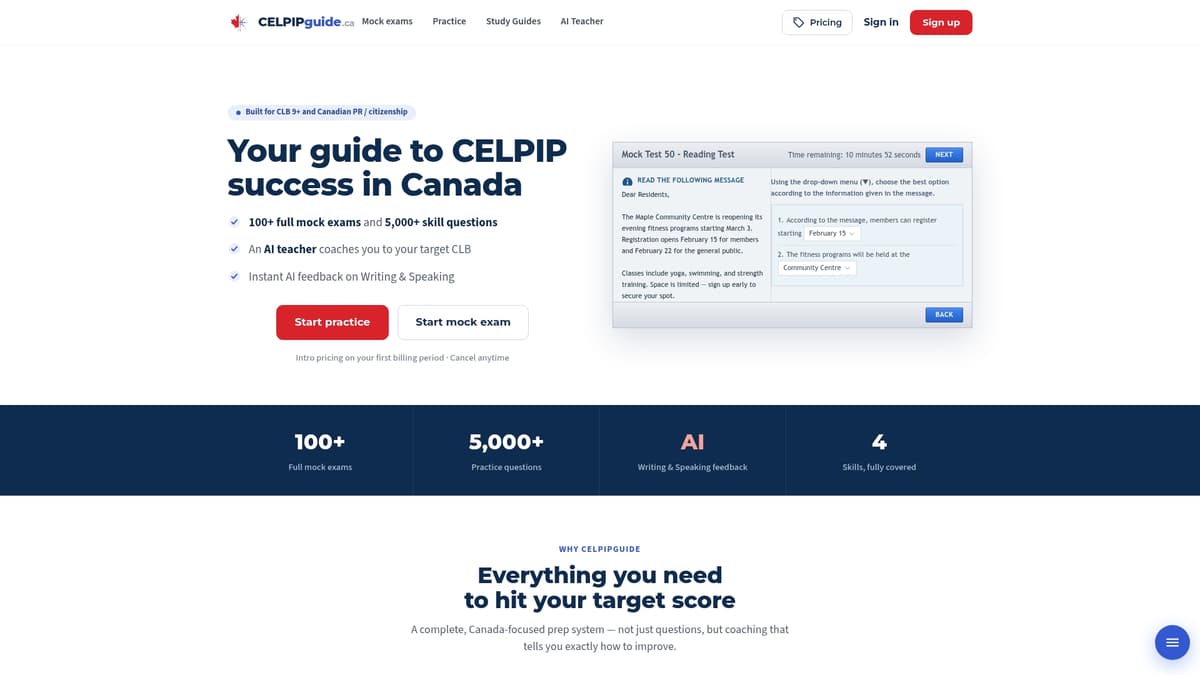
Plus includes everything you need to train each of the six listening parts on its own terms:
- Full-length mock exams that simulate real test timing and conditions.
- A large bank of practice questions covering all four question types.
- AI-driven diagnostics that flag your weakest parts automatically.
- Instant, rubric-style feedback so you’re not guessing at your own answers.
A weekly plan suits a short, intense push before test day, while monthly or quarterly access fits a longer, steadier study schedule, get started on the Plus plan and start training with a clear target in mind.
FAQ
What is 34 out of 38 in CELPIP listening?
A raw CELPIP listening score translates into a CLB level through CELPIP’s own scoring scale rather than a simple percentage conversion, and high scores typically sit near the top of the CLB range, which can support strong Express Entry points when paired with the official scoring table.
What are the different parts of the CELPIP listening test?
The listening test has six parts: Problem Solving, Daily Life Conversation, Information Exchange, News Item, Discussion, and Viewpoints. Each part uses a different audio format, from short conversations to extended monologues, and tests a mix of general meaning, detail, inference, and purpose questions.
Is it hard to get a 7 in CELPIP?
A CLB 7 in listening requires solid comprehension of detail, inference, and speaker attitude across varied audio formats, which many learners find challenging without targeted practice. Focused, timed practice on weaker parts, rather than general listening, tends to close that gap faster.
What are the two main types of CELPIP tests?
CELPIP offers two test versions: CELPIP-General, used for permanent residence and citizenship applications, and CELPIP-General LS, which covers listening and speaking only, often for provincial nomination programs. Both share the same listening test format and question types described here.