
CELPIP Blog
IELTS band descriptors: what every test taker must know
IELTS band descriptors: what every test taker must know

The official IELTS band descriptors for Writing and Speaking are the exact scoring rubrics your examiner uses during marking. You can download the IELTS writing band descriptors and the IELTS speaking band descriptors directly from IELTS.org, and the full scoring explanation lives on the IELTS scoring in detail page. These are not supplementary study materials. They are the documents your examiner consults while assigning your band.
A band descriptor is a written statement that describes the specific features of a candidate’s performance at each level on the 0–9 scale. Examiners use them to keep marking consistent and transparent across every test centre worldwide, including those in Canada.
Key takeaways
The single most important thing to understand about IELTS band descriptors is this: negative features in the official rubrics cap your score regardless of how many higher-band features you also demonstrate, so fixing your lowest-band weakness always comes before chasing higher-band performance.
| Point | Details |
|---|---|
| Where to find the PDFs | Download Writing and Speaking descriptor PDFs from IELTS.org and the British Council; both are free and official. |
| Rounding rules | Averages ending in .25 round up to the next half band; averages ending in .75 round up to the next whole band |
| Writing Task 2 weighting | Task 2 carries double the weight of Task 1; allocate 40 minutes to Task 2 and 20 minutes to Task 1. |
| Pronunciation and accent | Examiners assess intelligibility and phonological features, not accent; clear word stress matters more than sounding like a native speaker. |
| Celpipguide for practice | Celpipguide’s AI feedback and diagnostic tools apply the same rubric-based logic to CELPIP preparation for Canadian immigration applicants. |
Table of Contents
- What are band descriptors, and why do they matter for your score?
- How your overall band score is calculated
- Writing band descriptors: four criteria that shape your score
- Speaking band descriptors: what examiners actually listen for
- How Reading and Listening are scored
- How to turn descriptors into a real study plan
- An examiner’s truth most test takers miss
- Celpipguide: descriptor-based practice for Canadian test takers
- Sources
- FAQ
What are band descriptors, and why do they matter for your score?
Band descriptors are the official grading rubrics that define what a “Band 6” or “Band 8” performance actually looks like. They are not vague impressions. Each descriptor row contains specific, observable features an examiner checks for, and the assessment criteria are published to ensure transparency and fairness in marking.
The key distinction worth understanding is the difference between objective and examiner-led scoring:
- Listening and Reading use objective scoring. You either answered correctly or you did not. No examiner judgment is involved.
- Writing and Speaking use examiner-led descriptors. A trained examiner compares your performance against the published criteria and assigns a band for each of four separate dimensions.
That difference matters practically. In Listening and Reading, your score is fixed the moment you circle an answer. In Writing and Speaking, you have direct influence over your band by producing the specific features the descriptors reward.
“Candidates who align their practice to the descriptor language tend to make more efficient improvements because the descriptors show exactly what the examiner rewards.” IELTS writing band descriptors and key assessment criteria
Here is a concrete example of reading a descriptor. In Writing Task 2, the Band 7 row for Task Response includes the phrase “addresses all parts of the task.” Band 6 says “addresses the relevant parts of the task.” That single word shift — “all” versus “relevant” — tells you that a Band 6 response may leave a sub-question partially explored, while Band 7 requires complete coverage. Once you see that, you know exactly what to fix.
The descriptors also use bolded negative features to cap scores. A script that shows some Band 8 vocabulary but also contains the bolded negative features listed at Band 6 will be capped at Band 6, regardless of those higher-level moments. Knowing this prevents a common mistake: trying to impress with isolated advanced words while leaving structural weaknesses unaddressed.
How your overall band score is calculated
Each of the four skills — Listening, Reading, Writing, and Speaking — receives its own band on the 0–9 scale. Your overall band is the simple average of those four, rounded to the nearest half band using the official rounding rules.
The rounding rules work like this:
- Add the four skill bands together and divide by four to get the raw average.
- If the decimal is .25, round up to the next half band (e.g., 6.25 → 6.5).
- If the decimal is .75, round up to the next whole band (e.g., 6.75 → 7.0).
- If the decimal is .125 or .375, round down to the nearest half band (e.g., 6.125 → 6.0; 6.375 → 6.5).
One critical point: individual skill scores are not pre-rounded before averaging. The rounding happens only once, on the final average. A small improvement in any single skill can shift the overall band when the numbers are averaged together.
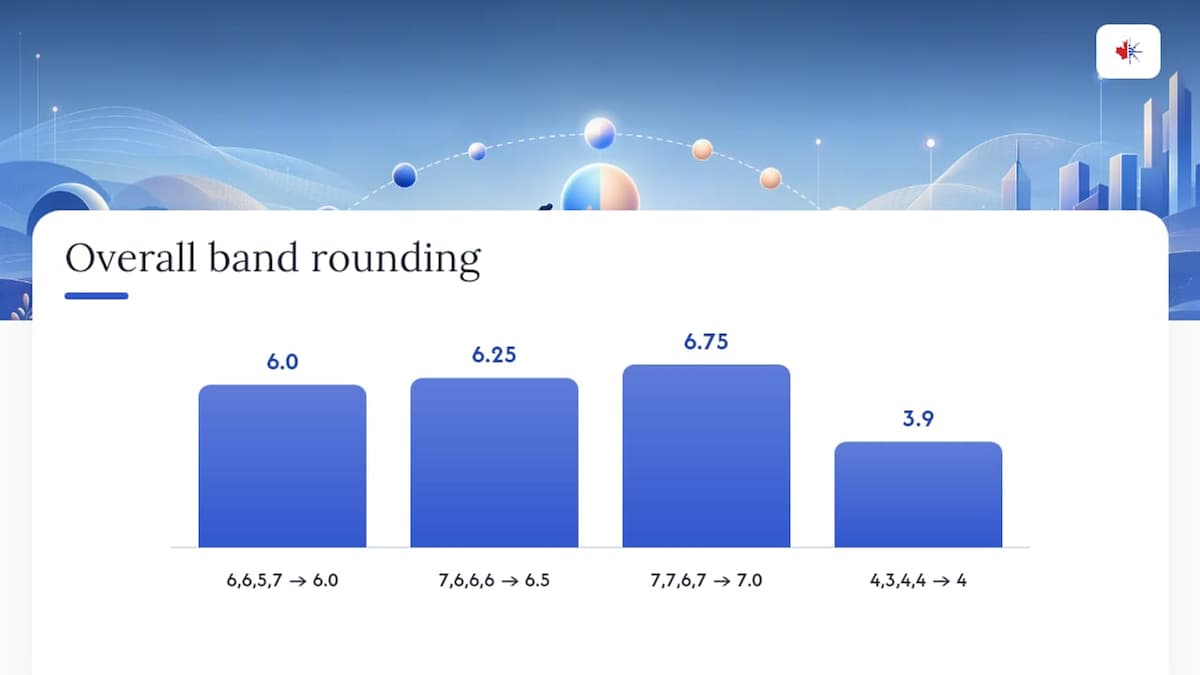
The table below shows worked examples from the British Council:
| Skill scores | Raw average | Rounded overall band |
|---|---|---|
| 6, 6, 5, 7 | 6.0 | 6.0 |
| 7, 6, 6, 6 | 6.25 | 6.5 |
| 7, 7, 6, 7 | 6.75 | 7.0 |
| 4, 3, 4, 4 | 3.9 | 4 |
Universities and Canadian immigration programmes often set minimum requirements for each skill separately, not just the overall band. Achieving a 7.0 overall with a 5.5 in Writing can disqualify you even when the average looks fine. Always check the per-skill requirements for your specific programme.
The guide to IELTS scores describes each whole-band level: Band 9 is “Expert,” Band 8 is “Very Good,” Band 7 is “Good,” Band 6 is “Competent,” and Band 5 is “Modest.” These labels help institutions interpret what a score means in practical terms.
Writing band descriptors: four criteria that shape your score
Writing is assessed across four equally weighted criteria, and Task 2 carries double the weight of Task 1 within the overall Writing band. Practically, that means you should spend roughly 40 minutes on Task 2 and 20 minutes on Task 1. Spending equal time on both is one of the most common causes of a lower Writing band, even for candidates with strong English.
The four criteria from the official Writing band descriptors are:
- Task Achievement / Task Response — Did you fully address all parts of the prompt? Is your position clear and well-developed?
- Coherence and Cohesion — Is your writing logically organised? Do ideas flow clearly between and within paragraphs?
- Lexical Resource — Do you use a range of vocabulary accurately, with appropriate collocation and effective paraphrase?
- Grammatical Range and Accuracy — Do you use a mix of sentence structures correctly, with only minor errors?
What separates Band 6, 7, and 8
Task Achievement / Response:
- Band 6: addresses the relevant parts; position is present but not always clear
- Band 7: addresses all parts; main ideas are extended and supported
- Band 8: covers all requirements sufficiently; ideas are well-developed with relevant examples
Coherence and Cohesion:
- Band 6: uses cohesive devices but not always accurately; paragraphing may be inadequate
- Band 7: logically organises information; manages cohesion well, though with some lapses
- Band 8: sequences information and ideas logically; manages cohesion effectively throughout
Lexical Resource:
- Band 6: uses an adequate range; some errors in word choice and collocation
- Band 7: uses a sufficient range with some flexibility; occasional errors in word choice
- Band 8: uses a wide range fluently and flexibly; rare errors in word choice or collocation
Grammatical Range and Accuracy:
- Band 6: uses a mix of simple and complex structures; errors are present but meaning is clear
- Band 7: uses a variety of complex structures; frequent error-free sentences
- Band 8: uses a wide range of structures; majority of sentences are error-free
A practical dos-and-don’ts checklist for self-marking:
Do:
- Fully address every sub-question in the prompt before developing your argument.
- Use a clear topic sentence in every body paragraph.
- Paraphrase the prompt in your introduction rather than copying it word-for-word.
- Vary sentence structure deliberately — mix simple, compound, and complex sentences.
- Check collocations carefully; “make a decision” not “do a decision.”
Don’t:
- Use memorised phrases or templates that do not fit the specific prompt.
- Rely on a single cohesive device (e.g., “however” in every paragraph).
- Spend more than 20 minutes on Task 1.
- Use rare vocabulary without knowing its exact collocation — the writing descriptors reward accurate, well-collocated vocabulary over isolated rare words.
- Leave a Task 2 sub-question partially answered.
Official sample answers with examiner comments are available through the British Council Writing band descriptors PDF. Comparing your own Task 2 response to a Band 7 sample and reading the examiner’s notes is one of the highest-leverage study activities available.
Speaking band descriptors: what examiners actually listen for
Speaking is also assessed on four criteria, each carrying equal weight. The official IELTS speaking band descriptors lay out exactly what an examiner notes during your 11–14 minute interview.
The four criteria are:
- Fluency and Coherence — Can you speak at length without unnatural pausing? Are your ideas connected logically?
- Lexical Resource — Do you use a range of vocabulary appropriately and flexibly?
- Grammatical Range and Accuracy — Do you use complex structures with reasonable accuracy?
- Pronunciation — Are you consistently intelligible? Do you use phonological features effectively?
Pronunciation is about intelligibility, not accent
This is worth stating plainly. The speaking descriptors assess pronunciation based on phonological features and intelligibility, not on whether you sound like a native speaker from a particular country. A Band 8 pronunciation descriptor targets being “effortlessly understood” and using a range of phonological features. Your Canadian, Indian, or Nigerian accent is not a penalty. Unclear word stress, mispronounced consonant clusters, or monotone delivery are.
Band 6, 7, and 8 differences in Speaking
Fluency and Coherence:
- Band 6: willing to speak at length; some hesitation but generally coherent
- Band 7: speaks at length without noticeable effort; some repetition or self-correction
- Band 8: speaks fluently with only occasional repetition or self-correction; hesitation is content-related, not language-related
Lexical Resource:
- Band 6: uses a range of vocabulary with some flexibility; some inappropriate choices
- Band 7: uses vocabulary with flexibility and some less common items; occasional inaccuracies
- Band 8: uses a wide vocabulary resource fluently and flexibly; rare inaccuracies
Grammatical Range and Accuracy:
- Band 6: uses a mix of structures; errors are present but rarely cause comprehension difficulty
- Band 7: uses a range of complex structures; frequent error-free sentences
- Band 8: uses a wide range of structures flexibly; majority of sentences are error-free
Pronunciation:
- Band 6: uses a range of pronunciation features with mixed control; generally intelligible
- Band 7: shows all features of Band 6 with greater consistency; easy to understand throughout
- Band 8: uses a wide range of pronunciation features; easy to understand throughout; L1 accent has minimal effect
The British Council Speaking band descriptors PDF mirrors these criteria and is a useful cross-reference for self-assessment.
Practice-priority checklist for Speaking
Work through these in order — fluency gaps cost more than pronunciation gaps at most band levels:
- Fluency first: practise speaking on a topic for 2 minutes without stopping. Record yourself and count unnatural pauses.
- Lexical flexibility second: for each topic (environment, technology, health), practise using three synonyms per key concept.
- Complex grammar third: target two structures per session — conditionals, relative clauses, or passive constructions — and use them naturally in answers.
- Pronunciation features last: focus on word stress in multi-syllable words and sentence-level stress patterns. Audiobooks are a practical tool here; listening to fluent English narration helps you internalise natural stress and rhythm before you practise producing it yourself.
How Reading and Listening are scored
Listening and Reading each contain 40 questions, and each correct answer earns one raw mark. Those raw marks are then converted to the 9-band scale using official conversion tables. The conversion is not a simple percentage — it is calibrated so that the same band reflects the same level of ability across different test versions, which vary slightly in difficulty.
A few practical points:
- Conversion tables can shift slightly between test forms, so the raw score needed for Band 7 in one version may differ by one or two marks from another version.
- Academic Reading is generally considered more challenging than General Training Reading, and the conversion tables reflect that difference.
- There is no penalty for a wrong answer, so leaving a question blank is always worse than guessing.
Approximate raw score targets (treat these as guidance, not guarantees, since official tables vary):
- Band 6: roughly 23–26 correct answers in Listening; roughly 23–27 in Academic Reading
- Band 7: roughly 30–32 correct answers in Listening; roughly 30–32 in Academic Reading
- Band 8: roughly 35–36 correct answers in Listening; roughly 35–36 in Academic Reading
Because Listening and Reading are objective, your preparation strategy differs from Writing and Speaking. There are no descriptor features to study. The work is volume-based: practise under timed conditions, analyse every wrong answer, and build the specific sub-skills (e.g., scanning for detail, understanding paraphrase in multiple-choice) that the question types test.
How to turn descriptors into a real study plan
Reading the descriptors is step one. Turning them into daily practice is where scores actually move.
Step 1: Run a diagnostic
Before you practise anything, identify where you currently sit. Write one Task 2 response and record one 2-minute speaking answer. Then open the Writing and Speaking descriptor PDFs and read each criterion row for Band 6 and Band 7. For each criterion, answer honestly:
- Which positive features do I already demonstrate consistently?
- Which bolded negative features appear in my work?
The negative features are your priority. They cap your band regardless of what else you do well.
Step 2: Skill-by-skill actions
Writing — Task Response: Take three past Task 2 prompts and underline every sub-question. Write a one-sentence response to each before drafting. This forces complete coverage before you develop arguments.
Writing — Lexical Resource: Build a vocabulary tracker for collocations, not single words. For every new word you learn, record two or three phrases it appears in naturally.
Speaking — Fluency: Use the “2-minute rule” daily. Pick a Part 2 topic card, speak for exactly 2 minutes without stopping, and replay the recording. Count filler words (“um,” “like,” “you know”) and aim to reduce them by one per session.
Speaking — Pronunciation: Choose five words per week where you are unsure of stress placement. Practise them in full sentences, not in isolation.
Step 3: One-week example plan
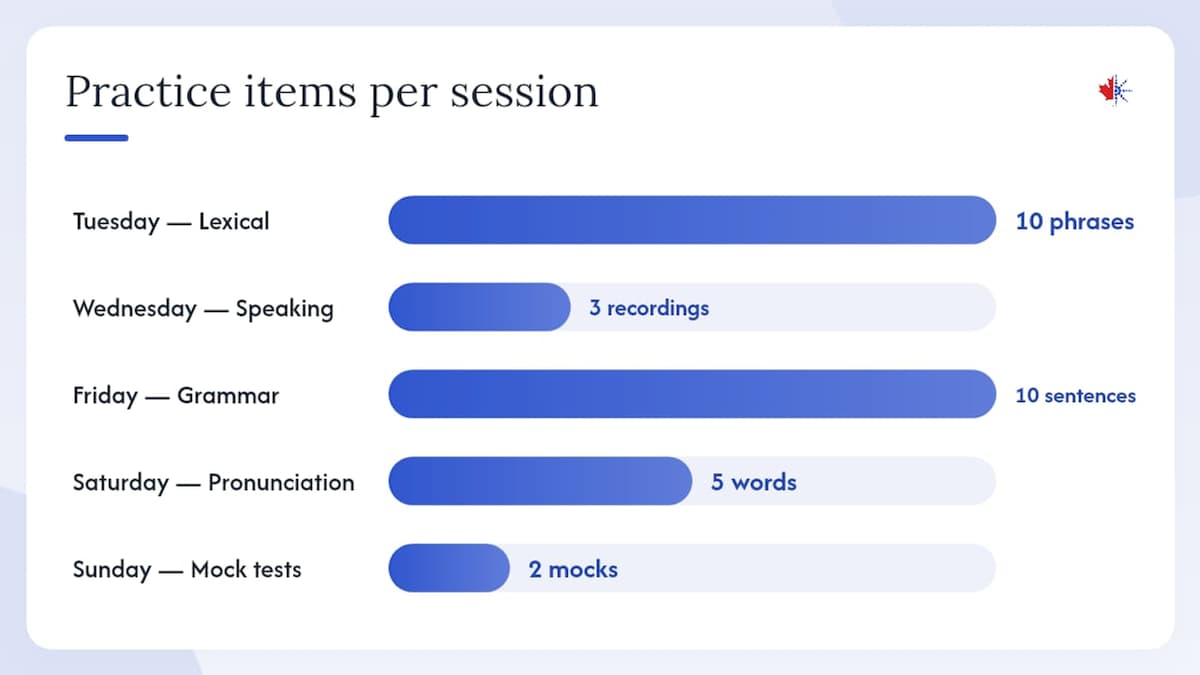
| Day | Focus | Task |
|---|---|---|
| Monday | Writing Task Response | Write one Task 2; self-mark against Band 7 descriptor row |
| Tuesday | Lexical Resource | Review collocations from last 3 essays; add 10 new phrases to tracker |
| Wednesday | Speaking Fluency | Record 3 Part 2 answers; count pauses and filler words |
| Thursday | Coherence and Cohesion | Rewrite one essay paragraph using only one cohesive device per sentence |
| Friday | Grammar Range | Write 10 sentences using complex structures; check against Band 7 grammar row |
| Saturday | Speaking Pronunciation | Practise 5 target words in context; listen to a short audiobook passage for rhythm |
| Sunday | Full mock + review | Complete one timed Writing task and one Speaking mock; compare to descriptors |
Pro Tip: When self-marking, always read the descriptor row below your target band first. If any bolded negative feature from that lower band appears in your work, your score is capped there — no matter how many higher-band features you also show. Fix the cap before chasing the higher features.
Pro Tip: For Writing Task 2, set a hard timer at 40 minutes. Practise stopping when it rings, even mid-sentence. Time discipline is a skill that needs as much practice as grammar.
Pro Tip: Pronunciation practice is most effective in short, daily sessions of 10–15 minutes rather than one long weekly session. Muscle memory for stress patterns builds through repetition, not duration.
An examiner’s truth most test takers miss
The most common mistake I see candidates make is treating the descriptors as a checklist to perform rather than a mirror to reflect honestly. They read “uses a wide range of vocabulary” and immediately start memorising rare words. But the descriptor rewards accurate, well-collocated vocabulary and effective paraphrase — not isolated impressive words dropped into sentences where they do not fit. The writing descriptors are explicit about this: memorised or isolated high-level vocabulary without correct collocation triggers the bolded negative features that cap your band.
The same logic applies to Speaking. Candidates who rehearse elaborate answers for predicted topics often score lower on Fluency and Coherence than candidates who speak naturally and simply, because the rehearsed answers sound disconnected and the delivery is hesitant when the topic shifts slightly. The descriptor rewards natural, connected speech — not performance.
My honest advice: use the descriptors as a diagnostic tool first, a study guide second, and a performance script never. Download both PDFs, run the diagnostic checklist from this article, and schedule one focused week of targeted practice. Small, specific improvements in the right criterion move bands faster than broad, unfocused study. A structured study plan built around your diagnostic gaps will always outperform generic preparation.
Celpipguide: descriptor-based practice for Canadian test takers
CELPIP and IELTS are different tests, but the underlying skills — writing clearly, speaking fluently, building vocabulary, and understanding spoken English — are the same. If you are preparing for CELPIP as part of a Canadian immigration or citizenship application, Celpipguide gives you the same descriptor-based, rubric-scored practice environment that makes IELTS preparation effective, built specifically for the CELPIP format.
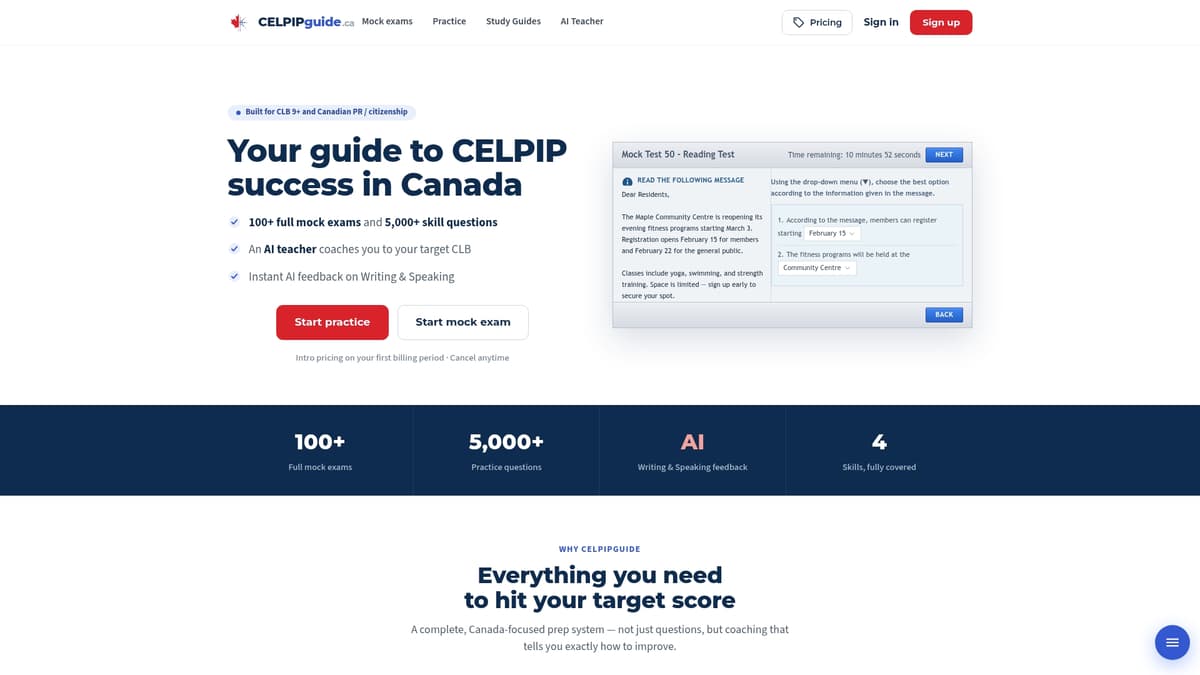
Where most practice resources give you questions and a score, Celpipguide’s AI feedback tells you why your writing or speaking response earned that score and exactly which features to improve — the same logic as reading the official band descriptor row, but applied instantly to your own work. Features that directly support descriptor-based practice include:
- Diagnostic assessment to identify which skill areas are capping your CLB rating
- Over 100 full-length mock exams and 5,000+ practice questions under timed conditions
- AI-driven instant feedback on Writing and Speaking tasks, mapped to rubric criteria
- Vocabulary tracker for building collocations and paraphrase skills
- Personalised study-plan generator that converts your diagnostic results into a week-by-week schedule
Use coupon BLG30 for 30% off on top of all other discounts. Start with a full-length CELPIP practice exam and run your first diagnostic today.
Sources
Official documents to download and bookmark before your next practice session:
- IELTS writing band descriptors
- Writing band descriptors (British Council PDF)
- How is the IELTS score calculated? | British Council
FAQ
What are band descriptors?
Band descriptors are the official scoring rubrics IELTS examiners use to assign bands in Writing and Speaking. They describe the specific features of a candidate’s performance at each level on the 0–9 scale, covering four criteria per skill.
Is a Band 7 out of 9 a good IELTS score?
Yes. The official IELTS score guide labels Band 7 as “Good” and describes a user who can handle complex language well. Most Canadian university programmes and skilled worker immigration pathways accept Band 7 overall, though some require higher per-skill minimums.
Does a 6.625 average round to 6.5 or 7.0 in IELTS?
The official rounding rule rounds .25 up to the next half band and .75 up to the next whole band; averages between those thresholds round down to the nearest half band.
Is IELTS 6.5 a bad score?
No. Band 6.5 sits between “Competent” (6) and “Good” (7) on the official scale and meets the minimum requirement for many Canadian immigration streams and undergraduate programmes. Whether it is sufficient depends entirely on the specific programme’s per-skill and overall band requirements.
How long is an IELTS score valid?
IELTS scores are valid for two years from the test date. Canadian immigration applications submitted after that window require a new test result.